
Reauthorizing the Small Business Innovation Research Program Isn’t Enough
Reforms to America’s seed fund should be a catalyst for policies that help more small businesses bring new technologies to market.
In late February, after a five-month stalemate, the US Senate reached a compromise on reauthorizing funding for the Small Business Innovation Research (SBIR) program, one of the country’s most important innovation pipelines. The House followed up on the Senate in mid-March by passing the legislation as well. Since the program’s creation in 1982, it has been celebrated as “America’s seed fund.” The SBIR program invests about $4 billion annually in commercializing scientific research produced by small businesses, intended to support the growth of innovative companies and enable the transfer of federal research to market. Though SBIR funding has produced many successes, arguments over the program’s execution made it a target for reform.
The case for SBIR reform gained traction because of two major shortcomings of the program. First, evidence suggests that some companies have received SBIR awards for decades without actually commercializing their technology, crowding out new firms in the process. Second, the program frequently grants awards to companies that cannot transition technology production to market scale, despite procurement demand from federal agencies. Together, these weaknesses in the system have allowed a fraction of incumbent companies, so-called SBIR mills, to benefit at the expense of other promising businesses.
Reforms proposed by Congress aimed to weed out firms with multiple SBIR awards that fail to commercialize. The reauthorization compromise directs individual agencies with SBIR programs to set their own caps on the number of proposals companies or individuals can submit each year. But this approach does little to encourage new companies to participate. More effective reforms would combine restrictions on incumbents with new policies to recruit fresh participants. Addressing bureaucratic barriers to entry and attracting new applicants with lotteries and golden tickets could make the applicant pool more competitive. The new reauthorization, though necessary and productive in many ways, does not go far enough in encouraging more American businesses to apply.
But reforms to the SBIR program alone will not fix the upstream challenges of the US commercialization environment. Even with SBIR support, companies still struggle to bridge the gap between technical feasibility and commercial success. Greater support for research translation by universities could help cultivate a richer pipeline for SBIR grantees. To improve the productivity of America’s seed fund in a truly comprehensive way, future SBIR reform should be a catalyst for policy change around tools for helping firms bridge the valley of death, including improved feasibility testing and more experimental grantmaking.
How the government drives innovation through small businesses
The Small Business Innovation Development Act of 1982 established the SBIR program to foster the inclusion of small businesses with commercial potential in federal research and development. The law requires federal agencies with research budgets above $100 million to allocate at least 3.2% of their budgets to an SBIR program.
Future SBIR reform should be a catalyst for policy change around tools for helping firms bridge the valley of death, including improved feasibility testing and more experimental grantmaking.
Across agencies, SBIR makes awards in three phases. Phase I awards are grants of roughly $200,000 to validate whether a technical concept can be commercialized. Successful Phase I recipients (or companies that have done equivalent work) are eligible for Phase II awards of around $1,000,000 (or more from some agencies) to develop prototypes based on the initial Phase I project. Finally, Phase III awards are contracts. No program funds are used for Phase III awards; instead, an agency follows up on a prior award with a new contract for products or services to be used by the federal government, funded through the agency’s general research and development or acquisition budget.
Effective SBIR investments support companies in their infancy to prove out their production potential, which allows them to eventually transition toward regular government contracting or commercial market sales. For example, the digital communications company Viasat depended on Phase I and II awards from the Navy and other military branches for survival in its early years. Over decades, these awards seeded research that led to other breakthrough products in satellite communication, along with hundreds of millions of dollars in Phase III contracts with the Department of Defense (DOD). Other major companies that used SBIR awards to grow include Qualcomm, Ginkgo Bioworks, Anduril, and 23andMe.
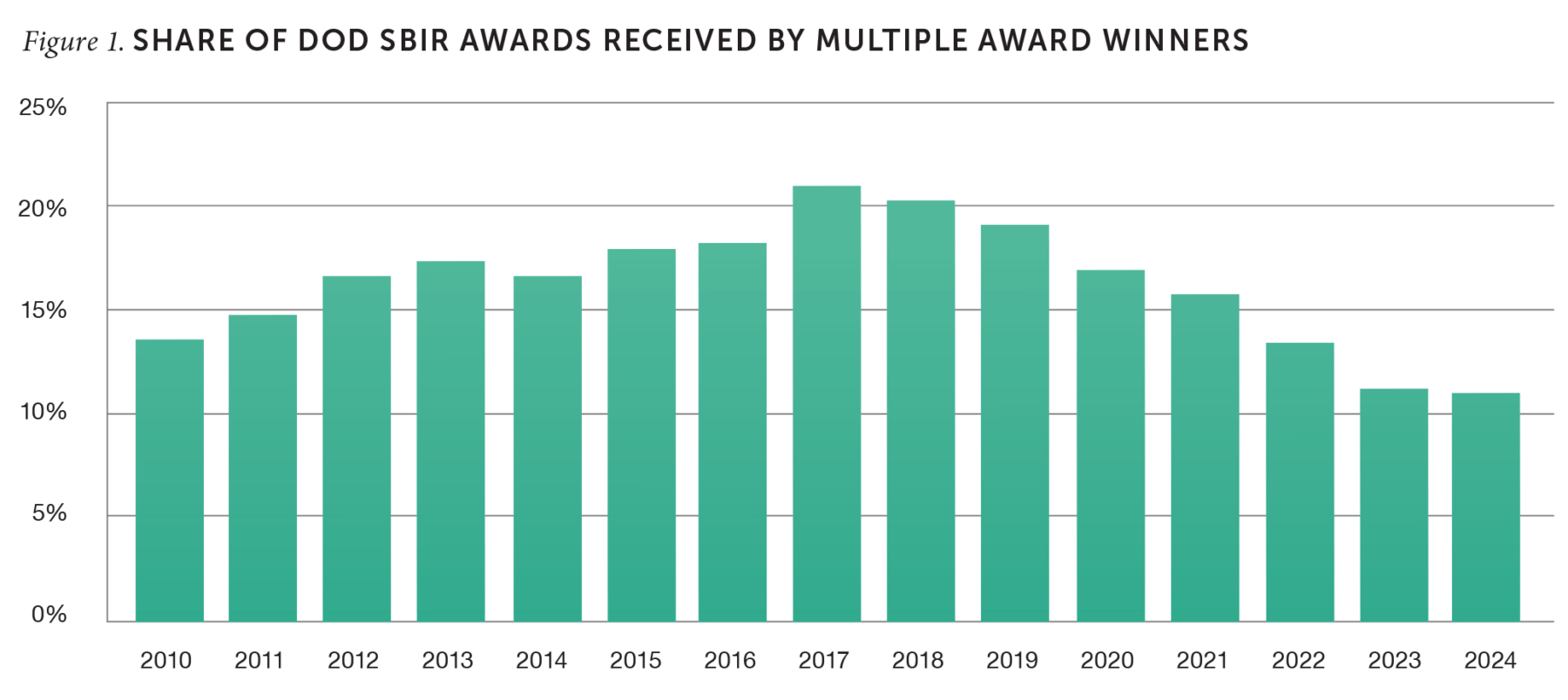
Viasat officially graduated from SBIR eligibility when an acquisition grew its staff to more than 750 employees—no longer small by program standards. But not all SBIR-dependent startups become established defense contractors; some stay dependent. Companies that participate in the SBIR program for multiple years (sometimes decades) but derive minimal revenue from commercial or non-SBIR government sources are considered mills, or “multiple award winners.” For multiple award winners participating in the DOD program between FY2010 and FY2025, SBIR awards constituted 56% of revenues on average. When companies receive more revenue from SBIR grants than from contracts for their technology over decades, that is a signal that the program may not be seeding growth as intended.
Multiple award winners have been studied for years. The Government Accountability Office (GAO), which released a report on the subject in 2024, counts them as companies which have received more than 50 Phase II SBIR awards during a 10-year period. (Others use the label more loosely, to refer to companies that have received many SBIR awards over many years.) Most of these companies are participants in the SBIR programs of DOD, its service branches, or NASA.
A majority of firms receive only one SBIR award and only participate in the program for a limited time, reflecting the original intent of the program. But a quarter of all SBIR awards from 2010–2024 went to just 70 companies (11,971 awards, worth $5.3 billion). Widely cited research published by the Naval Postgraduate School showed there is no consistent relationship between the amount of early SBIR funding a company receives and whether a company receives Phase III awards—only nine of the top earners of Phase I and II awards are also in the top earners of Phase III contracts. Since Phase III awards represent successful commercialization and agency adoption, this disconnect suggests many of the frequent SBIR recipients are failing to achieve the program’s core mission.
SBIR mills persist for a few reasons. The 2024 GAO report noted that program officers like working with these firms because they have the resources and facilities to conduct the niche scientific research agencies require. Experienced companies require less help from program officers to navigate the program, and the grant structure of SBIR awards affords companies more flexibility than contracts, which require more tangible deliverables. Though this might sound like a win-win, the convenience of the arrangement does little to advance truly innovative research. DOD’s program implementation has historically emphasized compliance over outcomes: In that environment, a risky award is a career gamble; a boring one is not.
These patterns deviate from the original intention of the program. SBIR was meant to facilitate a research marketplace for federal agencies and the private sector. The 1981 congressional report on SBIR reads that the program will give “special consideration in the funding review of Phase II proposals to applicants who are successful in attracting private capital commitments to pursue commercial applications of the federal research. This special consideration is given by awarding extra points of merit to those proposals that have attracted private sector commitments for follow-on funding.” The SBIR program was not created to constitute a majority share of a company’s revenue year over year for decades.
Encouraging new participants
SBIR mills are the focus of reform proposals because they have distorted the efforts of the program and hoarded resources that could be better distributed to more innovative firms. But reforms that focus only on discouraging these incumbents from participating in the SBIR program—for instance, by instituting commercialization benchmarks or imposing limits to the amount of awards companies can receive—underemphasize the importance of creating pathways for new entities. Increasing the participation of new companies in the program can help dilute the influence of mills in the application process, and, more importantly, is an important step toward furthering the original SBIR mission.
It’s worth looking into some of the methods scientists in other fields have adopted to expand research funding to new groups without sacrificing quality. One potential approach is having a percentage of SBIR awards allocated as science lotteries. Applicants would submit a proposal for a Phase I SBIR award, and if the proposal passed a baseline of technical merit, it would be put into a selection of worthy proposals for a given SBIR topic, and one would be randomly chosen. A lottery would likely work best for open topic awards (broad solicitations not tied to specific technical requirements), where proposals already cover a wide variety of technical solutions.
Science lotteries have already proven that they work. The Health Research Council of New Zealand implemented a modified lottery system for a grant program in 2013 and found that randomly selected projects among qualified proposals performed comparably to traditional peer review while reducing bias toward established researchers.
Increasing the participation of new companies in the program can help dilute the influence of mills in the application process, and, more importantly, is an important step toward furthering the original SBIR mission.
Another way to improve applicant diversity would be to give SBIR program managers golden tickets, an occasional pass—perhaps one per program cycle or every two to three years—on unanimous funding decisions, to advance one high-risk, high-reward proposal that scored just below the funding cutoff but shows exceptional promise for solving critical agency problems in novel ways. This creates structured room within the portfolio for calculated bets on transformative approaches that might otherwise be screened out by consensus-driven evaluation or more conservative methods. The discretionary authority required to award golden tickets already exists when it comes to funding other forms of innovative research. Program managers within DOD’s Defense Advanced Research Projects Agency, or DARPA, have long had the authority to fund high-risk projects that don’t fit standard evaluation criteria.
Bridging the valley of death
Even if the SBIR award selection process were reformed, many worthy companies would still struggle. Entrepreneurs face many problems that are not of a technical nature when trying to cross the so-called valley of death between research and commercialization. Has a market been identified? Does a scientist or entrepreneur know who the product’s customer is? Can the production of the new technology be scaled?
SBIR programs have a mixed record of addressing valley of death problems. When Congress reauthorized the program in 2011, reforms were included to improve commercialization, but their impact proved limited. For example, a 2015 National Academies report on the National Institutes of Health’s SBIR program showed that the commercialization rate for SBIR awards in 2015 was about the same as it was in 2005.
Of all federal SBIR programs, the ones housed in DOD and its military departments have dedicated the most resources to bridging the valley of death. The Defense Innovation Board has released multiple reports on reforming the SBIR program and other programs to make new technology more accessible to warfighters.
AFWERX, the innovation arm of the Air Force, created the Strategic Funding Increase (STRATFI) and Tactical Funding Increase (TACFI) programs, which award larger-than-usual SBIR Phase II awards ($3–15 million and $375,000–$2 million, respectively) through a combination of SBIR, non-SBIR government dollars, and private capital from venture capitalists. The Air Force uses these awards to help companies bridge the gap between SBIR program success and the ability to land long-term government contracts. More recently, the Army launched a similar program called CATALYST, and the Navy launched a program called Catapult. Both aim to shepherd new technology across the valley of death, as AFWERX’s programs do.
Entrepreneurs face many problems that are not of a technical nature when trying to cross the so-called valley of death between research and commercialization. Has a market been identified? Does a scientist or entrepreneur know who the product’s customer is? Can the production of the new technology be scaled?
To help solve smaller-scale valley of death problems, the next iteration of the SBIR program should contain strategies to assess the feasibility of commercialization. One way to do this would be to encourage more agencies to adopt pilot programs similar to those that have already been adopted within DOD, like creating a pool of Phase II SBIR dollars matched with private capital that can be invested into companies with readily deployable technology. Another approach is to create a fast track like the one the National Science Foundation’s SBIR program is piloting, with a one-time (per applicant) SBIR award requiring only a two-page application, focused on technologies that are quickly commercializable and need minimal validation before entering the market.
But crossing the valley of death may not necessarily require millions of dollars in funding—sometimes all that’s needed is a small amount of gap funding. However, the SBIR programs lack an applied method for assessing the readiness of a technology for commercialization. The Department of Energy has developed a method for thinking through risks around commercialization; its Adoption Readiness Levels framework and Commercial Adoption Readiness Assessment Tool show what this could look like in practice. Agencies could spend modest sums on market interviews, techno‑economic analysis, and regulatory and supply‑chain checks to score a technology’s “adoption readiness” before committing larger sums of capital.
Some universities also support unique approaches to gap funding via transition grants. Michigan State, Penn State, and the University of Washington are just some of the many universities that offer mid-five-figure to low-six-figure gap funds to give entrepreneurs money to build prototypes and proofs of concept.
Breaking down barriers to commercialization
Beyond crossing the valley of death, there are other ways to improve the SBIR program by improving the commercialization ecosystem in which the SBIR program sits. This ecosystem includes a vast array of stakeholders helping to produce and fund technical development: universities, academics, entrepreneurs, venture capitalists, and state and local governments interested in economic development.
The SBIR programs lack an applied method for assessing the readiness of a technology for commercialization.
In particular, university support for research translation is integral to the ecosystem. The majority of SBIR-funded companies include academics. A 2015 National Academies study of the National Science Foundation’s SBIR program showed that 80% of Phase II companies had a founder with an academic background.
But several systemic factors constrain university support for translation. First, many universities overlook research translation activities in academics’ reviews for promotion and tenure. When universities only reinforce the “publish or perish” trajectory of the academic career, academic entrepreneurs have little incentive to participate in turning their research into practical applications.
Second is the legal complexity of tech transfer. Although some universities take a hands-off approach to spin-offs, merely asking for a percentage of equity, other universities are far more involved. This involvement can include requiring higher percentages of equity, revenue sharing, and even annual fees for using a licensed technology. These more complicated agreements, especially for pre-revenue companies, make commercialization harder—outside funders don’t want to fund companies that have tangled financial obligations.
Simplifying the tech transfer process increases the odds that an academic or entrepreneur will use a technology produced by a university as the basis for an SBIR award. A university that wants to create a simplified licensing agreement does not have to reinvent the wheel. Simplified commercialization agreements, such as EASE at University of Colorado Boulder or the FastTrack Startup License program at Cornell University, can serve as models for other universities.
Finally, stronger support for navigating all the other aspects of research commercialization is necessary. Universities can support commercialization through research translation programs. For example, at the university level, University of Colorado Boulder’s Center for Translational Research solves many nontechnical problems that afflict scientific spin-offs. These include drafting the nontechnical parts of proposals, conducting market research for spin-offs, and connecting researchers with the right sources of state and federal funding research commercialization—such as the National Science Foundation’s Regional Innovation Engines, the US Economic Development Administration’s Tech Hubs program, and DOD’s Microelectronics Commons program. The National Science Foundation, through the Accelerating Research Translation program, is trying to develop more of these research ecosystems.
By reenvisioning the SBIR program’s role within the broader American scientific innovation ecosystem, legislators have an opportunity to reform SBIR in a more comprehensive way than has been achieved in the past. Lowering the barriers to entry for new kinds of firms means more small businesses get a chance to compete for SBIR awards. And targeting more SBIR resources at bridging the valley of death could give more small businesses a shot at growth. What’s more, these changes can be achieved without increasing administrative burden if the focus remains on creating new opportunities and pathways to participation. The SBIR program can then become an example of science funding that focuses on outcomes rather than paperwork, helping to ensure that the United States maintains its technical edge.