
Same Storm, Different Boats
Review of
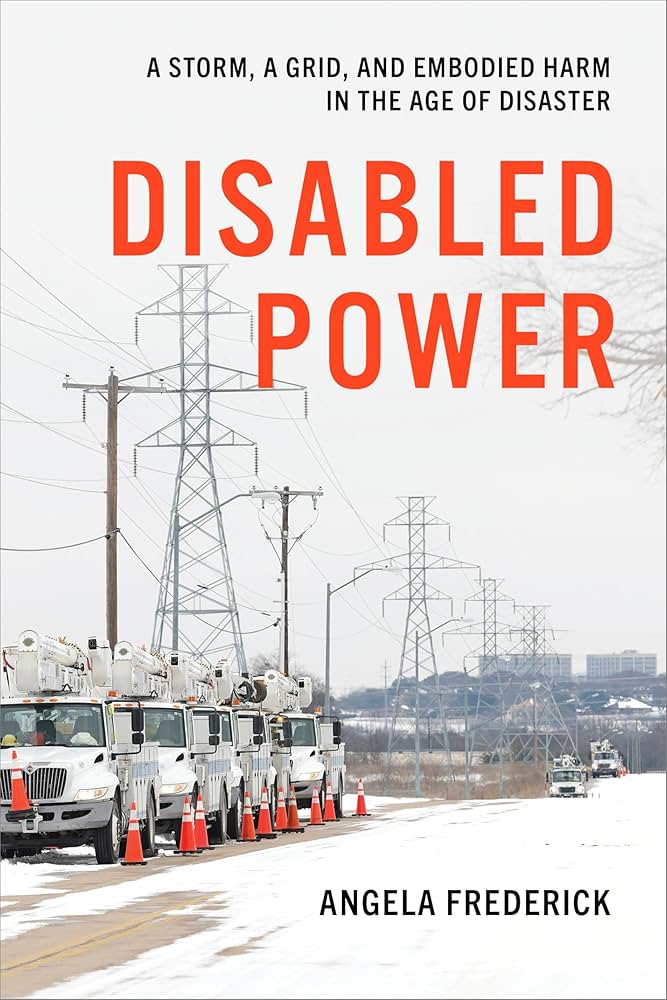
Disabled Power: A Storm, A Grid, and Embodied Harm in the Age of Disaster
New York, NY: New York University Press, 2025, 261 pp.
They died of hypothermia in their homes, buried under blankets. They died of carbon monoxide poisoning in their garages, idling their cars for warmth. They died when urine froze in their catheters and when their oxygen tanks ran out of power and when they fell on the ice and when they couldn’t get their medicine and when their cars crashed in a desperate attempt to escape. The official death toll was 246, but there is reason to believe it was higher, perhaps closer to 700.
Others survived, but damaged by frostbite. Some were down to the last battery on their medical device. Some burned their furniture for heat. Some had to boil water. Some had no water. Pipes burst in some homes and, in others, people brought in snow to flush the toilet. Some watched anxiously over sick children, the fog of breath visible in their bedrooms. Others were cuddled up by the fire, enjoying hot chocolate. Some went sledding. Senator Ted Cruz went to Cancun. Same storm, different boats.
Scientists call it Winter Storm Uri, but in Texas, we call that cold, stormy week the Big Freeze, Snowmaggedon, or Snovid, because it happened at the peak of the COVID-19 pandemic in February 2021. As Angela Frederick’s Disabled Power makes painfully clear: We were not prepared. Frederick, a sociologist at the University of Texas at El Paso, brings disaster studies and disability studies together to offer an account that is valuable both for its theoretical framing as well as its rich narrative form. She shows how the disaster could have been prevented, why it wasn’t, and how those failures heaped harm on the most vulnerable Texans.
About 27 million people rely on the grid run by the Electric Reliability Council of Texas (ERCOT). When temperatures plummeted, people cranked up the heat, resulting in demand that overloaded the system. On top of that, poorly winterized gas lines and power plants failed. As Frederick notes, this was the culmination of decades of policy decisions to deregulate and underinvest in public utilities. The spike in power demand coupled with failing infrastructure precipitated the need for rolling outages. On Valentine’s Day, things went dark across the state, and the cold crept in.
The best parts of the book are the stories told from interviews with 57 disabled survivors of the storm. Frederick’s research participants have a wide range of disabilities, including mobility limitations, sensory impairments, and chronic illnesses. For me, their stories brought back the trauma of those days, when my house felt like a ship stuck in sea ice, isolated in the moaning winds. I remember that feeling so vividly. I had a panicked realization that the human body is a controlled burn, a little metabolic fire. And, oh, how easily it can be snuffed out. To feel that precarity is educational. Those who make decisions about the infrastructure that keeps us warm need to read these stories. Hopefully, they will feel themselves in the dark in a wheelchair while the batteries die on the machine that gives them breath. Gasping, shaking, freezing, alone.
What Frederick calls disability vulnerability is the heightened precarity of people who have preexisting conditions exacerbated by a disaster. When disasters “disable” social and physical infrastructures, disabled people bear unique kinds of harm and suffer disproportionately. Indeed, they are two to four times more likely to die in disasters. Disability is a spectrum; in disasters, everyone is vulnerable, but not equally so.
Within disability studies, Frederick takes the welcome approach of using an embodiment model that combines the medical and social models of disability. The medical model understands disability as a pathology located in an individual body or mind. It pictures disability as a deficit or abnormality that requires treatment and management by medical professionals.
Those who make decisions about the infrastructure that keeps us warm need to read these stories. Hopefully, they will feel themselves in the dark in a wheelchair while the batteries die on the machine that gives them breath. Gasping, shaking, freezing, alone.
The social model, by contrast, holds that people are disabled not primarily by their bodies or minds, but by social, material, and institutional barriers that fail to accommodate human difference. From this perspective, Frederick argues that disability vulnerability in disasters is “not an inevitable consequence of individual disabled bodies.” It is, rather, socially and politically “produced” through policy and design choices. The social model, Frederick writes, is a “liberatory project of turning the oppressive stare from the individual disabled body back to the broader society.” It turns our attention to the choices that create unnecessary vulnerabilities and preventable harm.
For example, Frederick reports that Texas only has one program—if it can even be called that—devoted to aiding disabled people in disasters. It is nothing more than an Excel file known as the State of Texas Emergency Assistance Registry (STEAR). The intent of the registry is to provide local governments with information about people with functional and access needs for emergency plans. Because the registry has a reputation for being ineffective, very few disabled people have signed up for the program, which, of course, makes it even less useful. Not a single participant over the course of Frederick’s research received a wellness check from STEAR.
Yet, just as disability cannot be reduced to medical defect alone, it also cannot be located entirely as a social phenomenon. Frederick’s embodiment model emphasizes that disability is lived through the body as a meaningful, situated experience. Disabilities happen in the relationships between individual bodies and social bodies, shaping how people perceive and engage with the world. “I, in fact,” Frederick writes, “know not how to share my participants’ disaster stories without centering their embodied experiences.”
This is where that other meaning of “disabled power” comes into play: not power that has been disabled, but the power of disabled people. Although many of the stories in this book are harrowing, many more are hopeful and inspiring. Frederick shows how people improvised survival strategies to become “disaster hackers.” They fashioned makeshift wheelchairs, curated social support networks, rigged plumbing systems, and much more to care for themselves and others. These are examples of what the disability writer and activist Leah Lakshmi Piepzna-Samarasinha calls “crip genius.” Disabled bodies are not passive victims or merely sites of “special needs.” They are agents, full of disabled power.
You might be tempted to diagnose the rugged individualism of Texas as the root cause of this disaster. ERCOT, for example, is independent of and not connected to the two main grids—Eastern and Western—that provide electricity to the rest of the country. Frederick cautions against this assessment to argue instead that neoliberalism is to blame, and that this market-worshipping ideology guides decisions about the physical and social infrastructures that we all rely on. Short-term private profits take precedence over long-term investments for the common good.
Disabled bodies are not passive victims or merely sites of “special needs.” They are agents, full of disabled power.
That is certainly a big part of the picture. Yet we might push her point further by dropping the “neo” and pointing the finger at liberalism, especially the autonomous self at the heart of this political project. John Locke and the other founders of modern liberalism pictured humans as individuals who are born free and equal. In many ways, this is an ennobling account of the human condition, one that has been central to the development of democracy and individual rights.
Yet, we are not born free and equal. We are born interdependent and each in our own “boat,” our own social-bodily circumstances. And as we strive to make life more convenient through the control of nature, we undermine the myth of autonomy at every turn. The grid is a case in point. When the winter storm came it reminded us that our bodies, and our abilities, are dependent on wires strung across the ranches and plains.