If she didn’t focus on the building plans, Tamara would think about her mother. She would think she was fine, zooming in on a misspelled text one of her contractors sent, then she’d remember her mother’s face, a yellow paleness in the hospital bed, a clammy touch, lost of feeling. She would remember when the doctors told her that the feeling in her mother had faded—2 p.m.—and she’d remember shouting and nurses touching her, the fluorescent lighting of the hospital flickering overhead like a fire alarm, and because it was all so much, she looked at building plans. She focused on what her mother wanted. What she’dwanted to build, for the longest time.
“Are we sure these are the most recent iterations?” Tam asked John-Joseph, her right-hand man. He was the team’s operations lead, and coming in as CEO, Tam didn’t want to disrupt the system. Her mother had trusted him, so she trusted him. John-J helped organize the pitch decks for their meetings, he helped make sure Living Homes came across the best it possibly could. And now, at the Housing Minister’s office for the final meeting to determine whether they’d be awarded a government contract to support sustainable builders, Tam grabbed onto his steady arm as a source of comfort.
“The minister is not around,” his secretary shouted upon their entrance. The woman lay spread-eagle on a sofa, absentmindedly tearing pieces of a Gala sausage roll into her mouth as five standing fans surrounded her like subservient coworkers. The office—like everywhere in Abuja—was swelteringly hot. Patches of amber and red decor, and a tiny, burglary-proof corner window gave the boring office building some semblance of life. Tam had been in this office four times in the past two months, and she knew the shape of the secretary’s unfriendliness. He is not here was the secretary’s go-to. Even if the minister was washing his hands in the bathroom, finishing up with his afternoon prayers, so far as he was not in his chair, her tinny and directionless voice announced, He is not here!
“Okay, but we have a meeting—” Tamara started, but the secretary waved her off and tapped on a clear folder on top of her desk. Tamara grabbed the folder, and before she could flip the first page, the bolded words jumped out at her:
AWARD LETTER.
She had gotten the contract.
Tamara stared at the folder, dumbfounded. She didn’t understand. Although she had met with the minister month after month, attended conferences, all the networking brunches, the word on the street was that there would be a final round to determine the selected company out of a pool of shortlisted candidates. How was she already here, at the point of being awarded a sum that would change her business?
“I—” she started.
As if reading Tamara’s mind, the secretary interrupted. “Things move very fast in this office. Our budget increased, so we made a decision to support more firms than initially contemplated. Congratulations.”
“Thank … Thank you!”
The secretary raised her head and revealed a phone attached to her ear. “I’m talking to someone else now. Congratulations, my dear. Your home is blessed!”
The secretary lowered the phone and gave Tam and John-J a stare. “You are still here? I’ve told you people the minister is not around!”
The first seed of Living Homes was planted 13 years ago, when Tam and her mother were attempting to bake cookies in the oven. Tam hated being in the kitchen. It was worse than school, where her classmates walked the outdoor paths under thick umbrellas with white faces full of SPF 60. Where students suffered heat strokes in classes with the struggling AC on full blast. The world had gotten hotter, which meant the stove, the air fryer, the barbecue grill had become places of terror, close encounters with the sun’s unholy fire. But the heat didn’t stop her mother, no matter how much Tam wanted to collapse.
When Tam grew tired of messing up her mother’s simple instructions (“too much butter, too much butter!”), she escaped from the hellfire kitchen and hid underneath the neighborhood palm tree. Decades-old and sturdy, it was one of the few remaining unscathed spaces in her area since the Abuja Expansions. The tree stretched itself like a halo over her head, a best friend’s whisper, and Tam didn’t know she had drifted off until she woke up and saw her mother looking up at its leaves like they were the miracle to a world full of burn.
The tree stretched itself like a halo over her head, a best friend’s whisper, and Tam didn’t know she had drifted off until she woke up and saw her mother looking up at its leaves like they were the miracle to a world full of burn.
“What if that was our roof?” her mother asked.
Tam didn’t have a clue what her mother was on about.
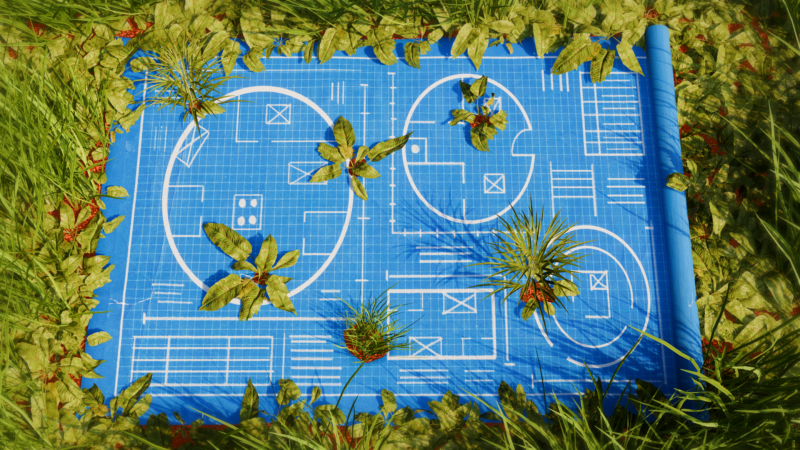
Years later, as a stressed business development student in university, she finally got a firm sense of her mother’s vision. The blueprints were vivid, a 3D fantasy: Her mother wanted to build a house that would be inseparable from its green spaces. A house with roots wrapped along the walls like a snake against a tree, with soil coating the roof, that would be covered in bougainvilleas and carpet-grass so thick and green you could roll around in it at the height of the afternoon sun and feel refreshed.
Tam didn’t need to be an architect to know it sounded impossible, almost fruitless.
But her mother believed, so why didn’t she?
The award was staggering, but so were the bills. In a week, John-J had dropped at least seven invoices on her desk. The painters needed more buckets of paint. The builders needed quality cement, lest they have to mix water with flood runoff and use it to patch the walls. The drainage team would find a new problem in each of their searches and demand an amount that would make Tam want to shit herself. The naira signs ran through her head like a fire truck oblivious to any stop sign.
“You’re worrying too much about everything being perfect,” John-J said as he bit into a messy sandwich. He had taken her out for an early lunch, or maybe he wanted her away from the rest of the team. Tam had spent the morning screaming at laymen for putting bathroom tiles on a kitchen floor.
“It just has to be. It has to be.” Tam picked at her quinoa bowl. Truthfully, she hadn’t slept. Three weeks had passed since she received the award, and she had appeared on news bulletins featuring the miracle sustainable houses, been approached to speak at housing conferences, and engaged with many of the aspiring homeowners who came to visit her plots of land.
Her team had amassed billions of naira in revenue, and Tam felt conflicted about it. On some days, she felt pride in all the work she was doing, and would pour herself too many glasses of red wine. On most days, though, she thought about how unrealistic this all felt, how unaffordable these houses were, how hard it was to execute a vision in a country that killed dreams, that killed her mother, that could kill her.
Her mother wanted to build a house that would be inseparable from its green spaces.
What was stronger than her resilience, what kept her up at night, was this wave of unbelief.
“You’re not letting yourself enjoy the fruits of your labor,” John-J said again, wiping his face with a used napkin. It was like everyone these days could read her thoughts. “There’s always going to be rough edges. But you have to look instead at the benefits. We are doing better than all our competitors. And everyone is working to their limits. Past them, even.”
“It’s not like I’m sleeping,” Tam replied, and John-J laughed and waved his hands.
“Of course not. You’re our madam. I just think you need to be easier on the team. They did nonsense on those tiles, but word among the people is that madam is not showing them appreciation for when they do get things right.”
Tam thought about his words carefully. It was possible that she had been too rigid, unappreciative even, but the expectations she had for herself were in line with her mother’s vision.
Tam stopped thinking when she felt a buzzing in her pocket. It was her work phone ringing. She’d missed a call from one of her team members, Ejiro.
Ma, you need to come to the site immediately. Some people from the government are here, and they are threatening to close us down.
When Tam was in her final year of university, her mother picked her up from Nasarawa State University and took her to the first plot of Living Homes. They drove two hours in silence, her mother tapping Tam’s lap in an almost giddy excitement. For months, her mother had talked about the project on every call—the beauty of picking out plants, the ease with which it came to her, and Tamara only nodded through each conversation, unsure of why her mother’s ease hadn’t been passed down to her in genetic fortune. She sweated through introductory business classes, fought to maintain a GPA that was average at best. Her mother parked on an untarred road and dragged Tamara out of the car with a force that made her focus on the scene in front of her and get out of her head.
On most days, she thought about how unrealistic this all felt, how unaffordable these houses were, how hard it was to execute a vision that came from imagination in a country that killed dreams, that killed her mother, that could kill her.
The land itself was miles of rocky red sand, which spilled out in three directions. Ahead, Tamara could see the Wonderland Twin Peaks, one of the region’s main hiking areas, full of stale grass and empty bottles that previous hikers must have scattered across the mountainside. It was not the land or the mountains, however, that grabbed Tamara’s attention. Her mother had built a model home over the past year, a small duplex that would provide a taste of Living Homes, and the sight of it made Tamara stop in her tracks.
The house looked like a creature. On the roof, moss rose and succulents bloomed, covering the home with a full head of hair. Around the house, she could see holes and windows where air entered and escaped, and if she listened closely, she swore she could hear the house whistle.
She climbed a pair of rock steps and entered the home, where she was greeted by hibiscus leaves germinating in clay pots. Eucalyptus leaves acted as small diffusers. The house was only a bed and a living room—it was so small, but it felt open, and everywhere she stretched her hands, she felt like there was light holding on to her, and beyond light, something else: air. It felt like a place where she could take a deep breath, release, and relax, the outside world melting to gray.
As they left the building and got back in the car, her mother squeezed her into a tight hug. “It’s ours, Tam. It’s all ours. And one day, Tam, my baby, all of this will be yours. What a mother creates, her daughter duplicates.”
Tam kept up a smile, but she felt her chest tighten. That was the problem. One day, all of her mother’s passions would be hers, but would the ease transfer over too? Would her care?
When Tam tried to picture it, the house died like a flower in her hands.
There were too many officials at the construction site. Men in yellow and blue unforms surveyed the scene like guard dogs, trying to sniff up anything they could find. Tam felt a gnawing in her chest, growing with each additional face she spotted.
When Tam tried to picture it, the house died like a flower in her hands.
A dark-skinned man with a scar across his left eye approached her. “What seems to be the issue?” she asked.
“Madam. Good evening. Please, call me Adetayo. I’m with the National Ministry of Housing Works. You’re the one we’ve been waiting for?”
Tam sized him up. He was clearly the superior, and his face was expressionless.
“What’s this about?” she demanded, and he clapped his hands, as though he had had been waiting for the question.
“One of your customers reached out to tell us there are structural problems with the houses you want to put on the market.”
“Is that one a house or a bush?” one of the Housing Works’ officials whispered, but Tam caught his words and stared him down till he looked at his shoes.
“We just want to inspect the property to clear things up,” Adetayo said.
Tam felt herself getting flustered. “There’s nothing wrong—”
“There’s no issue,” John-J cut in. Then he grabbed her hand and gave her a smile. “Sir, your team can go ahead and conduct your search.”
The Housing Works engineers were efficient. Books in hands, they scanned the foundations of the houses, the pipes, the drainage. They went over the corners of each property, looking for any scuff in sight, any building error. As they went through the buildings, Tam cracked a joke, asked them questions, hoping that someone would alleviate her worry and tell her this was just a formality.
The house looked like a creature.
But they were silent.
“They’re looking for money,” John-J rolled his eyes.
Tam wanted to believe him. John-J was always so confident, so unfazed. But she sensed an uneasiness in him, beneath his eye-rolling. For some reason, he was just as fidgety as her.
An hour later, Adetayo and his engineers emerged from the house, expressionless.
Adetayo raised up a hand full of wet grass, dense and matted. “Madam, do you know what this is?”
She took a deep breath, then inspected the plants closely. “They are bonesets. I-I think. We grow them on our rooftop. Though they aren’t in season yet.”
Adetayo cocked his head and gave her a warm smile. “Madam, this wasn’t found on the roof. We found this under the roof.”
Tam stood gravely still. “I don’t understand.”
He spoke in a childlike voice. “These aren’t bonesets.”
The men from the ministry all burst into laughter.
Adetayo’s cleared his throat, and his face went sour. “Madam. Simply put: This house is full of weeds.”
Two years ago, Tam’s mother started to get really sick. Tam didn’t know anything about her mother’s symptoms because her mother never said anything about them, and Tam was all the way in Lagos, a fresh graduate who had decided, on a whim, to participate in the country’s revamped national service program. But sometimes on the phone, Tam would hear her mother cough and cough, then transition into the next sentence, like nothing was wrong. And although Tam would ask her usual questions upon questions (“Are you drinking tea?” “Is it the dust in Abuja?” “Have you gone outside to get fresh air?”), her mother remained adamant that she was fine. She was always great, always perfect.
“Madam. Simply put: This house is full of weeds.”
But she wasn’t fine. Tam knew that for sure. Some days, she envisioned her mother curled up in bed, coughing and coughing till the life went out of her. But she shook her head and cursed her overthinking, because that was the problem. She was the inverse of her mother, and since she had never known ease, had never known anything but sweat, she lived a life where she never thought of anything as easy, anything as good.
This is how her mother died: A year after Tam had finished her service year and had returned to Abuja, one of the workers called her to say her mother had collapsed. She had experienced a fainting spell and had requested to be sent to the affordable hospital closest to the scene.
“It’s nothing,” her mother had said, from her bedside. “I just need rest, and you don’t need to take me to India for a small incident.”
The hospital was a slab of concrete, worn down and emptied of life. The building was boiling hot, worse than the ovens that they fought over growing up. Everywhere Tam turned, there were dark spots in hidden corners and a greyness that tinged everything: the walls, the chairs, the reception area—which made the entire place feel miserable. The nurses, when they weren’t chewing gum and snapping at Tam for her follow-up questions, barely ran any tests. They came in once a day and fluffed pillows with a halfhearted tap, barely taking in the signs of her mother’s deteriorating condition.
She died the way a flower did: The yellowing started, from her hands to her face, followed by the withering. Her face shrank and curled in on itself, shifting the woman Tam had known her whole life into someone foreign. Finally, on a day when she had stepped out to check on the construction, the doctor informed Tam of the news. Her mother had gone, peacefully in her sleep. It was something she couldn’t believe.
Tam screamed the building down. She was held back by one of the doctors and one of the nurses, who tried to calm her, who tried to keep her from fighting, from warring, from tearing down the curtains of the hospital room and wrapping herself in rage. She didn’t know how to express to any of them that her mother had just been there. Telling her not to worry. Telling her everything would be fine. And now, there was an empty shell of the woman she had loved, and Tamara felt the loneliest she ever had.
She was the inverse of her mother, and since she had never known ease, had never known anything but sweat, she lived a life where she never thought of anything as easy, anything as good.
Tamara curled up in her bed and covered her head. Her phone rang relentlessly. After finding the weeds, Housing Works had brought out red tape and closed off operations for “further investigation,” and the effects were immediate. Hours later, the sustainability influencers were raising questions about the visit. Within days, competing companies put out ads about their delightful (“weed free!”) buildings, capitalizing on her distress. Every hour each passing day, a buyer of one of the properties would ring her to scream or seek reassurance, as though she was the tether that held everything together. And maybe she was. Maybe this was her life, to be responsible for unfortunate incidents, to grapple with the great weight of other people’s expectations, and she had come to the realization that it would never get less difficult. Her head felt like it would burst at any moment.
She replayed the situation and tried to come up with effective answers. It had been a mistake. But how? It couldn’t be possible that in dozens of properties, at almost every Living Homes site, there were weeds growing through the cracks of each house, invading the beams of the roof, and no one had seen it. She tried to think in a different way. Maybe they had seen it, and they didn’t want to tell her because she wasn’t appreciative, like John-J had told her—she was feared. She shouted and screamed and cried. She wasn’t like her mother, who saw disaster and answered it with grace.
On the third day, she threw the covers off her bed and called John-J. She wanted to understand what had happened, and she knew he would know more than anyone. She met him at lunch once more, but this time, she couldn’t pretend to eat. John-J also looked wretched; he had bags under his sleepless eyes.
“I should explain,” he said.
She froze in her seat and felt heat building in her stomach. Why did he look so sad, so guilty? “What did you do?”
John-J took a deep breath. “You know we’ve been working on these houses for years. And I was with your mother from the beginning, from when you were in university and saw the model home. The prototype. I think you’ve been running things long enough to know that running a business in this country is expensive. Cement adds up, electricity adds up, the cost of land adds up. Your mother, may God rest her soul, sought as much funding as we needed to do the best job we could, but see, we had to keep things affordable when we could. So sometimes, instead of the flowers we pictured, you know, the roses and the lilies and the whatnots, your mother suggested we plant—”
“Weeds.” Tamara sat back in her chair. Bile, bitter and thick, rose to the roof of her tongue.
Tam screamed the building down.
He nodded, giving a half smile. “Siam weed, elephant grass—they were just a lot cheaper than, well, bonesets. It offered the same ground cover, and we believed we could manage the spread of a lot of their seeds, especially with smart planting. But nothing is perfect. It wasn’t the cost-effective solution we planned.”
Tam buried her face in her hands. Her voice kept getting higher and higher, the more she realized none of it made sense; it didn’t make any fucking sense. “She wouldn’t do that. She wouldn’t do that because she knew what she wanted and there were blueprints and the houses were supposed to be perfect. They’re supposed to have light shining through them and air that whispers through the gaps and she wanted a place where you could breathe, where you could step in and forget the world. Not fucking weeds!”
John-J sighed. “Look, she had a vision. But it’s hard, and she knew that. You believe in something so strongly, and one day, you look up, and it’s so different from what you imagined. But you learn to live with it: the cracks and the weeds and the imperfections.”
Tam put her head on the table. “No. No.”
John-J leaned down to her. “I think she wanted you to see things in a certain light, because you were her girl. But the truth is a lot of things are done this way, and we were no different. And to be honest eh, right now, we can’t afford to be losing customers.”
Tam looked up and glared at him.
His voice lowered to a whisper. “Look, I know one of the heads from Housing Works. Higher than that Ade-whatever guy. I talked to him about our situation, and he said we could get a report issued in a week that would put us in the clear. We just have to eh—treat the weeds. Get things to look a little better.”
Tam shook her head. “Is that even safe? From what it seems, the weeds have eaten into the structure of so many of our properties. They’ve damaged entire buildings.”
John-J looked at her and kept silent.
“I mean, we can’t knowingly sell people damaged buildings.”
John-J folded his arms and kept silent.
“John-J. We cannot know—”
“Me, I’m just saying you should think about it. You are our madam, and I can only advise you. But we cannot lose our people. Years of our work, our blood, our sweat. We cannot lose it.”
In the early days, when her mother was still juggling her job at the bank and Living Homes, Tam thought of her mother as the busiest woman alive. Tam would call her and she would be at a business meeting on financial strategies, and in the night, her mother would be interviewing project managers, talking about bad CVs over the phone. Tam thought of her as so wondrous, so inconceivable, a person who could do it all.
Sitting up in bed after the meeting with John-J, Tam could only think about those moments. Her mother showing her the blueprints. Their first visit to the model home. Her mother’s sickness, what it was, what caused it. Did it all feel different, knowing that behind the ease was a heaviness to her mother’s decisions, an opportunity cost hidden under the rug? She wished her mother had sat her down and told her of rough edges, of the hardness she faced, because Tam would have told her she felt it too. She felt it all her life. Now, it was far too late, and all she could feel was haunted by her mother’s decisions.
She wished her mother had sat her down and told her of rough edges, of the hardness she faced, because Tam would have told her she felt it too.
The offer sat at the back of her mind. She didn’t know what to do. It was midnight, devoid of stars, but she knew she needed to go and see Living Homes. She grabbed her keys and drove down the silent roads of Abuja, till she reached the bright red sign that said Living Homes, your eco-friendly paradise. Everything looked strange, covered in red tape. Tam tore through the tape and walked into one of the houses.
In the night air, their homes always felt cool. A breeze slid in through the open lattices they had installed instead of windows, and it felt welcoming, so calm. She walked up the earthen steps, caressing the plants they had placed in clay pots along the way—lilies of the valley, wild succulents; admiring the work. In a way, John-J was right. She had spiraled so much that she had forgotten to see the beauty in what they had built, in what her mother had envisioned.
In most of the houses, there was now a hole in the wall, torn open by officials to investigate the weeds. The news of the infestation had destroyed Tam, so she had never bothered to see it up close. Now, alone with the houses, she poked her head through the wall and assessed the damage.
Underneath the roof, thick weeds spread in patches, matted and clumped together like dry gum. Thick root stems ate into vital support beams, choking life from the house. The air inside the wall felt damp and soft, perfect for mold. Tam didn’t realize there were tears forming in her eyes until she pulled back and averted her gaze from the scene.
She never thought about how hard it must have been for her mother.
She had spent months trying for perfection, for the best version of what her mother wanted, and now she didn’t even know what that vision was. But what she knew intimately, and what she decided to rely on, was the foundation Living Homes was built on—the bond between herself and her mother, a prophecy that had come from a palm tree, a baked cookie, and a life together through a world of heat. Tam thought about it then, that moment in childhood when her mother first proposed the homes. She always looked at her mother’s ease from the lens of her own inadequacy, and never thought about how hard it must have been for her mother to keep insisting, even through bad finances, even through long hours and sleepless nights, that there had to be something better than a world that scorched and burned.
Maybe it was the part she had always overlooked.
So how could she sell a home that was already dead?
Her mind was clear. She called John-J.
“We have to tear them down.”
“Pardon?” His voice was groggy on the line, but it was still sharp.
“The houses. We have to tear them down, John-J. We have to rebuild them.”