The same day I made my 10,000th edit on my beloved but chaotic GayFactpedia (no, there’s no actual uncorrected proof of Pride and Prejudice where Elizabeth Bennet runs off with Charlotte Lucas—put that in the “Speculation” section), I reached my breaking point.
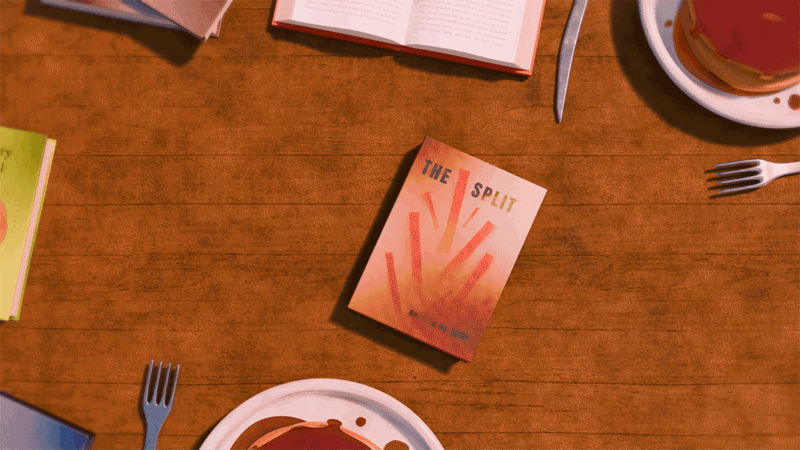
It arrived in the form of a book. A (ghostwritten) autobiography that I had been hired to fact-check had been published, and I was entitled to one contributor copy. I picked up the book on Market Day, my personal designation for the day I hike three miles downhill from my isolated compound, then ride another 10 miles on my electric bike to the nearest tiny township, where I can get baking powder, ibuprofen, duct tape, and my mail.
The arthritis in my hip was making the journey harder and harder. About time for another cortisone shot, but I was putting off that expense as long as possible.
I loaded my saddlebags and backpack with groceries, mumbled my biweekly hello at the postal clerk, and headed back home.
The ride through the spruce and aspens is pretty nice, the trek up the rocky mountain less so. But the remote location means no visitors, so you win some, you lose some. Cornelius the goat was standing watch upon my return, ready to check out what I might have in my saddlebags. I gave him a carrot for guarding the place and sat down on the weather-beaten bench with the book that had arrived with the mail.
Fortunately Amazeballs chronicles the life of Buff Dankers, tech trillionaire and founder of Amazeballs Industries, which had started as a social media site and now sold everything from handsaws to health care. Fact-checking the memoirs of a bloviating tech mogul wasn’t a job I had taken on with pride, but I have to eat, and so does Cornelius. (Lies: He mostly eats the blackberry bushes that keep sprawling back, plus vegetable scraps, mouthfuls of my hair, and on one memorable occasion, an entire flip-flop.)
Anyway, as a FactSearcher, I had taken great satisfaction crossing out the hundreds of exaggerations and falsehoods contained in Dankers’ account of his mythic rise to success. I had spent significant time annotating my corrections after tracking down primary sources. (No, he didn’t have a 4.0 at that Ivy League school; he got a 2.3 and then Daddy called and donated another building. Yes, he did declare bankruptcy twice before lucking into Amazeballs—I looked up the public records.) Flicking through the pages, I was eager to see how the editor had corrected these issues. I’ve worked with Lori a million times, and she always finds a way to assuage people’s egos and make it work.
She had corrected nothing. Page after page of outright lies, burnishing the reputation of one of the worst men in existence.
Worse still, a handwritten letter from Lori, tucked into the back jacket flap. I’m sorry, Jet. You know this isn’t up to me. All of his claims are backed up by entries on TechnoFactpedia. Legal says we can’t afford the lawsuits if we push back … There were a few more sentences, but it all added up to the same thing.
His Reality Edit had trumped mine.
Cornelius nosed the book in my hands. I tossed it on the ground for him to chew on as I gazed around my decrepit compound. This place had once been Judy’s dream, and mine: a small paradise for us, and for our friends fleeing an increasingly TruEvangelical Edit part of the country. We’d bought the land 30 years ago, just after The Split, from some other dreamer who’d installed half a cabin and a septic system before calling it quits. Now it was four ramshackle cabins, some partially broken solar panels, and a chicken coop that had caved in from Cornelius standing on it.
His Reality Edit had trumped mine.
Maybe it was time to give up. Sell the land to some techno-billionaire who wanted to build a picturesque mountain home. Sure, I’d promised Judy we’d grow old here, die and rot on this hillside. I’d kept the “grow old” part of the promise, and she’d kept the “die” part, so maybe we were even.
I heard an unfamiliar noise. It sounded like … whistling? Cornelius dropped the book and trotted over to jump atop the chicken coop. (He’s a coward at heart.)
An unfamiliar figure was coming around the last bend of the path, wheeling a battered electric bike. Curly brown hair, tucked under a ratty ballcap. At least three decades younger than me, apparent less by the lack of grey hair and more by the sheen of optimism on their face. They saw me and beamed.
“You are here! The gay oasis exists!!”
“The what,” I said flatly.
They put down their kickstand, hefted their pack to the ground, and surveyed the compound. Their face dimmed in confused disappointment as they took in the decaying cabins, the tumbledown outdoor furniture, the goat perched on the caved-in coop.
“GayFactpedia said it was here.” Their tone wasn’t actually accusatory, but it felt that way, freighted with the force of their disappointment. As if I’d kicked a puppy, and I hadn’t even known there was a puppy to be kicked.
“GayFactpedia has a problem with a) overly optimistic people and b) Slopbots,” I said. “Which one did you get hit with?”
In answer, they pulled up the site on their phone. There was an entry for “Legendary Unconfirmed Gayborhoods” (of course there was), and under that there was a stub listing for “Sunshine Hills.” Per the photos, Sunshine Hills consisted of a lovely mountain view (not ours) and several beautiful wood-and-stone communal buildings, festooned with rainbow bunting. None of those structures resembled our cabins, and looking closely at the shingles, I could see artifacts in the rendering. The map widget damn sure pointed to me though; I was going to need to edit that ASAP. “Slopbot,” I said, handing the phone back. “So you’ll probably want to be going now.” I remembered my manners. “Um, do you need water for the journey home?”
The kid’s face crumpled and they plopped down on a stump. This was not good. This was the wrong direction from leaving me ensconced in my grumpy peace and quiet.
“Don’t tell me this is your last resort? Is everything you own in that backpack?”
They nodded. “I canceled my AmazeballsHostels subscription.” They shrugged. “But it’s month to month, I can start it again. You don’t have anything like a hostel here, do you?”
I couldn’t be responsible for a young life, not even a 20-something life. Judy was the one who had wanted kids, not me. After she passed, despite my best efforts, my brain would sometimes spontaneously imagine the kid that she’d wanted to have. She would have Judy’s loud laugh and brown eyes, and she would look at me reproachfully when I did something like suggest moving away, or forbid Cornelius to eat my shoes.
After she passed, despite my best efforts, my brain would sometimes spontaneously imagine the kid that she’d wanted to have.
“What you see is what you get, kid,” I said sharply. “There’s nothing here for you. You’d better go.” I tried to rise to my feet, but my hip shrieked, aggravated by Market Day, and I fell back onto the bench.
The kid’s eyes got all big and empathetic. “Oh my gosh, do you need help?”
“Just my stick,” I said grouchily. “It’s over there.”
They ran in the direction I pointed (how wild, to be able to run after that 13-mile odyssey) and returned with the walking stick. “You live here alone, don’t you? That’s why Sunshine Hills is in disrepair!”
“This isn’t Sunshine Hills!” They tried to help me to my feet but I growled till they stopped. I could hobble back to my cabin just fine.
“You do need help!” they called after me.
“I do not!” I shouted back. “The well is by the pine tree. Goodbye!”
Between regular menopausal insomnia and my angry hip, I didn’t sleep well. Around dawn, I fell into a dream in which I argued with Judy about repairing the leak in the cabin ceiling. “I’m fine with the leak,” I told her. “That’s what saucepans are for.”
Judy didn’t listen to me (she never did), but kept pounding on the roof, nailing on shingles.
“Can’t you see I’m sleeping?” I called out, but the hammering continued, and then suddenly I was awake and there was no Judy, but there was still hammering.
“Christ on a cracker,” I said, and hobbled out of bed, throwing on a sweater against the morning chill. I grabbed my stick and went outside to find the kid cheerfully banging away on the broken chicken coop.
At the sight of me, they grinned and stepped back to admire their handiwork. Somehow they’d found salvageable boards to repair the structure. The moss was gone from the roof, which was now straight and covered with old shingles. They had even swept out the inside.
“Good, huh?” they said. “Now you can put the chickens back in!”
I glared at their bright shiny face. “I don’t have any chickens.” Then I stomped off to make breakfast.
They trotted after me. “Can I haul you up some water?”
“This cabin’s plumbed,” I said. “Rainwater catchment.”
“Sweep, then? Take out the compost? Gosh, just smell those pines!”
“Bin’s behind the third cabin,” I said, nodding at the bucket of kitchen scraps. At least that would get them out of my hair. I turned on the burner and threw some flour and baking powder and salt and powdered milk together in a bowl. I had a stack of creditable pancakes by the time they returned. Trying politely not to look at the pancakes, they produced an AmazeballsProtein Bar from their pocket and sat down at the breakfast table.
“So, how long have you lived here?”
“Put that bar away,” I said gruffly. “No Amazeballs in the house. Anyway, don’t you want pancakes?”
Their face lit up all over again.
Over breakfast, I learned more than I had about any other human soul in the past 15 years (if you don’t count my fact-checking research.) Their name was Sunny (far too appropriate), and they were ex-TruEvangelical Edit.
I knew what that was like.
Thirty years ago, The Split made official what we already knew. This country was fractured and it wasn’t going back. It split into seven jagged pieces, and Judy and I were left on this side of the Rocky Plains West, watching the laws slowly constrict around us. In this fragmentary environment, the competing Reality Edits had room to fully take hold.
“Reality Edits” was a loose term, coined by some armchair anthropologist around the time of The Split to describe the country’s competing ideological bubbles, but the image had stuck. Honestly, it was just naming something that had been true for a long time. Your personal reality was shaped by where you got your news, which books you were reading, what “facts” your friends believed. As the country splintered, these information clusters congealed. Groups began branching Factpedia to support and solidify their own Reality Edit. And now you can turn to the appropriate set of Factpedias (among thousands) to support whatever Reality Edit floats your boat and prove all your opinions to be positively, inarguably correct.
Your personal reality was shaped by where you got your news, which books you were reading, what “facts” your friends believed.
Now, people are people, so I’m not saying that the various Reality Edits line up exactly with geography, that every Edit is equally vehement about the certainty of its information, or even that all people subscribe 100% to one particular Edit. If you’re in Manhattachusetts, you’re probably following the back-and-forth dialogues of the various Factpedia branches popular among followers of the Progressive Edit (unofficial motto: Reality Has a Progressive Bias), but in Cascadia you might be equally following the Techno Edit. Or the Gay Edit, or the AsianDiaspora Edit, or all of the above, picking and choosing, or one of the many subEdits, ranging from obvious splinter groups to things that are just bonkers, like the FlatEarther Edit, whose eponymous Factpedia is a full compendium of every conspiracy theory out there (and which I sometimes think is populated more by trolls and science fiction writers than actual believers).
But far too much of Rocky Plains West lives and breathes by the zealotry of the TruEvangelical Edit. I left home at 15, kicked out by my parents when I came out to them, so Sunny’s story was all too familiar. They hadn’t come out to their parents until they were 19, but they were disowned just the same, and now they were doing the universal Flexincome hustle. And they lived in the city, so they had biked about 30 miles yesterday before the three-mile hike.
Sunny forked another bite of pancakes into their mouth. “I don’t mind though. One of my Flexincomes is delivery for a Chinese restaurant. They insist on feeding me at the end of the night.” More bites. “I could probably live off that alone if I were faster on the AmazeballsDelivery app, but there’s other cyclists who get there first.”
The stack of pancakes was all gone, and they politely didn’t ask for more, but I remembered what it was like to be able to ride 30 miles a day, hike another three, and then build a chicken coop. I pushed the rest of my stack onto their plate.
“Oh, I couldn’t possibl—”
“I could probably live off that alone if I were faster on the AmazeballsDelivery app, but there’s other cyclists who get there first.”
“You don’t eat as much at my age. You’re saving me from giving it to Cornelius, and he’s probably eating whatever you left unattended in your backpack.”
Sunny jumped up and looked out the door. Their face fell in betrayal. “He’s on the chicken coop I just mended!”
“I hope you made it strong then,” I said dryly. “You’ll never convince Cornelius to do anything he doesn’t want to do. And usually, what he wants to do is live on that chicken coop. Now, have you thought about what time you’re leaving today?” I said it briskly, before I could think, and regretted it immediately. Which was stupid. Sunny had a life to get back to, and I had a lack of life to get back to. Besides, there wasn’t going to be any money coming in for a while, and I could barely support me and a goat, let alone anyone else.
Sunny’s open, optimistic face went blank. They looked like Cornelius planning something forbidden. “I should, yeah,” they said casually. “I don’t suppose there’s anything else you need before I go?”
“No,” I said, wanting desperately to say yes.
“Great,” said Sunny, clearly meaning the opposite.
I stood up, holding my hand out for Sunny’s plate. “Gonna clear up now,” I said. “Safe travels.”
I washed the dishes, which I always did, and then I swept the cabin floor, which I didn’t always do. I don’t usually bother with the curtains either, but I tied them back with the ribbons Judy had cut long ago. The yellow velveteen was faded, but it still harmonized with the table that Judy had painted with a border of lemons, though that was worn and chipped too. Through the kitchen window I could see Sunny’s bike, charging on a flatpack solar panel in the sun. (Luckily Cornelius wasn’t eating the cords; I’d have to talk to them about that possibility.) But no Sunny.
This was suspicious. I hobbled around until I saw an open door at the last cabin. It’s set apart from the others, surrounded by a protective circle of pebbles and rocks to keep vegetation at bay. It’s the only other cabin I try to keep in repair. In fact, I dread the day it springs a leak in the roof, because that one I’d have to patch and I’m not sure how I would. I made my uneven way down to find Sunny lying blissfully on their stomach inside the cabin, surrounded by a pile of books.
They jumped up with a start when they saw me.
“Oh gosh, Jet, I lost track of time! I was looking for boards to mend your roof and then I saw … this.” They gestured around the cabin, eyes brilliant with delight.
“That’s my life’s work,” I said, and the words sounded cross, but really, the Book Cabin (as Judy had dubbed it) was the only thing of value I had left. It was bigger than the other cabins. (But by no means big enough.) Its walls were covered in shelves stacked two rows deep with books, and all the books were lugged lovingly in here, one by one, by me and Judy. A small amount of fiction had snuck in, but it’s mostly nonfiction: as many primary sources and well-researched books as we’d been able to find, full of actual, non-Slopbot facts.
And sure, facts can be a loaded word. There are many points in history that are debatable, many well-intentioned disagreements about the details and consequences of events. But that just means you collect multiple books on a subject. You read them all, compare, think for yourself. And you know that every time you return to that printed page, the words will remain the same. They won’t have been changed by someone in the Techno Edit who wants to glamorize their own biography. Nor by someone in the TruEvangelical Edit who wants to rewrite what we know about evolution, then burn the original books. The big idea behind the Book Cabin was to create a summation of everything that was known before The Split, to establish a ground truth of pre-Slopbot verities. We laughed at our own grandiosity, but we carted up the mountainside all the books we could. All the things that actual humans labored to learn and understand and record, so that people could know them in the future.
The big idea behind the Book Cabin was to create a summation of everything that was known before The Split, to establish a ground truth of pre-Slopbot verities.
“What were you reading?”
“A book about camels,” Sunny said, eyes alight. “Did you know they have two rows of eyelashes?”
“Nope. But I have that book there so I can know it, if I need to.”
Sunny spun around. “This place is a treasure trove! You’ve got to open it up to people who are seeking the truth. Half of my Ex-Tru meetings are just Rosane telling us new evolution facts she’s learned. You know how amazing this would be for young people who truly want to learn things?”
“Absolutely not,” I said. “I’m not letting anyone within a country-mile of this place. In fact, get up. Yes, you can bring your camels book with you. But close the door, for chrissakes. I don’t want Cornelius chewing anything up.”
They followed me out. “Does that cabin have anything in it?”
“No.”
“That one?”
“No.”
“So I could fix one of those up next! I could stay and help you!”
I turned so suddenly they ran into me. “Why on earth would you want to do that? Don’t you want to build an actual life somewhere? Can you even live on delivering Chinese food once a week?”
“No,” they said. “I’ve got the lowest tier subscription for AmazeballsHostels.”
“So what, it’s cheap enough you can afford it?”
“No, it’s free, but you pay for it by reviewing MurderSlop and PornSlop,” Sunny said. “To get it off the social media of the paying customers.”
I looked at them, horrified. I hadn’t heard those terms, but I could make an educated guess. All I’d had to deal with are the Slopbots who continually try to edit GayFactpedia. The Creationist Slopbots, the MoonLandingTruther Slopbots and all the rest, each trying to rewrite history in every pedia they can. And yes, we could be like TechnoFactpedia and only let people who pay $100K a year make edits, but then we would be no better than them, and we don’t want that. Editors like me spend our spare time banning Slopbots and undoing their edits. But most of the Slopbot edits are words.
I can’t imagine telling a kid they have to watch and delete a certain amount of murder and porn every day, in order to have a place to sleep at night.
“And then what? Do you at least get your own room for all that work?”
Sunny shrugged. “It’s a 3x4x6 capsule. But I can fit my e-bike in once it’s folded, so that’s all I need. It’d get stolen otherwise.” They handed me the camel book. “I’d better get going. Hopefully they haven’t already rented my bottom cube to someone else. It’s hard to hoist the bike into the higher ones.” They loaded their pack onto their shoulders and trudged toward their bike.
“You know how amazing this would be for young people who truly want to learn things?”
I let them get most of the way before I managed a word. “Sunny.”
They whirled, that terrible hope lighting them up again.
“I guess you can fix up that cabin, if you want.”
“I can?”
“But this is a day-to-day arrangement, you hear? No promises.”
“Sure thing, boss!” said Sunny, and I watched with a funny feeling as they traded one precarious living situation for the promise of another.
Sunny had been here for a few weeks before they brought up the idea of more people. By this point I had gotten used to a second person, but I wasn’t entirely sold on it either. Every night I listened to the handful of late-spring raindrops slide through the shingles and hit the saucepan and thought: Tomorrow I’ll send them on their way. Tell them to go find a real future, somewhere that isn’t just me, mired in the past. Okay, I’m lying: The first two nights I listened to the drips; on the third day Sunny patched the roof, and then I listened to the wind while I thought those ungracious things.
“Boss, your cabins really need a new coat of paint. I could hike down and get some.”
“I can’t afford paint, Sunny,” I said. “I’m through working as a FactSearcher. Dankers was my last gig. I can barely afford to buy coffee.” (That was a joke: I haven’t bought coffee in 20 years. And Sunny’s probably never tasted anything closer than the Amazeballs KoffyPowder you stir into hot water.)
Their nose wrinkled. “Then we’ll have to find a way to make money. Especially if we’re going to turn this place into Sunshine Hills for real!”
“That’s just a thing a Slopbot made up!”
“Law of averages. Even Slopbots have good ideas once in a while,” they said. “Here’s my idea. What if we rent out the other cabins and make this a retreat where you can stay and use the Book Cabin? I could advertise on a few queer sites. We’d only get good people.”
“Not everyone is automatically great just because they’re queer.”
They whirled, that terrible hope lighting them up again.
“Sure, but the percentage goes way up.” They grinned, their brown eyes crinkling with mischief, and I think how Judy would have laughed, taken to them, loved them right back. Judy was the only one who could jolly me out of my depressive fits. I loved her for it and got cross with myself for needing her to do it, and then tried to get better at doing it myself and then had Judy laugh at my feeble, grouchy efforts, a spiky cycle that kept humming along. She and Sunny would’ve been ganging up on me, I was positive.
Sunny was still gazing at me hopefully, so I added, “Anyway, the Book Cabin is too precious. I have to protect it.”
“And how’s your hip?” they said, mercilessly changing the subject.
“Fine,” I lied.
“You’re two months past the time you usually get a cortisone shot,” they said. (I shouldn’t have let them organize the box I throw receipts in.)
“I can’t afford—”
“So forget advertising for now. What if I just invited a couple people from my ex-TruEvangelical Edit support group? The Ex-Trus couldn’t pay much, but they could help with the work—and we’ll put what they can pay in a fund for your next shot. Plus, we could help them. You know we could, boss.”
I looked at Sunny’s brown eyes and saw Judy’s, asking me what was the point of our Book Cabin if we weren’t going to help people with it? Especially bright-eyed, family-less young people. Obviously I didn’t have an answer, so I got up to do the dishes. I took a wrong step and stabbing pain sent me crashing to the floor. Sunny jumped up to help me.
“Mmf,” I said as they leaned me back in my stupid chair. “Don’t expect me to talk to them.”
Two weeks later, our first pilgrims arrived at Sunshine Hills, as Sunny had taken to calling it despite my protests. Three young people came trekking up the path, panting at the hike. Sunny sprang into action, offering water and sandwiches.
Sunny had been up and down the mountain for the past two weeks, buying bits and bobs with what was left over from the Buff Dankers book. I told them to go ahead and get paint if they were so desperate for it, but I wasn’t getting the cortisone shot until there was actually new money from guests in the bank.
Don’t ask me how I ended up making pancakes for five the next morning. Kip, Magpie, Rosane, and Sunny squeezed into my cabin like baby ducklings—Sunny carrying a jam jar of early-summer wildflowers to brighten my table. I handed round stacks of pancakes, and they plowed through them, chattering about everything they were going to learn.
Magpie: “Factual biology—”
Kip: “Gender theory—”
Rosane: “No, no, we just need as many facts about evolution—”
Sunny: “Wait till I show you this book about gay penguins!”
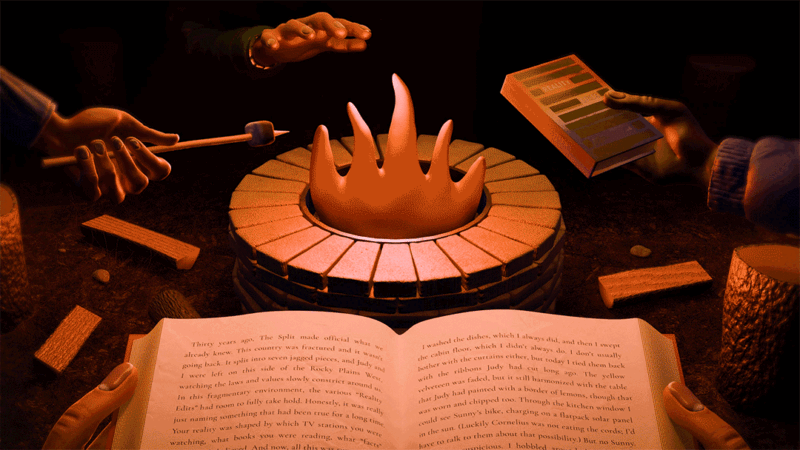
The next couple weeks I couldn’t go anywhere without tripping over baby ducklings. Cornelius stayed on the mended chicken coop, watching dubiously as the four cleared dry brush, mended the pasture fence, or sprawled on the grass, reading about theropods and invasive zebra mussels and the explosion of queer indie rock as traced against the timeline of The Split. At night, when the chill crept in, I would build a fire and they would sit around under a halo of stars, arguing about media, nomenclature, Reality Edits. I suspected they had all been raised in a church faction that enforced manners, for the disagreements were quite polite at first. I whooped in delight the first time I heard Magpie passionately argue Kip down about a minor point of evolutionary theory. (And then they all looked at me, shocked, except for Sunny, who laughed.)
Rosane, the duckling who had been so passionate about learning evolution, grew more standoffish as the days went by. A small-town elementary school teacher, she was a little older than the others. She’d spent the past week camped out on a big rock behind the Book Cabin, where she had started making two piles of books. We were finally moving into drier days, so I didn’t fuss about the books being outside. But I was curious, so I hobbled over to see what her thought process was.
She looked at me with a concerned face, as if she was trying to put something very tactfully. “Did you and Judy do any sorting as you shelved the books?”
I mentally clocked her use of “Judy” rather than “your wife.” One instance meant nothing, but my subconscious had started to alert me to patterns. “Oh, it’s a mess in there, I know.”
Rosane tried again. “I mean, how did you decide what to keep? What books did you decide were real histories, and not biased toward one particular side?”
I tried to stay neutral. “I think most of these books are as accurate as the authors could make them.”
She looked at me like I was a kindergartner she was trying to lead to the right conclusion. “Yes, your science and evolutionary books are great. That’s what I’m so excited about. I want to bring these ideas back to my school. Show my students that evolution and faith don’t have to conflict.”
“That sounds great,” I said warily. “I’ve never had much use for all that myself, but Judy did.” Judy had an expansive faith, one that believed love was all around us, that all beliefs were true and holy as long as they came from love. “I guess I’ve had too many people use their faith to attack me.”
Rosane nodded. “There are unkind people in every Edit, unfortunately. That’s why it’s important that some people do stay in the faith and work from the inside to change it.”
“I thought you all met in an Ex-Tru support group?”
Rosane flushed. “Well … I’m not precisely Ex-Tru—I’m actually part of a subEdit that wants the TruEvangelical Edit to include evolution. You can’t love the whole of earth’s creation if you don’t love the process, right? Every flawed thing still deserves love during its journey to the right path.” She hugged the Neanderthals book she was holding. “But truly, the important thing about faith is community. You have to come together and talk about things. You have to share facts, the good, neutral facts. And that’s what some of the current leaders don’t understand.”
They probably understand more than you know, I thought, but I kept that to myself. “So what are the piles?”
“Oh! Well, these are really good books.” She pointed to a stack of factual zoology books. “And these are ones I suggest you get rid of.” She pointed to the other stack. The title on the top was Megachurch Millionaires: The TruEvangelical Rise Leading to The Split. “Your Book Cabin could be an amazing resource if you just edit it a little bit.”
I tried to keep my voice level. “And I think it’s an amazing resource precisely because it has variety. People should be able to read everything and make up their own minds.”
“And I think it’s an amazing resource precisely because it has variety. People should be able to read everything and make up their own minds.”
“Then how do you keep people from arguing and breaking into a million pieces again? The whole point of the Edits is to support a community. Here’s what we agree on. Here’s what we don’t like.” She patted the zoology books. “I’m a teacher. I love my students. I want to teach them about mammoths and dinosaurs. I still don’t want them to read about bias and hate.”
“I think our perspective of community differs. Restricting someone’s ideas isn’t love.”
She nodded. “Well, there’s no need to argue, Jet. It’s not like you let anyone come up here anyway. Not much harm a bunch of hidden-away paper can do.”
Rosane’s words stayed in the back of my mind, but otherwise the days passed uneventfully. I got used to hearing hammering and happy chatter. At night, around the bonfire, we would compare things we had read in the various pedias associated with different Reality Edits, and argue peaceably about which truths seemed more probable, and who had read any primary sources to back them up. Most Reality Edits had something they were good at, after all. If you wanted to know how a new tech gadget worked, you probably would go to TechnoFactpedia, which legions of Techno Edit followers kept scrupulously up to date. But if you wanted the context about where the precious metals came from to make that gadget, you’d go check the pedia for the Progressive Edit, or better still, one of the Global Edits that dealt with the appropriate area, and get information from the primary source. (Or come to GayFactpedia, of course, if you wanted to learn about any unsung queer pioneers involved in the development of said gadget.)
“Well, obviously the basic premise behind the Edits is flawed,” said Kip, poking at the fire with his marshmallow stick. Sunny had procured marshmallows on a market run and the ducklings took to them with glee. “You can’t just have everyone invent their own set of facts.”
“I don’t know,” said Magpie. “The whole idea behind the Book Cabin is that you can read a variety of sources and decide for yourself. So if you take that in wider context—”
“If you have access to those sources!” said Sunny. “All information about other Edits was blocked in my school. All research was to come through the TruEvangelicalpedia, and anything you wrote better not contradict it.”
“You shouldn’t block anything, ever,” said Magpie.
“Unless it’s the Tru Edit,” joked Kip. He popped the charred marshmallow into his mouth. “Aagh, hot!”
Rosane gave Kip the look of a disappointed teacher. “I understand your feelings, Magpie, but how are you supposed to stop kids from accessing inappropriate material if you don’t block sites?”
“But who decides what’s inappropriate?” Sunny shot back. “The Tru Edit’s pedia says gay people all have rainbow face tattoos and devil-horn implants.”
“My mom told me when I came to the ‘godless city’ someone would immediately seduce me into getting a rainbow tattoo,” Magpie laughed. “Not gonna lie, I was kind of excited.”
I looked at the faces shining in the firelight and for a moment I could’ve been 30 years younger, hearing my friends argue about all the big questions, how we were going to change the world.
“The other Edits were blocked in my school, too,” said Magpie. “But I would hear about them and imagine I could run away to where people followed those instead.”
“You can’t just run away,” argued Sunny. “Then how would we help the other kids?”
“How can you help yourself if you don’t run away?” Kip turned to me. “Why didn’t you run away? Farther away, I mean.”
Sure, it would have been nice to live in one of the Progressive Realities like Cascadia or Manhattachusetts. Among community. But … “Judy and I grew up in this part of the world, and we were stubborn,” I said. “Anyway, you need a place like Sunshine Hills—I mean, you need an oasis in an TruEvangelical country. That’s where you need it the most.”
“Sunshine Hills is an oasis,” said Sunny. “A paradise.”
Rosane’s face was politely dismissive, but the other ducklings turned to me, fervent believers in this Slopbot Utopia, and that wasn’t good either, so I changed the subject by pointing at Magpie’s feet. “Are your shoes covered in mold?”
Magpie groaned. She lifted one foot, showing the terribly printed “hiking shoe” already peeling apart at the seams. “Ugh, I got taken in by a Slopbot.”
“Oh, listen to this one,” said Kip. “At my high school, you could do an extra project in shop class for extra credit? And I was like, I’ll make a shop table, that’ll be manly? Well. I got taken in by a Slopbot video, and I swear to heck it was a Möbius-strip shop table. The shop teacher looked so sad for me.”
“And of course the classes like that were gendered,” said Magpie, rolling her eyes. “So I also was stuck in shop when I wanted to be baking adorable cherry pies.”
“I’ll teach you how to make cherry pie,” said Sunny solemnly. “They might have Möbius strips on top though.” They high-fived Magpie.
“I’m so sorry, I’m still laughing at your shoes,” put in Kip. “But they look like someone printed a picture of a hiking boot on a sock.”
“I know! It’s so annoying!” sighed Magpie. “Especially when you’re always one Flexincome Fail away from getting an infected blister and then dying from it because you can’t afford the Amazeballs Antibiotix.”
“Oh, to heck with that Amazeballs guy,” said Kip. “He’s the worst.”
Magpie lit up. “Oh, you know what’s weird, y’all? I found Cornelius eating a book about him.”
“I figured that was its best purpose,” I said drily. “Cornelius likes a little baloney in his diet.”
“So you are getting rid of books you don’t like,” Rosane said suddenly.
“Well, that one’s just garbage,” said Sunny, adding indignantly, “And Jet told them, and they didn’t listen to her—”
“But you’re saying that people should read everything,” Rosane argued. “Then it turns out you make choices and weed stuff out too.”
“I live here,” I said shortly.
“Well, which is it? I brought a book with me I was still reading. A true history of what life was like for those of us with faith, before The Split. If I put that in the library, would you let other people read it? People like you always say to let people make up their own minds, but then you refuse to consider our point of view. So really, what you’re doing is just the same as the school blocking inappropriate material. Which is what needs to happen for a community to grow.”
“A true history? Or a ‘Tru’ history?” said Magpie, flashing scare quotes.
“A factual history,” Rosane said, temper flaring. “Like the ones I used to teach in elementary school. One that has positive information and protects kids.”
“And I’d give all these books to the schoolkids,” said Magpie. “I bet you if we gave every kid a copy of TruReality: What’s Missing in Your Edit, we’d radicalize them before they even got to middle school.”
Kip whispered loudly, “And I’d give all my old school textbooks to Cornelius. Maaaa!”
Rosane glared, then abruptly stood and stomped off.
Sunny looked reproachfully at Kip. “She’s still working on changing her thinking. You know the support group leader says some people have sticking points that take longer.”
Kip sighed. “I know. But it hits my own sore points. I’ll apologize tomorrow.”
The conversation turned to other things: a book Magpie was reading about invasive plants, how much peanut butter we had left, how much blackberry bramble should be cut back if we still wanted to harvest later in the season.
Later in the season, I thought, as I said goodnight. Sunny and their friends might be here later in the season, to harvest and make jam and jar it. We would need new metal lids. I could make a note in the morning. I’d better watch it, or I’d get used to drifting off to sleep to the sounds of the crackling bonfire, to earnest arguments, to thoughts about jam. I imagined Judy turning in early with me, chuckling about whatever Sunny and their friends had gotten up to that day. Somehow, this reverie lacked the fierce ache I’d become used to. “Just listen to that kiddo,” I could hear her saying. “Aren’t you proud of them?”
I fell asleep to the sounds and smells of one fire and I woke to a different one entirely. I shoved my shoes on and stumbled out the door in what should have been predawn light.
The fire was not in the pit. It was in the Book Cabin.
The fire was not in the pit. It was in the Book Cabin.
The cabin was burning. The cabin full of all the books that Judy and I had collected, one by one. This haven for facts, built to withstand everything that the Edits tried to gaslight us about, tried to bury. Up in smoke.
I shouted Fire, and Sunny stumbled out of their cabin, eyes agape in horror. They grabbed two extinguishers from the neatly mended shed, and they and Magpie started spraying. I passed out masks and bandanas. Had Kip help me clear any remaining brush around the perimeter so the fire wouldn’t spread past the protective ring of stones. Thanked fortune that the rain had stayed so late this year, so we could save the rest of our home.
I already knew the cabin was gone.
It had been on borrowed time anyway. Judy had planned, once, to install sprinklers, and she didn’t have time, and then I didn’t make time. The fire burned on all that splendid, crackling paper for a long time, and I sat on a distant log and watched the pyre.
Rosane had run off in the night, of course. Perhaps she had destroyed the whole cabin intentionally, but even in my grief I could guess a simpler story. She’d set fire to that pile of books she had made around back of the cabin, those dangerous books, that proof of a Reality Edit that contradicted her own. Wind and sparks had done the rest, and she had panicked and run.
The other ducklings apologized, a cascade of sorrys to the air around me; they hadn’t known, they would never have. I stared and watched one of my last connections with Judy burn, and Kip and Magpie packed up and left.
I think it was late afternoon before I stood up. I don’t know. I was covered in grime, eyes stinging, throat thick with smoke. I stumbled past the goat pasture to the nearest stream, stripped off my filthy mask and clothes, scoured my skin with the icy water. Shivering, I went inside my cabin, pulled on something warm, and passed out.
When I woke the next day it was late. A gentle rain had come, clearing the air. I limped outside to see Sunny sitting on the stump by their bike. They were packed, and Cornelius was gnawing on a backpack strap.
She’d set fire to that pile of books she had made around back of the cabin, those dangerous books, that proof of a Reality Edit that contradicted her own.
They stood hurriedly as I came out. “I’m so sorry,” they said. It tumbled out of their mouth several times. “I couldn’t—I never—I ruined everything.” They scrubbed their face. “Goodbye.”
They held out a hand. I ignored it until it finally dropped again.
“Don’t tell me you’re running off just when the work gets hard.”
They looked at me uncomprehendingly.
“We’ve got a lot to do. To get ready to open Sunshine Hills for real,” I said, a touch impatiently. “Don’t tell me you want to go back to watching MurderSlop.”
They still looked wary.
I tried one more time. It’s hard to say what you really mean. Judy always said I stunk at it. But somehow she loved me anyway, despite all the mistakes I made, despite all the times I had to get up and start again and try to do better. “Books are just books,” I said. “We can work to replace them.” Rosane was right about this: A bunch of hidden-away paper wasn’t any good at all. “Community is the real Reality Edit. Community and …” I trailed off, because Sunny was starting to look at me with that sunshiny optimistic face again, and I really couldn’t handle it. “Family?” I managed.
They dropped their things on the ground and squeezed me in a giant hug that my back and hip were really going to regret later, but I wasn’t going to say a word about it now, not one single word.
“Family,” they said.