When I first started editing Wikipedia in 2012, a couple of years into my doctoral program in communication, it was with reluctance. I attended an event at Pitzer College in Southern California aimed at improving the representation of women online—Wikipedia’s gender gap is well-documented—but found the volunteerism off-putting. I’d worked as a journalist before going into academia, and for my doctoral research, I was using feminist theory to explain the devaluation of writing work online. It troubled me that writers, who worked so hard, earned so little. Why should women writers, already underrepresented and underpaid, have to solve a problem we didn’t create?
The academic who led the event, the late Adrianne Wadewitz, described volunteer research and writing as public service. Her contributions to the encyclopedia reached far beyond the audiences of peer-reviewed journals, she said, and her work was often improved upon by others. I remember peering at her articles, not completely understanding what she meant.
Over time, as I began to contribute myself—including work on articles such as Ashley’s sack, Elizabeth Fulhame, and freelancer—I better grasped what Wadewitz meant, and began to widen my own feminist critique to the stakes and politics of this volunteer intellectual work. Wikipedia reached millions of readers, yes, but something else was happening, too. My fellow editors and I revised articles, added new sources, reverted changes, and occasionally our disagreements became “edit wars.” Sometimes this was contentious, sometimes it was generative. But the conventional notion of a singular, responsible author began to break down as I focused on the work of maintenance and repair in the production of knowledge. Meanwhile, the experience of editing was gratifying, consuming, and emotionally taxing—what researchers Amanda Menking and Ingrid Erickson call the “heart work” of Wikipedia. Unlike the paid writing work I was studying, Wikipedia editing was a weird process of tending to a shared public resource.
The conventional notion of a singular, responsible author began to break down as I focused on the work of maintenance and repair in the production of knowledge.
And Wikipedia is weird—as in, unusual. It’s a massive and influential user-governed platform within a largely commercial internet ecosystem. As an editor, I take pride in the fact that the online community behind the encyclopedia has become, as writer Richard Cooke dubbed it, “the last best place on the internet.” While anyone can edit, there is a learning curve. It took me a while to learn the three core content guidelines: Everything must be verifiable, original research is not allowed, and the point of view should always be neutral. Fringe theories shouldn’t be given undue weight, and conflict-of-interest editing isn’t allowed. As a tertiary source, Wikipedia is not in the business of determining truth; instead, editors debate source reliability. There’s a joke that if Wikipedia had existed before the Copernican revolution, the article on “the universe” would have started with Earth at the center, because that was what reliable sources of the period said.
Wikipedia has limitations. For one, verifiability doesn’t prevent falsehoods from slipping in. An uncited claim originating on Wikipedia can become verifiable through circular reporting, a phenomenon that troubles Wikipedia editors and even has its own entry. Additionally, the interests of the volunteer editorial corps have shaped what’s included in the English version’s seven million articles: There are an inordinate number of entries about transportation systems and military history, but far fewer about women scientists or childbirth. (In response, activist efforts such as Art+Feminism and WikiProject Medicine have made a dent in these asymmetries.)
Over the years, my own feminist criticisms of Wikipedia’s structure and culture have expanded from economic inequity to research on invisible labor, infrastructural authority, and the conditions under which knowledge is created, debated, and maintained. I appreciate Wikipedia’s transparency and version control—every edit is saved—but I’m increasingly concerned about what happens when Wikipedia’s content leaves the platform, which happens every second. The encyclopedia’s articles are freely available for reuse under a Creative Commons license, Wikipedia supplies machine-readable structured data to knowledge bases such as Google’s Knowledge Graph, and Wikimedia Enterprise licenses data from Wikipedia and its sister sites to technology companies to train AI large language models and voice assistants.
As a tertiary source, Wikipedia is not in the business of determining truth; instead, editors debate source reliability.
This makes Wikipedia’s inherent contingencies appear factual, especially when they are removed from the encyclopedia’s context of open, ongoing, collaborative revision, updating, and adjustment. They are becoming what the French sociologist Émile Durkheim termed a social fact: something made by people but experienced as external to them, with the power to shape their lives. I think of Lawrence Lessig’s contention that “code is law” in his influential 1999 book, Code and Other Laws of Cyberspace. Wikipedia’s position in the internet ecosystem allows a technological legerdemain whereby information flows ever outward, stripped of the social and technical relations through which it was created and maintained.
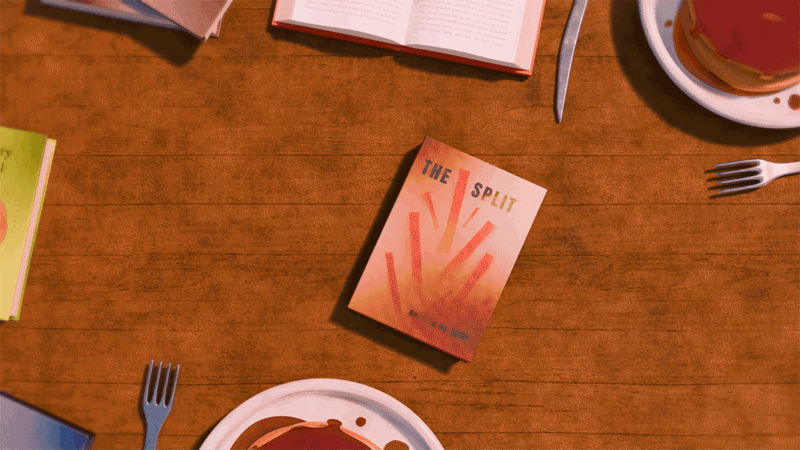
So when I read Tina Connolly’s “Sunshine Hills Reality Edit,” I felt unsettled. The story is set in a future where the United States has fractured into several independent territories. People in each territory make sense of their lives according to “Reality Edits” produced through media, books, social networks, and countless community-edited, forked branches of “Factpedia.” These Reality Edits transmute beliefs, biases, obsessions, and blind spots into something resembling social truth. Jet, the queer, widowed protagonist, valiantly attempts to counter the post-fracture spread of exaggerations, puffery, conspiracy theories, and outright lies by working as a FactSearcher at her off-the-grid homestead in the Rocky Plains West territory, where she’s assembled a private library of print sources.
It’s not hard to see Connolly’s future as an allegory for the United States in 2026: a country on the brink of crisis and beset by inequality, a broken health care system, economic precarity, xenophobia, and a polarized media ecosystem. And the endlessly subdivided and forked “Factpedia” is clearly a cracked-mirror version of Wikipedia—a vision of the encyclopedia fractured along with the country, its users and editors turned away from the project of shared knowledge and toward self-perpetuating informational bubbles.
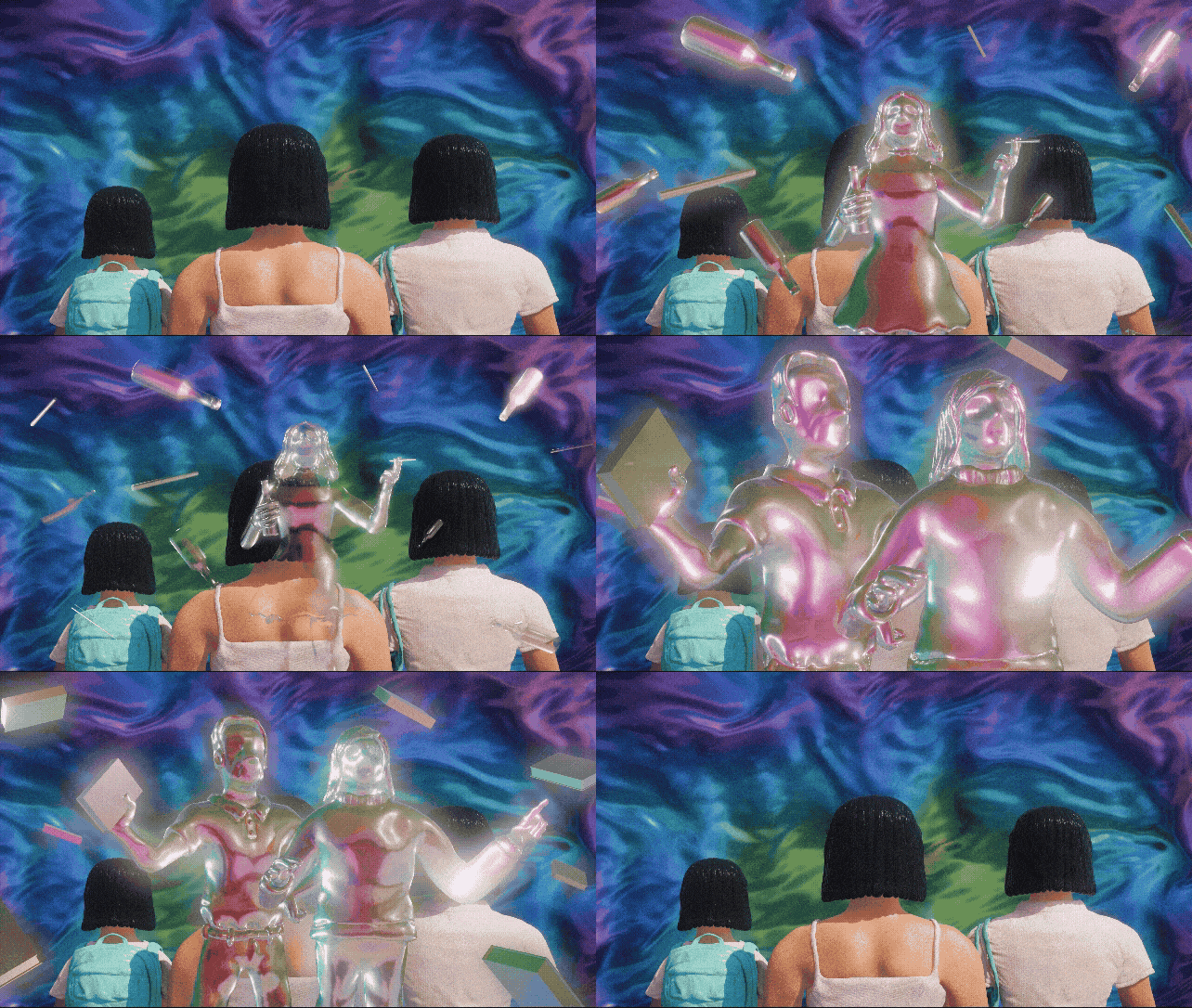
Jet’s last straw comes after she’s painstakingly combed through Fortunately Amazeballs, the ghostwritten autobiography of a tech trillionaire, to verify and correct each fact, only to learn that her corrections have been entirely ignored. The trillionaire’s lies are backed up by information on TechnoFactpedia (where contributors pay $100,000 per year for editing access), and Jet’s editor warns that including her corrections would have exposed the publisher to legal trouble. “His Reality Edit had trumped mine,” Jet reflects in dismay as she throws the book to her goat to chew on.
Soon after, Jet finds herself hosting young exiles fleeing the TruEvangelical Edit that dominates Rocky Plains West. The irrepressible and curious Sunny arrives first, following the guidance of an AI-powered “Slopbot” that erroneously describes Jet’s isolated compound as “Sunshine Hills,” a lively queer community; four others follow. What makes Jet’s home unusual, her physical library, becomes a centerpiece of their experience. The young refugees glory in discovering books about camels and evolution; they discuss the provenance and reliability of facts, their conversations echoing the debates of today’s Wikipedia editors.
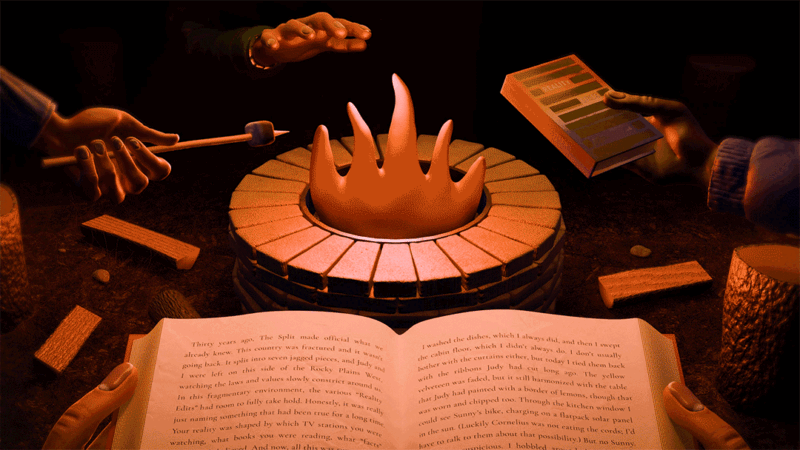
But tension rises when Rosane, one of the young people living at Sunshine Hills, becomes increasingly distressed after realizing that the largely secular print literature Jet has compiled doesn’t seem to acknowledge the stories she’d been told about her community before The Split; she understands her history as a story of religious persecution. While Rosane’s peers have vociferously rejected their own TruEvangelical upbringings, she hopes to reform the community from within, so there’s little room for her to work through her conflicted feelings without judgment. Her distress ultimately takes a destructive turn when she sets fire to a stack of Jet’s books that she finds objectionable.
Wikipedia domains have been losing page views as search engines point users toward AI-generated summaries.
As I read the story, I found myself clenching my teeth. Science fiction so often gives us a way to make sense of the present, and it can throw into relief shifting norms we might otherwise overlook. Since 2022, Wikipedia domains have been losing page views as search engines point users toward AI-generated summaries—these pat answers can discourage clicking on the links to websites and thus sever information from its sources. This change in online architecture is not entirely new, but rather an acceleration of the longer process of unbundling and decontextualization that began with the transition from analog to digital. What’s significant about our latest iteration of decontextualization is that the modicum of provenance readers gained with search engine results—hyperlinks to websites; citations and editorial discussions within Wikipedia—is obscured by design. This erosion is not unlike the fire that Rosane builds in Connolly’s story; it starts small but can quickly get out of hand.
Rosane’s decision to burn some of Jet’s books is destructive and tragic; book burning has long been associated with acts of censorship, anti-intellectualism, and authoritarian violence. In the story, however, Connolly avoids casting Rosane as a villain. Rather, we see that her actions are driven by her painful internal conflicts about how to provide access to knowledge while also protecting her community’s interests and values. She’s concerned about feelings, and perceives knowledge as freighted with danger, particularly for young people. The fire she lights can thus point to the inherently inflammatory potential of information as well as the damage that is already underway to our knowledge ecosystem. While generative AI companies are also destroying books after they ingest the sentences, it’s not merely the erasure of the paper that’s worrisome (in many cases, as University of Washington professor Melanie Walsh explains, these books were already out of print and circulation and may gain more visibility through generative AI), but the sycophantic pseudo-authority of generative AI that makes the integrity of responses difficult to discern. Current AI-powered interfaces for chat and search also discourage digging deeper.
What’s unique about Wikipedia—its messy, collaborative, unpretentious processes—can be erased when information hardens into durable social fact, and the laborious relations that made the information possible disappear from view.
This brings me back to the feminist critiques I had when I first began to edit. What’s unique about Wikipedia—its messy, collaborative, unpretentious processes—can be erased when information hardens into durable social fact and the laborious relations that made the information possible disappear from view. It only takes 12 minutes for content newly published to Wikipedia to end up in generative AI responses. Twelve minutes! Not nearly enough time for editors to vet newly added facts to ensure verifiability based on reliable sources. Meanwhile, large language models now power a range of services and online software for millions of people around the world, and in the process, the things I appreciate about Wikipedia—its transparency, its iterative contingencies—are marginalized. It’s easier than ever to tweak or manipulate the public’s access to information. In an information ecosystem like this, Connolly’s trillionaire memoirist would have no problem bulldozing over history to elevate his preferred version of reality. But Connolly doesn’t leave us there, bereft of hope. The one thing that reassures me—what I think is the gift of the piece—is Jet’s transformation. When the story opens, she’s grieving the loss of her wife, Judy, and has closed herself off to relationships. But she softens as her isolated homestead becomes a community. She begins to care for Sunny, and she chooses to persist in nurturing relationships even when things get hard.
That matters because relations are the heart of information and knowledge-making. It’s to our detriment when we treat knowledge as “content” to be passed along in a vessel, innocently transmitted through technology, rather than understood as the outcome of rich and complicated relations among people, sources, tools, institutions, methods, and histories. Wikipedia, at its best, makes these relations visible. But as Connolly reminds us, the durability of what we take to be reality is also the outcome of relations. We’d be wise to do as Jet does: Choose to persist in nurturing the messy relationships even—especially—when things get hard.