“We need to keep this hush-hush,” the nervous little corporate man says as he leads me through the hallways of the Vitalidad Biotech facility. “If the media gets wind of what was stolen, it will be a disaster.”
“What was stolen?” I ask, for the third time.
He says nothing, just enters a long string of numbers into a keypad, lets a laser scan his iris, and pushes open a door.
I let out a long, low whistle. “Really cleaned you out.”
It’s sarcasm, and my guide doesn’t appear to appreciate it. The room is slightly larger than a broom closet, with nothing in it except a bulky last-century computer and a ladderback chair.
A tall woman in a pencil skirt arrives and I offer her my full attention, hoping she’ll be more forthcoming than her underling.
“Detective Carmina Marquéz-Johnson,” I introduce myself.
“Dr. Rosalía Ortiz. I’m the CEO of Vitalidad.” She gives me an appraising look. “You worked for the CNI?”
Mexico’s national intelligence agency. “Early in my career, yes. Then the FBI north of the border.”
“Who fired you for using … unorthodox methods.”
To my credit, I don’t wince the way I once would have. “It was a little more complicated than that. My private practice has been on the up-and-up.”
“On the contrary, that’s why we hired you. Use whatever means you need to track the thief. We do not want any law enforcement or media involved.”
“It’s a substantial bounty you’re offering.”
“And we’ll double it if you can bring the perpetrator back to us alive. We just want to recover what was stolen.”
“Which was what?”
She takes a step into the room, the click of her heels like punctuation marks on the hard floor.
“Everything was stored on this computer. Research notes, genome sequencing, clinical trial results, everything.”
Her Spanish is Cuban-accented, the words fast as a train I can barely grab onto.
“No backup?”
“We have backup files. But the originals were stored here, in this offline computer. A security measure we thought would prevent hacking. Yet somehow, the perpetrator infiltrated Vitalidad.” She pulls out a tablet she’s had tucked under her arm and shows me a picture of a man. Instantly my glasses scan his face to start pulling up details. “He was hired six months ago,” she continues. “Passed every clearance check, never gave us any reason to be suspicious until last night.”
“Six months, huh? Not many people would apply for a new job two months after receiving a terminal diagnosis.” At her shocked look, I pluck a file from my vision and place it onto her tablet; warnings flash red until she approves the transfer and squints at the profile I shared. “You should add hospital records to your clearance interviews. Low chance this guy is really your perpetrator. He probably donated his identity to one of the revolutionary groups, handed over his face and credentials so he could live out his final days on a beach in Belize.”
“His face?”
“So to speak.” I wave my hand in a circle around my own face. “Biometrics are a lot easier to hack than anyone wants to admit. Fingerprint stickers, special contacts, facial prosthetics.” I tap my cheekbone; I’ve got my own prosthetics on—it’s a safety measure. No one but my family ever sees my true face.
“The data was heavily encrypted,” Dr. Ortiz says. “We believe he downloaded all of the records onto an external hard drive. It won’t be as easy to transfer as that little byte you just gave me.” She tucks the tablet under her arm again and approaches the computer, gives the space bar a sharp tap. “He left this message.”
I lean toward the screen to avoid the glare from the overhead fluorescents.
A pox on both your houses
I stand upright so fast my head swims.
“It’s Mercutio.”
“Excuse me?”
My pulse races. He’s the very reason I’m not with the FBI anymore. I thought I’d left him behind me. I heard he’d been executed by rival revolutionaries after the incident in Venice Beach. But that message tells me there’s only one person who could have done this.
Dr. Ortiz grins like a calavera. “So you know where to find him, then?”
I don’t. But I’ve tracked Mercutio before, and I can track him again. Instead of answering, I tap my left forearm, lighting up my gauntlet keyboard. I request data from all border crossings between Tijuana and Texas and set an alert on all his known aliases, including this new one he’d used at Vitalidad. Within seconds, I’ve got a list of all border crossers who have been flagged in the last 12 hours, including one “Facial Recognition Fail” at the Los Algodones/Yuma station about an hour ago.
When I’m done, I ask my own question: “It’s a plague, then?” The two Vitalidad executives stare at me with confusion, so I clarify: “What he stole. ‘A pox on both your houses.’ These are blueprints for a genetically engineered virus, something that could wipe out humanity?”
They exchange a glance before the man clears his throat and answers, “Quite the opposite, in fact.”
“It’s a plague, then?”
A panacea. That’s, in essence, what Vitalidad says Mercutio has stolen. A series of genetic treatments that slow aging, prevent or reverse mutations, and make the human immune system a fortress. It’s beyond any miracle drug or groundbreaking procedure that’s been touted before.
“Surely it can’t cure everything.”
Dr. Ortiz gives me a glimpse into their research to allay my skepticism, showing me case files of trial patients, including a man who started treatment at age 90 and just turned 110. They’ve been developing this remedy for decades, and the evidence is clear: It works.
“The procedure is complex,” she explains. “It’s important that we maintain complete control to prevent dangerous, low-quality imitations.”
If the data leaks, Dr. Ortiz insists, Vitalidad will be out decades of research expenditures with no way to recoup. The more she talks about what they stand to lose, the more obvious it becomes that they intend to offer this treatment exclusively to the ultrawealthy.
“It’s important that we maintain complete control to prevent dangerous, low-quality imitations.”
I’m still digesting the idea that this cure-all is even possible as I wind through the streets of Tijuana on my way to the train station. I pass a dozen biotech clinics, their English signs advertising the stem cell therapy, dentistry, and cosmetic surgery that have fueled medical tourism for a century. Vitalidad is worried Mercutio will sell the data, but if any of these rival companies were his customer, he wouldn’t have made a run for the border. The only question is whether he went west into the international waters of the Pacific, or north into the deserts of the United States.
While I wait for enough of a break in traffic to scurry across a busy street, a call buzzes in my ear and my sister’s photo pops up on my smartglasses. A pang of sadness fuels my hesitation to answer. Just last week, Sofia announced to the whole family that she’d been diagnosed with a late-stage cancer. It had been growing for several years, apparently, but she’d chalked the symptoms up to the stresses of being a 45-year-old woman with a full-time job and full-time kids. Mamá’s grief had manifested as anger—she told Sofia that she’d poisoned herself by handling all those drugs in her career as a pharmacist. Now they’re not talking.
I wonder if the blueprints Mercutio stole could reverse what’s killing Sofia, or if she’s already too far along for even this miracle cure. Our family could never afford the price tag they want to put on this treatment, but maybe I could ask Vitalidad for a favor at the end of this case—having saved their company and the world as we know it and all.
I mull over all of this for so long that the call goes to voicemail and I have to snap out of it and call Sofia back. I start walking again as it rings, weaving between cars while electric bikes zip around me.
“I’m on a job,” I tell her in English.
“You’re always on a job, Carmina.”
False. This is actually my first case in several months.
I expect Sofia to offer the latest update from her doctors, but instead she says, “I’ve been thinking about the space stations.”
That catches me off guard. “Why?”
“I’d like to visit them.”
She’s never mentioned this desire to me before. The closest spaceport is in southern New Mexico. Commercial spaceflights happen only once per month and they’re booked years in advance.
“Which part? The zero-gravity nightclubs or the low-orbit asteroid mining?”
“All of it,” she says with uncharacteristic wistfulness. “Don’t you think it would be amazing to look out the window and see the Earth so far away? To swim through the air without the weight of the world dragging you down?”
I’ve never entertained any such thought. Most of what I know about the space stations has to do with the shady dealings that go on in these unregulated orbital environments, the white-collar criminals who fly up there to circumvent the laws of their countries down on the surface. Maybe it’s the pain relievers talking, or maybe she’d always harbored a secret philosophical side. Either way, there’s no point in trampling her fantasy.
“The cylindrical microgravity gardens seem pretty neat,” I concede.
I’m almost to the train station, so I reluctantly say I’ve got to let her go. I have records to request and footage to review and encrypted revolutionary servers to stalk. The clock is already ticking and the trains are speeding fast as bullets. I tell my sister I love her and hope she feels better, and then I get to it.
I tell my sister I love her and hope she feels better, and then I get to it.
I wait for my informant on the border at Los Algodones, which these days is a stripe of paint across the middle of a bustling train station. I’ve got on an albedo duster, the white fabric and thermo-threads reflecting the desert heat, and a broad-brimmed hat shading my face from the sun. Even still, I’m sweating behind my ears and eying that nearby agua fresca stand. At least San Diego has a coastal breeze; in these border towns, the sun gives no quarter. I lean against the wall of a heladería, placing one foot squarely on either side of the painted line, watching the faces as people flow across like nutrients through a cell membrane.
When I was a kid, visiting Papá’s family in Mexico, the border was long lines of cars waiting in the brutal heat, concrete walls and spirals of barbed wire, hard-eyed agents telling us to step out of the vehicle and stand against the wall while a drug dog sniffed our car and they interrogated my white mother about why she had two brown children. And that’s to say nothing of the detention centers and manhunts beyond the official checkpoints, where so much blood was spilled on desert sand.
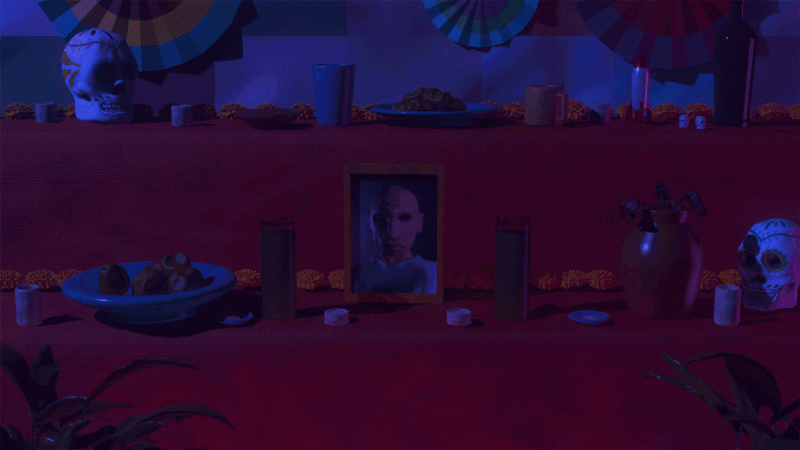
Now, the walls and fences have been replaced by two train tracks that run all the way from Baja to Texas, and the trains come once an hour. It was a radical change, and then a gradual one, as the border reshaped itself into a place of meeting instead of a place of division. There’s an ofrenda across the walkway from me, dedicated to the people killed by Border Patrol, who never had the chance to become ancestors. Permanent stalls throughout the station sell tepary beans and cholla buds, nopales and machaca, while temporary vendors toss out their blankets or unfold their tables, offering handmade tin art, jewelry, and ponchos. People fan themselves while they wait in line outside a dentist’s office, suffering the heat for half-price root canals and fillings that cost pesos instead of dollars.
I’ve spent my whole life living in two different worlds at once. I’m Chicana—Indigenous and Spanish, carrying the blood of both conquered and conquistador. I’m a Marquéz who makes tamales from scratch every winter, and I’m a Johnson who gets a stomachache from the chiltepín peppers I insist on eating. I was a federal agent in a culture that still equates every type of law enforcement with la migra, even though ICE was dissolved long ago and immigration policy thoroughly renegotiated. Even with the FBI, I was always finding ways to skirt the law, never entirely trusting the system I was supposed to uphold. The way this border exists now makes it so much easier for someone like me to move through the world.
Of course, it also means a counterrevolutionary who steals blueprints from biotech companies can waltz across with nothing more than a digital flag when the AI systems that monitor the crossings fail to recognize the face he decided to put on that day.
“Well, if it isn’t Carmen Sandiego.”
It was a radical change, and then a gradual one, as the border reshaped itself into a place of meeting instead of a place of division.
I narrow my eyes at a familiar face—not the one I was waiting for. The man tips his hat at me. Being named Carmina, hailing from San Diego, and working as a detective combine to make this an easy nickname that numerous men seem to think is clever.
“What do you want, Elton?”
He stands on the US side of the border, hands stuffed into trouser pockets, head protruding so far forward I almost feel sorry for his strained neck muscles. He shrugs shoulders nearly up to his ears.
“Can’t I say hello to an old coworker?”
“I’m waiting on someone.”
“Mercutio?”
I push myself off the wall, ready to punch him in the eye the way I did that time in Tucson when he got too drunk. Elton takes a step back, pulls his hands out of his pockets, raises them in surrender.
“He’s in Las Cruces,” he says. “Laying low, only been seen with some fringe groups, no one important.”
I pause my attack. “Why are you tracking him?”
“I’m not. Merely keeping an eye on persons of interest. I hear he’s been in Tijuana.”
“What else you hear?” If other investigators are already involved, then Vitalidad has no hope of keeping the heist under wraps.
“Same old. Hacking banks, plotting to destabilize world government.”
Mercutio’s schemes were never so prosaic, and I can’t tell if Elton is being condescending.
“I’m tracking someone else,” I lie, “but if you hear anything more about Mercutio, let me know, yeah?”
“Likewise.”
Elton tips his hat to me again and I roll my eyes. He wanders off through the station just as my actual informant shows up, looking nervous as all hell.
I set physical and digital tails on everyone Mercutio’s been in contact with and then jump on the eastbound train. As much as I’d hoped Elton’s tip would be a red herring, my informant confirms it. Mercutio was last seen exiting a train at Las Cruces, New Mexico, about 40 miles north of the border. I check in with a friend who works for the train company, and she reports a ticket under one of his known aliases. I also get a reasonably credible tip-off that he was hired by a newish biotech startup in Denver that’s helmed by two men who were arrested a few years back for financial fraud.
The border train from Yuma to Juárez takes only a few hours, and once there I’ll catch another north to Las Cruces. I’m sorting through surveillance records when I realize I’ve missed a call from my sister. I play the voicemail.
“Mamá took me to visit the sea lions today. They smell terrible. I love them so much.”
I smile and then check to see why the message cut off so abruptly, but that’s all that recorded.
I call her back, but this time her voicemail answers. I try Mamá instead. Sofia’s message must mean the two of them are on speaking terms again.
“It’s not good,” Mamá whispers. She describes the treatments Sofia’s undergoing, and how they’ve made her even sicker. “Doctors give up too easily these days. Her estimate has dropped from a few years to a few months.”
The tension in my shoulders thickens as I listen. They’re in San Diego and I’m hyperaware of how rapidly the train is taking me in the opposite direction. Once I hang up, I think about the last time the whole family went to La Jolla Cove, when Sofia’s kids were young, and how upset she got when a massive sea lion ran them off their towel and lounged on it, rolling its rubbery body all over her lunch pack.
“Didn’t love them so much then,” I mutter wistfully.
I give myself another moment to experience the stress and sadness before I intentionally tuck my feelings away. I have a job to do. Dr. Ortiz from Vitalidad has been haranguing me for updates, reminding me how this case could have damaging consequences for the entire health care industry. If Mercutio stays three steps ahead of me, all I’ll be able to tell her is which rival company he sold the data to.
The city of Las Cruces sprawls through the desert at the southern edge of New Mexico, a thin trickle of the Rio Grande like an IV drip on one side, the jagged teeth of the Organ Mountains biting up at the sky on the other. Billboards advertise commercial flights up to the international space stations from the spaceport 60 miles north of town, and murals on downtown walls tell the history of battles fought over this dusty land.
Billboards advertise commercial flights up to the international space stations from the spaceport 60 miles north of town, and murals on downtown walls tell the history of battles fought over this dusty land.
I can’t spot Mercutio at any of the expected haunts, but Elton (damn him) tips me off that he’s put in for a visitor’s pass at a local hospital on the north edge of town. Finally meeting his customer, presumably. I rush over there, hoping I can intercept him before he manages to offload his stolen data; otherwise, I’m left the fool yet again.
The hospital could pass for a swanky hotel on the outside—Pueblo Revival style with sandstone and vigas—but inside, it’s Stress City. Nurses and orderlies shout at each other down the halls, cots clutter the hallways, people step around hazmat situations that belong in a horror movie. I’d pictured Sofia getting her treatments in cushioned chairs, tended by soft-spoken nurses, but now I’m concerned she’s being subjected to the San Diego version of this chaos.
I get the information I need from a harried receptionist—Mercutio hasn’t arrived yet. Good, then I’m still undercover. I fold my duster in the way that transforms it into a bulky purse, make sure the gauntlet on my forearm is covered by my thin shirtsleeve, and adjust my facial prosthetics to a new position, emphasizing the “old lady” look that I’m genuinely on vector toward anyway.
The front doors whoosh open, letting in a rush of hot air, and even though I’ve never seen his true face before, I know it’s Mercutio by the way he moves. My glasses scan his features and the red-flagged profile confirms my intuition.
“Gotcha,” I mutter, although I haven’t got him quite yet.
Without his disguises, he looks so young, with a mess of black curls, hooded brown eyes, and a narrow build. It pisses me off to realize that 10 years ago when I was tracking him, he was no more than a teenager. He clutches a battered briefcase so tightly it whitens his knuckles.
He starts down the crowded hallway and I barrel toward him. There’s enough chaos that I could apprehend him right here and hardly anyone would notice. But there’s also enough chaos that I can’t quite catch up before he ducks through a doorway.
I wait a few seconds, then peek through the narrow window. Inside a patient room that miraculously only has one bed, he sets the briefcase on a chair and then proceeds to clutch the hand of an unconscious young man and cry.
Nothing’s stopping me from barging in, except it feels … wrong. Too soon, I could be crying at Sofia’s bedside just the same, and the thought of someone bursting in on that—well, it turns out that’s something I don’t wish on my literal worst enemy. So I watch through the sliver of window until he cleans himself up, reclaims the briefcase, and leaves.
I duck into the room and check if he’s left anything slipped into the tissue box, taped to the rails of the hospital bed, tucked into a pillowcase. I even open the clasped hand of the coma patient, then feel like shit when my suspicions turn up nothing.
I rush back to the lobby, cursing my momentary lapse into empathy.
“Curly-haired guy with a briefcase. Which way did he go?” I demand of the receptionist. She nods toward the front doors. I slide my card across the desk. “Cold, hard cash for each name if you call me when anyone else visits that room.”
In the parking lot, I watch Mercutio shut the door of a rideshare, and I lament the days when my FBI creds would let me bring a self-driving vehicle to a dead stop. I follow in my rental car, almost losing him in traffic several times. But I realize where he’s going even before his car makes the final turn: the train station.
I glimpse Mercutio stepping onto the northbound train, so I board the next car. I pass through the gangway and then intentionally trip over my own feet and sprawl out in the aisle right beside him.
“Oof, tía, you okay?” he says.
This strategy has worked for me a dozen times before: Make them think I’m weak, like a killdeer faking a broken wing. I groan with a pain that’s only half-pretend and splay my palm on top of his briefcase to push myself up, making sure the paper-thin bug I was holding gets nestled into the outer fabric real good.
He offers a hand. I grab it to pull myself to my feet, coming nose-to-nose with him for the first time. Even without my facial prosthetics, he wouldn’t know me. I’ve never been this close to him before. It’s exhilarating. The last time we crossed paths, he fled the Venice Beach apartment he’d been squatting at moments before I arrived, and I took a shot at him down a busy street that cost me my badge. The time before that, I’d tracked him purely through surveillance footage and forensic evidence as he navigated between two rival ecoterrorist groups. And the first time I encountered Mercutio, well … let’s just say I thought back then that I was up against a very different type of criminal.
The train’s already moving. I’ll have to apprehend him at the next stop, where we can switch tracks and start the journey back to Tijuana. It’s open seating and the car’s barely half full. I choose a seat a few rows away where I can watch the back of his head. The couple behind me is talking excitedly about watching the liftoff at the spaceport—it’s still rare and novel enough to be a spectacle.
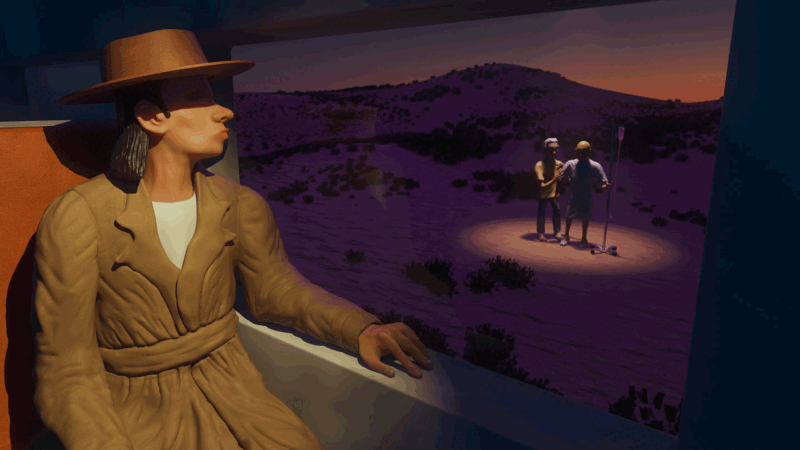
As the train rolls away from Las Cruces, I settle in and check the bug. It’s active, a comforting red blip sliding steadily along the tracks. I think about checking on Sofia, but just moments after the train starts moving, Mercutio’s on his feet. I dip my head and pull my hat low as he passes. My eyes follow the legs of ratty jeans as he brushes past me, a nail-bitten hand clutching the scuffed briefcase. I flip open a compact mirror to watch where he’s going. He passes the luggage racks near the end of the car and enters the small bathroom.
He’s in there long enough that I nearly let my guard down. While I’m waiting, I get a text message from Mamá that’s only one word: hospice. I stare at that word for far too long, letting my imagination fill in the gaps. It’s only been a few weeks since Sofia received her diagnosis. We knew the cancer was late-stage, but how are they already moving to end-of-life care? I blink tears away, and the rapid eye movements cause all kinds of glitches in my smartglasses. From the train window, I can see the buildings around the spaceport in the distance. I think about how Sofia said she wanted to visit the space stations, and suddenly I can’t believe that I’m here without her.
While I’m waiting, I get a text message from Mamá that’s only one word: hospice.
An older man in a pinstripe suit nearly trips over the leg I’ve let casually slide out into the aisle. I apologize profusely. He says not to worry and it’s only when he switches a familiar battered suitcase to his other hand that I realize. I swing my head back toward the train bathroom just in time to see a frantic mother and her young child entering.
I curse under my breath. He’s changed faces again.
I scramble to my feet, lurching against the opposing momentum of the slowing train as I scan for the pinstripe suit. Instead of going back to his seat, he’s already passed through the gangway to an adjacent car. The screens above the door announce that we’re approaching our first stop: the spaceport. Through the small window I see him position himself close to the exit, still turned away so I can’t get an ID on his new face, while others hoist their luggage off the racks.
A pox on both your houses. I stop short, grabbing onto an overhead rail as I understand the mistake Vitalidad made in their assumptions, which I’ve taken for granted. I should have known—one of the previous times I tracked him, he was playing two ecoterrorist groups against each other. He’s doing the same now, taking money from one company to steal from another, but he never planned to deliver Vitalidad’s miracle cure to the Denver startup.
I lift my forearm gauntlet and type out a request for the entire passenger list for the next commercial flight out of the New Mexico Spaceport.
That’s why he’s stuck so close to the border. That’s why he lingered for so long in Las Cruces, visiting old friends like he’d decided to hitchhike into town. Because he has another border to cross—and if he makes it to the other side of the atmosphere, I won’t be able to touch him. None of us will.
He’s not trying to sell the data he stole to the highest bidder. He’s trying to release it open source. Things like this have certainly happened before. Whistleblowers who, before announcing what they know, seek asylum in the international waters—so to speak—of the space stations.
I mull over the implications while I navigate into his train car. Dr. Ortiz had warned me that in the wrong hands this data could lead to the collapse of hospitals and private practices, coupled with hyperinflation of insurance premiums so that even the most basic services become inaccessible. The economic impact alone could be enough to destabilize, well, nearly everything.
Then again, I’ve watched the world change and adapt to destabilizing technologies my whole life. The world wouldn’t be free from all disease overnight. It would take time. The DIY biohackers would jump on the tech first and surely hurt people, leading to government regulations and media fearmongering. Even if every doctor and med-school dropout could perform Vitalidad’s procedure, there would still be variation in the execution of the treatment, religious opposition to tinkering with “God’s plan,” and people still too poor to afford it, even if the price was driven down by wide availability.
Then again, I’ve watched the world change and adapt to destabilizing technologies my whole life.
Still … a lot of people would have longer, healthier lives. Would it really be so bad if this type of cure were as prevalent as the stem cell therapy and dentist offices that pepper the border towns?
I keep one eye on the back of Mercutio’s head and the other eye on the spaceflight passenger list, searching for a potential match. I’ll disrupt the entire launch if I have to, but that’s a last resort. Then the train comes to a stop, and I have to devote my full attention to his movements.
The doors open with a blast of searing air. I’m not prepared for the surge of people entering the train, though, and I get pushed farther back into the car. I fight my way through the crowd, losing sight of Mercutio, who has already exited.
“Please clear the doors,” the train’s mechanical voice announces. “We are preparing for departure.”
“No,” I say out loud. “He’s not getting away again.”
I stumble over suitcases and push a few people out of the way. I thrust my arm forward just as the train doors are nearly shut, and the sensors aren’t fast enough to stop the crunch as it closes on my forearm gauntlet. My smartglasses flicker and go dark. The doors instantly spring open again.
“Please clear the doors,” the train’s mechanical voice repeats. “We are preparing for departure.”
I tumble onto the platform like blood spilling from an open vein. I shake my arm. The skin and bones are fine, but the hardware that I’ve become so reliant on is dead. I can’t follow the tracker I set, can’t access the databases to ID him, can’t warn anyone about his true plan, can’t call to delay or cancel the launch. I’m cut off, nothing to catch him with except my own two hands.
I yank the glasses off and scan the crowd for pinstripes. It’s that ratty old briefcase he’s clutching that I recognize as he passes the observation deck. I shove my useless smartglasses into the pocket of my coat as I weave and dodge through the crowd. He starts toward the station bathroom. I change course and duck into the hallway behind him. Just steps away from the bathroom door, I grab a fistful of pinstripes and slam him against the wall, my shattered gauntlet pressed against his throat.
He’s altered the shape of his cheekbones, aged his skin, and changed his eyes from a vibrant brown to a dull hazel. The wig isn’t the best, but it passes for a regrettable toupee. He looks at me with such confusion that, for a second, I half-believe I’ve accosted the wrong man. Then recognition dawns and his lips curl up in a smirk. He may not know exactly who I am, but he knows what I am.
“Howdy, tía,” he says, using the same endearment as when I stumbled in the train car.
“Where’s the data from Vitalidad?”
“In my bag,” he answers easily.
My eyes dart to the briefcase, flat and diagonal on the floor where he dropped it. If I lean down to pick it up, I’ll have to let him go, leaving me vulnerable to a knee in the face. I press harder against his collarbones instead.
“Who paid you to steal it?”
Instead of answering, he says, “Haven’t you ever lost someone you loved to a disease that could have been cured?”
“Haven’t you ever lost someone you loved to a disease that could have been cured?”
I loosen my grip slightly, taken aback. It’s such a general statement, a claim that nearly anyone could relate to, yet it catches me off guard because of what’s happening with Sofia. I haven’t lost her yet; I’m in the midst of losing her. That grief breaks through the box I’ve stored it in, and although I try my best to stuff it back, tendrils seep out. He must see it in my face.
“Imagine a world where no one else has to experience that loss.”
“No.” I shake my head. “It’s a dream.”
“And what’s wrong with that?” he asks. “Dreams are where change starts. Those border trains were once nothing but a dream. This spaceport was someone’s dream.”
I narrow my eyes at him. “What is it your namesake says? Dreamers often lie.”
A grin spreads across his face. Now he knows that I know he’s not some two-bit criminal.
“Were you one of the Venice Beach cops, too?” he asks. “Please—I must know.”
I don’t have time for this. Keeping one arm pressed against him, I reach for my handcuffs. “I’m no cop, but you’re coming with me back to Tijuana.”
“You think you’ll be one of the special ones?” he asks. “You think they’ll save your life when you need it because you brought their secret back to them?”
I cringe. I’d thought maybe I could ask that favor for Sofia. Before I knew it was too late for her.
“You think,” he continues, “that they’ll let anyone who deserves it have access to this treatment?”
He’s trying to distract me.
It’s working.
“You don’t get to decide who deserves to live or die,” I say.
“But they do?”
“Leaking this data won’t save the world! You’re going to cause chaos and mayhem like you always do.”
“I’m just like you,” he says.
I push harder against his throat. “You’re nothing like me.”
“You don’t get to decide who deserves to live or die,” I say.
“It was my mom,” he says, and despite my convictions, my grip loosens again. I want to call him a liar because that was definitely not a mother I saw him crying over at the hospital, but I don’t want to tip my hand that I was watching him there. “She got sick when I was a kid. We had insurance, she’d paid her dues, yet she still had to wait months to see a doctor. When she finally got in, you know what they told her? Stress. Drink more water, lose some weight. A week after that appointment, I found her unresponsive in her room. Ambulance wouldn’t even come to our neighborhood because they knew no one in the barrio could pay that bill. It took two days to get her body out of the house, and no one ever told me what she actually died of.”
“I … don’t …” I can’t let my charge’s sob story stop me from doing my job, yet I can only see Sofia’s face superimposed on his mother’s, picture my sobrinos watching her die as we speak.
“You’re right,” he says. “It won’t save the world. But it can save thousands of families the heartbreak that you and I live with. Or it can prolong the lives of a handful of celebrities and CEOs who already have more than the rest of us can ever dream of.”
“Do we have a problem?” The voice comes from a spaceport security guard, one hand at the taser on his hip.
I release my grip on Mercutio, tug roughly on the lapels of his jacket to straighten them.
“No problem,” I say to the security guard, still looking at Mercutio.
“Sir, did she hurt you?” the guard asks.
“A scratch.” Mercutio rubs his neck with a smirk. “Nothing but a scratch.”
Slowly, he leans down to grab the handle of his briefcase, gives the security guard a nod, and walks back out into the crowd.
I let him go.
With my gauntlet broken, I can’t prove my identity, but I tell the security guard I’m a PI and he glances nervously over his shoulder.
“Do we need to flag him?” he asks.
Rocket ships don’t speed off as fast as trains do. Mercutio will have to go through a security check and a physical exam before he and that data get loaded onto the ship to be shot up into the sky. I could still stop him from leaving.
Instead, I tell the guard, “False alarm.”
It’s probably too late to save Sofia, but I think about the world Vitalidad wants and the one Mercutio envisions, and really, the choice is easy. Yeah, I’ll lose out on the bounty. A few extra zeros in my account won’t balance with the long list of unnecessary obituaries I’d feel responsible for if I took him in.
I take one more look out the observation deck window at the ship, nose pointed to the sky like a full syringe. Then I head back to the train platform to find out which line will get me back to San Diego the fastest.
Sign up for the free Future Tense Fiction newsletter! Our monthly email will let you know when we publish a new story, and we share discussion questions, related reading, Q&As with authors, and much more.