Nurturing America’s Seed Fund
The Small Business Innovation Research (SBIR) and Small Business Technology Transfer (STTR) programs are easy to underestimate. They make up a fraction—just 3.65%—of the total federal research and development budget. Their administration is decentralized across 11 federal agencies. Their individual awards have statutory limits of $305,000 for Phase I and $2 million for Phase II—modest compared with the scale of federal procurement, university research funding, or venture capital. And they sit at the intersection of several policy domains: small business, federal R&D, commercialization, procurement, regional development, and national security. Each domain sees the utility of the programs through a slightly different lens.

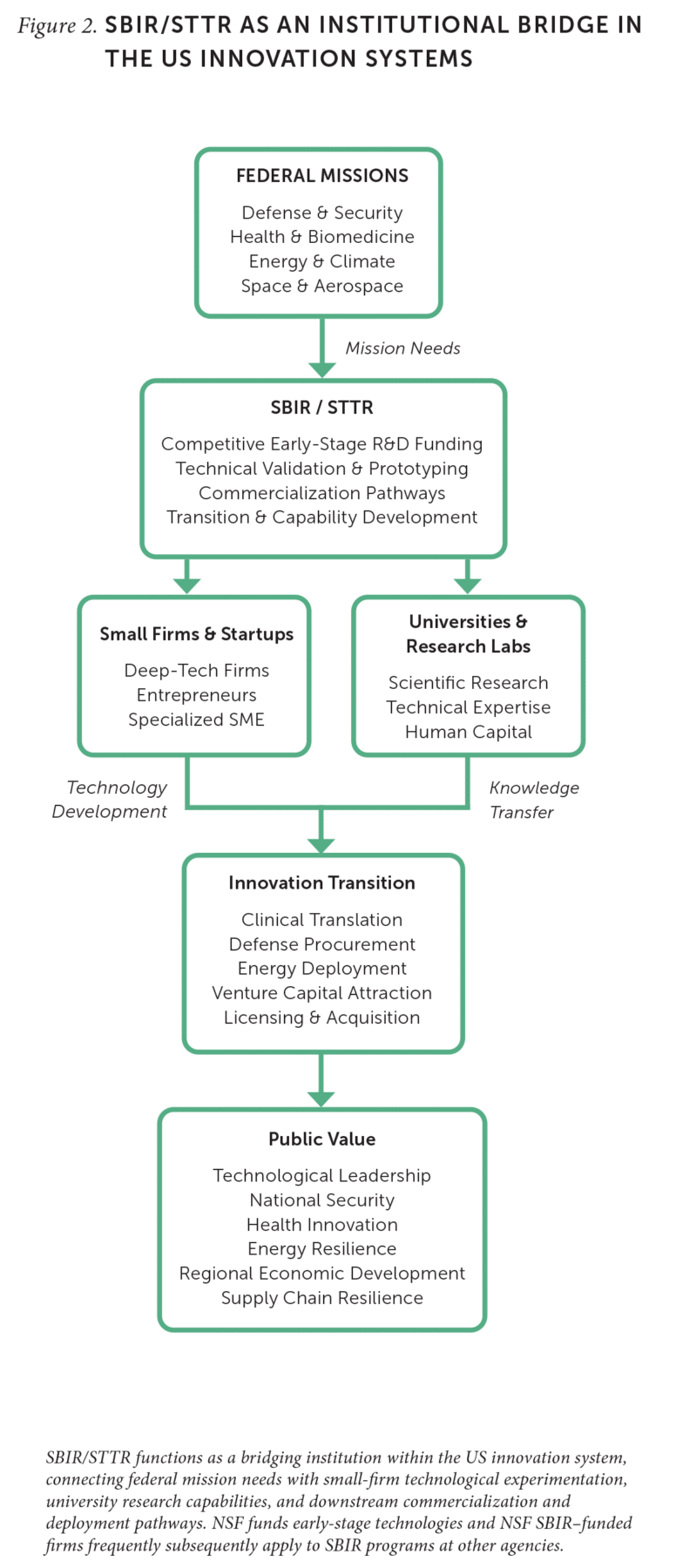
For more than four decades, SBIR and STTR have served as the federal government’s most important mechanism for connecting small firms to public-purpose innovation. The programs provide competitive early-stage R&D funding to small businesses working on problems that are too applied for much academic research, too uncertain or long horizon for much private capital, and too early-stage for conventional federal procurement. In this sense, SBIR/STTR support is a bridge between academic research grants, agency procurement, and venture capital.
Within the US research enterprise, these kinds of bridges are rare, and they matter even more now than they did in 1982, when SBIR was created to focus on reversing industrial decline and restoring US technological competitiveness. Today’s pressures are broader and more consequential: securing leadership in emerging technologies, sustaining resilient domestic innovation capacity, and ensuring that the next generation of transformative industries is developed and scaled within the United States rather than elsewhere. Renewed concerns around defense modernization, energy security, health innovation, supply chain resilience, and the geographic concentration of opportunity put pressure on the federal government to access innovation from firms that are not yet established contractors, not yet attractive to private investors, and not yet ready to sell a finished product. SBIR/STTR creates a disciplined way for agencies to identify those firms, test their technical ideas, and, when successful, help move them toward broader use.
The SBIR/STTR programs have endured because they solve a real institutional problem. The United States needs a way to bring small firms into the federal R&D system, support technical experimentation tied to public missions, and create pathways from research toward use. Markets alone will not do this reliably. Academic research grants alone will not do it. Traditional procurement alone will not do it. SBIR/STTR occupies the space between them.
And yet, despite broad agreement around the importance of SBIR/STTR from policymakers and the research community, Congress recently let the programs’ reauthorization lapse for more than six months. The April 2026 reauthorization extends the programs through September 2031 and includes new provisions aimed at commercialization, technology transition, awardee data, and security review. After a period of such uncertainty, that reauthorization was welcome. But the debate surrounding it revealed deeper questions: What exactly is SBIR/STTR for? And what should it be optimized to do?
The SBIR/STTR programs have endured because they solve a real institutional problem. The United States needs a way to bring small firms into the federal R&D system, support technical experimentation tied to public missions, and create pathways from research toward use.
The answer is not the same for every agency. That is the central lesson from a collection of recent reviews by the National Academies of Sciences, Engineering, and Medicine (NASEM) of SBIR/STTR programs at the Department of Energy (DOE), the National Institutes of Health (NIH), the National Science Foundation (NSF), the Department of Defense (DOD), and the National Aeronautics and Space Administration (NASA), which we participated in over the last several years. Across these reviews, the evidence is clear that the SBIR/STTR programs work. They stimulate innovation, support agency missions, broaden the participation of small firms in federal R&D, and create pathways toward commercialization and follow-on funding. But they work differently in different agencies. Variation between agencies and between divisions within agencies is not a defect. It is the core design feature that allows SBIR/STTR to serve a federal innovation system with missions as diverse as biomedical research, energy technology, and national defense.
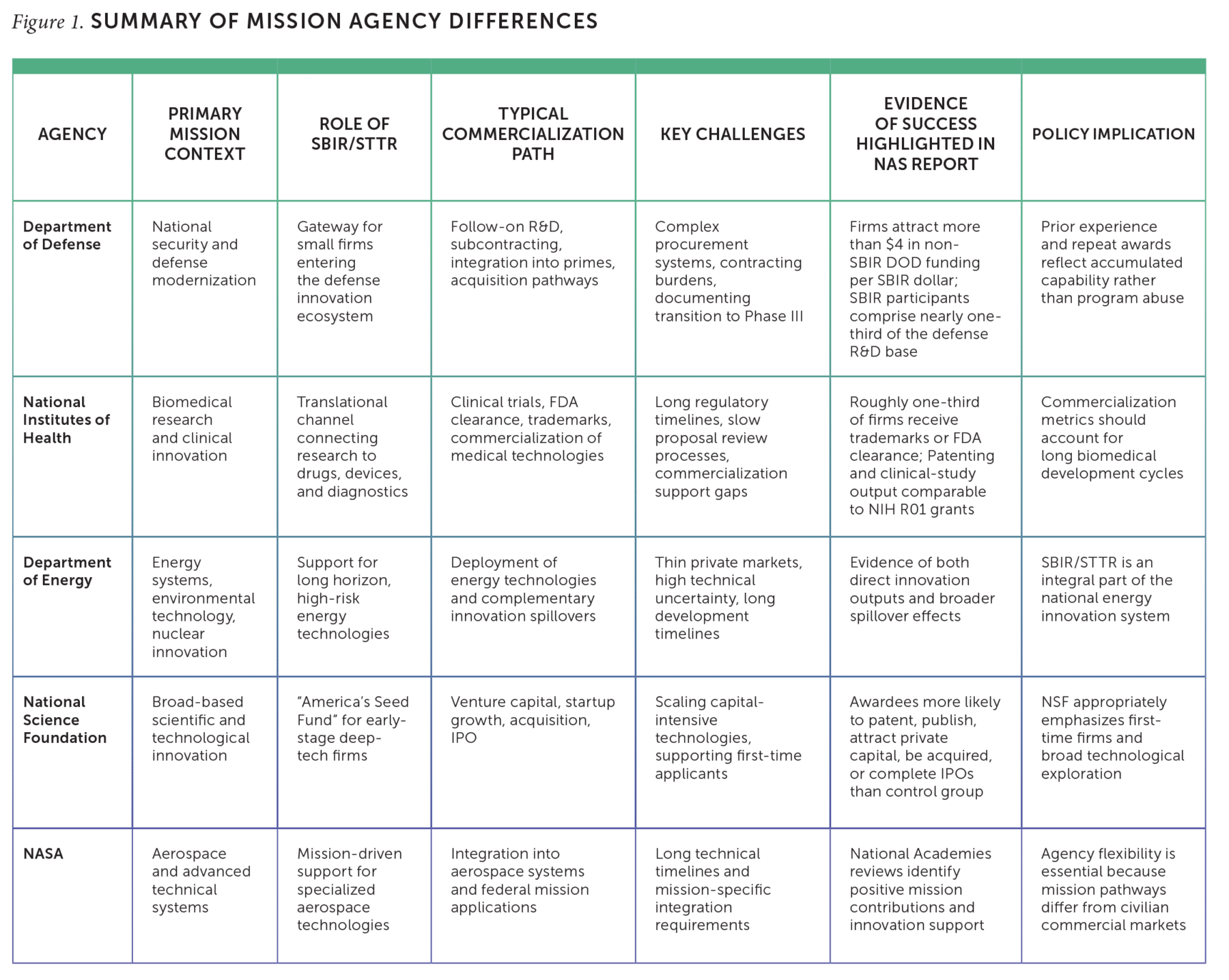
At DOE, NASEM found that SBIR/STTR stimulates technological innovation and contributes to DOE R&D needs. The program supports small firms working in energy, environmental, and nuclear technology domains where development timelines are long, technical uncertainty is high, and the path to private finance can be difficult. But the program is more than just a set of grants to individual firms—it is as an integral part of the national energy innovation system. The evidence suggests these awards enable both direct outputs and broader spillovers; that is, DOE SBIR/STTR projects can stimulate complementary innovation by other firms in related technological areas. For every patent generated by a DOE SBIR/STTR recipient, three additional patents are produced by other firms and inventors benefiting from spillover effects. Approximately 60% of these spillovers remain within the United States, and many go beyond the technical domains of the original research, indicating that the program diffuses knowledge broadly across industries as well as regions.
At NIH, SBIR/STTR plays a different role. As the world’s largest funder of biomedical research, the NIH’s dominant model is investigator-driven science, especially through research project grants. SBIR/STTR adds a translational channel aimed specifically at small firms developing biomedical technologies, drugs, devices, diagnostics, and related products. NIH-funded SBIR/STTR firms have introduced clinically important drugs, devices, and products; about one-third of awardees have received a trademark or Food and Drug Administration clearance to market a drug or device after receiving an award. NASEM found that NIH SBIR/STTR awards generate patents and clinical studies per award and per dollar at levels similar to the agency’s Research Project (R01) grant program. And this estimate probably understates the number of patents associated with SBIR/STTR awards, which are likely underreported by awardees.
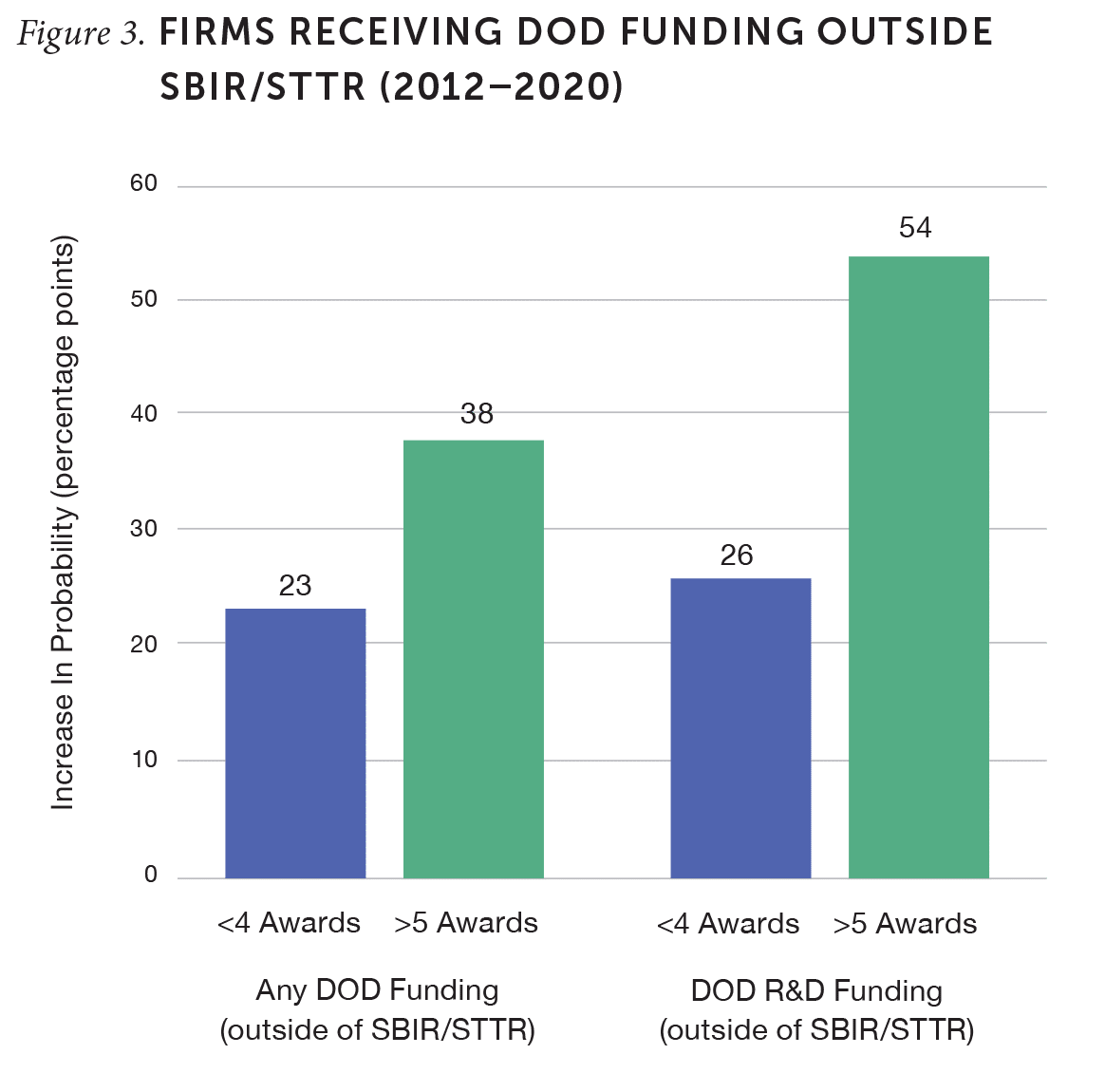
At DOD, the program directly connects small firms to national security needs. The DOD SBIR/STTR programs are large in absolute terms but small relative to the department’s overall R&D and procurement enterprise. Yet they are a crucial gateway for firms entering the defense innovation ecosystem. NASEM found that DOD SBIR/STTR firms ultimately attract more than four dollars in non-SBIR/STTR DOD funding for every dollar of DOD SBIR/STTR funding, and that firms that have participated in the programs represent nearly one-third of the defense R&D base. This does not mean every award becomes a deployed system. Defense procurement is complex, and many small-firm technologies are incorporated through subcontracting, acquisition, or integration into larger systems in ways that are difficult to observe in public data. But the pattern is clear: SBIR/STTR helps small firms enter a demanding mission system that they otherwise would struggle to access.
At NSF, the role is closer to the classic idea of “America’s Seed Fund.” NSF does not have the same mission-specific procurement demand as DOD, nor the disease-focused structure of NIH, nor the energy-system orientation of DOE. Its SBIR/STTR programs support young firms across a wide technological frontier. NASEM found that NSF SBIR/STTR awardees contribute scientific publications and patents and realize financial and commercial outcomes consistent with the program’s goal of encouraging small businesses to engage in federal R&D with commercialization in mind. Compared to non-awardees, NSF awardees are more likely to publish, patent, attract follow-on private capital, be acquired, or complete an initial public offering. NSF also funds a more diverse set of technologies and geographies than venture capital typically does, including capital-intensive areas such as semiconductors, medical devices, pharmaceuticals, chemicals, and advanced materials.
Seen together, these findings show why it is misleading to ask whether SBIR/STTR is “really” a commercialization program, a research program, a procurement program, or a regional development program. It is a mission-oriented innovation program. Commercialization matters, but it takes different forms across different agencies and industries. At NIH, commercialization may mean movement toward clinical trials, Food and Drug Administration clearance, or a product embodied in a new drug or device. At DOE, it may mean progress on a difficult energy technology where markets are thin, timelines are long, and complementary innovation matters. At NSF, it may mean helping a young deep-tech firm attract private capital. At DOD, it may mean follow-on R&D, integration into the defense industrial base, acquisition by a prime contractor, or eventual use in a system where the SBIR/STTR firm is not the final vendor.
The nuance around how SBIR/STTR is leveraged by different agencies has largely been lost in the discourse around “multiple-award winners,” a major point of debate in the lead-up to the latest reauthorization. A recurring criticism of SBIR/STTR is that firms receiving multiple awards are somehow gaming the system. In some cases, that concern may be worth examining. Any program with public funds should guard against dependency, low performance, or strategic behavior aimed at capturing awards rather than solving problems. But the broad claim that multiple-award winners are inherently suspect is not supported by the evidence.
In fact, in some mission environments repeated awards are precisely what one would expect from a company that is successfully accumulating capabilities. DOD is the clearest case. The defense innovation system is technically demanding, administratively complex, and highly specialized. Firms must learn how to work with program managers, contracting officers, laboratories, prime contractors, acquisition pathways, classification constraints, and operational users. A firm that has received several awards may have developed rare capabilities that are valuable to the government—exactly what the program was designed to encourage firms to do.
NASEM’s analysis suggests experienced firms bring unique value to the broader defense innovation ecosystem. These firms do not simply accumulate contracts; many operate as durable institutional repositories of engineering expertise, tacit knowledge, and commercialization experience in technological areas where private demand is uncertain and venture financing episodic. In that sense, the program’s historical tolerance of multiple award winners may reflect an implicit recognition that the national defense innovation system benefits from maintaining a standing cadre of technically capable small firms able to respond to emerging agency needs, sustain long-horizon R&D, and train successive generations of specialized personnel.
In contrast, NSF SBIR/STTR has deliberately prioritized first-time applicants and young firms, and that emphasis fits its broad seed-funding role in the innovation system. Many NSF awardees go on to receive subsequent awards from other agencies, including DOD and NIH. That makes sense; NSF can serve as an early gateway for a broad set of deep-tech firms. But the NSF model should not simply be imposed on DOD, DOE, or NIH. In defense, prior experience may be essential. In energy, firms may require sustained support across long technical development cycles. In biomedical innovation, firms may need different forms of staged support as they move through preclinical, clinical, regulatory, and commercialization milestones. Program managers should be able to select the best proposals for their mission needs, whether those proposals come from first-time applicants or firms with a long history of successful federal R&D engagement.
The right goal to pursue now that the programs have been reauthorized is therefore not to force SBIR/STTR into a single model. It is to preserve the flexibility that has made each of the programs valuable, while improving execution, data, speed, transition pathways, and accountability.
First, Congress should provide long-term stability. The repeated five-year cycle of temporarily reauthorizing SBIR and STTR creates uncertainty for small firms and for the agencies that administer the programs. Early-stage innovation requires planning horizons longer than a few months. A firm deciding whether to pursue a new technology, hire technical staff, enter a federal market, or seek matching capital needs confidence that the program will exist long enough to support a plausible development pathway. The recent reauthorization through 2031 is an important step. But making SBIR/STTR permanent would protect the firms the programs aim to help from recurring funding cliffs.
Second, agencies should improve technology transition pathways. The most difficult point in the SBIR/STTR process is often not Phase I feasibility or Phase II development, but what comes next: finding a customer, investor, acquirer, procurement pathway, regulatory route, or larger system into which the technology can be integrated. DOD needs better visibility into Phase III outcomes, subcontracting, and integration through its prime contractors. NIH needs faster and more commercially informed review and support for firms moving toward clinical and regulatory milestones. DOE needs commercialization assistance that helps technically strong firms build the managerial and market-facing capabilities needed for deployment. NSF needs flexibility to support capital-intensive technologies whose development requirements exceed standard award amounts. The recent reauthorization does call for additional training for contracting officers and acquisition personnel in federal agencies around Phase III awards to facilitate commercialization, but further reform should maintain agency flexibility around how to set and achieve those goals.
Third, agencies should address speed and administrative burden where delay is a binding constraint. The April reauthorization is net negative in terms of relieving administrative burden—it requires the federal agency to put limits on the number of proposals that an applicant can submit, but it doesn’t remove transition and commercialization benchmarks for experienced firms required by prior authorizations. Reform should target bottlenecks rather than impose symbolic constraints that make the program harder to use. At NIH, review and award timelines can be poorly matched to the needs of small biomedical firms. At DOD, administrative burden arises in different places, including due diligence, contracting, and transition into acquisition pathways. At DOE, strict budget control structures can limit the program’s ability to allocate SBIR/STTR resources across the agency’s broader mission needs.
Fourth, agencies should broaden participation without confusing outreach with dilution of standards. SBIR/STTR has the potential to expand access to federal innovation funding across regions, demographic groups, institutions, and technology communities. The NASEM SBIR reviews show some successes, but also persistent gaps. DOE and NIH continue to attract relatively low levels of participation from women-owned, minority-owned, and underrepresented-state firms. NIH STTR collaborations with minority-serving institutions remain rare. NSF has made progress in some areas, but unevenly. The solution is to widen the pool of capable applicants and reviewers, improve information access, partner with trusted networks, and reduce unnecessary complexity that disadvantages outsiders.
Fifth, the federal government needs better data. Across the NASEM reports, data limitations were a constant obstacle. Agencies and the Small Business Administration often lack integrated, reliable systems linking applications, awards, firms, researchers, technologies, patents, publications, clinical outcomes, private investment, federal follow-on funding, procurement, subcontracting, and demographic characteristics. Better data would not only support external evaluation; it would improve program management. Program managers should know which types of topics, review processes, outreach efforts, award structures, and transition supports are associated with better outcomes. The recent reauthorization called for additional fields to the SBIR database and improvements to the federal government’s procurement data systems, but future congressional action should require and fund data infrastructure adequate to the scale and importance of the program.
The right goal to pursue now that the programs have been reauthorized is therefore not to force SBIR/STTR into a single model. It is to preserve the flexibility that has made each of the programs valuable, while improving execution, data, speed, transition pathways, and accountability.
Finally, any future reform should recognize that SBIR/STTR’s impact extends beyond any single success metric. As participants in more than a decade of SBIR/STTR evaluations, we feel it is necessary to point out that a narrow focus on measuring any single program outcome could undermine both programs’ broader effectiveness. For example, focusing narrowly on private-sector sales could overlook defense technologies that transition through federal follow-on R&D or integrate into prime contractors. A narrow focus on job creation could mistake these programs as employment programs. A narrow focus on venture capital could undervalue energy, defense, and deep-tech projects that private investors often avoid precisely because they are long horizon, capital intensive, or mission specific. A narrow focus on first-time applicants would miss the value of experienced firms that agencies rely on to solve hard problems. Evaluation metrics need to be diverse and multifaceted in order to preserve SBIR/STTR’s public value as a bridge between disparate constituencies and functions of the research enterprise.
The evidence from DOE, NIH, NSF, and DOD all points in the same direction: SBIR/STTR is a high-value component of the US innovation system. The task after reauthorization is not to constrain it into uniformity. It is to strengthen the conditions under which it works. Of course, the SBIR/STTR program is not perfect. With better data, better transition mechanisms, faster processes in some agencies, stronger outreach, more strategic commercialization assistance, and clearer recognition within agency planning, it can become more effective.
America’s SBIR/STTR program works because it is competitive, mission-linked, decentralized, and adaptable. Those qualities should be preserved. The next generation of reform should make the program more stable, more transparent, more inclusive, and more effective at moving promising technologies from early experiments to public value. That is how SBIR/STTR can continue to serve not only small businesses, but the nation’s long-term capacity for innovation.