
Henrietta Swan Leavitt: The Woman Who Measured the Universe
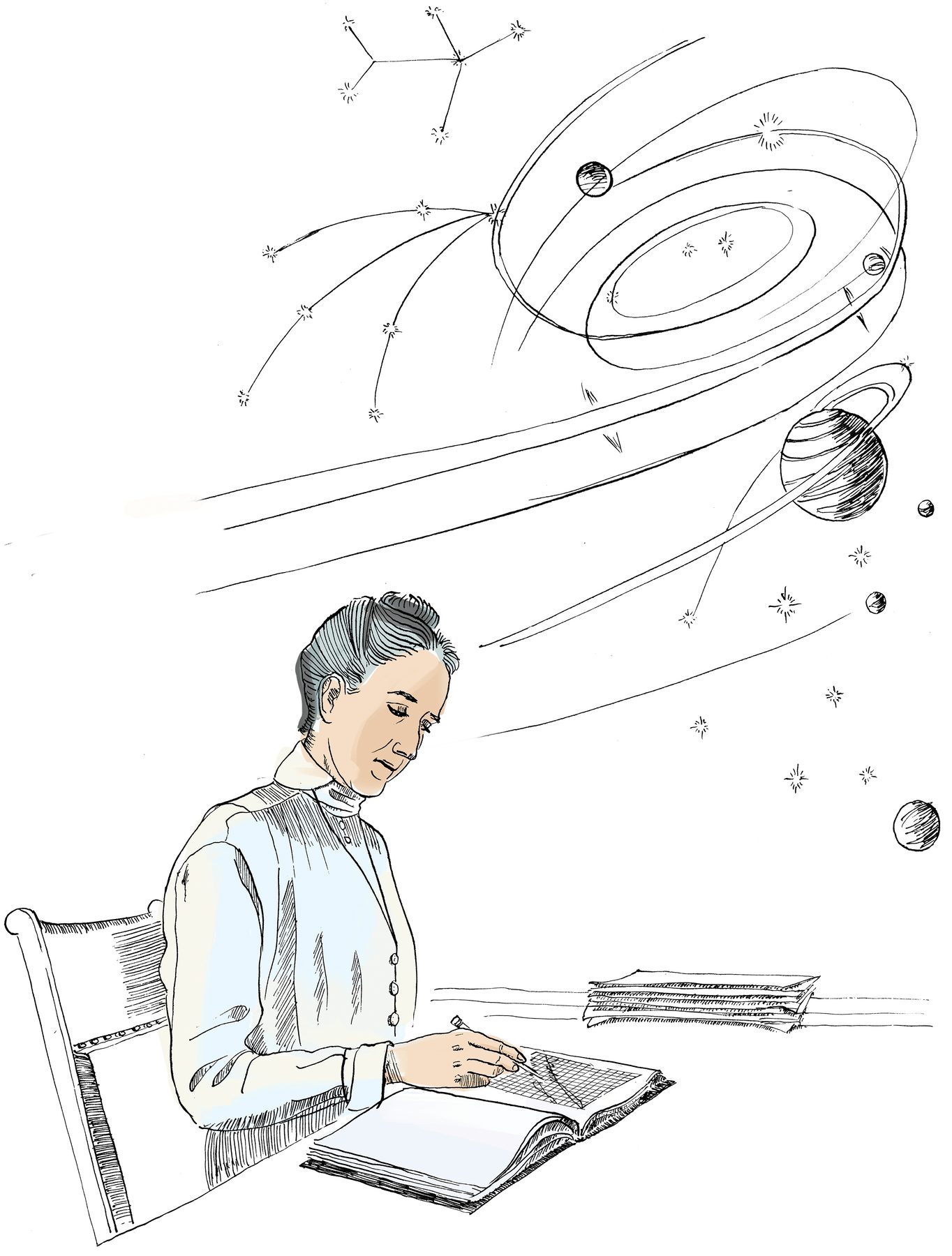
American astronomer Henrietta Swan Leavitt’s (1868–1921) research laid the foundation for modern astronomy’s understanding of the structure and size of the universe. After graduating from Radcliffe College in 1892, she joined the Harvard College Observatory, where director Edward Pickering employed women as “computers” to analyze photographic glass plates of the night sky. The meticulous work was poorly paid, but it was how Leavitt would change our understanding of the cosmos.
Leavitt focused on variable stars, whose brightness changes over time. While studying the Small Magellanic Cloud, she discovered a crucial relationship among pulsating Cepheid stars: the brighter the star, the longer its pulsation period. First reported in 1908 and confirmed in 1912, this finding provided astronomers with a reliable way to calculate stellar distances. By comparing a Cepheid’s observed brightness with its intrinsic brightness, researchers could determine how far away it was. Leavitt’s discovery transformed astronomy from a map of the sky into a tool for measuring the depth of space.
Leavitt’s discovery transformed astronomy from a map of the sky into a tool for measuring the depth of space.
The significance of her discovery became clear only after her death. In the 1920s, astronomer Edwin Hubble used Leavitt’s work to show that galaxies exist beyond the Milky Way and that the universe is expanding. Decades later, astronomers used related distance-measurement techniques to discover that cosmic expansion is accelerating.
Leavitt received little recognition during her lifetime. Swedish mathematician Gösta Mittag-Leffler sought to nominate her for the 1926 Nobel Prize in Physics, unaware that she had died nearly four years earlier. In 2008, nearly a century after her discovery, astronomers formally renamed the period-luminosity relationship Leavitt’s Law, recognizing her central role in revealing the scale of the universe.