Here’s how it happens: Clarissa finds an ad for a job on the page that lists opportunities for graduate students. Artist’s personal assistant. She calls the number and a voice gives her an address on the south side of town, half an hour away by bus. On the bus she thinks about her dissertation, a study of Monet. The apartment building is huge, with a grimy façade. The voice from the phone replies on the intercom, the buzzer goes, and Clarissa works her way through two doors that clang with a brutal, cage-like sound.
It’s a studio apartment. The artist is lying on the bed, propped on pillows. There’s a smell of something sour or beginning to spoil, and Clarissa thinks later this must have affected her, but in the moment her attention is absorbed by the artist’s glasses. They aren’t real glasses—more like a joke. A ping-pong ball has been cut in half and the two halves connected with a bit of pipe cleaner. The earpieces are made of pipe cleaners, too. On each blank, egg-like ping-pong-ball segment, someone has drawn a black dot with a magic marker.
The artist invites Clarissa to sit down, and she sits on the only chair, which is covered with pale leather like something in a doctor’s office. The artist’s name is Sabrina Searl. She remarks that she and Clarissa must both have had romantic parents to wind up with such flowery names. She’s thin, and seems very old, though her hair is still mostly brown, lying on her shoulders in sparse dry stalks. She’s wearing a cardigan and a long skirt. Everything about her seems normal except the glasses that goggle whitely at Clarissa.
Sabrina Searl needs someone to go through her mail, bring in her groceries, and do some light cleaning. Clarissa needs the job, and she takes it. She notices that the dots on the ping-pong-ball halves are slightly off-center. She sees a cardboard box in the corner, full of pairs of these ping-pong-ball glasses.
She sees a cardboard box in the corner, full of pairs of these ping-pong-ball glasses.
Artists are eccentric. Look at Monet. In 1886, he is painting on a small island off the coast of Brittany. He dresses like a fisherman in woolens and heavy boots, topped with a hooded oilskin wrapper. In this getup, he paints the storm, his cape streaming with water, his easel lashed to the rocks with ropes. The wind tears the brush and palette from his hands and sends them flying. He ends the day battered, drenched, disgusted, discouraged.
Work at Sabrina Searl’s is not difficult. Three times a week, Clarissa lets herself in with the artist’s spare keys. If there are grocery bags with Sabrina’s name on them in the vestibule, she takes them upstairs. She chats with Sabrina while she puts groceries away and cleans out the mini fridge. She sweeps the floor, takes out the trash, and flings some lemon-scented stuff around in the little toilet closet. Since she started coming, the smell in the place has improved considerably. Sabrina’s mail is mostly junk, which Clarissa deposits in the recycling bin downstairs. She feels sorry for Sabrina, who is always patient and smiling, despite her obvious loneliness, and who, Clarissa suspects, is not an artist. She looked Sabrina up and didn’t find anything. Nothing art-related arrives in the mail. There are no pictures on the walls.
But why would Sabrina put up pictures when she can’t see? Can she see? She wears her kooky, childish glasses and her placid smile. She strokes the red lacquered cabinet beside her bed, rubbing its lid contentedly, as if it’s some kind of security object. She remarks on the weather. She asks about Clarissa’s graduate program. “Monet,” she repeats with a wide grin. One day she says out of nowhere: “You must be wondering about my glasses. I know they look funny. But I don’t want to hurt anyone.”
Clarissa sets this remark aside. It’s like something said in a dream, she thinks, or an accidental sound, like a belch, that should be ignored out of politeness. Two weeks later she discovers the diary, or story, of Sabrina and Oscar.
It’s a thick pile of printed pages, bound with plastic rings. There is no title page. She’s sorting through Sabrina’s papers when she finds it, trying to make some sense of the old magazines and tax documents strewn over the lid of a large metal chest. The chest stands in the corner farthest from the bed. Next to it is a plastic storage box, about the size of the small fridge, also covered with papers; then comes the red lacquered cabinet; then the bed. Clarissa has often thought of Sabrina’s three containers—wooden cabinet, plastic box, metal chest—as three magic objects from a folktale. The chest, which could easily hold a coffin, is the biggest. She stands beside it, glances at Sabrina, who lies in bed smiling at the ceiling, and reads.
“You must be wondering about my glasses. I know they look funny. But I don’t want to hurt anyone.”
Sabrina has just finished her MFA when she meets Oscar at a party. He’s somebody’s brother, visiting from out of town. She is immediately repelled by his elegant suit, his ostentatious watch, and the amused way he regards the crowd of artists and musicians, as if they’re children playing at life. She hears people call him a tech bro. She’s determined to avoid him, but somehow they wind up in a corner talking about Marina Abramović. Sabrina, chattering volubly, which is unusual for her, tells Oscar about Abramović’s performance piece The Artist Is Present, during which Abramović sat for eight hours at a stretch in the Museum of Modern Art and allowed visitors to sit opposite her and gaze into her eyes. She’s annoyed that Oscar has never heard of this famous work. She thinks that’s why she’s talking so much. They’re standing directly under an orange-shaded lamp, which floods Oscar with lurid light. He’s clean-shaven—of course, Sabrina thinks scornfully. His hair, brushed back from his forehead, looks sculpted. He watches her with a serious expression. Ice-gray eyes, she thinks, ice-gray eyes, and the phrase keeps ringing foolishly in her head as she goes on talking, folding her arms tightly over her chest, unpleasantly aware of her torn trench coat, which she’s suddenly afraid might seem pretentious, then furious that such a thought would cross her mind, and determined to impress upon Oscar the research value of Abramović’s project, which attracted the interest of neuroscientists. Really, says Oscar. Yes, Sabrina replies with unnecessary force, there were brain experiments, they examined the brain waves of Abramović and the person sitting with her, and they found that their brain waves synchronized when they were looking at each other with complete attention. She steels herself against Oscar’s reaction, but he doesn’t laugh. He asks her how the museum visitors felt after sitting with Abramović. Healed, she says. His ice-gray eyes are flecked with orange glints. And Abramović? he asks. Exhausted, says Sabrina.
Clarissa returns to herself with a start. She rustles the papers and makes some humming noises, flicking her eyes nervously toward Sabrina, but Sabrina doesn’t seem to have noticed anything. To make up for her snooping, Clarissa tackles the greening bathtub, scouring it with gritty suds, her hair caressed by the folds of Sabrina’s clothes, which hang on a rail above the tub, dispensing a dreary basement odor.
He asks her how the museum visitors felt after sitting with Abramović. Healed, she says.
At home, Clarissa tries to work on her dissertation, but she finds it hard to concentrate. Monet is no longer a painter but a hunter. Followed by five or six children, he goes down to the beach, where he lies in wait for the light. He pounces on one canvas after another, seizing the same scene under different conditions of sun and shadow. He gathers the rain by handfuls. Clarissa works on her bed, laptop perched on her knees, though she knows this is not recommended for insomniacs. She doesn’t have a desk. The walls of the old house where she lives are enormously tall, and so thin she can hear her housemate in the room next door—the same low, murmuring conversation every night, the housemate’s lengthy session with her therapist. Monet makes pictures of scintillant yellow, blinding sapphire and emerald, livid lead. His hands are so chapped he smears them with glycerin. In the Creuse Valley, where he paints the oak, the landscape of rocks, hills, and foaming water exudes an infinite desolation. Clarissa blinks at her laptop. She’s never tried an AI therapist, though her housemate recommends it, and of course she can’t afford a human one. She tries to look up Oscar, but she doesn’t know his last name. Oscar tech company, Oscar computer programmer, Oscar and Sabrina. Monet battles against time. He gets the owner of the oak to have its new leaves removed so he can finish his winter painting. The men are out with ladders all morning, stripping the tree of green. But what exactly does Clarissa want to say about Monet? The river is vaporous, dusky, drawn toward the sea like all brooks and streams, the images softening, melding, the laptop screen as featureless as fog, a mass of mist sucked up into the sky where all waters eventually meet in a level, ashen, impenetrable cloud.
She returns to Sabrina’s apartment with a weak, cowardly feeling, heart fluttering. She manages to avoid the bound pages for about 15 minutes, making conversation, opening and closing the door of the fridge and toilet closet at random. Then she stands and reads. At least this time she remembers to keep one hand moving steadily among the scattered papers, so it sounds like she’s doing something. She looks at Sabrina often; Sabrina is always flat on her back, perfectly still, her calm face grotesquely interrupted by the bulbous plastic eyes.
Two months after the party, Sabrina receives an email from Oscar. The subject line reads Can’t stop looking. She clicks abruptly, as if stung by an electric shock. Oscar says he got Sabrina’s email address from his sister; he hopes she doesn’t mind. Sabrina can’t remember who his sister is and she can’t understand his message, which streams through her head like a piece of ribbon. She reads it again more slowly. Oscar says he can’t stop watching clips of The Artist Is Present online. He thinks it demonstrates a fundamental human need. To see and be seen, he says, to exchange a look. He writes about mirror neurons and empathy. He says eye contact stimulates the limbic mirror system. Alpha synchronization, he writes. Relief from pain. He says there are applications, major applications. He wants to see her.
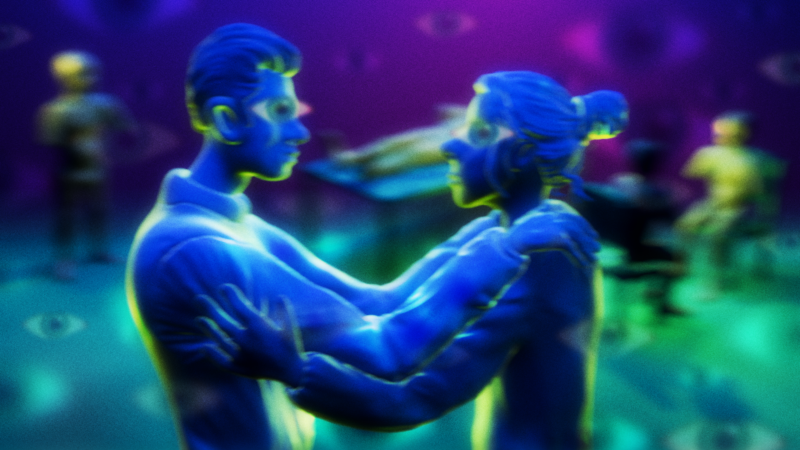
They meet at a restaurant. His suggestion; on her own she would never go there. She wears a black dress. There’s a crescent-shaped booth, cushions, a tiny lamp on the table. A ridiculously romantic place. She can smell his cologne, faint, woodsy, magnetic, she hates all of this, he’s leaning forward, his eyes alight, he pushes his cuffs up, exposing his horrible watch, she eats without tasting the excellent food, she wants to argue with him but feels herself carried away, lifted and borne away on the wave of his talk, his exuberance, and an idealism that surprises her. She’s never encountered this kind of dreamy, altruistic enthusiasm in combination with such a frank interest in money. She feels disarmed. He tells her that, up until now, the development of caregiving robots has concentrated on speech. Everybody’s focused on comfort through a meaningful simulation of conversation. But what about looking? I mean, he says, so much is happening in a glance. He pauses. For the first time, he seems to run out of words. As for her, she finds that her discomfort has been transformed seamlessly into absolute confidence. She is holding his gaze with her own. She lifts her glass. Can’t stop looking, she says. He swallows. Yeah, he says. He laughs, and then they’re both laughing, and everything is suddenly marvelously easy, as if, she thinks, it had all been written long ago.
I mean, he says, so much is happening in a glance.
She moves to his city and into his apartment. He won’t let her pay for anything; she’s a consultant, he insists, the rent is part of her fee. The apartment is glassy and cold, overlooking the gray river that runs through the city, and the happiness she feels there has a dazzling quality, as she could never have imagined being happy in such a place. With his white marble countertops, his espresso machine, his ironing board. His home gym. She goes through bouts of ecstatic giggles. He grins. He says they’re perfect for each other. With them, no explanations are necessary. Everything is solved with a look. Instead of saying I love you, they tell each other: Can’t stop looking. And there’s a seriousness, she thinks, a direction to her life now, something she’s never experienced before, getting up early to go to work with him, checking her phone as she rides in his sumptuous, clean-smelling car, walking into the building past the pinball machines, ping-pong tables, and retro arcade games, where he always moves faster, frowning, embarrassed by the infantile trappings of his workplace, a reaction she finds endearing, until they reach his lab.
A seriousness. A purpose. And ice-gray eyes. Hours spent under the EEG cap, gazing at each other. Going over the graphs, the tender synchronization of waves. Eyes open in bright light. The beginning of tears. The deference of his colleagues, his assistants, and even his boss, a bumptious, gap-toothed man who always seems to be snacking out of a bag, the way they accept Sabrina immediately. She’s the artist, Oscar tells them, her input is essential, and she feels it’s true as she argues with him about the language of eyes, debating pupil dilation, blink rate, and saccade. She finds herself absorbed by reflection, refraction, and intensity. One night she unpacks her sculptures and shows them to Oscar: the miniature objects of glass and metal she hasn’t looked at, has hardly thought of, since her final show at school, as if she wanted to forget them. Oscar touches the sculptures carefully with his fingertips, sitting on the couch in his T-shirt, with rumpled hair. She laughs. You can hold them, she says. She says they don’t matter anymore, she’s moved beyond them, into what will be her real work. But don’t you see, murmurs Oscar, how perfect this is? You were made to build a robot. He believes in destiny, Sabrina thinks as he embraces her. He’s superstitious, she knows: always sets his coffee cup down the same way. Much more spiritual than me, she thinks, closing her eyes.
She finds herself absorbed by reflection, refraction, and intensity.
Clarissa glances at Sabrina. Suddenly she’s afraid the sound of her hand moving among the papers has become too rhythmic, false. Sabrina lies on her back. Is she asleep? What does she do all day? There’s no TV in the room, no radio, no cell phone, only the red plastic phone on the wall for the landline, which never rings. Senile, thinks Clarissa. It probably doesn’t matter whether she rustles the papers or not. Would Sabrina even notice if she came two days in a row? Clarissa’s fingers tremble. She’s back the next day, breezy, cheerful, heart racing; as she expected, Sabrina shows no sign of surprise or confusion but lies serene as ever behind her white eyes with their motionless black pupils. Clarissa reads. She sees Sabrina and Oscar bent over the robot. Its rubbery flesh. They’re frustrated, it’s not working, they’ve given themselves too much to do, this body, its weight, and then it has to have a smell, Oscar complains, and how the hell are they going to do that? They go to his favorite dive bar, where he always goes when he’s depressed. A brown and noisy place with a huge TV. They drink cheap beer and play darts. What if there’s no body? Sabrina shouts over the music. What? No body! Just the head. She gestures at her head. His eyes gleam. They remove the head and work from there, concentrating their efforts on the contours of the face. The skin. Above all, the delicate eyelids. If they can crack the first impression, Oscar says, automatic mimicry should kick in. They have to get past the distinction between a person and a thing. We want affective empathy, he says, not cognitive empathy. We don’t want them rationalizing. Just feeling. Just mirroring instantly. That’s how emotion becomes contagious. Like love at first sight.
Instead of saying I love you, they tell each other: Can’t stop looking.
Like love, thinks Clarissa, riding home on the bus. Like when you can’t stop looking. In her room, she curls up with her laptop and creates a new file. She’s not going to write about Monet. She realizes she’s stumbled onto a lost treasure from the history of modern art. She’s going to write a dissertation about Sabrina Searl. Excitement is coursing through her. She types up everything she can remember from Sabrina’s book. She works late into the night, sleeps for a few hours, bounces out of bed in the morning before her alarm goes off. The sun is throwing big yellow squares of light across the wall. The scratched floor shines. She sees them struggling with the curves of the face, the smile. Oscar almost punches the thing in a rage. Sabrina grabs his arm. They go out for a walk, it’s winter, snowflakes are blowing into their eyes. Oscar strides off toward the river, as if to punish himself by walking where it’s coldest. Sabrina follows, numb. Under a streetlight, he turns toward her. Then we don’t do the head, he says, almost laughing, his mood completely changed. He grasps her shoulders, shakes her. We don’t do the head! Just the eyes. A kiss like an icicle, except for his hot breath.
Sabrina maneuvers fragments of glass with a pair of tweezers. Eats takeout from cardboard boxes in the lab. Stays there all night. Laughs hysterically when Oscar puts on music and does a striptease. He’s naked down to his eyes. Across the room, the Eyes are balanced on stalks, attached to a stem that stands on a box containing all the hardware. A trim and graceful design, she thinks, like a plant. They’re almost ready. Clarissa writes effortlessly. Watches a film with her housemate. Makes paella. Somehow there’s time for everything: classes, errands, the meeting with her advisor where she speaks lyrically and persuasively about her new project, nail polish and coffee with her housemate who says she’s changed, yes, it’s true, she hasn’t felt this good since Michael moved back to Columbus. Not since he left has her room seemed like this: bright and secure, like a place where a person could live. And while she knows there are several hurdles ahead—she’ll have to talk to Sabrina eventually, get her permission to use the papers, convince her to do some interviews—the smoothness and rightness of everything makes her feel certain it’s all going to fall into place.
Yes, as if it’s all been written, written down long ago.
What if there’s no body?
Almost ready. Sabrina’s head lolls with tiredness. Get some sleep, says Oscar. Okay, she says, and crouches to lie down behind the desk. No, he says gently, you’re worn out, go home and get a good night’s rest. Leaning over her, lit from behind by fluorescent light, his body seems outlined in filaments of silver. His eyes are dark and warm, like caves. He helps her up from the floor, and it’s as if she’s rising into a dim, volcanic heat. Can’t stop looking, one of them says, and the other, Can’t stop looking. She’ll never be able to remember who spoke first. Then Clarissa turns the page. She turns her head to glance at Sabrina’s bed, out of habit. And Sabrina is turned toward her, fixing her with a blank white stare.
Clarissa starts back from the papers. Her heart seems to leap up in her throat. Her voice quavers out of her rigid larynx, saying some meaningless word. “Well,” she says, or is it “okay,” anyway it comes out like a sudden cough. The old woman says nothing, just confronts Clarissa with her thin, still face. An expressionless face, as if drowned. And those terrible eyes with their skewed pupils. She knows everything, Clarissa thinks wildly, she’s been watching me the whole time. Clarissa backs toward the door, babbling. She stumbles and almost falls. The worst part is how Sabrina’s face moves slightly to follow her all the way.
For two days, Clarissa doesn’t return to Sabrina’s apartment. She feels cold all the time and has trouble swallowing food. She dreams of Marina Abramović. The artist is present in her chair, wearing one of her floor-length gowns: black, white, or red.
Then she convinces herself to go back. After all, Sabrina didn’t say anything. Maybe, thinks Clarissa, nothing is really wrong. Or maybe she can explain herself and Sabrina will forgive her. And even if everything is over, she has to return the keys.
And Sabrina is turned toward her, fixing her with a blank white stare.
She goes back. She’s filled with a sense of dread, like poison in her marrow. The clashing of the doors. The unheated, cavernous stairwell. She climbs the steps like a penitent. Knocks at Sabrina’s door, then opens it, singing out her prepared greeting. The room is empty.
No one in the toilet closet. No one there. An abandoned odor of old sheets. Never has Clarissa known Sabrina to go out. But now she’s not there, and the story with its plastic binding is lying open on the chest, just as Clarissa left it.
She was so close to the end. Why pretend? She’s going to read it. She thinks of new things to say if Sabrina comes home in a fury. It’s my day, I’m supposed to be here, maybe you forgot. Yes, I let myself in, I just got here. The pages shimmer, white.
Sabrina wakes up alone in the apartment, without Oscar, who stayed at the lab. It’s late, she can tell by the light, and she feels wonderfully refreshed. She stretches luxuriously, grateful to him for insisting she go home and sleep. She takes a long shower and makes herself a good breakfast, cutting up fruit. Then she drives Oscar’s car across the river to his building. The trees are powdered with pale spring green. The door to the lab is locked, and she laughs, thinking, You weirdo. She knocks. Oscar? she calls, still smiling.
No answer. He’s fallen asleep, she thinks. She knocks harder. Oscar!
A sound. It’s his voice, strangely grating. She can’t make out the words.
She drums at the door. Oscar, you locked the door!
He answers more loudly now, in a voice that seems torn from his throat: Go away!
Sabrina stands and looks at the door. Its matte, pewter-colored surface. Something like mist rises from that surface, enveloping her body. It’s as if she’s become absorbed, trapped, in the substance of the door. She hears herself knocking, pleading, arguing in an increasingly hoarse voice. Why? Why? she hears herself ask. People gather around her. The janitor comes. The security guard. Nobody can open the door. He’s changed the code, the guard explains. But why? Why would he change the code? Oscar! More people come, police, Oscar’s boss in a T-shirt and gym shorts. The guard disappears. The boss knocks on the door, calling Oscar buddy, then pounds with the side of his fist, yelling about company property. He starts making legal threats. Oscar replies almost in a scream. Get out of here! Get Sabrina out of here!
She meets the boss’s eyes and shakes her head. She’s not going anywhere. The guard returns and gives a quiet nod. They’ve overridden the code. There are people between Sabrina and the door. She tries to force her way forward, but the boss holds her arm—apologetically, or maybe with distaste.
Oscar, her Oscar, is seated on a chair, and he is screaming. Don’t look at it! Don’t look! He’s screaming at the people entering the room, but he doesn’t turn his head. He keeps staring straight before him at the Eyes. Their beautiful project. The fine pieces of glass Sabrina placed with such care. She doesn’t catch the gaze of the Eyes directly, but she sees they’re functioning. There’s something perceptibly on about them—not a light but an aura. Oscar won’t stand up when ordered by the police. When they take his arms, he kicks out viciously, knocking over the Eyes.
The sound he makes when he breaks eye contact. An appalling, gurgling cry of pain.
Sabrina rushes to him. Sobs to the cops to let him go. Touches his dear chest. Oscar. Looks into his ice-gray eyes. Remains there, frozen. In the immeasurable. In the hole.
The sound he makes when he breaks eye contact. An appalling, gurgling cry of pain.
It was as if, she will write later, I was gazing down a luminous tunnel. And that tunnel had no end. And even as I looked, I knew I was only seeing a faint reflection of what Oscar had seen when he looked into the Eyes.
Clarissa raises her head. The light has changed. Dusk is falling. She can hear the muted sound of traffic below Sabrina’s window. The objects in the room stand out from the gloom with a strange finality. The clothes hanging above the tub from their gaunt shoulders. The vacant bed. All at once she knows Sabrina is never coming back. Briefly, she thinks she should start calling hospitals. Then she switches on the lamp on the chest, casting a tent of golden light over the few remaining pages.
For three weeks, Sabrina is not allowed to see Oscar. She takes long walks along the river, bumping into benches and people. One day she goes back to the building where she and Oscar used to work and finds the lab untouched, as if it’s been sealed in invisible plastic. Nobody has even picked up the chair that tipped over when Oscar was dragged away. Sabrina sets the chair on its feet. She collects their things. It takes her several trips to get everything down to the car, and she thinks the security guard might try to stop her, but he looks on sympathetically and even helps to carry the larger items. It’s the same guard who opened the lab door, and Sabrina assumes he feels sorry for her, which he probably does, but later she thinks he must have been motivated by the impending lawsuit, following orders not to get in her way. The suit is being brought by Oscar’s sister, who has filled Sabrina’s phone and email with messages Sabrina leaves unanswered. But that day, driving back to the apartment, she doesn’t connect the barrage of messages to the guard’s behavior. Nothing is connected. Not even the windshield and the hood of the car.
At last she visits Oscar in his white room. He’s a sweetheart, the nurse tells her chattily in the hall, everybody’s favorite, and Sabrina wants to grab her by the tortoiseshell clip at the back of her head and shove her face into the linoleum. Door stays open! the nurse coos as she goes away, pushing a wedge of wood under the door with the toe of her clog. Oscar sits on the bed, dressed in green. He’s wearing slippers of some white fiber. Plastic glasses cover his eyes.
A sweetheart, said the nurse, as long as you don’t try to take his glasses!
Even as I looked, I knew I was only seeing a faint reflection of what Oscar had seen when he looked into the Eyes.
Oscar. He smiles broadly. Sabrina! He holds out his hands. She runs to him. She takes his hands. She kneels on the hard floor, looking up at him. Touches his face. He covers her hand with his, firmly, not letting it move toward the glasses. His beard has grown out, his hair is uncombed, and she thinks he looks like an artist. Don’t cry, he says. I’m really sorry about what happened. But it’s okay now. His glasses: a ping-pong ball split in half and wired together with pipe cleaners. Like a child’s project. Two black dots scrawled on with marker.
Boxes filled with these glasses stand against the walls of his room. I’m keeping busy, he tells her. When she leaves, he will make her take a box with her. Just in case, he’ll say. I’ve made enough for everybody. Now he soothes her, stroking her hair as she sobs with her head on his knees. He says it was always risky, what they were doing. Always on the edge. He knew it. That’s why he sent her home and locked the door. He asks her if she’s destroyed them. You’ve destroyed them, haven’t you? She’s crying too hard to answer. You have to do it, Sabrina, he tells her quietly. Everything about him is calm: his voice, his hands. He has been on a long journey, he tells her, and he’s never coming back. No one really comes back from there, he says. From that place of amplification, where gazes meet and forever resound.
Really, we were successful, he says. We were so successful. We should be happy! You can’t imagine, he says, being so fully seen. Everything you experience is reflected and sent back to you with incredible precision. Your wonder, your joy, your pain. Your increasing terror. It all keeps growing. Abramović, you know—he laughs—she knew all about it. She understood how it worked. But the thing with Abramović was, she could tire. Even she, with her great endurance—eventually, she had to blink.
Sabrina goes home. She writes it down. She’s preparing for her journey. She ends her story by quoting the Renaissance polymath Leon Battista Alberti. I say among my friends that Narcissus, who was changed into a flower, according to the poets, was the inventor of painting. And so, Sabrina writes, I am finally, truly becoming an artist. For what is an artist but the one who sees? And what is a painting, a sculpture, or any visual invention but the embrace, through art, of what gleams on the surface of the water?
From that place of amplification, where gazes meet and forever resound.
Clarissa closes the book. She stands back, alone in the room before the three magic containers: the chest, the box, the cabinet. If she opens them, she knows what she will find: in the first, a slack, yellowish body without a head; in the second, a head without eyes; and in the third, behind the glossy wood panels Sabrina used to rub for hours, for days, the pair of glittering, sleepless Eyes. Once you’ve caught a glimpse, Clarissa thinks, you want to see. To be the artist, the visionary. But even now, she doesn’t think she’s going to open the cabinet. Instead, she imagines she’s on the phone, calling hospitals. She finds Sabrina. She visits her. A white room, a bed with a vinyl curtain. She takes Sabrina’s hand. She talks to her for the first time—really talking, not just chitchat, undaunted by the plastic eyes. She even seems to see something in those white balls with the black dots: a consummate steadiness, a silent comprehension. Clarissa talks to Sabrina about Monet. His hunting boots, his walking stick. The dented felt hat that protects him from the weather. He is going down to the water. A cigarette gleams in the thatch of his beard. He is simplifying his life, reducing the landscape to the pool in his garden. It is the famous pool of lilies, cold and green in places, in others penetrated by the gold dust of the invisible sun, changing hour by hour, mauve in the morning like a length of silk, bronzed and blue in the afternoon when the trees reflect themselves in the depths, brilliant in the evening when the inverted sunset ignites the air with shimmering cascades of molten copper, and always, at every hour, shot through with beams of ungraspable color: saffron, rose-gray, lilac, pearl. He fills one canvas after another, focusing in order to magnify, contracting to expand, until perspective melts and there is no longer any horizon, until he thinks in violet, grows sad in indigo, and rejoices in salmon pink, endlessly standing before this repeated fragment of space, going so far as to have his hair cut on the brink of the pool, without stopping work, by the barber of the village, so as not to lose an instant of gauzy green or limpid brown that might reveal the secrets of unseizable matter, painting the gap between himself and things, a mirror of shifting tones where all forms multiply, dissolve, and confound themselves, tirelessly and infinitely renewed before his helpless, hypnotized gaze, like an eye that never shuts.
One day, Clarissa says, he takes a photograph of the pool. You can see the shadow of his hat reflected in the water.
At that, Sabrina sighs, lifts her hand, and removes her protective glasses. And Clarissa looks into her eyes.