Until I was around 12 years old, I loved video games as a source of distraction and challenge, and that was more than enough. They were a diversion from reality, a space where things followed a rigorously fair and predictable order. Upon entering my teenage years, I played a few heartfelt games that actually moved me to tears. Games about heroic intentions that fall short, fighting beautiful but innocent monsters, like the ones that inhabit Shadow of the Colossusand The Legend of Zelda: The Wind Waker. Those tears, those specific expressions of the eye, proved to me that games were capable of something more.
When I was a freshman in college studying for a degree in the recently minted field of interactive media and game design, the debate over whether games could be considered art was beginning to heat up. It was the sort of thing you would see think pieces about on gaming publications that were courting controversy. I even weighed in with a cocky and overly certain blog post that I hope is unfindable now, written during a boring lecture in 2010 or so. My 18-year-old self would argue: “Surely these experiences are the domain of fine art, producing tears of emotion!”
Those tears, those specific expressions of the eye, proved to me that games were capable of something more.
Youthful grandiloquence and bravado aside, I held onto that opinion as I began my career in earnest. As a fledgling game developer, I aspired to create serious, emotionally complex games. It was 2014, and I’d played Brendon Chung’s Thirty Flights of Loving, one of the first games to use rapid cinematic cutting between scenes to great effect. That experience collided with a classmate making a poignant piece about memory loss. In the face of a looming deadline for my experimental games class, the final ingredient was remembering an errant conversation I’d had years before about the concept of a game that could detect a player’s blinking. As luck would have it, I could just about get my laptop’s webcam to detect when I blinked. It barely worked, and the vision-tracking software that made it possible had only been available to the public for a few months, but it allowed me to begin work on my debut game, Before Your Eyes.
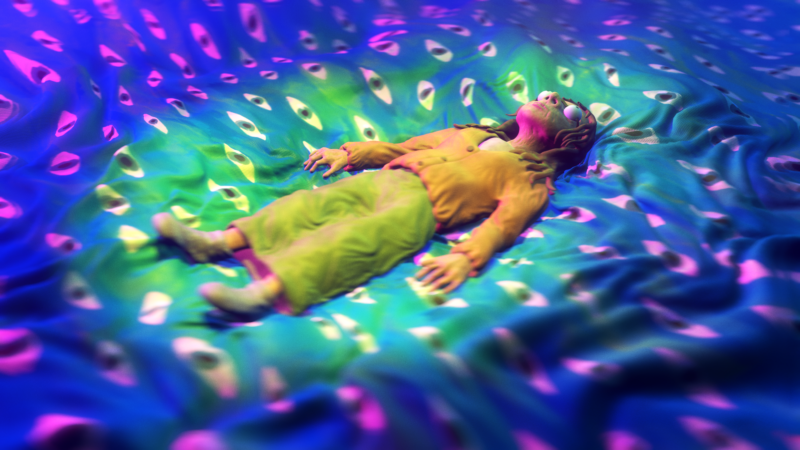
I imagined Before Your Eyes as a game wherein every time the player blinks, no matter what, the scene ends and the narrative jumps forward in time. “Could be five seconds, could be five years,” I found myself repeating over and over while pitching the game. (I did eventually add lenience to this system, so that the game cut to the next scene only once every few blinks.) I intended this eye-tracking mechanic as a ritual experience, enabling a player to viscerally experience grief and even ponder their own eventual death: a way to emotionally prepare for the way that death shocks us.
When I first showed off Before Your Eyes (at the time titled Close Your) at festivals, I would become engrossed watching players engage with the game. I’d check in as they finished the 20-minute demo, and every once in a while someone would tear up just before they would take the headphones off. I admit that I would nod in satisfaction at my codevelopers: We got another one!
I intended this eye-tracking mechanic as a ritual experience, enabling a player to viscerally experience grief and even ponder their own eventual death.
We were confident in our ability to provoke emotion using the physical feedback of blinks to shape players’ narrative experience. It didn’t work all the time at first, and for a while we were on the brink of canceling the whole thing when it couldn’t handle variations in eye shape. Truthfully, we never really cracked detecting blinks behind thick, dark-rimmed glasses, but we had to concede the effort.
So when I read Sofia Samatar’s story “Mirror, Mirror,” I felt as though it was speaking directly to me, a fellow meddler in eyes and art. At the heart of the story is a project undertaken by Oscar, an idealistic technologist, and Sabrina, a passionate young sculptor, to create a machinic set of eyes that can return and hold a person’s gaze. The endeavor is framed by Oscar as a way to advance social robotics, perhaps for medical applications, but it becomes increasingly clear that their quest is more ineffable and mystical: a search for truth and self-knowledge in the eyes of another. Like Oscar and Sabrina, I was trying to use the viewer’s own gaze to dredge up suppressed emotions and bring healing. And I hoped my game would be a shortcut, a way to practice grief without real loss.
I have been both Sabrina and Oscar; I’ve believed in the magic of technology and digital art to heal and connect. I’ve fallen in love with the ways we might craft new experiences. I was an early adopter of virtual reality and its capacity as an “empathy machine.” I cut my teeth freelancing for a studio that made “serious” VR experiences about harrowing real-life occurrences, like recreations of bombings in Palestine or being harassed by antiabortion protestors while you enter a clinic. I endeavored to use these new tools to find something more moving, more unexpected, more perfect—the beginning steps on a road trodden by Oscar, but also by Claude Monet, whose obsessional project to capture the vagaries of light and the ever-changing surface of the pond at his home in Giverny haunts Samatar’s story. Using blink detection in Before Your Eyes, I was chasing novelty, but as we started to gain attention at award shows, I began chasing perfection.
I can tell you exactly when my heart sank and the dread of a tragic ending struck me while reading “Mirror, Mirror.” It was when Sabrina described Marina Abramović’s famous 2010 performance piece The Artist is Present to Oscar; in that piece, visitors entered a gallery and waited in line for a chance to sit in a chair across from Abramović, who maintained a focused presence with the person and make direct eye contact. She sat for more than 700 hours over the course of 79 days. Sabrina mentions that visitors to the exhibit felt healed, but the artist felt drained. If Oscar had the same respect for the laws of thermodynamics that my physicist father drilled into me, he would never have tried to make a version of Abramović’s piece where there is no human artist whose energy is being drained. There is no free, unlimited energy device, and there is no The Artist is Present without an emotionally and physically depleted Marina Abramović.
I hoped my game would be a shortcut, a way to practice grief without real loss.
Looking back, I still regret how long it took to finish Before Your Eyes, despite how proud I am of it, and fully knowing that it couldn’t have gone any other way. At the time, I was obsessed with what it could be. We spent a lot of that seven-year span in pursuit of the perfect way to do things, always striving to come up with something more clever than the standard gameplay method or storytelling approach, always debating and arguing over the design decisions that would affect our players most profoundly. As creative director, I couldn’t stop giving notes, even on scenes that already moved me deeply and worked well. We built the game from nothing and fumbled many times before we found something true. But I still remember the two weekends of screaming rows with friends and collaborators over the way a plant would change if the player watered or didn’t water it (we ended up not even using the plant in the final game). It wasn’t until I started holding back on 90% of the feedback I was so preciously compiling and decided to trust in the talents and judgment of my collaborators that it finally came together.
This is to say, I felt for Oscar when he couldn’t resist trying to tinker and build upon The Artist is Present with his haunting, ultimately addictive set of unblinking machinic eyes. Why not try to create a perfect, infinite, tireless version of a piece of healing performance art? Sabrina, too, couldn’t resist the quest for restorative sculptural technology. During my time working on Before Your Eyes, I was similarly entranced by how image processing and tricks of the eye could demonstrate a new approach to experiencing a story viscerally.
Likewise, our narrator Clarissa, an irrepressibly curious art history student, can’t resist the pull of Oscar and Sabrina’s failed experiment in perfection, even when she learns how it’s broken them. And in the end, I don’t think any of Samatar’s characters are to blame. Most people are familiar with Narcissus’ tragedy—looking for too long, too deeply—and yet we can’t help ourselves. As Samatar writes: “For what is an artist but the one who sees? And what is a painting, a sculpture, or any visual invention but the embrace, through art, of what gleams on the surface of the water?” It wasn’t easy finally putting pieces of ourselves into Before Your Eyes: real retellings of trauma and loss, the frustrations between children and parents. Late in the process, I realized that I was making this game to give myself a rehearsal of grief; my father, 61 when I was born, would be gone much sooner than the parents of friends my age.
The specter of perfection is anathema to anything ever being made, any creative pursuit ever being finished, regardless of its quality
The lesson I took from the entire development of Before Your Eyes:Not only is the perfect the enemy of the good, but the specter of perfection is anathema to anything ever being made, any creative pursuit ever being finished, regardless of its quality. Sometimes I think perfection is an idea that belongs locked up in mathematics alongside unthinkable and abstract mysteries like the monster group or the value of infinity. But the reason that “the perfect is the enemy of the good” is such an oft-repeated maxim is that so many of us find the notion of perfection irresistible.
My father, who taught me the laws of thermodynamics, was himself unable to resist the lure of perfection in science. He worked at the Hughes Research Labs, and one day during his lunch break, a friend invited him into a private lab to check out something new: a perfect form of trapped light. Against the wishes of management, that friend, Theodore Maiman, had created the world’s first laser. Light bounced precisely between two mirrors until it shot out in a perfect beam. That sharp red dot that my father saw on the wall led to a lifelong fascination with (and career in) optics. Today, a laser like the one Maiman showed off that afternoon would warrant colossal mandatory safety warnings for goggles and other protection; a stray beam could’ve easily blinded one of my father’s colleagues. But how could they have known? When your machines promise to open a door to a new kind of world, a more perfect world, how can you resist looking for yourself?