
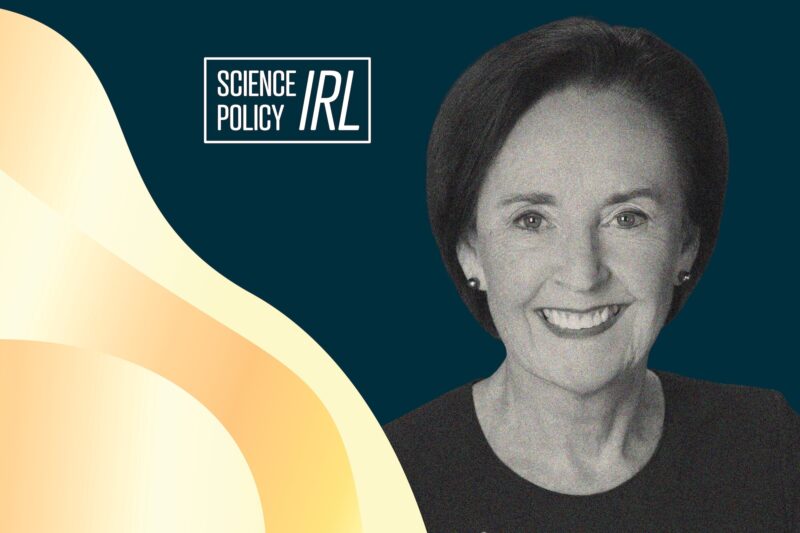
Mary Woolley Advocates for American Research
On Science Policy IRL, we talk to people in science policy about what they do and how they got there. In this installment, host Josh Trapani talks to Mary Woolley about leading Research!America for 35 years. During her tenure, Research!America grew into a major research advocacy organization and helped advocate for many changes, including doubling the budget of the National Institutes of Health.
In this episode, Woolley reflects on the transitions she has seen in science and the role of scientists over her career, and shares how researchers can engage with policymakers and the community.


Resources
- Read Mary Woolley’s letter in Issues about the importance of public engagement and understanding public sentiment.
- How do Americans feel about science? Check out the results from Research!America’s 2026 January National Survey.
- Learn more about the McClintock Letters Initiative, a national op-ed letter writing campaign to share why science needs investment.
Transcript
Josh Trapani: Welcome to The Ongoing Transformation, a podcast from Issues in Science and Technology. Issues is a quarterly journal published by the National Academy of Sciences and Arizona State University.
I’m Josh Trapani, contributing editor at Issues. In this installment of Science Policy IRL, I’m excited to talk to Mary Woolley, who led Research!America for 35 years. During her tenure, Research!America grew into a major research advocacy organization. They helped advocate for many changes, including doubling the NIH budget and a more engaged role for scientists in the community.
Mary, welcome. I’m excited to learn about your career, but first we always start these podcasts off the same way by asking our guests how they define science policy.
Mary Woolley: Hi, Josh. It’s great to be with you. I define it as everything that is part of the context of science. It’s not the conduct of science, but the context of science, and that includes the public and political context of science.
Trapani: What do you include in that context?
Woolley: Okay, I include funding for science, federal funding, but also private sector and philanthropy funding. Sometimes, especially in medical research, we have patient group funding. That’s part of the context. Public opinion, when I say the public, the data, and we’ve collected some of that data through commissioned surveys over 30 plus years. So the public attitudes, public questions. It was actually Abraham Lincoln who famously said, “Public sentiment is everything. Without it, nothing can succeed, but with it, anything is possible.” Those are some of the things that are part of the public context. There’s also a policymaker context, of course, and to use a kind of funny, if you want, a way of talking about that, it’s the golden rule—he who has the gold makes the rules.
It’s important for the science community to a person to think about the fact that unless they’re independently wealthy at very high levels, somebody else is paying the bill.
When it comes to federal support, that’s Congress and the administration—but it’s Congress really who has the gold. So they make the rules and that includes policy rules. The administration makes a lot of rules too. That’s important to keep in mind. And then in the other sectors, there are philanthropists who have the goal and others as well, the private sector. So it’s important for the science community to a person to think about the fact that unless they’re independently wealthy at very high levels, somebody else is paying the bill, and that calls for awareness, accountability, and constant learning about what that holder of the gold cares about and where aspirations align, and they align all over the place. We just often don’t talk about it that way.
Trapani: You worked in the middle of the context you just described for 35 years or more as the leader of Research!America. Can you give us a sense of what kind of science policy work you’ve done in your daily life, how you worked in that context?
Woolley: Well, in many ways, Josh, in many ways over those 35 years, and before that I was the CEO of an independent research institute located in San Francisco, no longer is extant because it’s been merged into a medical center. But in those years, I was working in policy as well. And when I say working in policy, I mean being informed about and working to change when appropriate, specific policies. They might be about, and one that’s alive at the moment is, indirect costs, but actually that’s been a policy challenge since the 1980s. And there’s other policies that have been challenging for a long time, those involving use of animals in research. After that, stem cell research, things that can be quite controversial. Lots of aspects of public health. Right now, vaccine utilization, of course, is very much something that needs to be engaged on. And we at Research!America, not just me personally but my colleagues as well, are involved and always, always funding for research of which we need more, not less.
Trapani: Could you talk a little bit, I know you’ve talked about this elsewhere, but how you came into the role at Research!America and maybe a little bit about what it was like to make the transition from the work you were doing before into the federal environment, whether that was a big transition for you or, as you said, you’d already been working in policy?
Woolley: Well, it was an enormous transition. As the CEO of what was in the Medical Research Institute of San Francisco, I was involved with a lot of things that CEOs are involved in. There are hundreds of people working there and we had grant support, philanthropic support, private sector support, doing, I would say, exceptionally fine research. But involved in that was making sure that our connections to our community, in that case San Francisco, but increasingly, the board members came from across the country, making sure that they understood what we were all about. So I instituted—this was a big lesson for me—I instituted a program for our board where we asked investigators at the Institute to give talks to the board so that they would come to understand in a better way what we were all about and would help us raise more money, frankly, for our work and to feel a real sense of ownership and pride in it.
And unfortunately, the first case was a disaster. This is how you learn. That particular scientist—who’s a celebrated scientist, I might add—gave a talk as though he were talking to his peers and that was not what was called for. There were very few, like two, I think as I recall, scientists on that particular board. So the chair of the board said to me afterwards, “Don’t you ever do that again.”
And whoa, okay. So what I learned from that was that, okay, it’s time for scientists to learn how to talk to some of the people who have the gold, if you will, and we started a program. I suggested it, and with colleagues we got it set up so that any scientist who wanted to talk to the board would first give a talk to the administrative and financial staff of that institute. And they were instructed, that staff, were instructed to raise their hand anytime the scientist said something that they didn’t understand, including words. So very few got through the first sentence without hands being raised and they learned. They learned how to talk to people who aren’t scientists, and that’s a big learning that I took to Research!America and have always stood for as a way to make friends for science. But the shocker of going from running the operations and the executive decisionmaking of a freestanding research institute to Washington, DC, was a big game changer for me. There were three employees at that point, including me, and we had a lot of work to do.
Trapani: That challenge that you gave the scientists to speak to the staff first, does Research!America run other programs or have you done a lot of things to help scientists become better communicators? Because obviously that remains a huge challenge for the scientific community.
Woolley: Yes, we do. We have lots of programs, as you mentioned, Josh. And also, I just want to make a really important point here. The science community had effectively outsourced that work to some rather spectacular and very influential individuals. For example, Mary Lasker; Paul Rogers, the former congressman; Jack Whitehead; John Whitehead; Susan Whitehead, that whole family; John Edward Porter, the former congressman; Ann Lurie; Herb Pardes; Isadore Rosenfeld ; Gordon Gund; former Senator Roy Blunt; former Health and Human Services Secretary Louis W. Sullivan; George Vradenburg; Jed Manocherian more recently. These are people, in many cases, of high personal wealth who made the commitment to speak for science and to convince political decisionmakers—remember those people with the gold who make the rules—to support especially medical research, but broader science as well, which is what Research!America increasingly has stood for—the broad science and technology enterprise.
Scientists themselves didn’t have to do it and could continue with the fond idea that they didn’t have to. They didn’t have to get involved in politics, if you will. They could just walk on by or hide their eyes. And by the way, it’s not part of the culture of science to learn about and get engaged in its context. It goes back to the personal-political context idea. I’ve been trying to change that, and not just me personally but others for years, but things have changed. Now to quote someone, you’ve probably heard this repeated many times by now, the prime minister of Canada’s recent speech at Davos. So Mark Carney, in speaking of the World Order 2026, he said, “This is a rupture, not a transition.” It’s true for science also. And more and more, we’re seeing that especially early career researchers want to get involved, don’t want to be blocked out of the public context of science. They want to be put to work, and we have lots of ideas for them in that regard.
Trapani: Can you let us know what are some of those ideas? If I am an early career scientist, let’s say, who hasn’t really entered the policy space, what are some constructive things that I could do?
Woolley: Well, there’s things you can do as an individual and there’s things you can do with others. So let me give you examples of both. So as an individual, you can make an appointment to go see your elected representative in her or his office locally, and they all have local offices within reach. So I’m talking about the person whose district you live in and whom you vote for or don’t vote for. You may think you have nothing in common with them, but you actually do. You both serve the public’s interest. So you’ll get that appointment. It might be with a staffer instead of the member themselves, but that’s important to do. To go and show up and talk to them as a constituent, not as a representative of the university of your state or wherever, but as a constituent who has a workplace, and your workplace might be that university, but your role, I got to emphasize this, is as a constituent.
So the reason that meeting is going to be taken by the member themselves or a staffer is that you’re a voter and they want your vote and they want the vote of all the people you connect with and influence. So you get that meeting, you show up, you thank the member of Congress or their staff for serving the public’s interests even if you disagree with many things they stand for—they’re still serving the public’s interest—and say, “I serve the public’s interest too.” And they’re going to ask you what you do, which is when you have the opportunity to speak to them in terms that are not loaded with jargon, but rather describe what you and that member of Congress, and people all around you, have in common and that’s aspirations for better health, better quality of life, security, and prosperity. All of them brought to you by science. You’ll have a great conversation, and you’ll learn some things too.
Now I also said, “What can you do in groups?” Let me give you the example of the McClintock Papers, which was brainchild of a group out of Cornell that later extended across the country. Its acronym is SNAP, and they came together in February 2025 and decided they were going to do something. These are all early career scientists, many postdocs, and they decided to organize to write letters to local hometown newspapers.
So the concept roughly was, “Hi there, I grew up in Lisbon, North Dakota,” that’s where my mother’s from, “In Lisbon, North Dakota, and I know you. I share your values. Lisbon, North Dakota is where I learned to be who I am today, which is a scientist. And I’m dedicated to finding answers to the problems that continue to concern, and in some cases actually plague, the people I grew up with and your family and friends. Today, and you may not know this, but today the science enterprise is being threatened with budget cuts and in other ways, and I’m asking you to think about helping. And the way you can help is let our congressmen and senators know that this is not the time to cut science.” And letters like that, and that was very much a paraphrase, appeared in over 200, letters and op-eds both, 200 newspapers around the country. And I’m telling you that congresspeople, senators, and their staffs read all local publications. So they ended up reaching the decisionmakers, but also a public that is likely to be interested and hopefully concerned.
Trapani: So it sounds like, at a high level, what you’re suggesting is that scientists make connections back to their communities, to society, and then that is the key to helping them engage with politics and policy. Is that how you would put it?
Scientists are invisible, whether you like it or not, and I don’t mean that lightly. They often don’t self-identify as a scientist because they’ve had bad experiences with that.
Woolley: Yep, I would put it exactly like that. And being invisible to the community is largely a reality. Scientists are invisible, whether you like it or not, and I don’t mean that lightly. They often don’t self-identify as a scientist because they’ve had bad experiences with that over time with people whose eyes glaze over or change the topic when they say they’re an astrophysicist or an agronomist or a fill in the blank. All of a sudden you make people who aren’t science trained feel bad about their lack of knowledge. And that’s not a good way to meet people where they are.
The right way when you meet somebody new or re-engage with someone who says, “Now remind me again, what do you do?” or they could be asking the first time, and you say, “Well, I work for you.” And stop and wait for the question, which could range from something that might get a laugh. “Well, could you put my suitcase in the overhead bin, please?” or whatever to, “What do you mean by that?” to which you say, “Well, you pay taxes, right?” “Oh, I hate paying taxes.” “Well, maybe I can tell you about something that you might actually be proud of paying for.” And then you go on from there. But again, not speaking in jargon and listening all the time for questions because questions is part of the scientific method. When people ask questions, they’re thinking like a scientist, something you can reinforce for them because scientists are held in very high regard by the American public as a profession, along with doctors and nurses. Scientists are right up there in the top three and have been for a very long time.
Trapani: I think you raise a really good point too by bringing up the linkage to the taxes people pay. I think it’s easy for a lot of scientists who are federally funded to forget that they are stewards of taxpayer dollars and that that should be part of everything that they do from the research they propose to the way that they go out into the community and engage as you’re suggesting. I would love to pull back for a couple of minutes and ask you some questions for the wonks in the room, including me. One thing that I’ve been really curious about is I read that you and Research!America were instrumental in the doubling of the NIH budget that occurred between 1998 and 2003, I think. That has become an iconic event, and despite all the attempts to replicate it for other agencies subsequently, it’s never happened again. I was wondering if you could just give us a little perspective, since you were there, about how that came to be and what it took to do that.
Woolley: Yeah, years and years. Yes, we’re really proud of the, and I’d say major, role we played in that, in doubling. And it was actually ‘99 to 2003, but that’s a small point. So back in 1993, there was a guest article in Science magazine by Harold Varmus, before he was the director of the NIH, and Michael Bishop and a third colleague that made the case, with a lot of data, that NIH could benefit—NIH and thus science and the public would benefit—from having double the amount of money available for it to invest in science. So I saw that, I mean, a lot of people read that, of course, and thought, “Oh, this would be an interesting idea to socialize with members of Congress who were known to be supporters of the NIH.” So I did that, and John Porter at the time was one of those along with Senator Hatfield and several others, actually.
And one of the things that came up was, “Gee, I wonder if the public would support that.” So we had already commissioned a couple of national opinion surveys. And so the next one we did, we tested it, tested whether people felt that the current—it was about three cents on the health dollar at that point—amount of money dedicated to research for health through the federal agency of NIH was about the right amount, too much, or too little. And we found out that most people thought that it was not enough, and some of them were saying that it should be 20% of the health dollar. So we did that enough times, plus informally socialized it, and those members of Congress did too, to know that there wasn’t going to be any problem around public support so that nobody was going to lose an election on the basis of supporting doubling the NIH budget.
We did enough surveys in enough individual states as well as nationally that came to the attention of by then Speaker Newt Gingrich, who initially was dismissive, even though he was a longtime fan of science. But I believe, and I don’t have evidence of this, but I believe did his own socializing, possibly surveying, and became a champion of doubling the NIH budget at a time when there was some saber-rattling about cutting it by 15%, 20%, 25%. So you can tell because you mentioned it was ‘99 was the first fiscal year that NIH got a major boost of 15% and that continued for five years, but it took from back in ‘93 to really work that through.
Now I will also say that something major happened to our country in that five-year period, and you’ll quickly remember it was 9/11. So everything changed in terms of our budget. We created the Department of Homeland Security, which almost overnight had a budget higher than the NIH. So money has really never been the issue, but we know that Vice President Cheney was on a war path to cut everything, so to speak, on the war to cut everything possible to fund that exactly, that war, and that included NIH. But President Bush stopped it because he had made a pledge to that very plan when he was running for office. So among other things, Research!America gave him an award for maintaining his promise, keeping his promise, and the Senate and the House both kept theirs and so that was accomplished in five years. Now, if you’ll allow me, I’m going to add a postscript to that.
Trapani: Please.
Woolley: I personally and others put in substantial efforts to try to get equivalent kind of commitments for the NSF and other agencies, but the time just didn’t seem to be right for that. Their communities involved weren’t organized to make it happen. And I don’t blame the communities. I just think it takes a long time to make these things happen. And finally, it’s going to happen again, and I’m counting on that being in my lifetime, that we’ll see doubling NIH and NSF and CDC—well, CDC needs more than doubling, frankly—and we’re going to see a surge in public support for the sciences. It’s overdue and we’re already way behind China, already.
Trapani: What do you think is going to bring that about?
Woolley: A combination of scientist engagement themselves, individual scientists, led perhaps by early career scientists, being visible and engaged in their own communities, valuing that in science. We have a huge potential army, if you will, out there in every congressional district who can be visible and be leaders for more public and policymaker support for science. And then there’s the global competitiveness argument. I mentioned China. The US is not good at being second place or third place or last place. It’s just not. And there’s a whole lot of reasons beyond just pride and nationalism. There’s clear economic advantages, among many others. We’re going to get there.
Trapani: I really like that optimistic view of the future, and one of the things I really like about it is that you’re really giving a lot of agency to scientists, individually and as a community, to bring this about. There may be a feeling among some right now that there’s really not a lot that they can do, but what you’re saying is, “Actually there is a responsibility here for all of us.”
Individual scientists have more agency than they think and partly that’s because they’ve been socialized to this pleasant fiction that they shouldn’t be involved or don’t have to be, but that is over.
Woolley: Absolutely right. I love your word agency. Individual scientists have more agency than they think and partly that’s because they’ve been socialized to this pleasant fiction that they shouldn’t be involved or don’t have to be, but that is over. I would say it never was there to begin with, and we’ve got a real wake-up call for science. A lot more vulnerable than we thought we were, and we can meet the moment. We can do it with the combined commitment of, as I say, especially early career scientists, but also scientific and professional societies. Academia has to really get behind this at the highest level. I foresee a day when promotion and tenure will include public engagement right up there with research and teaching and service. The meaning of service has really changed over time and often means service to science these days, but a big service to science would be connecting with the American public, a big service.
Trapani: Well, yeah. When you talk about promotion and tenure, you’re really talking about one of the big elephants in the room here and I think a source of frustration for a lot of scientists, academic scientists who would like to get more involved. So I have one more final question for you, which is hopefully a fun question.
Woolley: Oh, good.
Trapani: I read somewhere that you are a deltiologist. Could you say more about what that is and what that’s all about?
Woolley: Sure. It’s a strange word for collecting postcards. Now I have always been a person who writes letters, hand writes letters and sends postcards. I’ve done that all my life. What I didn’t know for many, many years is that there was a strong history of doing that in my family. And when my grandmother died, which was quite a while ago now, there was this box. The box itself is probably 120 at least years old right now, a big box that was filled with postcards from the 1900s and into the early parts of the twentieth century. And there were some letters in there too, but it was the postcards that were so fascinating. And combined with all the postcards I had sent my parents over the years, I had quite a treasure trove. And it turns out there’s other deltiologists in the world, of course. So it’s just one of those fun things I do, and I send postcards to my grandchildren now, any place I can find them. They’re very hard to find these days. People don’t use them anymore. We’ve got texts and TikTok and all those other things.
Trapani: So it started as a family, sort of personal history and then sort of grew from there. Is there one, either postcard or one aspect of them that you really, really enjoy?
Woolley: Well, I like the old ones for sure. There was quite a period of time when photographers in the earlier days of photography captured disasters, a fire in Alton, Illinois, and made it into postcards for people to send, people who lived there to send to friends and relatives who didn’t live in the same town to help them see what was going on there, what tragedy had befallen them. And so there’s quite a bit of that around if you’re willing to page your way through or pick your way through the postcard collections in the back of very dusty, dingy, secondhand shops. I’m proud to say that I have a son-in-law who’s very into doing this, so I have a companion when we go into those places.
Trapani: Oh, that’s great. Yeah, that’s really fascinating, not what you would think about for postcards. Mary, it was such a pleasure to speak with you today. Thank you so much for coming on the podcast.
Woolley: Thanks, Josh. It’s been fun and informative too. You’ve taught me some things. Thank you.
Trapani: Check our show notes to find more resources on Mary Woolley and Research!America’s work. Please subscribe to the Ongoing Transformation wherever you get your podcasts. Thanks to our podcast producer, Kimberly Quach, and our podcast editor, Shannon Lynch. I’m Josh Trapani, contributing editor at Issues. Thanks for listening.