
Water Breathing Is a Blind Spot in Animal Welfare Science
Concerns about animal welfare have been around for hundreds of years. In his “Introduction to the Principles of Morals and Legislation,” the philosopher Jeremy Bentham wrote in 1780 that the key question was not whether animals can reason, but whether they can suffer. The Royal Society for the Prevention of Cruelty to Animals was founded in 1824 and continues to raise public awareness and influence laws.
Related Reading
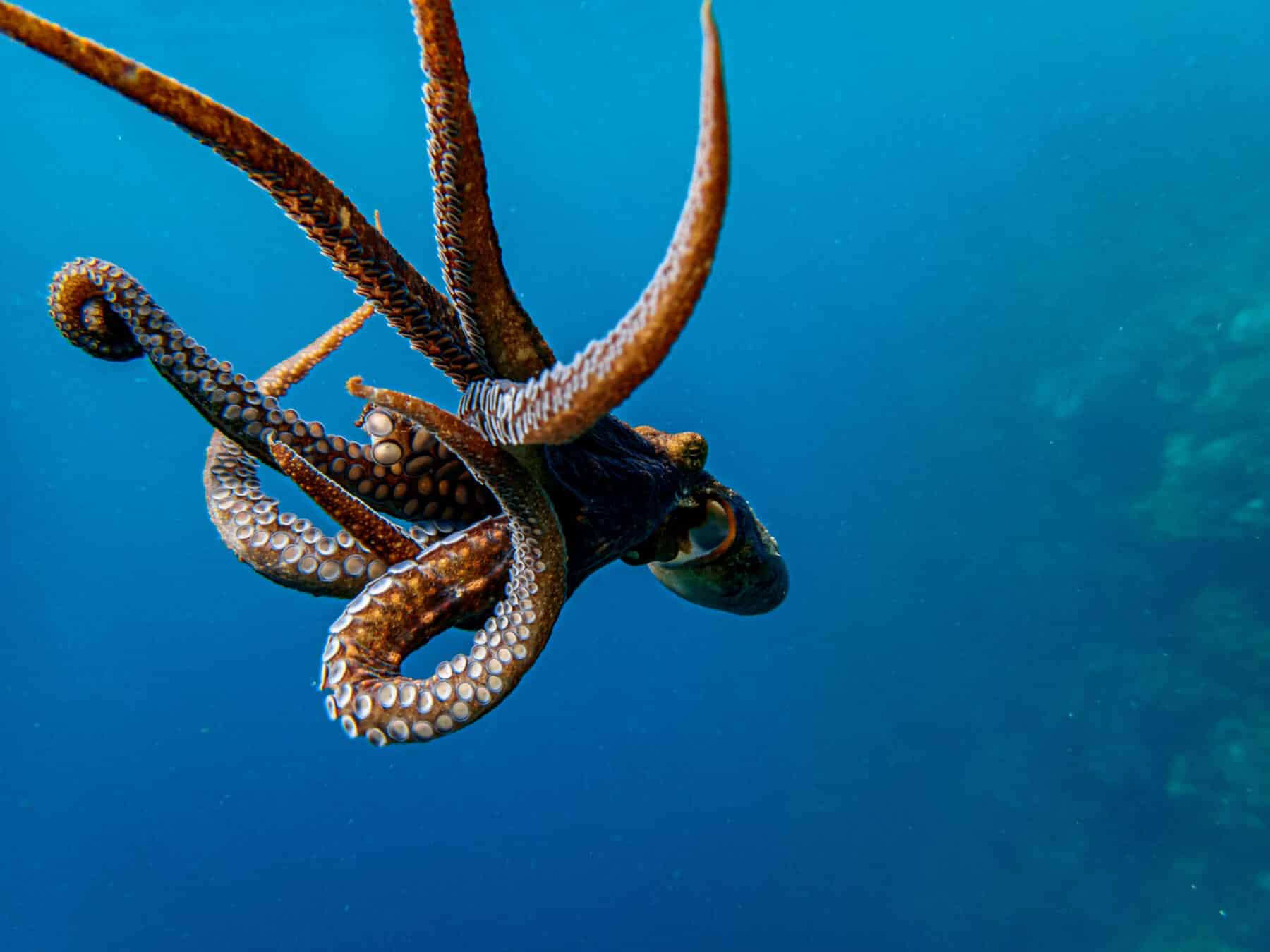
Still, some animals have been routinely overlooked: water breathers. This blind spot has harmed countless species, including fish, sharks, cephalopods, and other aquatic invertebrates. That harm is accelerating with industrial approaches to aquaculture and fishing, and as warming waters result in decreased oxygen in their habitats. Including broader consideration of how water breathers differ from air breathers in policy and practice could improve welfare for these animals, both captive and wild.
Bias in the air
The science of animal welfare dates back to activist and writer Ruth Harrison’s 1964 book, Animal Machines, which pointed out that industrial practices were treating animals as commodities rather than sentient beings. In his history of the field, animal welfare scientist Donald Broom recounts how the British government responded to Harrison’s book by setting up a committee in 1965; its subsequent report laid the foundations for animal welfare science as a field. Influenced by committee member William H. Thorpe, an ethologist who focused on insects and birds, the report states that there are “sound reasons” to believe “pain, suffering, and stress” are substantial in animals and refers explicitly to mammals and birds. The report’s call for animals to have freedom of movement for a variety of natural behaviors became known as the “five freedoms,” a reference to Franklin Roosevelt’s speech on the “four freedoms” essential for humans. The UK Farm Animal Advisory Committee later refined the list of freedoms as (1) from hunger and thirst; (2) from discomfort; (3) from pain, injury, or disease; (4) to express normal behavior; and (5) from fear and distress. However, because the five freedoms were conceived of by air-breathers about air-breathers, they say nothing about the freedom to breathe.
Missing elements
Endotherms, the warm-blooded animals such as mammals and birds, require a huge amount of food energy to maintain an elevated body temperature. For air breathers, hunger and thirst are of primary importance. But for water-breathing ectotherms, the availability of dissolved oxygen is preeminent.
Because the five freedoms were conceived of by air-breathers about air-breathers, they say nothing about the freedom to breathe.
That need for oxygen is why the world’s largest water-breathers (whale sharks and basking sharks) and the fastest water-breathers (tunas) have enormous gill surface areas. When surrounded by air instead of water, their gill lamellae, normally separated by the water flowing between them, clog up and cease to supply oxygen to the blood. A 1992 study examined survival of rainbow trout after they had been “played,” or “exhausted” on a hook before being reeled in; 72% of fish exposed to air for 60 seconds and 38% of those exposed to air for 30 seconds after this died within 12 hours, compared to 12% that were left in the water.
A handful of other studies have found that air exposure quickly raises plasma cortisol, glucose, and lactate concentrations, indicating physiological stress. A 2015 review published in the journal Fisheries recommended that captured fish be exposed to less than 10 seconds of air before being released, but we have observed very little or no sign of this in research, recreation, or commercial endeavors. Indeed, each of us has witnessed too many incidents of well-intentioned marine biologists taking water-breathers into stifling air to show to an audience, with no recognition of the pain they are inflicting. A 2018 discussion of the unique sensory world, or Umwelt, of a fish, led by a fish ethologist promoting humane fish farming practices, included analysis of chemical sensing and electrosensing, but did not explore the sensation of hypoxia. Efforts to improve water breathers’ welfare are missing the boat unless they appreciate something land dwellers find counterintuitive: Water-breathers without water to irrigate their gills are suffocating.
An exacerbating (and related) problem is the lack of understanding of what stimuli are painful to these species. Consider that an estimated 1.1–2.2 trillion wild-caught fin-fishes, 80 to 170 billion farmed fish, plus uncounted other water breathers are harvested or killed as bycatch each year. Though it’s long been known that fish have nociceptors (or pain receptors) and respond to analgesics, researchers’ investigations of pain have almost exclusively focused on questions related to angling and fish hooks by, for instance, applying electric shocks or irritants to the mouths of these animals. Pain resulting from low oxygen has been largely overlooked. This is a significant failure, given that air asphyxiation is the most common method of fish slaughter.
Efforts to improve water breathers’ welfare are missing the boat unless they appreciate something land dwellers find counterintuitive: Water-breathers without water to irrigate their gills are suffocating.
There is some newly available evidence, and it’s disturbing. In 2025, an international team considered behavioral and physiological lines of evidence to assess the pain associated with air asphyxiation in rainbow trout. Looking at behavioral, neurophysiological, and pharmacological indicators of a stress response, the researchers found that air exposure can cause “excruciating” pain in fish and noted that “even a few seconds of air exposure” has been associated with “higher expression of markers of neuronal activity in brain regions homologous to those involved in aversion processing in mammals.” What’s more, oxygen deprivation can quickly lead to acidosis, which activates autolytic (or self-dissolving) enzymes—the fish begins to marinate itself. Something similar happens when overexertion, as a fish struggles against a line or net, leads to hypoxic tissues. Along with postmortem processes, the stress caused by capture is associated with a condition described as “burnt tuna”: The tuna’s muscles degenerate and the flesh becomes green-tinged and sour-tasting.
If humans recognized the plight of water-breathers, we could easily—but uncomfortably—start to consider the pain of a fish being played on a line, lifted out of the water (along with other thousands of suffering conspecifics caught in a trawl or net), used in a study, or simply admired and photographed.
Unbreathable water
Hypoxia can also occur in the water. The World Organisation for Animal Health notes that elevated carbon dioxide levels in holding water, as well as asphyxiation by removal from water, both compromise fish welfare.
But concerns go way beyond holding water. As global ocean temperatures rise and nutrient runoff into oceans worsens as a result of human activities, ocean oxygen levels are declining. Warming oceans and marine heatwaves are a major risk to water breathers. Salmon, for example, are farmed by the thousands in net pens anchored to the seabed. If a small increase in ocean temperature triggers an increase in their oxygen demand, the trapped fish cannot seek cooler waters. Indeed, a study published in 2024 in Scientific Reports found that the occurrence of mass mortality events of farmed salmon increased in Norway, Canada, and the United Kingdom from 2012 to 2022.
To be sure, guidance for keeping water-breathers in captivity often includes maintaining acceptable ranges of dissolved oxygen. The American Fisheries Society’s Guidelines for the Use of Fishes in Research emphasizes maintaining acceptable ranges of dissolved oxygen and refers to it as one of “the most immediate issues” when it comes to fish density, though its focus is on animal husbandry and productivity rather than suffering. To ensure the welfare of water breathers, guidelines, practices, and general awareness must foreground the fact that these species’ major constraint is extracting the oxygen they need to live.
Modern welfare science arose in response to industrial farming practices on land over the past 60 years. Industrial farming of fish is both more recent and more complex. The aquaculture sector now produces about 94 million metric tons (mt) of animals each year—more than the 69 million mt of beef that are produced globally but less than the 120 million mt each of pigs and chickens. Land-based farming far outweighs aquatic animal farming, but aquaculture spans many more individual animals than terrestrial farming and many more species—at least 400 species across six phyla, almost all of which are water-breathers. A 2021 study in Science Advances (which Jacquet coauthored) reported that more than half of all farmed aquatic animal species lack even a single species-specific welfare-related publication.
To ensure the welfare of water breathers, guidelines, practices, and general awareness must foreground the fact that these species’ major constraint is extracting the oxygen they need to live.
In some contexts, even the most basic welfare knowledge is lacking. For instance, the aforementioned 2025 Scientific Reports analysis on air asphyxia in rainbow trout notes that some proposed alternatives to air asphyxiation (such as asphyxia in ice or chilling in ice slurry, as proposed for commercial octopus farms) would lead to even greater pain. They recommend mitigating the pain fish experience by first stunning them.
The knowledge relevant for water breathers extends beyond sensations of pain. Animal welfare science has expanded over the last several decades to consider not just how to minimize harm (something still unachieved) but also to increase positive welfare. In 2015, scientists expanded the original five freedoms framework to five domains: (1) nutrition, (2) environment, (3) health, (4) behavior, and (5) mental states encompassing both negative and positive experiences. When thinking about pleasures for water-breathers, one example is almost certainly spawning. Some female fish release up to 30% of their body weight in the form of thousands oxygen-demanding eggs, and then experience a flood of oxygen in their now-lean bodies. (With all this newfound oxygen, they have higher food conversion efficiency and, post-spawning, gain weight more quickly, impacting their general welfare).
Even if we cannot imagine the water-breather’s pleasure, we can make the intellectual and moral effort of considering hypoxia-caused suffering. A great first step tied to the rainbow trout study is the recent “22 minutes” campaign to draw attention to fish welfare and sentience, including water-breathing. The campaign’s title refers to the finding that rainbow trout experienced an average of 22 minutes of intense pain when asphyxiation was the means of slaughter.An expansion of the first of the five freedoms to include breathing—freedom from hunger, thirst, and asphyxiation—would be major progress. In the past, a better understanding of animals has reverberated through science and practice. For instance, evidence that whale species had minds and cultures helped spur a moratorium on commercial whaling.
Our mammalian bias, which has emphasized food as our main need and vision as our main sense, has rendered us oblivious to the plight of water-breathers. The Guide for the Care and Use of Laboratory Animals, produced by the US National Academies, holds that “unless the contrary is established, investigators should consider that procedures that cause pain or distress in human beings may cause pain or distress in other animals.” In principle this statement is encouraging—but practically it represents an enormous blind spot. We human beings do not breathe the same medium as those who breathe water. But breathing air relatively easily should not keep us from learning to care.