
Make Room for Robots
As robot-human interactions become more commonplace in urban spaces, policymakers can use a diagnostic to find the best existing tools for governance and determine when new ones are needed.
A security robot patrols a corporate lobby, a police robot roams a subway station, and a drone hums over a busy intersection. On a Chicago sidewalk, a delivery bot rolls toward pedestrians who duck aside. “This was a vehicle coming toward us,” one of those pedestrians later said. “It has cameras, its bright headlights were shining in full force, and we instinctively got out of its way.”
Robots are appearing in cities, raising concerns about privacy, safety, and shared spaces. However, as a category, “robots” vary in function, size, autonomy, and the spaces they occupy. Each variation offers a mixture of potential benefits, challenges, and harms. Following the International Organization for Standardization (ISO), we define robots as physically embodied machines that sense, decide, and act in shared environments. Just as a single “vehicle policy” would struggle to address forklifts, bikes, cars, and 18-wheelers, “robots” is a broad label for dramatically different devices, functions, and operational contexts.
For policymakers facing the introduction of these novel urban agents, it may be tempting to take a precautionary approach—possibly even prohibiting their deployment. Early experiences bear this out. Consider Chicago: In the past couple years, robotics companies Coco and Serve Robotics began testing food delivery robots in the urban core. By mid-April 2026, more than 4,300 people had signed a “Pause the Sidewalk-Robot Program” petition, with over a quarter of signers also submitting incident reports that included collisions, injuries, and robot-caused obstructions of wheelchairs and strollers. In February 2026, an alderman in one of the 14 pilot neighborhoods announced he would block further expansion after overwhelming community feedback. While some cities, like Dallas–Fort Worth and metro Atlanta, have welcomed drone deliveries, many—including Toronto, Knoxville, and Jackson—have banned delivery robots from sidewalks and bike lanes.
It’s true that, if integrated poorly into urban environments, robots run the risk of inconveniencing or even harming pedestrians and bikers, surveilling citizens without consent, and creating other hazards. But robots also bring many potential benefits to urban areas. They might serve homebound elders and increase mobility and accessibility for people with disabilities, reduce congestion or delivery-related emissions, monitor and repair crucial infrastructure, and take over dangerous and repetitive work.
Rather than throw up their hands or attempt to start from scratch in creating new “robot laws,” local officials can draw on an existing toolbox of policies and actions to govern city robots and meet public demands for clear behavioral rules, public consultations, and the release of safety data. Draft international standards, for example, include rules for robots to adopt stand-aside behaviors and respect a “shy distance” from humans. On public sidewalks, Americans with Disabilities Act (ADA) compliance requirements and commercial-use permits, like those used for food carts or sidewalk cafés, already apply.
What policymakers need is a way to find the right tool quickly and to identify where there are actual governance gaps. We propose three diagnostic questions to match governance responses with the robot problems at hand: 1) What kinds of spaces are robots occupying? 2) What kinds of interactions are being created? 3) What kind of infrastructure do robots depend on?
Each answer points to a different set of existing policy tools and to the places where new ones will need to be built.
What kinds of spaces are robots occupying?
A cross section of a single city block reveals the complexity of urban spaces, with at least four spatial layers stacked on top of one other. Each space is governed differently, and robots entering them must abide by those structures and rules. One question for policymakers, then, is which rules already apply to the space a robot occupies? Policymakers should consider four urban spatial layers: private spaces, semipublic spaces, public rights-of-way, and airspace.
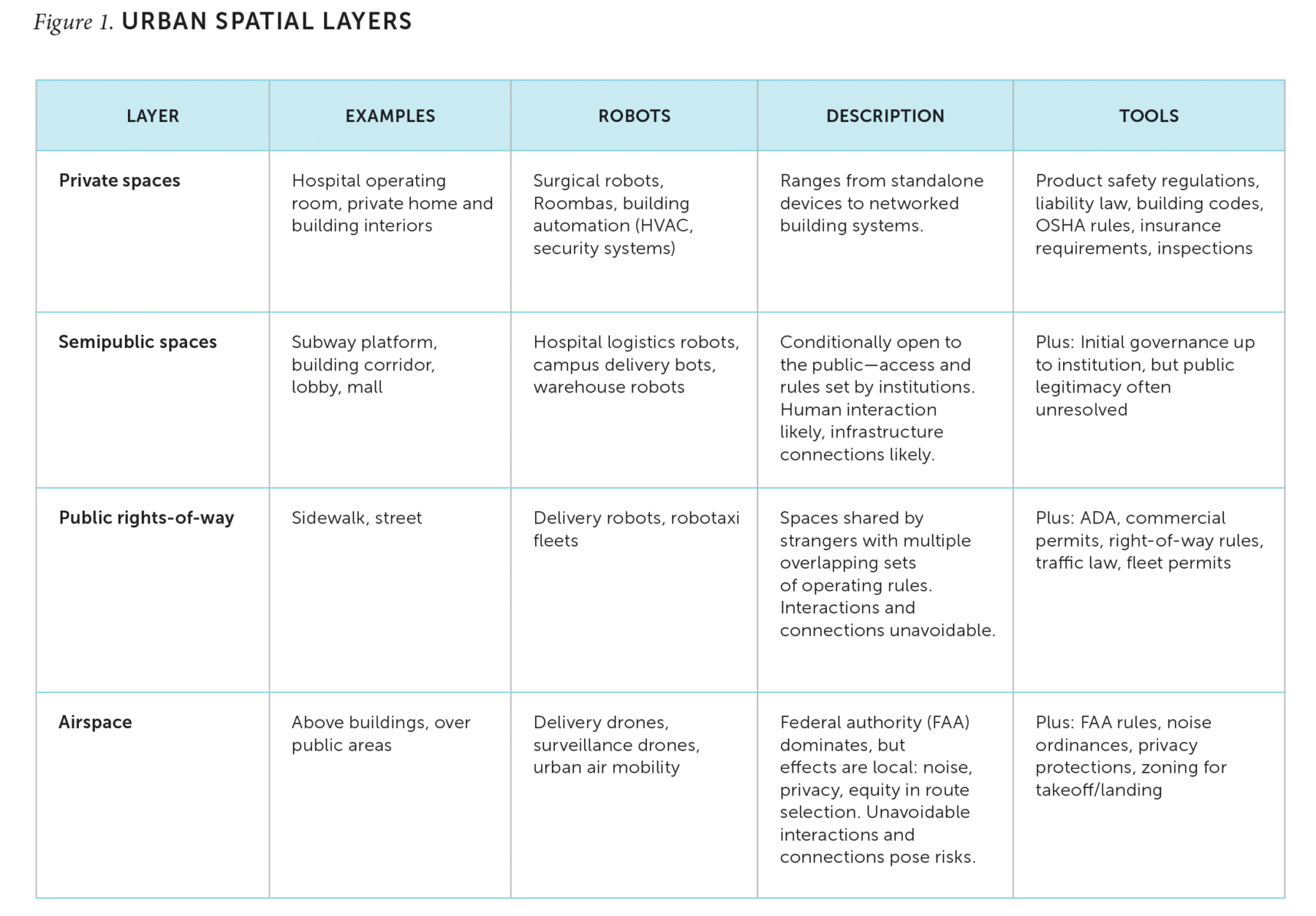
Private spaces, or more specifically private interior spaces, are perhaps the clearest governance situation. Domestic robots like Roomba vacuums, surgical robots in hospitals, and other robots that function in private spaces are covered by product safety regulations and liability law. Building-scale automation, like automated heating, ventilation, and air conditioning (HVAC) systems, offers an analogy for how these robots could be governed; in some ways, automated HVAC, security, and lighting systems replicate the sensing, decision, and action pathways of embodied robots. When buildings started to become automated in the 1970s and ’80s, these new systems slipped into environments with mature governance systems, including building codes, Occupational Safety and Health Administration (OSHA) regulations, insurance requirements, and regular fire or electrical inspections. Smart buildings inherited these governance systems without much friction, and today they serve more than 40% of US commercial floor space. Americans have been living with smart building systems for decades without needing new laws; the same may apply to robots in private, interior spaces.
But step outside, and the regulatory picture is murkier. Semipublic spaces are open to the public but only conditionally, since an institution controls access and sets the rules. For example, you can browse a mall, but only when it’s open, and security can ask you to leave. You can ride the subway, but the transit authority decides what’s allowed on the platform. This is where many robots operate, such as delivery bots on college campuses and security robots in office complexes. It’s also where some spectacular failures have taken place. In 2023, the New York City Police Department tried deploying security robots to patrol subway platforms. The experiment attracted attention when people couldn’t understand why the robots were preferable to security cameras, or how their surveillance data would be used and stored. Robots in semipublic spaces might be authorized by the controlling institution, but their longevity can depend on public acceptance.
Each space is governed differently, and robots entering them must abide by those structures and rules. One question for policymakers, then, is which rules already apply to the space a robot occupies?
Public rights-of-way—the streets—present even bumpier governance terrain. These spaces are shared by strangers; they also help give cities their “cityness,” with diversity and unexpected events on full display. As the Chicago delivery case suggests, space in this layer is a competitive resource where a deep bench of existing traffic law, licensing, and liability regimes already exist. Over a century, cities have segmented the street into roadways, sidewalks, and, increasingly, bike lanes. What may be newest is the contest at the curb, where delivery, ride-hail, bikes, and potentially robotaxi drop-off zones compete for limited footage.
Airspace is another place where robots are appearing, as Wing’s commercial drone delivery service for Walmart in metro Atlanta illustrates. The Federal Aviation Administration (FAA) has built a dedicated regulatory framework for drones, including pilot certificates and a mandatory “digital license plate.” The agency’s authority over airspace preempts most direct local control of flight itself, which gives cities less room to maneuver than they have with sidewalk and street regulations. But drone noise and surveillance are intensely local and will be felt by some neighborhoods more than others. Cities still have power to intervene, for example, with noise ordinances and zoning for launching and landing sites; Princeton, Texas, for one, has already used such ordinances to set hours of operation for drone delivery hubs. FAA also provides opportunities for public review through environmental reviews under the National Environmental Policy Act.
Asking “What kind of spaces are robots occupying?” helps direct attention to existing governance tools and highlight where new ones may be needed.
What kinds of interactions are being created?
Robots span a spectrum of social interactions, from those attending to single individuals to those serving broader public functions. Devices designed around one-to-one interactions include assistive exoskeletons that help paralyzed individuals walk, companion robots for the elderly, or educational robots for children. For these one-to-one robots, the governance picture is relatively clear. User consent requirements, the participation of professional intermediaries (like doctors or therapists), or product liability and Food and Drug Administration medical device regulation are all ready-to-hand governance tools. Most questions concerning the regulation of these robots are about carefully applying existing tools rather than inventing new ones.
The more difficult cases involve more populous social interactions, when robots stop interacting with consenting individuals and start interfacing with strangers. Delivery robots, warehouse robots, and autonomous vehicles are examples of robots that enter a flow of movement among other workers, pedestrians, or vehicles. Current right-of-way law assumes agents are human or human-operated. The question of how robots should yield to pedestrians and communicate their deference has no existing answer. As the Chicago anecdote we opened with shows, norms may be inverted in practice—with pedestrians stepping aside—before governance weighs in. Self-driving cars may come with their own federal and state regulatory ecosystem but share right-of-way challenges.
There’s no one-to-one consent agreements for these 40- to 4,000-pound robots, which must read and respond to the behavior of strangers. Still, there are existing resources for governance. Draft international standards like the ISO 4448 series cover sidewalk-robot behavior, communication with vulnerable road users, and incident reporting. These standards do not carry direct legal force in the United States, but there is precedent for international standards being rolled into domestic regulation, such as OSHA’s robotics safety guidance, which draws on the ISO 10218 series. As ISO 4448 matures, cities could reference its provisions in delivery-robot permit conditions.
Some cities have moved ahead on their own. Los Angeles, for example, produced detailed rules for personal delivery devices, as they have done for bikes, scooters, and vendors, which include speed limits, weight caps, ADA-compliant signage, and data-sharing requirements. These rules draw on the same spatial governance tools cities use to manage sidewalk space (e.g., permits, right-of-way rules, and insurance mandates).
At the far end of the social interaction spectrum are crowd-scale applications. These robots might take the form of drones monitoring a music festival, facial recognition-equipped robots at transit hubs, or mobile trash pickup machines moving among crowds. Fundamentally, many robots are mobile data-collecting platforms operating in public spaces. Such machines raise concerns about privacy and data storage, with a range of consequences, including intrusions of state power into public spaces. Laws regarding storefront security cameras and police body cameras, as well as biometric information privacy laws, offer existing parallels that policymakers can draw on. But as residents of Chicago point out, the “massive and growing” dataset robots are compiling is an elephant in the room that demands attention from policymakers, especially as robot fleets grow.
Moving along the spectrum of interactions from individuals to flows of traffic and public crowds, the spillovers and potential impacts become more consequential. Exploring social-interaction questions queues up different governance discussions, including product safety for personal devices, right-of-way and accessibility rules for flow-based interactions, and privacy and democratic legitimacy for crowd-scale surveillance.
What kind of infrastructure do robots depend on?
The third diagnostic question enables consideration of risk by looking at how tightly the robot is coupled to urban infrastructure. For example, when an uncoupled, standalone device like a Roomba fails, it affects only a private user. But in more institutionally coupled robots, such as those used in buildings, hospitals, or city streets, the lines are blurred between the machines and the smart-city environments where they operate. When intelligence is distributed, it can lead to communication failures and far-reaching consequences.
Exploring social-interaction questions queues up different governance discussions, including product safety for personal devices, right-of-way and accessibility rules for flow-based interactions, and privacy and democratic legitimacy
for crowd-scale surveillance.
We use “medium coupling” to describe robots that depend on shared networks. The autonomous mobile robots that hospitals use to ferry medications or linens between floors often run on the same Wi-Fi network as the patient record system, for example. Automation systems embedded in buildings—again, a good analogy for robots—sense, decide, and act in shared environments, and failure can propagate through this connected infrastructure. In 2016, a distributed denial-of-service attack overwhelmed the automation controllers in two apartment buildings in Lappeenranta, Finland, trapping the controllers in an endless reboot loop and cutting off heating for roughly a week in below-freezing temperatures. The takeaway is that medium-coupled systems can fail for reasons that originate outside the system being governed. To respond to such vulnerabilities, cities might rely on procurement as a leverage point by, for example, requiring security audits before signing contracts and mandating incident reports and network dependency disclosures.
As coupling deepens even further—if robotaxis communicate with traffic signals, building systems tie to smart grid demand-response, or emergency robots tie into 911 systems, for example—the stakes rise even higher, as illustrated by the 2025 Waymo blackout.
The Waymo blackout
This three-question diagnostic can bring clarity to decisionmakers dealing with complex situations. To demonstrate how it works, we consider one of the spookier—and more hazardous—examples of robots running into trouble on the streets. On December 20, 2025, a fire at a Pacific Gas & Electric substation resulted in a power outage for roughly a third of San Francisco. Traffic signals went dark and Waymo’s robotaxis, programmed to treat broken stoplights as four-way stops, began requesting remote “confirmation checks” from human fleet-response agents. The scale of the outage overwhelmed the remote assistance pipeline and the robotaxis froze in place, blocking intersections and arterial roads. They also hindered first responders. The city’s 911 dispatchers reported difficulty reaching the company for information about where the stalled cars were located; one dispatcher was put on hold for nearly an hour. In subsequent hearings, Waymo disclosed that there had been nearly 1,600 stoppages during the outage period and that 64 robotaxis required manual retrieval. One city supervisor asked whether San Francisco’s first responders should be expected to act as “roadside assistance” for a multibillion-dollar company.
Applying the three-question diagnostic to the Waymo blackout begins with considering space. The blackout unfolded on public rights-of-way, including city streets, intersections, and arterial roads. California’s autonomous vehicles regulations are some of the most developed in the country, but were largely designed around individual vehicles rather than fleets. During the blackout, Waymo’s cars treated dark signals as four-way stops, exactly as the rules require. But the state vehicle codes do not address the nearly 1,600 autonomous vehicles simultaneously executing this same cautious behavior and paralyzing the street network.
Looking next at kinds of social interactions, the blackout created a cascading disruption much larger than a one-to-one event. Philip Koopman, professor emeritus of engineering at Carnegie Mellon University, called it an “operational management failure,” meaning the chaos was not traceable to a software flaw or a vehicle code violation, but rather to the system’s inability to absorb so many vehicles needing assistance at once. “What if this had been an earthquake?” Koopman asked, highlighting the need to scrutinize automated vehicles’ use of emergency routes in dire situations.
There is no framework for what happens when hundreds of algorithmically operated vehicles fail simultaneously. More broadly, robot fleets’ monoculture problem—same software, same failure points—does not have an existing governance analogue in surface transportation. This points in a direction different from transportation law, suggesting the need for fleet management regulations similar to resiliency requirements imposed on telecom or utilities. For example, the Federal Communications Commission requires communication providers to maintain backup power systems and coordinate restoration during disasters because the public depends on these systems. Both Koopman and Missy Cummings, director of George Mason University’s Autonomy and Robotics Center, have argued that additional permitting should be required for robotaxi operators once their fleets grow beyond a certain threshold.
Finally, asking about infrastructure coupling draws attention not only to the Waymo fleet’s dependency on functioning traffic signals, but also to its reliance on cell networks to communicate with remote operators, cloud infrastructure to process those communications, and, perhaps most importantly, the small human team of reviewers who were responsible for confirming decisions when the cars were uncertain. Hearings revealed that Waymo had limited remote assistance operators to service its fleet, so when 911 dispatchers also tried to reach the company, they were placed on hold. To avoid similar situations in the future, policymakers could consider imposing backup capacity requirements for emergency situations or minimum staffing ratios, as is the case with air traffic control towers. Cummings has called for federal regulation of teleoperations (the remote-human-assistance layer that most automated vehicle companies rely on), including training and certification standards for human reviewers.
As decisionmakers consider the risks of robots interacting with infrastructure, they may wish to use other tools to provide additional public transparency and reassurance against multiple failures across a distributed system. For example, New York City’s procurement for autonomous vehicle testing asks that operators certify adherence to “industry best practices” but goes little beyond self-attestation, at least so far. California’s proposed regulations go further. They would require what is called a “safety case” to explicitly state the company’s claims about its system’s safety and the evidence supporting those claims. These requirements are typical in aviation and the nuclear industry, and unlike standard self-certification procedures, rigorous safety cases can be audited by third-party experts and subjected to stress tests the company itself may not have anticipated. This would constitute a shift from the companies saying “trust us” to “here are our safety tests, and here’s how you can stress test them.”
Coexisting with the robots
Local officials facing robot encroachment of urban areas can begin taking three actions immediately, none of which require new state or federal authority. First, use procurement as leverage: Any contract or permit cities sign with robot operators can require incident reporting, accessibility audits, disclosure of teleoperation staffing, and limits on what data the robots may retain about the people they pass. Second, begin building the coordination layer. Identify a single point of contact in city government for robot-related incidents, a public registry of authorized deployments, and a standing channel between local officials and emergency services for fleet-scale failures. Third, strive for transparency. The patchwork of local responses becomes less haphazard when cities publish their permit conditions, incident data, and lessons learned, so that other officials—and those in other cities—don’t have to start from scratch.
It’s worth remembering that cities have been disrupted by alien agents in the past. A century ago, the arrival of the automobile threw cities out of balance. Automobiles were called “devil wagons,” “juggernauts,” “death cars”; a Georgia court classed them with “ferocious animals.” The Farmers’ Anti-Automobile League reportedly urged members to spend Sundays “chasing automobiles, shooting and shouting at them.” Policy and regulation lagged the new technology. In the “years of driving dangerously” of the early twentieth century, there were no stop signs, traffic lights, lane lines, brake lights, driver’s licenses, or posted speed limits. It took decades to work out the rules of the road—and today’s average of 40,000 traffic deaths every year suggest we never fully did.
Robots are different from cars in scale and potential lethality, but the pattern is familiar. When new agents arrive in shared spaces, existing norms are disrupted and the question of accommodation remains open. Our three-question diagnostic offers a starting point for policymakers to identify the tools they have and the ones that are missing.