Robert Rauschenberg: Reinventing the Art of Flight
“I always liked Leonardo so much, because he had a curiosity that was boundless. I thought I had the curiosity of the Wright brothers.” Robert Rauschenberg’s observation offers an entry point into the artist’s lifelong engagement with flight. For him, Leonardo da Vinci and Orville and Wilbur Wright represented more than milestones in the history of invention. They embodied curiosity, experimentation, and a willingness to pursue possibilities that had not yet been realized. Rauschenberg’s fascination with flight consequently extended beyond aircraft and space exploration to broader questions of ingenuity, freedom, technological progress, and the relationship between nature and culture.
Leonardo’s Codex on the Flight of Birds (1505–06) represents an early investigation into the mechanics of flight and the possibility of human ascent. Four hundred years later, the Wright brothers transformed that aspiration into technical reality with their first successful powered flight in 1903. Rauschenberg was fascinated by the connection between imaginative speculation and technological achievement. In 1996, when asked what work of art other than his own he wished he had created, he replied that he would have liked to help the Wright brothers develop their concept of “flying bicycles.” The response reveals his attraction not simply to the accomplishment of flight, but to the inventive process that made it possible.
This spirit of inquiry shaped Rauschenberg’s artistic development. At Black Mountain College in North Carolina, where he studied from 1948–49 and 1951–52, he encountered an interdisciplinary environment that challenged conventional artistic boundaries. His collaborations with choreographer Merce Cunningham and composer John Cage encouraged him to consider movement, sound, performance, and visual art as interconnected forms of expression.
In New York during the 1950s, Rauschenberg deliberately resisted the dominant conventions of Abstract Expressionism. Rather than emulate artists such as Jackson Pollock, Mark Rothko, and Willem de Kooning, he developed a practice that incorporated drawing, painting, sculpture, photography, collage, screenprinting, theatrical design, and found objects. His Combines (1954–64) were especially important in this development. By bringing together photographs, fabrics, printed images, and everyday objects, he challenged distinctions between painting and sculpture and created what he described as a space “between” life and art.
Rauschenberg was fascinated by the connection between imaginative speculation and technological achievement.
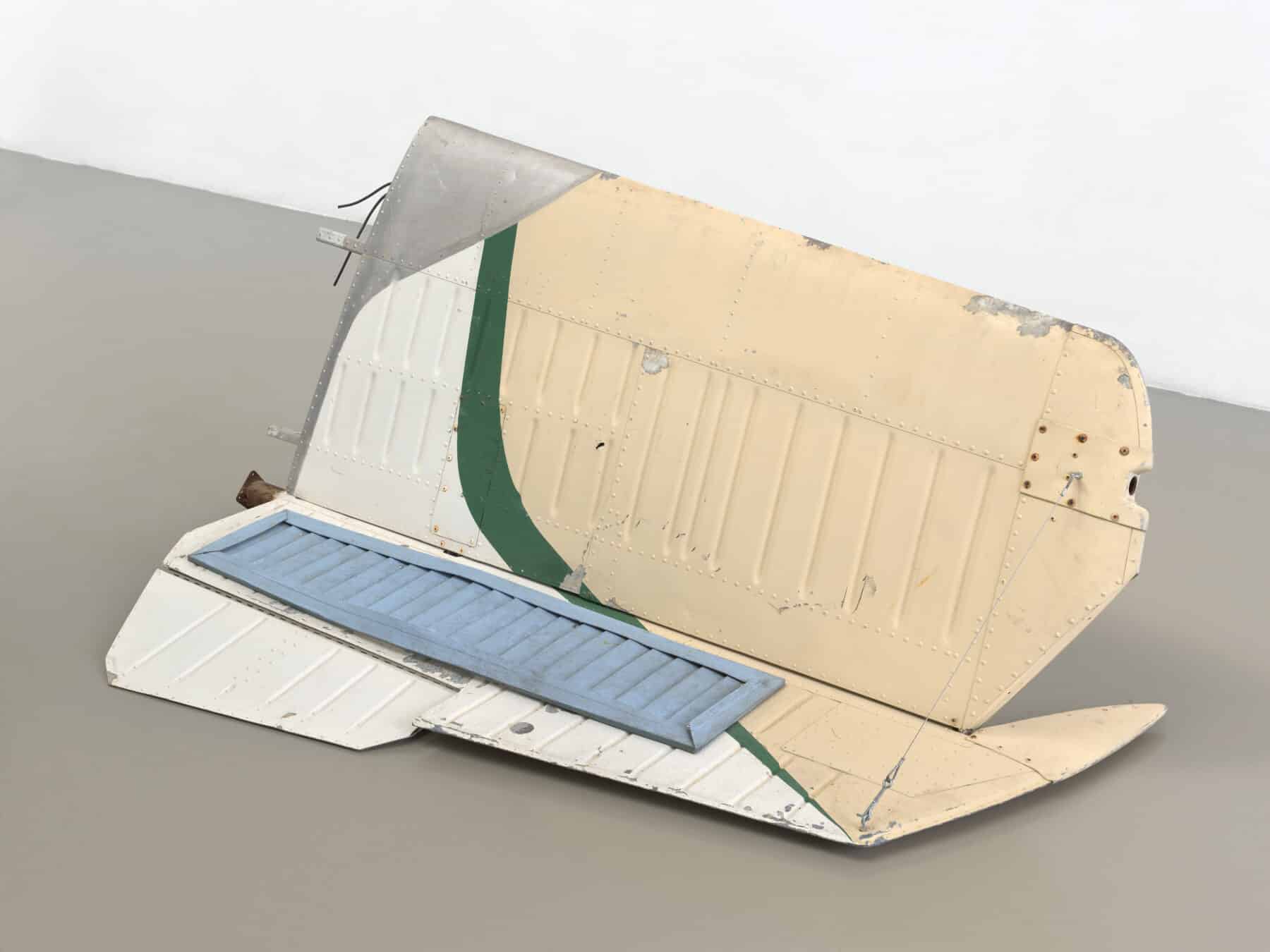
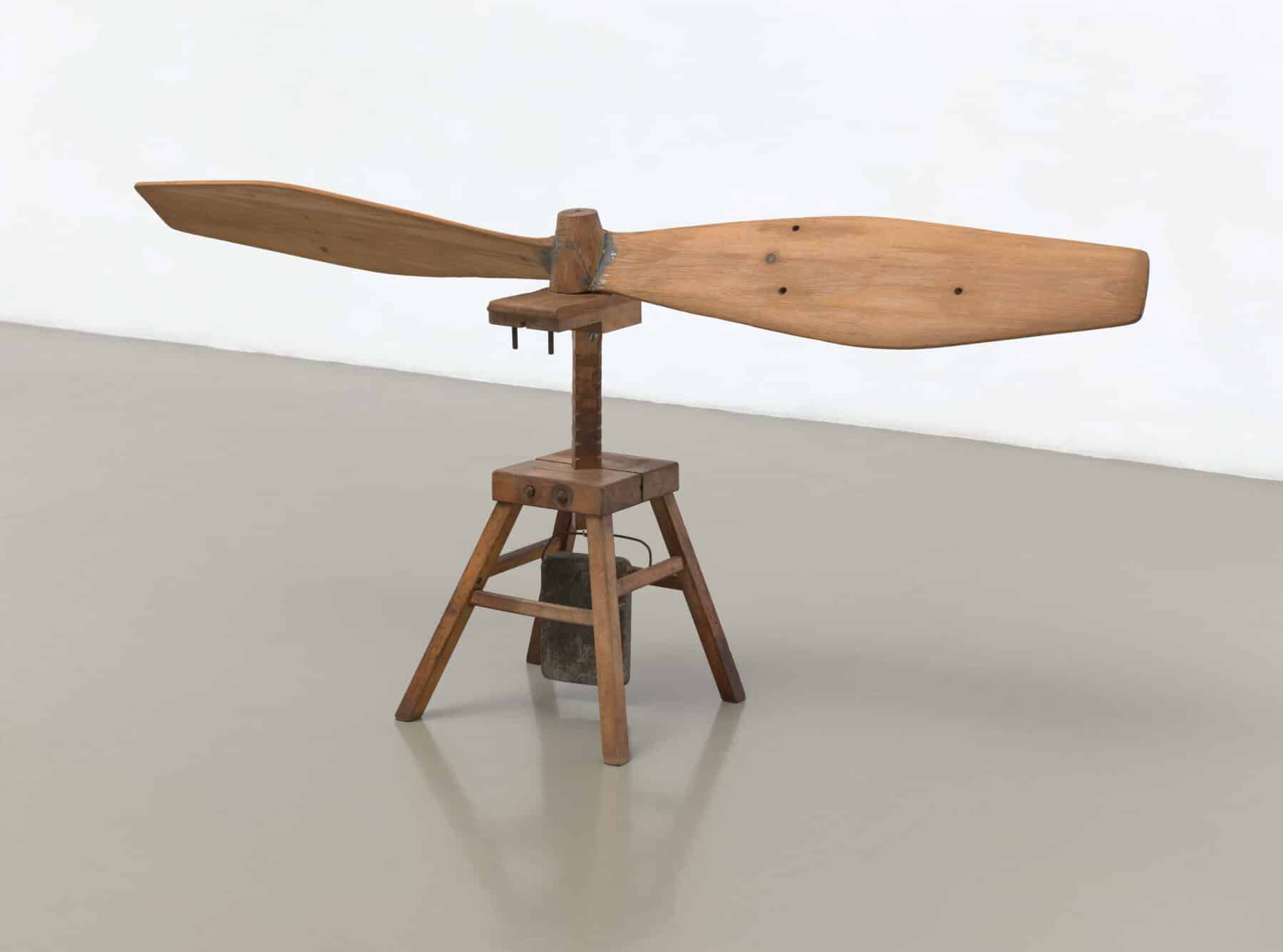
Flight offered a natural extension of this boundary-crossing practice. Rauschenberg repeatedly incorporated aircraft, rockets, parachutes, bicycles, birds, and insects into his work. Birds in particular invoke the traditional association between flight and freedom while also reflecting his interest in wildlife and environmental concerns. In works such as Odalisk (1955/58) and Canyon (1959), avian imagery becomes part of the complex structures of his Combines, allowing flight to operate as both visual subject and metaphor.
The Wright brothers remained a particularly important source of inspiration. Kitty Hawk (1974) and Killdevil Hill (1975) use bicycle imagery to reference the brothers’ bicycle business in Dayton, Ohio, and their eventual achievement at Kill Devil Hills, North Carolina. For Rauschenberg, the bicycle represented the transformation of an ordinary technology into a means of achieving the extraordinary. This idea of reinvention recurs throughout his work, including in pieces such as Prehistoric Rose Spore (Kabal American Zephyr) (1981).
His participation in NASA’s Art Program in 1969 expanded this inquiry from aviation to space exploration. At the Kennedy Space Center, Rauschenberg witnessed preparations for and the launch of Apollo 11, gaining firsthand access to the technological and human dimensions of the mission that culminated in the first human landing on the Moon. His earlier interest in space had been shaped largely by images reproduced in magazines, but his experience with NASA provided new materials, perspectives, and observations that transformed his approach.
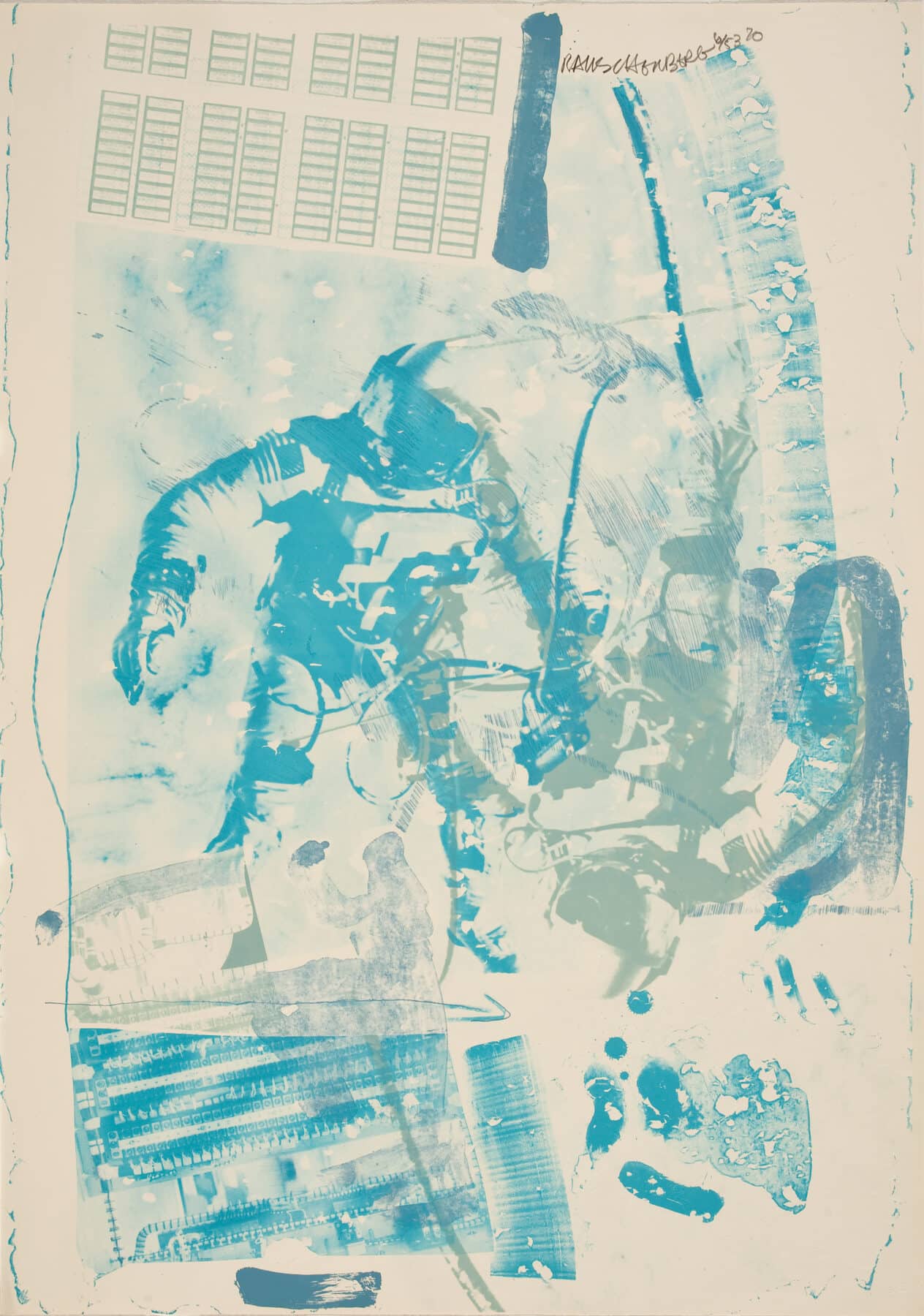
The resulting Stoned Moon series (1969–70), comprising 33 lithographs, reflects both the achievement of the Apollo program and the questions it raised. Rauschenberg did not treat space exploration simply as a triumph of technology. White Walk (Stoned Moon) (1970), for example, portrays astronaut Ed White during his historic 1965 spacewalk alongside a circuit breaker panel and spacecraft annunciator system. The floating astronaut conveys the freedom and exhilaration of moving beyond the spacecraft, while the warning equipment introduces the vulnerability of the human body in space. The work recognized that exploration depends upon both courage and technological safeguards. Expanding human possibility often entails confronting significant risk.Rauschenberg’s response to the space program was also shaped by the political and social tensions of the late 1960s. The Stoned Moon works celebrate the achievement of reaching the Moon while reflecting the Vietnam War, racial and gender inequality, and the loss of cultural icons. His interest in space therefore existed within a larger inquiry into the promises and contradictions of technological progress.
His curiosity also led him beyond official NASA projects. In Moon Museum (1969), Rauschenberg collaborated with Forrest Myers, Andy Warhol, Claes Oldenburg, and others on an unauthorized effort to place an artwork on the lunar surface aboard Apollo 12. His later interest in participating in the Space Shuttle program and obtaining space-related materials, including Moon dust, further illustrates his desire to engage directly with the materials and technologies of exploration.
Nature remained equally important to his conception of flight. His kite works, including Sky House I and Sky House II (1988), explored the interaction between art and wind, while the Hoarfrosts (1974–76) incorporated images of hang gliders and used unstretched fabric in ways that allowed environmental forces to influence their presentation. His desire “to create a painting that would not be art if nature would not accept it” suggests an unusual willingness to surrender control and allow nature to participate in the artistic process.
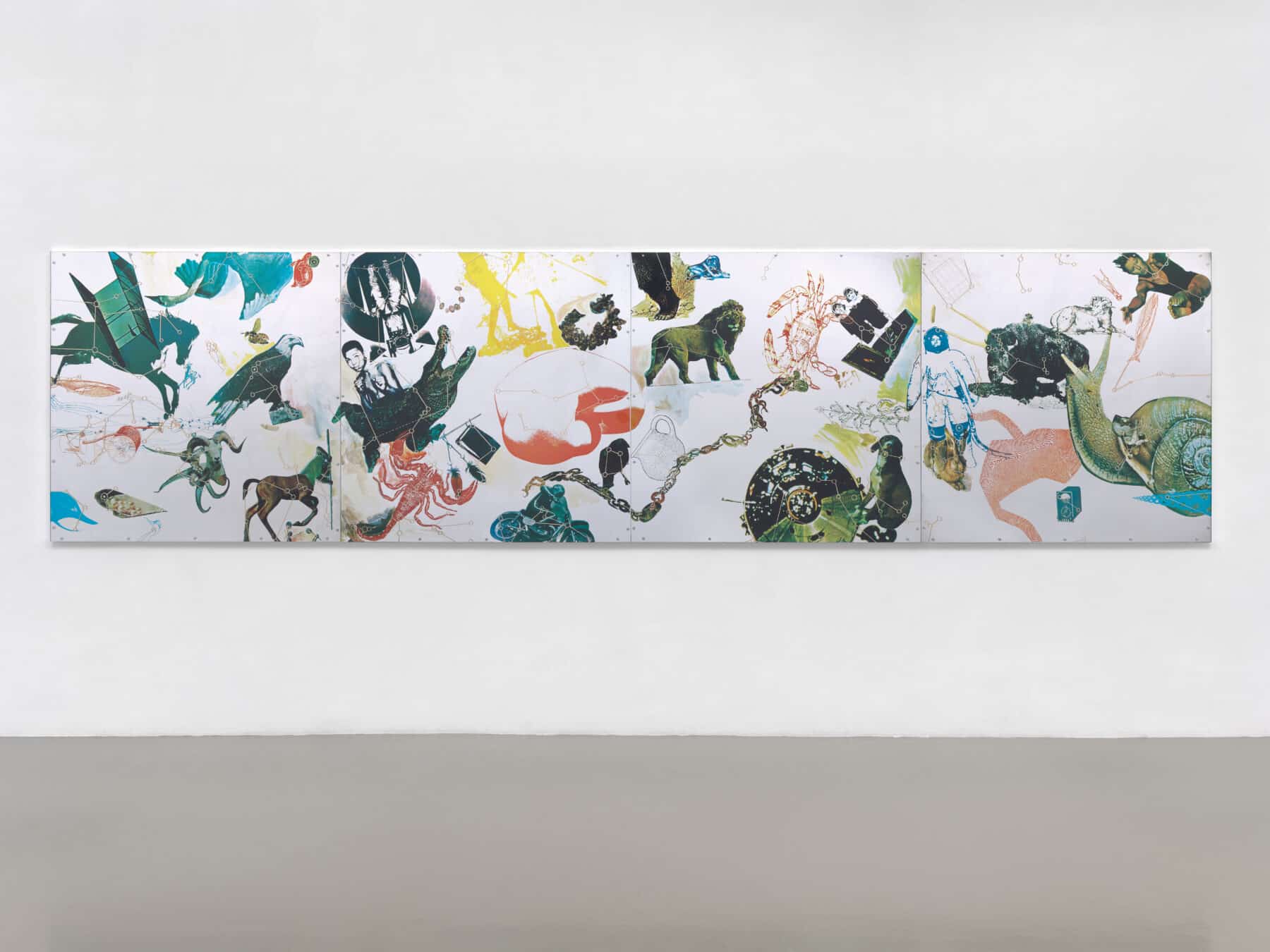
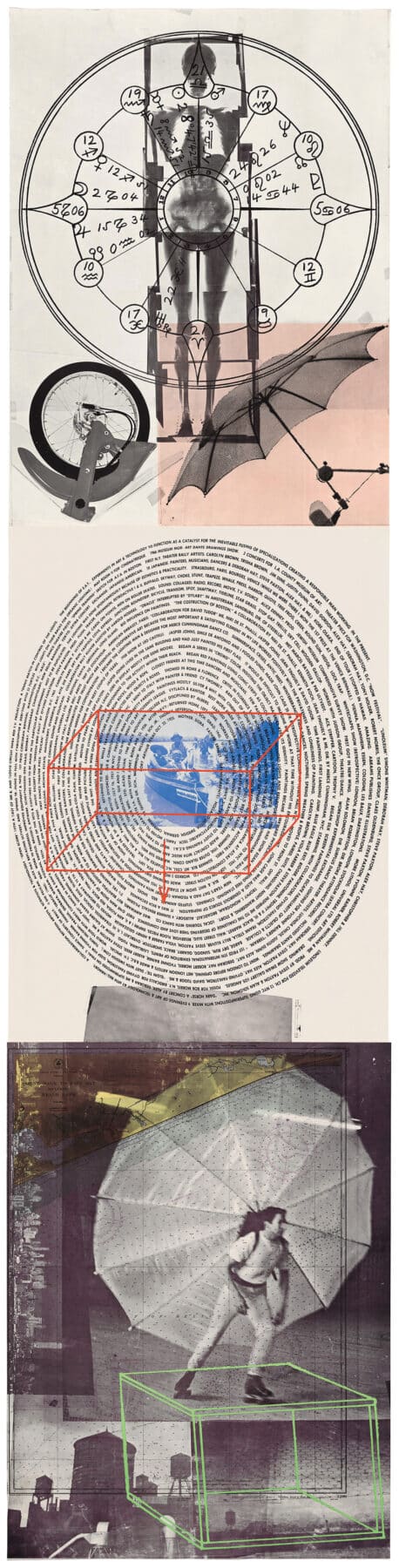
Rauschenberg brought the same combination of research and imagination to his representations of the cosmos. In Star Quarters I–IV (1971), he reconfigured constellations through contemporary cultural figures and imagery. A portrait of twin girls by photographer Diane Arbus stands in for the Gemini twins, while the winged horse Pegasus appears with biplane wings reminiscent of the 1903 Wright Flyer. Although the works initially seem playful or disorienting, their compositions were carefully positioned using star charts and other reference materials. Scientific systems became a framework for artistic intervention.
Rauschenberg’s engagement with flight is more than a recurring subject. It provides a framework for understanding his larger artistic philosophy. Flight allowed him to explore curiosity, freedom, experimentation, risk, and human possibility while moving fluidly among art, science, technology, and nature. Leonardo imagined flight; the Wright brothers transformed that imagination into achievement; and Rauschenberg translated their spirit of inquiry into an art that continually tested the boundaries of what could be seen, made, and imagined.
His work argues that exploration is not the exclusive domain of scientists or engineers. It is also an artistic impulse: the willingness to question what is known, experiment with what is available, and imagine what might exist beyond the limits of present experience. For Rauschenberg, flight became a powerful metaphor for that process, and an invitation to look outward, cross boundaries, and remain open to possibility.