
Education, Social Invention, and a Society in “Spiritual Chaos”
Nearly 80 years ago, a report appeared on President Harry Truman’s desk requesting a 1,400% increase in federal funding for educational institutions, arguing for “free exercise of initiative” rather than top-down oversight, and supporting basic research at universities in the name of national security. No, it was not that report.
The six volumes of Higher Education for American Democracy, published in 1947, in many ways constitute the forgotten twin of Science, the Endless Frontier, Vannevar Bush’s treatise on the US postwar scientific enterprise. (And yes, like Bush’s report, Higher Education for American Democracy was also described as “a blueprint” by none other than The New York Times in 1948.) Along with an unequivocal demand to desegregate higher education, the report advocated expanding access through federal scholarships, tripling the number of 18–21-year-olds continuing beyond high school from fewer than 16% to 49% by 1960, and creating a national network of community colleges to serve these new students. Today we can see that the United States managed to invent a smartphone that put a computer in every hand without ever fully democratizing education and opportunity. Even so, the country’s community colleges have pulled off something close to a moonshot in making education accessible.
The only president elected in the twentieth century without a college degree, Truman had requested the report at the end of the Second World War because he wanted to avoid the unemployment crisis and unrest that followed the doughboys’ return from the first. To prepare universities to accommodate veterans returning to school on the GI Bill, he asked George F. Zook, president of the American Council on Education, to head a 28-member commission. Zook had long taken an interest in the mix of public and private two-year schools—then called junior colleges—viewing them as a “sieve” to separate vocational candidates from those transferring to a bachelor’s degree elsewhere.
Zook seemed likely to take a conservative approach, but by the time he submitted the report, the committee had reconceived the junior college as a “people’s college” and renamed it the “community college,” with a central role in soaring postwar rhetoric about the perils of the atom bomb and the need for democracy to triumph over totalitarianism: “It is essential today that education come decisively to grips with the world-wide crisis of mankind…. Nothing less than a complete reorientation of our thinking will suffice if mankind is to survive and move on to higher levels.” In order to build Bush’s technological arsenals, Zook’s argument went, the nation needed to build new minds to use them.
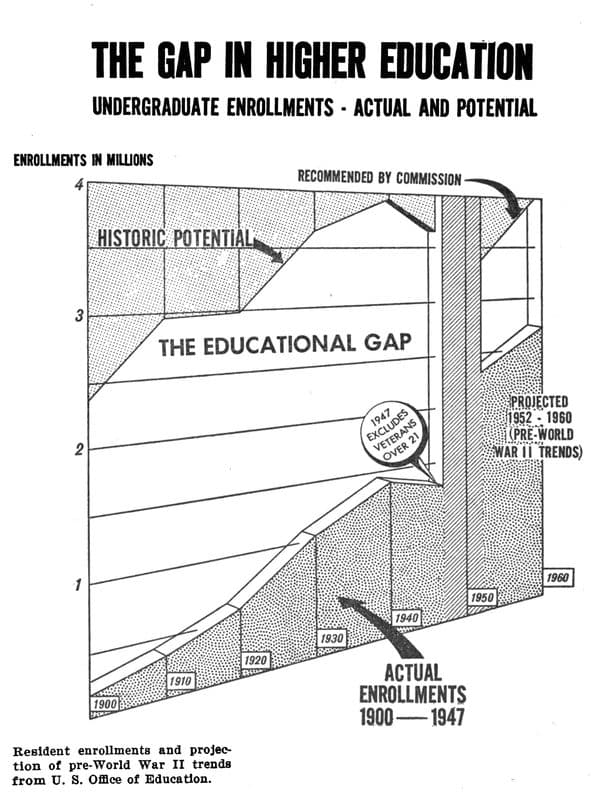
The report decried the country’s low spending on higher ed as “a sobering failure” to make good on the implicit values of democracy, leaving the economy with nearly twice as many “functional illiterates” (people who completed fourth grade or less) as college graduates. “For the great majority of our boys and girls, the kind and amount of education they may hope to attain depends, not on their own abilities, but on the family or community into which they happened to be born or, worse still, on the color of their skin or the religion of their parents.” The report’s argument for equal opportunity was moral and strategic: “We are not only denying to millions of young people the chance in life to which they are entitled; we are also depriving the Nation of a vast amount of potential leadership and potential social competence which it sorely needs.” An accompanying graph illustrated an “educational gap,” foreshadowing more recent reports about “lost Einsteins.”
The report and its philosophy were considered controversial at the time; leaders in higher education particularly scorned the idea of wider access to education for the masses as a pipe dream. Education policy historians Ethan Ris and Eddie Cole have written that the report presaged massive changes to US education. It urged desegregation seven years before the Supreme Court mandated it in Brown v. Board of Education; proposed federal need-based scholarships 17 years before what we now call Pell Grants; assailed “antifeminism” 25 years before Title IX; advocated for 49% postsecondary education 41 years before the nation actually got there; and teed up a national wave of community colleges—between 1965 and 1972, a new public institution popped up at the rate of more than one per week. Ris encourages viewing the report less as prophecy and more as “a brilliantly crafted political document that helped set an immediate agenda for higher education policy in unexpected and innovative ways.”
Today the country’s 1,015 public, tribal, and independent community colleges have exceeded some of the report’s brilliant ideals: They educate 38% of US undergraduates while providing educational opportunities to high schoolers, returning students, and people getting shorter-term certificates and apprenticeships. Community colleges are accessed by learners across age, race, ethnicity, and religion, including significant numbers of women, first-generation students, disabled students, single mothers, and lower income students. More than half of the country’s minority-serving institutions are two-year colleges.
But echoes of the past persist in inequitable outcomes, for example, for Black learners, who are less likely to graduate or transfer, carry more debt, and earn lower salaries than fellow students. And although generations of Americans have eagerly reoriented their thinking about education, federal policymakers have tended to focus on student loans rather than supporting institutions of higher ed; in 2024 the feds only put up about 11% of funding for community colleges, with about 58% coming from state and local governments and the rest from tuition and other sources.
Despite their struggles, community colleges have become a distributed set of laboratories of education and democracy, executing hundreds of highly local experiments in linking individuals to education, economic mobility, and community needs. In the interview for this issue, DeRionne Pollard, president and CEO of the American Association of Community Colleges, describes adversity as a “muscle memory” that informs colleges’ resilience. “When we have economic strain, when we have warfare, when we have labor market shifts, when we see that there is a rift in the fabric of who we are, this nation turns to higher education—specifically community colleges—to help do the healing.”
Despite their struggles, community colleges have become a distributed set of laboratories of education and democracy, executing hundreds of highly local experiments in linking individuals to education, economic mobility, and community needs.
With little fanfare, community colleges have become crucial gateways for the science, technology, engineering, and mathematics workforce: Half of all America’s recent STEM bachelor’s degree earners, a fifth of doctoral recipients, and nearly two-thirds of workers in STEM-related fields have attended a community college. What makes this feat even more remarkable is the scale of social innovation required: 73% of community college students report that their housing, food, childcare, or transportation is insecure, and 90% of community colleges have a food pantry. In these scrappy, underfunded hallways and guidance centers, the twin postwar promises of Bush and Zook are still entwining to shape the nation’s future.
As deindustrialization and other social shifts left communities struggling, the potential of education to change individual and regional trajectories has become more salient. “We have always been seen as an access engine,” Pollard explains. “But right now, what you’re seeing us do is play a much more complex and robust role…. We’re increasingly becoming the primary infrastructure of our communities. We are workforce developers; we are economic engines; we are civic support structures.”
Pollard offers a compelling vision of how community colleges can help reconceive local economies by deliberately connecting people, education, employers, and technological advances while creating a sense of belonging. This is something that George Zook might have recognized when he wrote, “Adult education is also more than a service to individuals. Rightly conceived and promoted it would help to bring order into the spiritual chaos of today and to create a democracy with enhanced material, moral, and intellectual strength.”
With a few exceptions, the voices of community colleges’ leaders have been missing from Issues’ pages and the science policy conversation in general. Earlier this year, we secured grant funding from Ascendium’s Education Philanthropy to map the influence of community colleges in the STEM landscape and profile how their educational innovations interweave individual economic mobility and regional change. Elevating community college leaders’ perspectives in the science policy conversation will provide insights and tools for the process of social innovation, skill development, and industrial catalyzation that lies ahead. In this issue, you’ll find some of this evolving series.
In late 2026, it is disorienting to spend a few days in the 1947 mindset. The postwar pact for international relations, federal science funding, and the relationship of the government and society are all being demolished, making the “spiritual chaos” Zook referenced feel eerily familiar. The arrival of generative artificial intelligence gives new resonance to the report’s concern about “a world in which technology is acting as a solvent of cultures.” And the advice is no less urgent for being 79 years old: “Upon leadership in social invention, then, as much as upon superiority in natural science and engineering, rests our hope of national survival.”
Elevating community college leaders’ perspectives in the science policy conversation will provide insights and tools for the process of social innovation, skill development, and industrial catalyzation that lies ahead
In white papers, meetings, Substack newsletters, Signal chats, and this magazine, the science policy community has been feverishly reimagining itself, with new types of research institutions such as focused research organizations, new rubrics for investment and evaluation like metascience, and competing visions of a “new golden age” for science. But who is all this science for? What kind of nation and world is it meant to serve?
Higher Education for American Democracy’s lasting influence in the goals and institutions of American education demonstrates the value of articulating a bold political vision for a more moral democracy, in which the promises of science and technology are more evenly distributed. Community colleges demonstrate how this vision can be accomplished by local “civic support structures” designed to turn no one away.