
Nova Scotia’s Experiment in Research That Solves Real Problems
Locally focused research investments enable coalitions of scientists and citizens to serve community needs.
During the 15 years I spent managing fisheries in Canada and New Zealand, I worked closely with scientists, fishers, and many others to put research to use. Doing this well meant going beyond established “science products” such as stock assessments for target species. It required forecasting complex trade-offs and uncovering unexpected interactions among fish population levels, catch limits, habitat protections, and fishing seasons. This required research—and conducting that research required insights from and coordination across harvesters, Indigenous rights-holders, fishery managers, purchasers, academics, and community groups. For example, it took the collaboration of regulators, researchers, squid harvesters, and more to learn how to keep endangered New Zealand sea lions from being caught as bycatch in trawl nets. Our solutions certainly weren’t perfect, but improvements were real.
Related Reading

Ten years ago, I left fisheries to dive into the world of research funding and management. It was soon clear that the approach we’d taken to fisheries research applies in other areas: Solving a practical problem has merit as an organizing principle. However, traditional research funding systems rarely adopt this approach when selecting what science to support.
Science in service of society is a foundational priority for Research Nova Scotia (RNS), the organization I now lead. During the pandemic, we funded a trial that took approximately four years and $3 million in Canadian dollars to test technology to prevent respiratory viral infections in long-term care facilities. It was very much a project of fluid dynamics, geriatrics, ophthalmology, engineering, and microbiology. But in addition to determining whether the intervention was effective, the project also planned out testing for feasibility, acceptability, scalability, and cost effectiveness. Research to solve a practical problem also means understanding how something could work in the real world.
RNS has now embedded this pragmatic ethos more deeply into the research we support. In 2025, we committed C$27 million to support integrated teams to tackle thorny issues that would be addressed piecemeal or ignored altogether if left to standard research funding approaches. Our goal was to incentivize collaborations of research providers and research users to approach complex problems from the perspectives of those affected, to design research toward solutions, and to work in partnership with RNS to deliver results.
We call these grants focused research investments, or FRIs. Each FRI takes on an urgent societal problem in a way that’s appropriate for producing real-world solutions. The research may be fundamental or applied; in the lab or in the field; limited to a single discipline or spanning many. We judge project success not by traditional markers like patents or papers, but by whether it helps achieve desired societal outcomes.
Solving a practical problem has merit as an organizing principle. However, traditional research funding systems rarely adopt this approach when selecting what science to support.
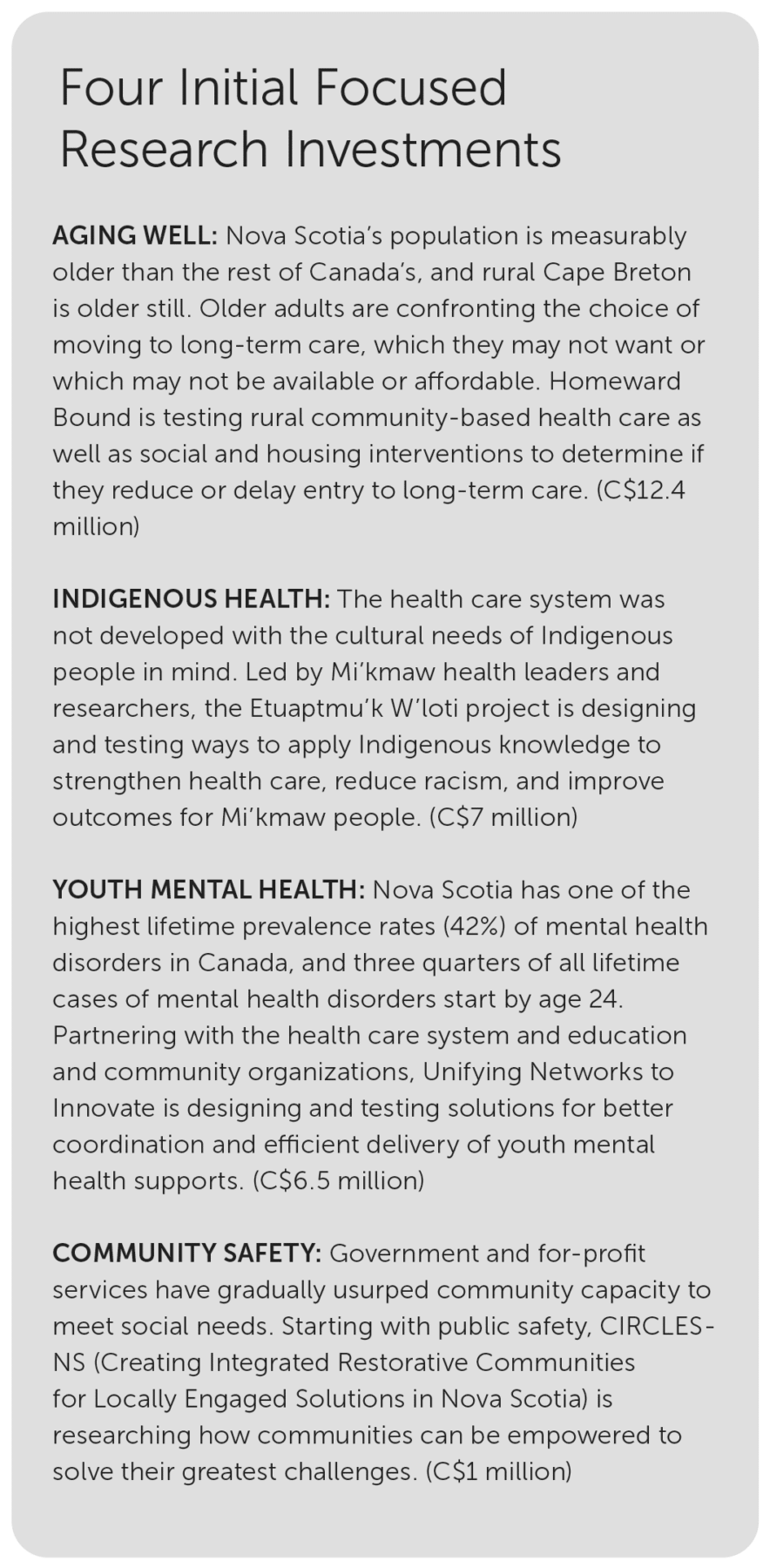
Research is now underway in aging, Indigenous health care, mental health, and community safety (see box). Though still a work in progress, our initiative is a public affirmation that such research is important, rigorous, and worthy of serious investigation. Are we sure this is all going to work? No. Is it worth trying? Hell yes.
Missing research
In most government-funded science, individual research groups compete for grants by submitting lengthy proposals to reviewers looking to identify “excellent” research. This process often prioritizes research described as “cutting edge” or “novel,” favoring projects most likely to produce scientific papers and other such markers of achievement. The system has produced outstanding results but neglects huge swaths of worthwhile projects.
FRIs are one of many new mechanisms aimed at filling gaps left by other funding mechanisms. Focused research organizations (FROs), for example, are intended to produce scientific resources that will accelerate work in a specific field, such as automated neural mapping or databases detailing clinical compounds’ biological activity. A suite of similar models worldwide (BBNs, X-labs, opportunity spaces, and more) are also being explored to produce something more targeted than what can be achieved by any individual research group responding to a broad funding call. These new systems are not intended to replace existing infrastructure, but rather to make it more complete.
Research Nova Scotia’s FRIs take their name and inspiration from FROs. Like proponents of FROs, we hope to create initiatives that, as such advocates have put it, “benefit society broadly in ways that industry cannot rapidly monetize,” with projects characterized by tight coordination and teamwork. But where FROs focus on technological advancements to accelerate research, our FRIs support coordinated research efforts to ease tangible societal problems.
For an FRI, funding work that led to a Nobel Prize would be a failure if it didn’t actually make something better for the community. The former head of the US National Institutes of Mental Health, Thomas Insel, once lamented that during his 13-year tenure, the organization spent US$20 billion on research into mental disorders without measurably reducing suicides or hospitalizations or improving recovery for people with mental illness. What those billions did buy, he said, was “lots of really cool papers published by cool scientists”—exactly what agency grant reviewers are primed to select.
FRIs understand that putting scientific contributions to use requires far more coordination than putting them into print. As a report from the King’s Fund, an English charity working for better health, wryly put it, “If you think competition is hard, you should try collaboration.” Solving society’s problems requires an unusually high level of collaboration across team members working with different norms, incentives, business models, and even time scales. That sort of cooperation is not something that springs up organically, especially given the competitive nature of grant applications. Pure scientific achievement is arguably better realized with less managerial oversight, so it doesn’t make sense to apply tools created primarily for identifying scientific novelty to a selection process that prioritizes broader implementation. Thus FRIs deliberately assess the potential of—and marshal resources for—collaboration across researchers, community groups, community service providers, and other relevant groups.
FRIs bear some similarities to participatory research, or co-production of research, in which academic researchers and people affected by the issues being researched collaborate to answer questions that matter most to the community. Topics have included how best to deliver COVID vaccines, how to plant crops in a changing climate, and how experimental treatments affect quality of life. Still, participatory research often refers to structures that encourage community members to participate as actively as the researchers. While FRIs can take this approach, ours is neither an embed-the-scientist-within-the-community nor an embed-the-community-members-within-the-science model. The role of and interactions among universities, community members, local clinics, and even purpose-built organizations are determined by what’s needed under the circumstances.
Certainly, the intended benefactors of research should agree on what outcomes would be beneficial, and researchers assessing options need to understand what interventions communities would realistically adopt. That said, FRIs are intended to produce knowledge valuable beyond a single specific application. We want to fix things, but we also want broadly useable insights; this is what the “R” in FRI is getting at.
Designing the FRI call
Research Nova Scotia put much thought into designing, gathering feedback, and communicating what sort of research projects we were looking for. We knew we couldn’t start small. Twenty-seven million dollars was large for our agency: approximately twice what we’d ever spent in a year. Project teams would be eligible for three times the amount of any of our past awards, which had typically ranged from C$100,000 to C$3 million.
We hoped the FRI offering would attract ambitious and creative proposals that could impart something that our communities need. We defined “community” beyond geography; it could refer to any identifiable group, whether a set of industries, patient groups, policymakers, clinicians, or any group with a common interest in applying research to address their needs.
FRIs deliberately assess the potential of—and marshal resources for—collaboration across researchers, community groups, community service providers, and other relevant groups.
We insisted that projects meet the definition of research according to criteria published by the Organisation for Economic Co-operation and Development. Projects had to be novel (aimed at new findings), creative (based on original concepts and hypotheses), uncertain (involving discovery rather than the delivery of specified services), systematic (deliberate and intentional), and both reproducible and transferable. Included in the criterion of transferability is the ability to generate insights beyond a specific, narrowly defined situation. We wanted to see ideas that had the potential to address societal challenges that were broader than what was described in the proposals. We excluded narrowly defined research outputs that were single use, such as running a single clinical trial, developing a particular technology, or anything meant to supply an answer exclusively within a given context.
We wanted results that mattered to Nova Scotians. We told applicants “the objective is societal benefit” and asked what concrete outcomes they expected to produce. We were looking not for specific results, but rather for a quality known as salience: that the research effort would help industry, community members, service providers, and other “research users” make better decisions to serve societal ends, providing research they needed—when, where, and in the form most useful to them.
Once we’d agreed to the scope of work and intended outcome, we let research teams decide how to allocate their funds. Our goal was appropriate accountability for use of public money without unnecessary and overbearing control. Teams could put funding toward personnel, equipment, infrastructure, and even operating costs. We allowed researchers the discretion to make changes once work got underway. For instance, funding could shift between project years or between different types of costs. This flexibility is uncommon, but critical for incentivizing and supporting course corrections. In our view, flexibility is essential for project governance to stay focused on achieving societal outcomes.
Reviewing proposals
RNS was pleased to receive 46 expressions of interest. Although we considered the specifics of what each team planned to do, we focused on each project’s purpose. We wanted research questions that originated from societal need, not research findings that would somehow have to push themselves into practice. In other words, the demand of what society needs mattered more in our evaluation than what research is primed to supply.
We were looking not for specific results, but rather for a quality known as salience: that the research effort would help industry, community members, service providers, and other “research users” make better decisions to serve societal ends.
Next, we assessed the likelihood for effective collaboration, looking for signs that team members could work toward a common purpose. Cohesion amplifies salience because stakeholders are more familiar with each other’s capacities and needs.
We passed over applicants seeking funding to carry on an existing program much as before. We weeded out projects that gave no sense of how labs or disciplines could work as an integrated whole, or that supplied little insight into what the pathway to impact might be or who might apply the work.
Ultimately, we selected nine teams with whom we would work closely to submit full proposals. Funders and applicants codeveloping proposals is an unusual and fundamental aspect of our FRIs. A skilled facilitator provided by RNS helped teams understand what we meant by research outputs that could be put toward the desired social outcome, guiding them toward stronger connections to end users, a tighter focus on outcomes, and better-articulated theories of change. We also helped applicants strengthen their approach to governance by getting more specific than, for instance, simply stating an intention to set up a committee. And we pushed our teams to gather granular information on what the intended beneficiaries of research wanted—such as by gathering ideas at community events.
Though it is difficult to be both a developer and adjudicator, RNS worked hard to be transparent and objective. One important step we took was separating the development and adjudication processes within RNS. We’re convinced the improvements we saw during codevelopment made the effort worth it. It allowed teams to gain a better understanding of the objectives of our program while giving RNS a much more profound understanding of each team’s passion, proposed approach, and capability to deliver.
Learning to invest
The expressions of interest and proposals generally fell into two groups. One group included community-minded proposals that needed further development to ensure that the work was truly research (rather than implementation) and would produce results transferable to other situations. The other group involved more technically focused proposals that were undeniably research but which needed help connecting to end-users in society. Ultimately, it was easier to shape the first group into an FRI than it was the second group.
When funders prioritize impact-focused, user-driven objectives, researchers struggle if they lack a deep connection to society or if they work in fields where the societal connection is more abstract or distant. What’s more, genuine connections to end users are nearly impossible to forge under the time crunch of a few months to develop proposals and launch projects. As a result, the FRI program wound up selecting teams where researchers and community partners had preexisting collaborative relationships. For example, the Centre of Excellence for Healthy Aging at Cape Breton University was already working closely with health providers and local groups in several rural communities that have steadily skewed older over time.
In the future, a seed program that builds trust and familiarity between researchers and communities could be very useful for fostering connection-building. Regardless of whether such a program is developed, it’s never too early to forge connections, build trust, and figure out how to be useful.
The penultimate step of our vetting process was sending the nine developed proposals to subject-matter experts. We were already convinced the projects targeted welcome solutions, but we needed to vet whether the proposed research and analysis plans were both feasible and well-aligned with the research objectives. The expert assessments yielded suggestions for improvement, but all the projects were deemed scientifically competent. We deliberately completed this assessment after we’d selected proposals that best met the objective of FRIs. Scientific rigor is a condition for funding; the objective is advancing solutions.
Ultimately, we awarded grants ranging from C$1 million to C$12.4 million to the four teams that seemed most capable of delivering benefits relevant to Nova Scotia, with the money to be spent over a period of three to seven years. Our FRIs are still very much an experiment themselves. Still, I would hesitate to call FRIs an innovative funding program. After all, each so-called innovation in our FRI program already existed: an application process where successful pitches are then codeveloped with the funder, flexible grants, end-user engagement, a focus on societal outcomes, and an expectation of transferability. But the way we have bundled and tuned these components is notable for supporting great research that serves community needs.
When funders prioritize impact-focused, user-driven objectives, researchers struggle if they lack a deep connection to society or if they work in fields where the societal connection is more abstract or distant.
Our C$27 million isn’t huge in the broader scheme of research funding. The US National Science Foundation annual budget is 460 times the size, and the 2021–2027 Horizon Europe budget is 5,700 times larger. But these FRIs are opportunities to learn, to put different pieces together, and so deliberately and methodically connect scientific prowess to the tangible needs of people and communities.
On the surface, Nova Scotia may seem like an odd location for this kind of experimental approach—the province has the population of Rhode Island and an economy smaller than Vermont’s. But this has also helped us succeed: We are small and nimble enough to launch a new program, select the first recipients, and start the projects in just one year and four days.
Still, we have a lot riding on this. FRIs represent a huge commitment of attention and funds: We have just spent about a fifth of all public money we’ve been provided since RNS started, and we take the public compact seriously to make FRIs as effective as they can be.
We’ve committed to learning as much as we can to do this well. As the projects got underway, we solicited reflections from our expert advisory panel, which remarked on the “effort required to bridge the institutional cultures of government, academia, and community.” We also surveyed teams from all nine finalist projects as well as others involved in the FRI program about their experience. For researchers trained to define success differently than FRIs do, the feedback felt a little uncomfortable, but also welcome. One FRI researcher commented that the initiative was unique in holding researchers “accountable” to society. “FRI requires a shift in thinking—we are being asked to go beyond what we think is interesting to a problem that we have to actually deliver on.”
It will take years to know whether the potential that reviewers saw in selected proposals will be realized, but we’re optimistic. Through deliberate and controlled experimentation, places like Nova Scotia can find new approaches to using science to benefit society.