
What We Need to Measure to Understand Community College Outcomes
Community colleges are the connective tissue of the US postsecondary education system. For communities across the country, these institutions train the skilled technical workforce, anchor partnerships with local industries, and act as hubs for students and workers in transition. By offering diverse education and training pathways to students at all stages of their academic and professional careers, community colleges are well positioned to support social, economic, and educational mobility.
Related Reading

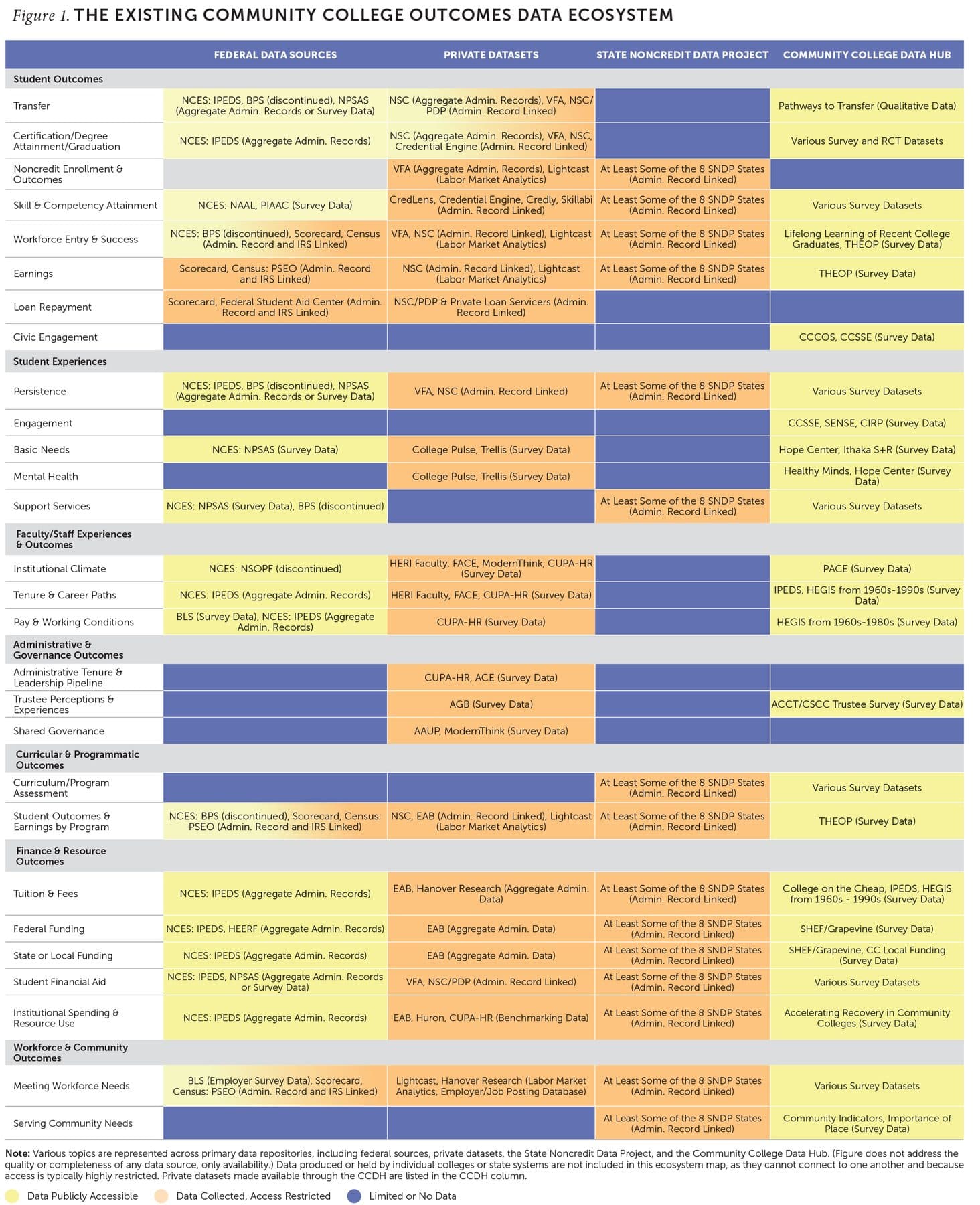
But measuring these contributions poses challenges. Data on community college outcomes are collected at the state level, by the federal government, and by a number of private organizations. Yet with few exceptions, these datasets operate independently of one another, and their levels of public accessibility vary. The resulting data ecosystem is rich but fragmented, and the remaining gaps and blind spots constrain researchers’ abilities to measure all the community college outcomes that matter.
For example, a lack of federal data capturing information about individuals is a major hindrance to researchers focused on community colleges. Without standardized and accessible data tracking individual students’ progress through the US postsecondary system and into the workforce, researchers are limited in their ability to assess the factors that contribute most significantly to positive student outcomes, like credential completion, reintegration after interruption, university transfer, and workforce entry. A lack of student-level data makes it particularly difficult to evaluate the colleges’ ability to serve specific populations who may benefit from targeted support, such as immigrant families, older adults, incarcerated or formerly incarcerated learners, veterans, and active-duty military personnel.
Other gaps in the data ecosystem make it difficult to determine answers to important policy questions related to students’ or taxpayers’ return on investment. Incomplete or inaccessible data make it challenging to measure community colleges’ responsiveness to regional workforce needs or their ability to translate college credentials into economic value. These information gaps hinder institutional action, as well as legislative and consumer decisionmaking.
As researchers in this space, we have analyzed the community college data ecosystem to better understand the existing sources, gaps, and opportunities to build a more useful collection of evidence for decisionmakers. Constructing a more robust and student-centered data ecosystem will require sustained investment from all stakeholders, especially the federal government. But such a system is needed to inform policies that better leverage community colleges’ roles in workforce development and regional economic growth. Furthermore, more granular and widely accessible data will enable researchers to ask more nuanced questions, which can lead to better services and support at every level of education.
Elements of the ecosystem
Federal data remain the backbone of the community college data ecosystem, due to their scope, widespread accessibility, and use of standardized measures. Simply put, federal data give researchers the necessary tools to answer fundamental questions about community college enrollment patterns, completion rates, institutional finances, student demographics, and sources and uses of public and private funding. Federal datasets are used by scholars at universities and nonprofit research centers (including the 300 or so members of the Council for the Study of Community Colleges) and by philanthropic organizations, member associations (such as the American Association of Community Colleges), journalists, college faculty and administrators, and many others interested in assessing and improving the American education system.
Federal data give researchers the necessary tools to answer fundamental questions about community college enrollment patterns, completion rates, institutional finances, student demographics, and sources and uses of public and private funding.
The Department of Education’s Integrated Postsecondary Education Data System (IPEDS) provides annual, aggregate information on enrollment, completion, staffing, finance, and institutional characteristics for nearly every college and university in the country. Federal surveys conducted by the National Center for Education Statistics (NCES), data commissioned by the Institute of Education Sciences (IES), and selected Census Bureau datasets also provide insight into educational participation and workforce outcomes. Together, these resources establish a baseline for tracking higher education trends to better understand who community colleges serve, what federal investments are used for, and where institutions and systems need support.
Yet existing federal datasets have limitations. Some federal surveys, including those conducted by the National Science Foundation, focus primarily on bachelor’s degree recipients. There is no federal effort to capture data on noncredit programs or enrollments, so noncredit students are either undercounted or absent from national datasets. And many postsecondary data sources, including IPEDS, only report institutional-level information. Consequently, these sources preclude analyses of critical variables that affect student progress and success, like employment status, age, specific program of study, prior postsecondary experience, and other demographic variables. This kind of student-level data is needed to understand—at a national level—who community colleges are helping and who is being left behind.
Perhaps the greatest limitation of federal community college data is its inability to connect student enrollment and educational progress to workforce outcomes at a national level. Understanding whether students successfully transition into employment requires linking education, workforce, and earnings data across different agencies and levels of government. Over the past few years, 35 states have joined the Census Bureau’s Post-Secondary Employment Outcomes (PSEO) project, which links university transcript and earnings data. Community college data are contributed by roughly 20 states, although two of the three states with the largest community college systems—California and Florida—do not yet participate. As a result, the PSEO currently captures only about 40% of college graduates nationwide. Other initiatives use the PSEO as the basis of further analysis on graduate earnings, and some researchers are linking student-record data with Internal Revenue Service information to, for example, examine the role of colleges in intergenerational mobility. But such studies are unlikely to occur on a national level, and, due to privacy concerns, permissions granted for specific analyses utilizing IRS or Census Bureau data involve tight data restrictions.
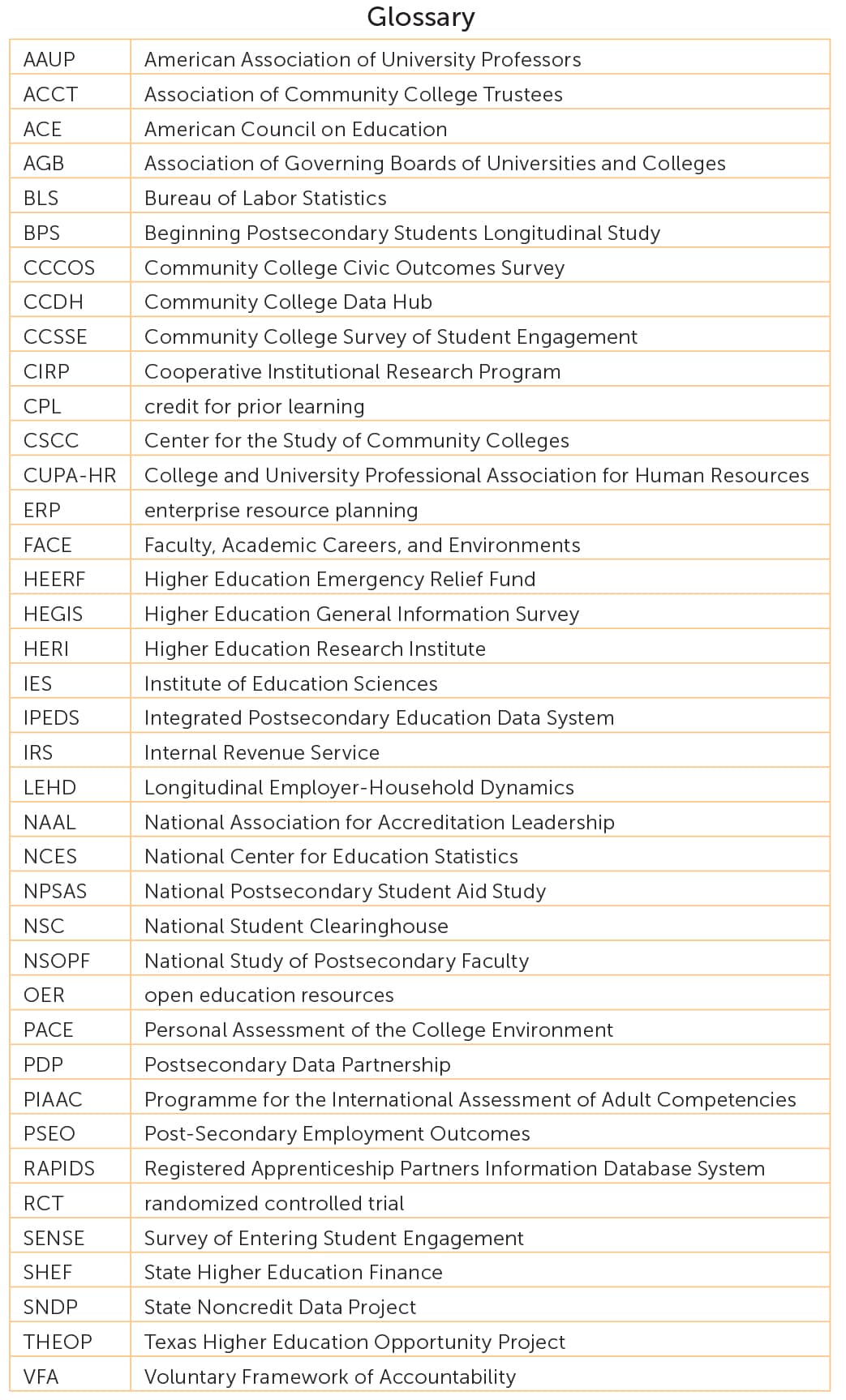
Other limitations to federal datasets are the result of recent federal policy changes or workforce reductions. Nearly all major NCES postsecondary surveys, including the Beginning Postsecondary Students Longitudinal Study, have been effectively discontinued. Similarly, modernization projects—such as those critical to maintaining the Digest of Education Statistics—have been halted, and updates to numerous surveys delayed. For example, data collection for the 2023–2024 National Postsecondary Student Aid Study has ended, but there is no current estimate for when the results will be available. This disruption means that policy decisions are being made based on data that are more than six years old and may no longer reflect the current state of the sector or its students.
Thus, while federal datasets are the most important component of the data ecosystem on community college outcomes, they are struggling to keep pace with the needs of researchers, educators, and policymakers.
Data aggregated at the state level could be even more useful for scholars and policymakers. Most states maintain statewide longitudinal data systems or postsecondary unit record systems that link K–12, higher education, and sometimes workforce or wage data using unique student identifiers. However, student-level data held by state agencies cannot track students who transfer or obtain employment across state lines. And these data are almost never publicly available. Access typically requires a formal data use agreement, which may be available only to researchers connected to a state’s sponsoring agency, as well as university Institutional Review Board approval and compliance with the Family Educational Rights and Privacy Act, which can take months to secure. Furthermore, because state systems operate independently, scholarship examining student-level patterns across state lines is time-consuming, often limited to a handful of states, and restricted to researchers from organizations that have negotiated multiple data use partnerships.
As a result, datasets operated by private organizations have become valuable resources for researchers. The most important private dataset containing community college information is operated by the National Student Clearinghouse (NSC) Research Center, which aggregates enrollment, persistence, transfer, and degree attainment patterns based on student-record data contributed by nearly all institutions of higher learning in America. The NSC annually publishes national trends reports, but the dataset offers limited information about sub-baccalaureate credentials or earnings, and the underlying student-level data cannot be accessed without specific permission granted by each institution.
Another private dataset, the American Association of Community Colleges’ Voluntary Framework of Accountability (VFA), collects data pertaining to institutional performance, student progress across various credit and noncredit programs, and workforce outcomes. The VFA has not historically shared any of the data collected by participating institutions and is primarily used by individual clients or charitable foundations to track outcomes for their initiatives at specific colleges. However, a new partnership between the VFA and the NSC’s Postsecondary Data Partnership could result in inclusion of some aggregate VFA data related to noncredit programs and workforce outcomes in future NSC reports.
Additional private organizations fill demands for data, for a fee. Private credit bureaus offer data that can be linked to student records to assess earnings, loan repayment, and other metrics of economic stability and mobility. However, like the NSC and VFA, these data are frequently only available through institutional partnerships or via subscription. Relying on private data for scholarship or policy development drives up costs, creates duplication of efforts, and does little to advance data equity. As such, private sources cannot replace a robust, standardized, and publicly available data infrastructure.
Emerging efforts to connect the dots
Two recent initiatives, the State Noncredit Data Project and the Community College Data Hub, fill some of the gaps in the ecosystem.
More granular and widely accessible data will enable researchers to ask more nuanced questions, which can lead to better services and support at every level of education.
The State Noncredit Data Project (SNDP) was formed in 2021 to create the infrastructure for standardized noncredit program data collection across the United States. The project has three goals: generating research; creating a taxonomy to guide data collection; and fostering learning opportunities to share practices across states and systems. Led by scholars at the Rutgers Education and Employment Research Center, the University of North Carolina at Charlotte, and the Noncredit Research Collaborative, and funded by a set of foundation grants, the SNDP has worked to inventory state-level noncredit data elements and provide consistent operational definitions; collect and examine data related to the purpose and design of noncredit programs, student outcomes, enrollment and demographics, and noncredit finance and policy drivers; and report on relevant policy implications. The first two phases centered on community colleges in eight states: Iowa, Louisiana, Maryland, New Jersey, Oregon, South Carolina, Tennessee, and Virginia. Through the SNDP’s Taxonomy 3.0, the project will extend to university systems, labor departments, and longitudinal data systems.
The SNDP does not collect data directly. Rather, it encourages states to collect more robust information on noncredit programs and students using common data elements and definitions so that, over time, the noncredit data infrastructure will reflect the broader ecosystem of credentials and providers and, ultimately, provide data about the effectiveness of these programs. This effort is hugely important and has become even more consequential following the 2025 authorization of Workforce Pell grants, which expands Pell eligibility to students enrolling in shorter-term training programs.
The SNDP is not a national database, although it supports states in collecting noncredit program data in a standardized form. However, the SNDP may provide a blueprint for national efforts to collect and disseminate noncredit data. Ideally these could be linked to other longitudinal data systems, as well as information about workforce needs, industry-based certifications, skill and competency attainment, and program funding and governance.
The second emerging resource for researchers and policymakers is the Community College Data Hub (CCDH), a joint project of the Center for the Study of Community Colleges (CSCC, co-led by Kisker), the Belk Center for Community College Leadership and Research at North Carolina State University (managed by Jaeger and Deal), and the Inter-University Consortium for Political and Social Research at the University of Michigan (ICPSR). Created to facilitate scholarship, policy development, and institutional improvement, the CCDH enables widespread access to existing datasets and data-related publications associated with community colleges and their students, administrators, faculty, staff, and communities. Many of the datasets included in the CCDH were collected by private organizations or university centers and would otherwise not be freely available to scholars, scholar-practitioners, and policymakers.
The CCDH currently consists of roughly 60 datasets selected by subject-matter experts from CSCC and the Belk Center and curated and indexed by ICPSR. New data—as well as updates to existing datasets—are added each year. Some CCDH datasets are national or nearly national in scope; others are limited to specific states or institutions participating in a given survey. In this way, the CCDH both complements federal datasets and provides an avenue for making privately held data more accessible.
Remaining blind spots
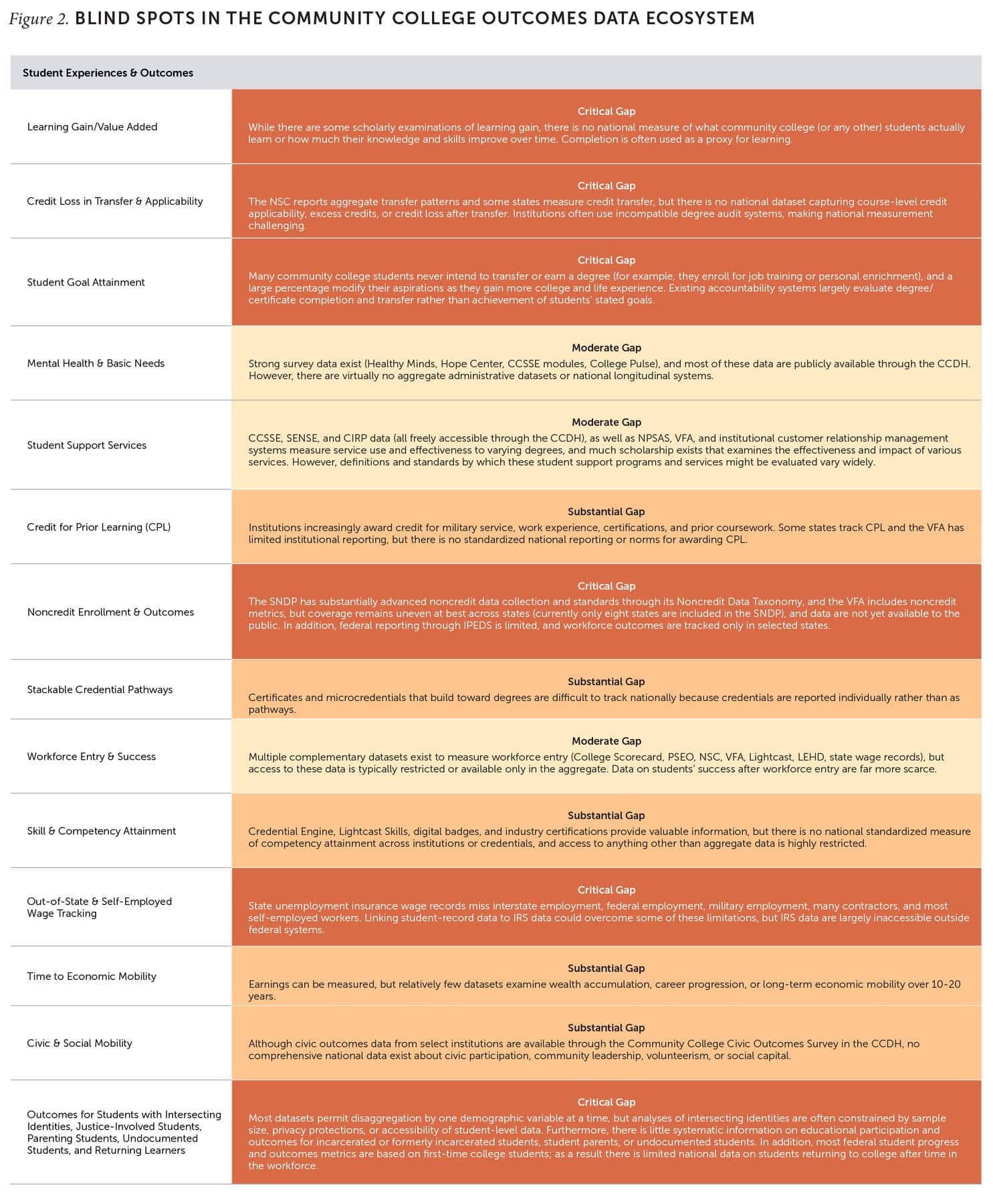
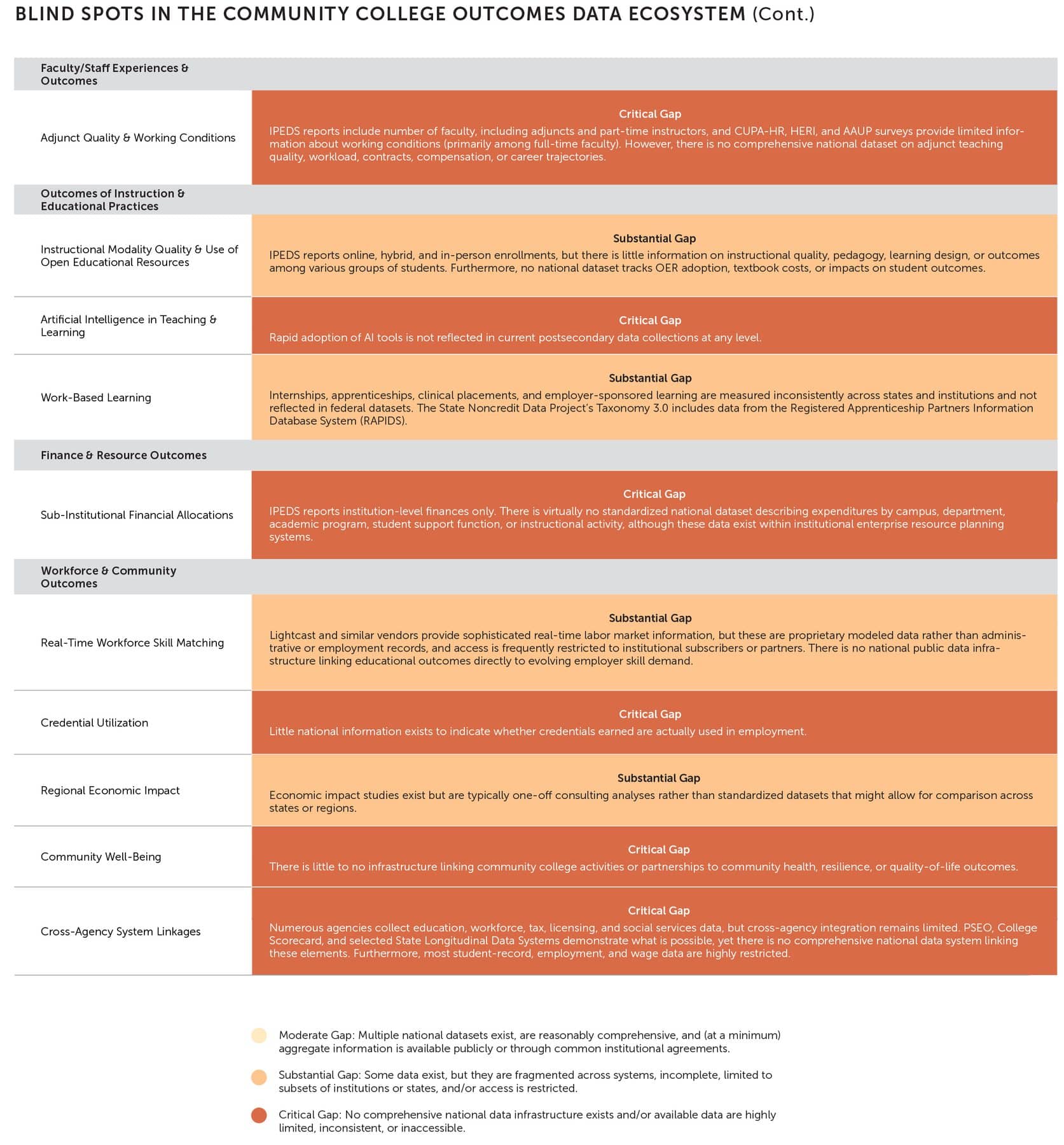
The United States has a relatively strong infrastructure for measuring postsecondary inputs and outcomes at the institutional level, but it does not yet have the capacity for tracking individuals or for measuring educational quality, student experiences, skill development, or long-term economic impact—all critical to assessments of student mobility or societal impact. Looking across the entire community college data ecosystem, we see six remaining key ecosystem weaknesses, four of which pertain to the community college student experience.
First, student-level data are much less accessible than institutional data, which prevents analyses of outcomes among student populations not typically captured in aggregate datasets (e.g., veterans, returning learners, students who are parents, or those with intersecting identities). Second, experiential measures such as mental health, basic needs, engagement, and support services rely largely on voluntary surveys rather than standardized administrative records, limiting comparability and longitudinal tracking. Third, learning and skills are difficult to measure. Credit-based credentials and completions are widely tracked, but noncredit participation—as well as actual competencies, skills gained, and employer-valued learning outcomes—lacks consistent national definitions and reporting. Fourth, data showing how learning translates to earning are incomplete. Some state longitudinal data systems provide substantial insight into post-college employment, but access to these data is often highly restricted. Until the PSEO or a similar national initiative expands to include all states and institutions, researchers’ ability to track interstate employment, self-employment, federal employment, and real-time skill demand is limited.
The fifth weakness is an institutional challenge: There is limited financial transparency at departmental or programmatic levels. IPEDS tracks college-wide revenues and expenditures, but standardized data on spending by program, department, or student service are generally unavailable, which prohibits institutional benchmarking on costs and limits nuanced assessments of taxpayer return on investment. For example, operating costs for nursing programs are often several times the cost of a typical liberal arts program due to higher faculty-to-student ratios, specialized equipment and facilities, and instructor compensation that must be commensurate with local nursing salaries. Without program-level expenditure data, institutional “cost per completer” analyses average spending for programs that are inexpensive to run and have modest wage returns (e.g., general studies) with those that are expensive to run but whose graduates tend to earn substantially more (e.g., nursing). Additional financial transparency at the program level would allow both college leaders and state legislators to make more informed investments in the programs, leading to greater labor market value.
Finally, data integration remains the largest structural challenge. Education, workforce, tax, licensing, and social service datasets are maintained by separate agencies under different legal and technical frameworks. Although initiatives such as the PSEO, College Scorecard, and state longitudinal data systems demonstrate the value of linking records across agencies, comprehensive cross-system integration remains limited nationally.
Initiatives like the CCDH and SNDP have made significant progress in integrating available resources and addressing notable blind spots in the community college outcomes data ecosystem. By organizing curated datasets into discoverable, open-access platforms, and by developing consistent standards for the collection and use of noncredit data, these efforts reduce barriers for researchers, policymakers, and institutional leaders alike. Further investment in the CCDH, SNDP, and similar initiatives is a necessary step toward improving the collective ability of the field to enable data-informed decisions about educational policy and practice.
However, these tools are built to complement, not replace, the public data infrastructure required to answer higher education’s most pressing questions. Publicly funded data systems provide a transparent, common evidence base that allows researchers, educators, and policymakers to examine critical questions using widely available information.
As such, rebuilding and modernizing the existing national postsecondary data infrastructure should remain a top priority. At a time when this administration is calling to “back community colleges as regional hubs of scientific and technical talent,” recent disruptions to federal data collections, cutbacks to survey programs, and delays in updating key statistical resources make attaining that goal more difficult. Without current data, it is difficult to monitor trends, evaluate student and workforce outcomes, and understand what is working and for whom. Before launching new systems, the federal government should focus on strengthening existing data collections, improving coordination across agencies, and restoring timely access to transparent public data.
Under current statute, IES is best positioned to fulfill this role. However, if the current administration continues to transfer Department of Education functions to the Department of Labor, there may be an opportunity to better merge postsecondary and labor market data. Beefing up the role of the US Census Bureau and making its datasets more readily available for research purposes are other ideas worth further discussion.
While federal datasets are the most important component of the data ecosystem on community college outcomes, they are struggling to keep pace with the needs of researchers, educators, and policymakers.
At the same time, federal and state agencies—potentially in collaboration with nonprofit organizations, university centers, or both—must embark on a long-term effort to design and develop systems that can safely and securely merge longitudinal student-record data and institutional information about programs and credentials across states and link them to workforce, tax, licensing, and social services datasets. One promising strategy centers on constructing a singular, trusted national list of education and training providers, programs, and credentials that connects to existing federal systems—essentially creating a common identifier that would reduce duplication, improve data quality and consistency, and help government agencies understand how public investments help people prepare for good jobs.
Postsecondary education faces new pressures to demonstrate return on investment. In such a climate, simply tracking inputs and outputs no longer suffices. A more robust and student-centered ecosystem—one built on a foundation of standardized, interconnected, and widely accessible federal datasets—will enable researchers to move beyond twentieth-century questions of “What happened?” and begin to ask, “Why did it happen?” or “What difference did it make and for whom?” A more comprehensive and granular data ecosystem will also help prospective students make smarter decisions about which programs to enter; facilitate educators’ efforts to support students and more effectively allocate institutional resources; aid policymakers in determining the best uses for taxpayer dollars; and help business and community leaders build the foundation for an economic transition or better align the regional workforce to industry needs. A data ecosystem that enables such analyses is critical for community colleges to continue facilitating social mobility and contributing to community growth and prosperity.