
Dinomania
Review of
Making Our Beasts: Paleontology in the United States
Oakland, CA: University of California Press, 2026, 255 pp.
In a recent collection of poems, the scientist-poet Brandon Kilbourne writes the following lines in the voice of a scientific collector engaged in ransacking the Belgian Congo for specimens:
Simply even to know
this continent, bring
its darkness under science’s
ken, a smear of blood
sets in the creases of our palms.
I had these words in mind as I read Elana Shever’s new book, Making Our Beasts, about the history and practice of dinosaur paleontology in the United States. Shever, an anthropologist, describes the book as “a science-in-action ethnography.” But it is also a timely reflection on paleontology’s role in America’s westward expansion and a critique of the ways in which dinosaur-centered “edutainment” continues to promote “the scientific defense of colonialism” to a wide, and not entirely adolescent, audience.
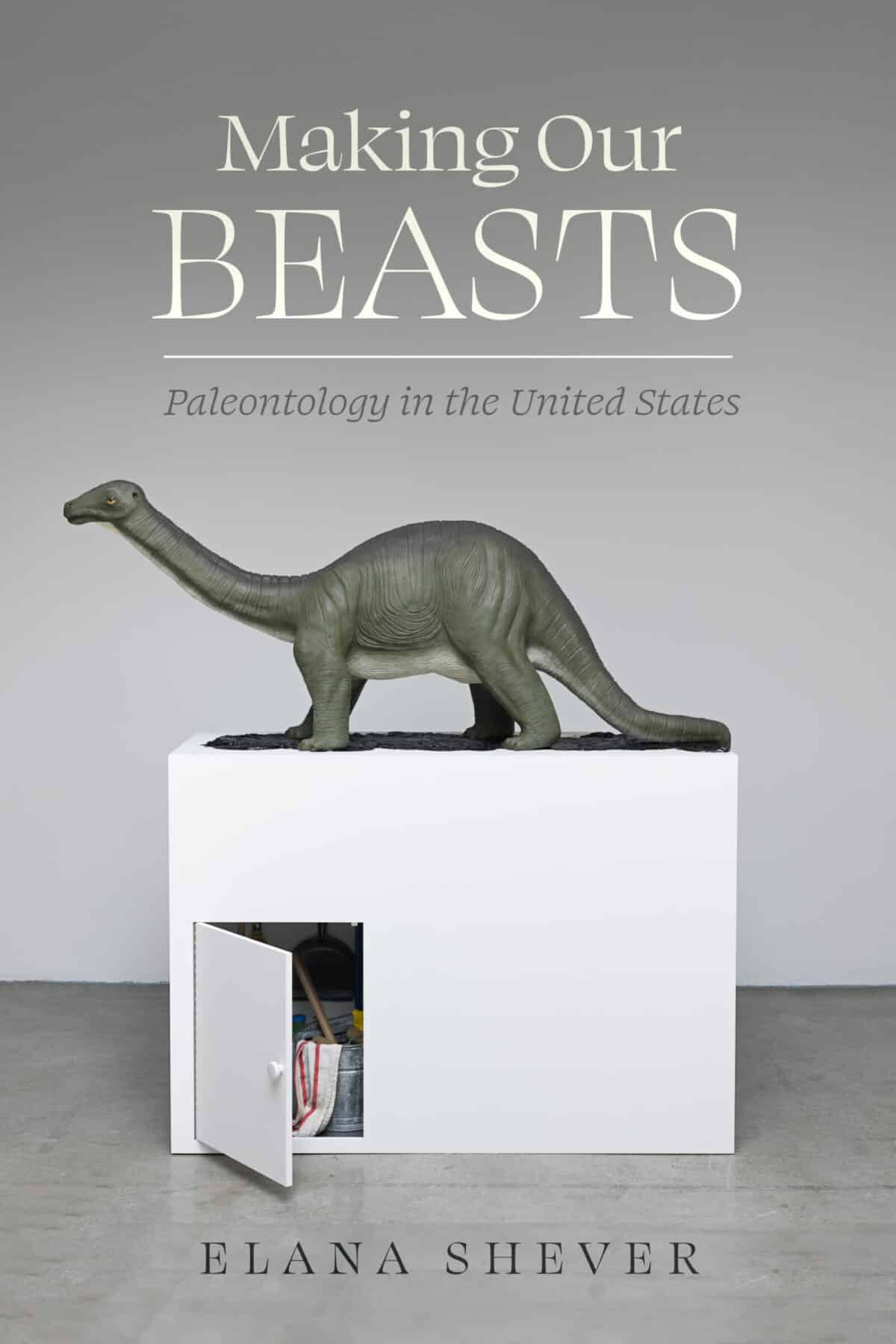
The book begins with a useful introduction in which Shever positions her project in relation to earlier, constructivist accounts of dinosaur paleontology. These accounts have tended to see dinosaurs as neutral projection screens, capable of accommodating virtually any set of meanings people care to project upon them. But Shever is alive to the powerful materiality of fossils, which constrains the meanings they can embody. Her perspective draws attention to the agency of nonhuman objects, which collaborate with humans in the creation of scientific specimens. The process of fossil-making thus generates “composite” objects comprising “rock, putties, glues, and other materials,” as well as “human labor, skill, knowledge, meaning, and value.” This perspective also leads her to reject the notion of scientific discovery, which she describes as a “fable that illustrates cultural values, not the actual process of scientific inquiry.”
Shever’s discussion of these topics is compelling (although parts of it will be familiar to anyone who has read Caitlin Wylie’s kindred book, Preparing Dinosaurs). Still, her criticisms of the notion of scientific “discovery” strike me as overreach. Shever seems to think that either fossils are made or they are discovered; and since she has good reasons for thinking that they are made, she rejects the very notion of scientific discovery. But using a distinction from Wylie, which separates “fossils” as field objects from “specimens” as composite objects or artifacts, it is possible to say that fossils are both discovered and made—discovered as field objects and then made into specimens by skilled excavators and preparators, working in collaboration with the stone. This is not to question Shever’s other criticism of discovery: that claims of discovery have often “been deployed to dispossess Indigenous people of their homelands, material resources, and knowledge.” All I wish to suggest is that you can retain that line of criticism without taking the (to my eyes, rather implausible) step of denying that fossils are, quite literally, discovered.
One aspect of producing meaning from fossils that Shever focuses on is the making of “paleontological charisma”—that extraordinary quality that attaches to certain prehistoric animals like Tyrannosaurus rex. She asks how T. rex came to be understood as the very epitome of violence—the “tyrant king” of the late Cretaceous. Of course, there is an obvious answer to the question: T. rex was big and scary. Still, as Shever insists, that can’t be the whole story. Celebrity paleontologist Steve Brusatte has described T. rex’s head as “a killing machine, a torture chamber for its prey, and an evil mask all in one.” That is hardly a neutral description of cranial morphology; it is a celebration of violence that arguably says more about the expectations of Brusatte’s readers than it does about the animal itself.
Shever is alive to the powerful materiality of fossils, which constrains the meanings they can embody. Her perspective draws attention to the agency of nonhuman objects, which collaborate with humans in the creation of scientific specimens.
Shever’s discussion of T. rex’s “more-than-human charisma” is a highlight of the book. In it, she draws attention to the gendered nature of this charisma that naturalizes a particular form of violent masculinity, “making it seem prehistoric, even timeless.” The gendered charisma of the animal arose, in part, from the gendered charisma of the men who discovered it: “fossil hunters” like Barnum Brown, who was notorious in his life as much for his promiscuity as for his scientific exploits. But it also arose from features of the specimens, like the flattened skull of Brown’s T. rex, which resulted in the decision to reinsert the teeth into the tooth cavities only partway, exaggerating the “evil” of the “mask.” It’s not difficult to imagine who this violence appeals to: Shever draws from her ethnographic research to discuss how museum docents preferentially engage white adolescent boys “using [T. rex] teeth, while largely ignoring the other people and objects in front of them.” Through observations like this, the reader is made to understand why dinosaur paleontology is a field dominated by white men and permeated by a macho culture that Shever delights in exposing.
One aspect of paleontology that’s often overlooked is the importance of touch. Yet paleontology is a tactile science as much as a visual one, rooted in “physical contact between human bodies and earthly matter.” Among other things, touch is an important way that humans forge intimate and affective connections with fossils and the animals they represent, at times moving these humans to tears. Shever suggests that these connections are an invaluable part of paleontological research—so valuable that we should reject blanket prohibitions against anthropomorphism, which seek to ban the projection of human qualities onto nonhuman animals, including extinct ones.
Another highlight of the book is Shever’s discussion of contemporary paleontological “edutainment,” which tends to replace “the horrors of settler colonialism … with a heroic narrative—giant beasts, great hunters, and an adventurous pursuit of science—about which Americans can feel proud.” She examines two very different settings in which this narrative is enacted: Disney’s DinoLand U.S.A. (which permanently closed in February 2026) and the Dinosaur Ridge outdoor museum near Denver. In both places, visitors are treated to a sanitized version of the history of paleontology in which the “march” of knowledge produces epistemic goods without harming anyone. Of course, it ain’t so. Shever takes special care in troubling the narrative presented to visitors at Dinosaur Ridge, which centers on the exploits of a nineteenth-century settler named Arthur Lakes. According to Shever, “Lakes’ life story illustrates how paleontology benefited from white invasion, broken treaties, land and resources grabs, and the dispossession, impoverishment, and decimation of native peoples.” Yet the legacy of these sins is “unrecognized by the vast majority of visitors, guides, and scientists at the park.” This needs to change.
Visitors are treated to a sanitized version of the history of paleontology in which the “march” of knowledge produces epistemic goods without harming anyone. Of course, it ain’t so.
The final chapter examines what Shever calls the “paleontological real.” And again, she seeks to trouble something taken for granted—that fossils are real, while the human-made replicas of fossils (casts or “bone-clones” used in many museums) are not. According to Shever, this “secular-scientific binary” fails to accommodate the true complexity of the situation. In the place of a distinction between “real” fossils and “fake” casts, Shever proposes “a nondualistic, multifaceted continuum of paleontological objects.” Ultimately, she defends a counterintuitive thesis: A fossil and a replica of that fossil are equally “real,” despite differences in their materialities. (“In both the fossilization and casting process,” she writes, “the overall shape and internal structure [of the bone] remain largely the same while the material composing the bone changes.”) It’s a thesis that dovetails nicely with the account presented in her first chapter, bringing the book to a satisfying conclusion.
There is much to praise in Making Our Beasts. The book is well-written, passionately argued, and held my attention throughout. I found many sections challenging in the best way: They made me question my own preconceptions, and in some cases, even my parenting habits! It is especially strong on issues of gender and science; there is much more on this topic than I have been able to indicate in these brief remarks, and it is all well done. Science studies scholars of all stripes should pay attention to this exciting book.