
India’s Pursuit of Tech Self-Reliance
Review of
Computing in the Age of Decolonization: India’s Lost Technological Revolution
Princeton, NJ: Princeton University Press, 2026, 296 pp.
Why does India produce numerous Silicon Valley leaders yet remain in the relative wilderness when it comes to tech innovation and industry profits? Computing in the Age of Decolonization delivers an answer to this paradox. This marvelous book, written with clarity and verve by Dwaipayan Banerjee, a professor at the Massachusetts Institute of Technology, excavates the history of India’s computing industry to offer a persuasive explanation that centers political and economic factors as much as technological ones.
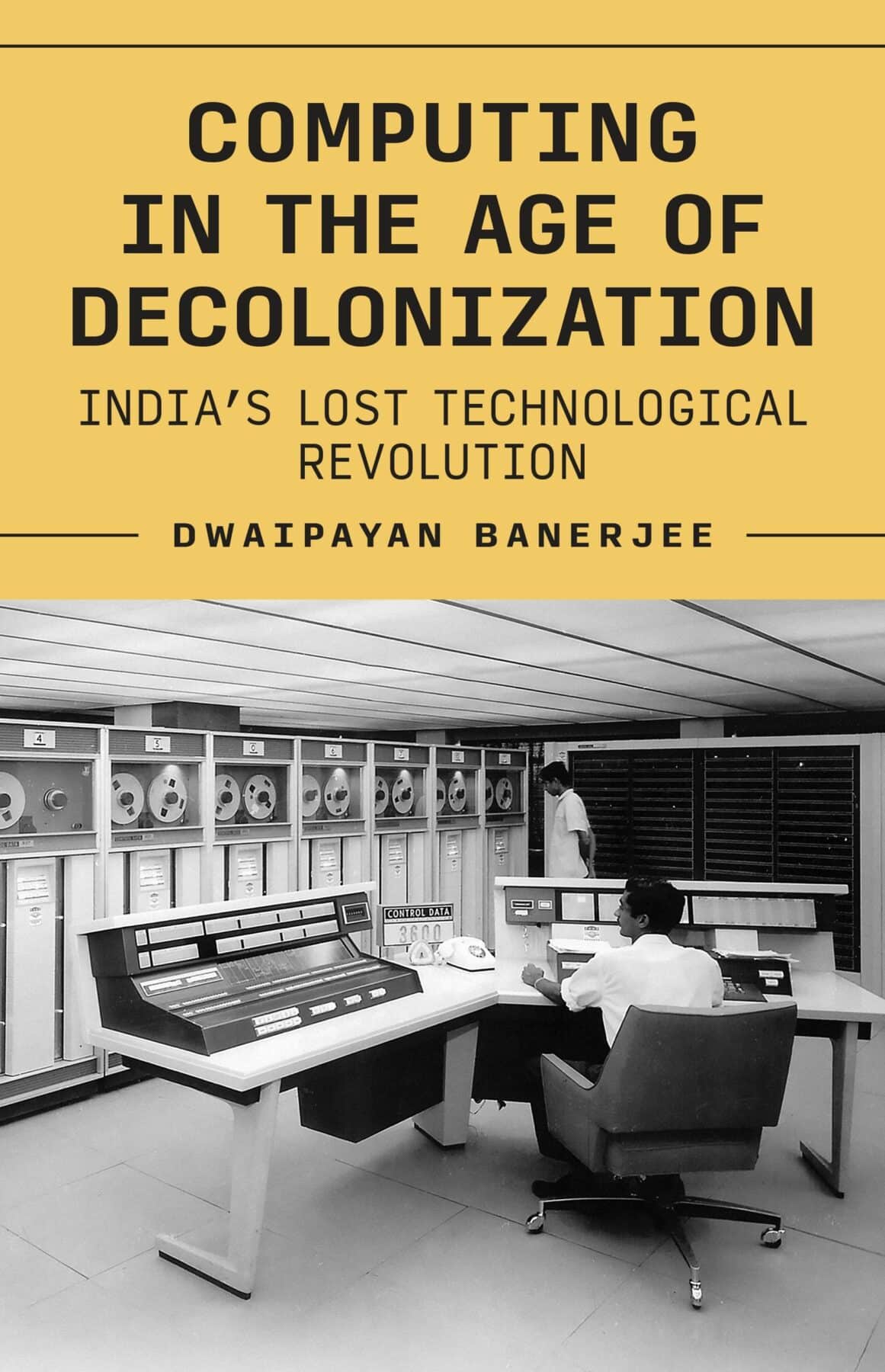
Banerjee argues that the sharp inequalities in wealth generated by the computing revolution have less to do with technology and innovation itself than with the matrix of global politics and capitalism in which computing emerged in the second half of the twentieth century. “Postcolonial computing projects did not fail because of technical incompetence or cultural deficiency,” he writes. “Rather, they failed because Global North governments and corporations actively hindered computer pioneers outside Europe and the United States.” This important book is a signal contribution to histories of computing and technology not just in India but throughout the Global South. In addition to being of interest to scholars, it offers lessons to policymakers about capacity building, technology transfers, and the vital significance of power relations in explaining why the wealth unlocked by technology is unequally distributed across the globe.
Today, while Indians make up “an important part of the global computing labor force,” their status is precarious, subject to swings in immigration policy in the West and mainly serving “the interests of corporations based in the Global North.” Banerjee argues that this dynamic echoes a colonial past: “The postcolony produces the ‘raw material’ of cheap labor and services, while new global centers control the more profitable ‘upstream’ end of the value-chain.”
But this was not the vision of the founders of India’s computer program. In the wake of independence from Britain, still chafing from the memory and consequences of prolonged exploitative trade, Indian technocrats such as the brilliant and enterprising Cambridge-educated physicist Homi J. Bhabha—founder-director of the Tata Institute of Fundamental Research (TIFR)—insisted on the need for India to develop expertise and strategic autonomy in computing. Self-reliance was seen as crucial to decolonization. But according to Banerjee’s history, which spans 1945 to 1980, this foundational vision of computing independence lost out over time due to pressure from foreign governments during the Cold War, global corporations such as IBM perceiving Indian computing as a threat to their business, and a domestic business lobby that realized easier profits in offering services to companies in the Global North.
The sharp inequalities in wealth generated by the computing revolution have less to do with technology and innovation itself than with the matrix of global politics and capitalism in which computing emerged in the second half of the twentieth century.
The book’s narrative begins in colonial Bombay with Bhabha and mathematician Damodar Kosambi (a polymath employed at TIFR) searching for a way to bring India its first digital computer. Propitious circumstances and international contacts appeared to have created an opening through the newly established United Nations Educational, Scientific and Cultural Organization (UNESCO). Set up in 1945, UNESCO’s leadership, including its first director-general, Julian Huxley, believed in a postwar scientific internationalism that would build bridges between the Global North and South.
To Bhabha’s and the Indian government’s great excitement, one of these proposed bridges was a UNESCO-funded International Computation Center in India. However, while Kosambi and Bhabha were traveling abroad to select the computer they wished to receive (the American ENIAC) and learn about its operation and maintenance, America’s foreign policy establishment grew anxious over UNESCO’s political direction during the Cold War. This led to a pressure campaign that forced out some of UNESCO’s leadership and an implicit stipulation that American backing for an International Computation Center would only be forthcoming if it were located in Europe.
Singed by this experience, the lesson Bhabha took was that scientific internationalism and friendship could not be relied upon. And given India’s early postcolonial poverty and its dire foreign exchange situation, it could not afford to purchase these million-dollar computers on the open market. India—increasingly autarkic in its scientific and economic orientation in order to undo colonial dependencies—needed to build its own digital computer. Bhabha, as the director of TIFR and also now the head of the Indian Atomic Energy Commission, “emerged as the country’s strongest advocate for self-reliance.”
The Tata Institute of Fundamental Research Automatic Calculator (TIFRAC) was the fruit of that vision. The project began in 1954, and by 1960, a combination of brilliant scientists and skilled working-class artisans (using a small fraction of the budgets available to computation centers in the United States) had delivered India’s first domestically made digital computer. Astonishingly, when the project began, Banerjee notes that “none of the team members had ever seen or used a computer before.”
Still chafing from the memory of prolonged exploitative trade, Indian technocrats insisted on the need for India to develop expertise and strategic autonomy in computing. Self-reliance was seen as crucial to decolonization.
TIFRAC was a remarkable but short-lived achievement. A lack of resources, compounded by a national balance of payments crisis, meant slow progress, the inability to import upgrades, and bitter trade-offs. By the time the machine was built, it was outpaced by international advances in computing, and the foreign currency necessary to import parts for improvements was nonexistent. But, as Banerjee hastens to add, TIFRAC should not be dismissed as a failure—it proved the technical possibility of self-reliance and that poor countries like India could build a computer.
The disappointment over TIFRAC’s limited utility, however, led to a reconsideration of strategy. While still committed to the principle of self-reliance, Bhabha realized that the circumstances in which India found itself meant that some strategic short-term international partnerships might be necessary. India’s war with China in 1962 provided such an opening. During that conflict, Prime Minister Jawaharlal Nehru inducted Bhabha into the newly constituted National Defense Council as the head of the Department of Atomic Energy (DAE), giving Bhabha and TIFR access to new levers of influence. And in 1963, when the American government, eager to secure a friend in the region, agreed to an $80 million loan to the DAE in return for nuclear reactor oversight, TIFR could now afford a state-of-the-art computer, the CDC 3600, at a cost of $2 million.
This “new path towards technological sovereignty”—“Self-Reliance 2.0,” as Banerjee puts it—through selective partnerships rather than strict self-reliance, recognized both the “limitations of complete autarky and the risks of uncritical dependence on foreign technology.” The approach was crystallized in the 1966 Bhabha Committee Report. Written by Bhabha and physicist M. G. K. Menon (who would follow Bhabha as director of TIFR after his death in 1966) upon Nehru’s invitation, the document made it national policy to strategically import technologies while also building production capacity at home.
The report led to Menon being put in charge of the powerful Department of Electronics, a technocratic holdout among other bureaucrat-run departments and staffed by numerous TIFR employees: TIFR had entered the corridors of power. The Department of Electronics, committed to building long-term self-reliance, waged a campaign against IBM’s monopolistic business practices in India and established public sector enterprises such as the Electronics Corporation of India Limited to lead domestic computer manufacturing.
This second push for technological sovereignty would come undone in the cascading crises endured by India’s state-led development model in the 1970s—namely the oil shock of 1973, declining foreign aid from the United States, and Prime Minister Indira Gandhi’s authoritarian takeover from 1975 to 1977 (commonly referred to as “The Emergency”). These crises led to the public sector losing credibility and initiated a process in which the Electronics Corporation of India Limited turned from focusing entirely on domestic manufacturing to exporting software services to earn precious foreign exchange.
Indian software firms had no incentive to develop software for Indian hardware manufacturers. This resulted in greater reliance on foreign corporations as Indian software firms sent programmers abroad to client sites—“a practice that accelerated both technology transfer and brain drain.”
But after the development of India’s Software Export Scheme, which prohibited servicing domestic needs, Indian software firms had no incentive to develop software for Indian hardware manufacturers. This resulted in greater reliance on foreign corporations as Indian software firms sent programmers abroad to client sites—“a practice that accelerated both technology transfer and brain drain.” What was initially borne of necessity took on a life of its own, with the backing of critics of India’s socialist policies and a domestic business class that looked to short-term profits over capacity building or research and development. India locked itself into cheap, skilled, backend service provision: reliance, not self-reliance.
This sequence of events makes one wonder if self-reliance was always doomed. Was state-led economic development itself the problem, as several critics have argued? Banerjee ends the book with a forceful and persuasive argument to the contrary. Using the examples of Taiwan, South Korea, Japan, and China, he demonstrates that the combination of powerful economic bureaucracies, “disciplined state-industry relations,” technology transfer from a Cold War superpower, and access to that superpower’s markets could lead to drastic technological transformation. What held India back was not its reliance on the state, but rather the fragmented nature of the state, its inability to direct capital efficiently, and India’s geopolitical position during the Cold War.
These lessons are well worth the consideration of policymakers in India as the country embarks on another mission of self-reliance. Branded Atmanirbhar Bharat Abhiyan (Self-Reliant India) by Prime Minister Narendra Modi, India is yet again on the margins of a computing revolution—this time in artificial intelligence.