
Repurposing Grand Challenges in Tumultuous Times
As research budgets tighten, priorities evolve, and new funding models emerge, the grand challenge framework can restore coherence, direction, and shared purpose across the scientific enterprise.
As scholars brace for funding freezes and program cuts, long-held goals such as curing disease or ending climate change can feel like distant pipe dreams. Recent attempts to reduce science budgets and a shift away from federal support of university research suggest there is still more turbulence in funding priorities to come. In such times, grand challenges, and their focus on solving highly complex global problems, are not distractions from survival. Instead, they offer a powerful framework capable of restoring coherence, direction, and shared purpose to the scientific enterprise.
The turmoil researchers face today is only the latest chapter in a longer story: a gradual disempowerment of public research and development that has spanned many administrations. For better or worse, federal R&D funding has declined from 9% of the federal budget in 1962 to just 3% in 2024, while businesses now outspend government four-to-one in the United States. Industry even supports more basic research at universities than federal agencies do. In 2023, philanthropic funders contributed as much as 17% of US basic and applied research and development.
How do we tackle grand challenges—climate change, environmental sustainability, energy security, pandemics, cancer, AI governance, and more—when our R&D system is so fragmented?
It has been many decades since the American research enterprise operated under the blueprint pioneered by Franklin Delano Roosevelt’s science advisor, Vannevar Bush, in his 1945 report, Science, The Endless Frontier. His postwar model of public agencies steering “Big Science” projects, such as moonshots and particle accelerators, through stable, long-term commitments has given way to a complex ecosystem of public, private, and philanthropic actors with divergent roadmaps, incentives, and risk tolerances. The scientific establishment’s imperative, therefore, is to understand and reconsider how the R&D ecosystem now operates. Above all, can the diverse institutions—federal agencies, universities, industry, and philanthropies—self-organize to achieve ambitious scientific endeavors?
The challenge is particularly acute here in the United States, but it’s not limited to North America. A 2024 review of Horizon Europe, the European Union’s seven-year framework for funding research and innovation, found that “most actors are still in the process of ‘sense-making.’” Shifting from more laissez-faire guidance to a mission-oriented approach, the Horizon programs explicitly tie funding to five societal missions. This kind of grand challenges framework is becoming more popular; since COVID, the United Kingdom committed over £1 billion to its Advanced Research and Invention Agency (ARIA), and Germany devoted €1 billion to its Federal Agency for Breakthrough Innovation (SPRIND)—both high-risk funding agencies that replicate the model of the US Defense Advanced Research Projects Agency (DARPA). New specialist funders, or focused research organizations, have adopted similarly inspired program management practices to de-risk and promote grand challenge–relevant technologies.
Today scientists and engineers face a profound question: How do we tackle grand challenges—climate change, environmental sustainability, energy security, pandemics, cancer, AI governance, and more—when our R&D system is so fragmented? The answer is not to try to restore the old centralized system (which, for all its strengths, often struggled to advance grand challenges), but rather to master new mechanisms that coordinate effectively across a diverse, decentralized network of public agencies, private industry, and philanthropic organizations in ways that make us even more effective than we were before.
The three of us—two engineers and a physicist—have analyzed various collaboration mechanisms and programmatic approaches used to coordinate networks of researchers around grand challenge projects. The cases we studied revealed that success depends less on who funds the work than on how effectively participants are able to align across institutional interfaces and technological lifecycles. We also observed that the mechanisms we outline below for achieving such alignment work best in combination, tailored to specific challenges. Accelerating climate-mitigating technologies, for example, will require different coordination mechanisms than optimizing a pandemic response, which may be very different than the best mechanisms for achieving AI security.
Since we finished our report, we’ve realized that there are lessons within it that can help the science enterprise be prepared for shifts in political administrations. But our research also offers a vision: By adopting proven frameworks for navigating grand challenges in this new landscape, and by applying novel mechanisms for collaboration across organizations, the US R&D ecosystem could become even more effective than it has been at both solving grand challenges and generating economic returns from innovation.
Figure 1. APPLYING SYSTEMS THINKING TO GRAND CHALLENGE COORDINATION.
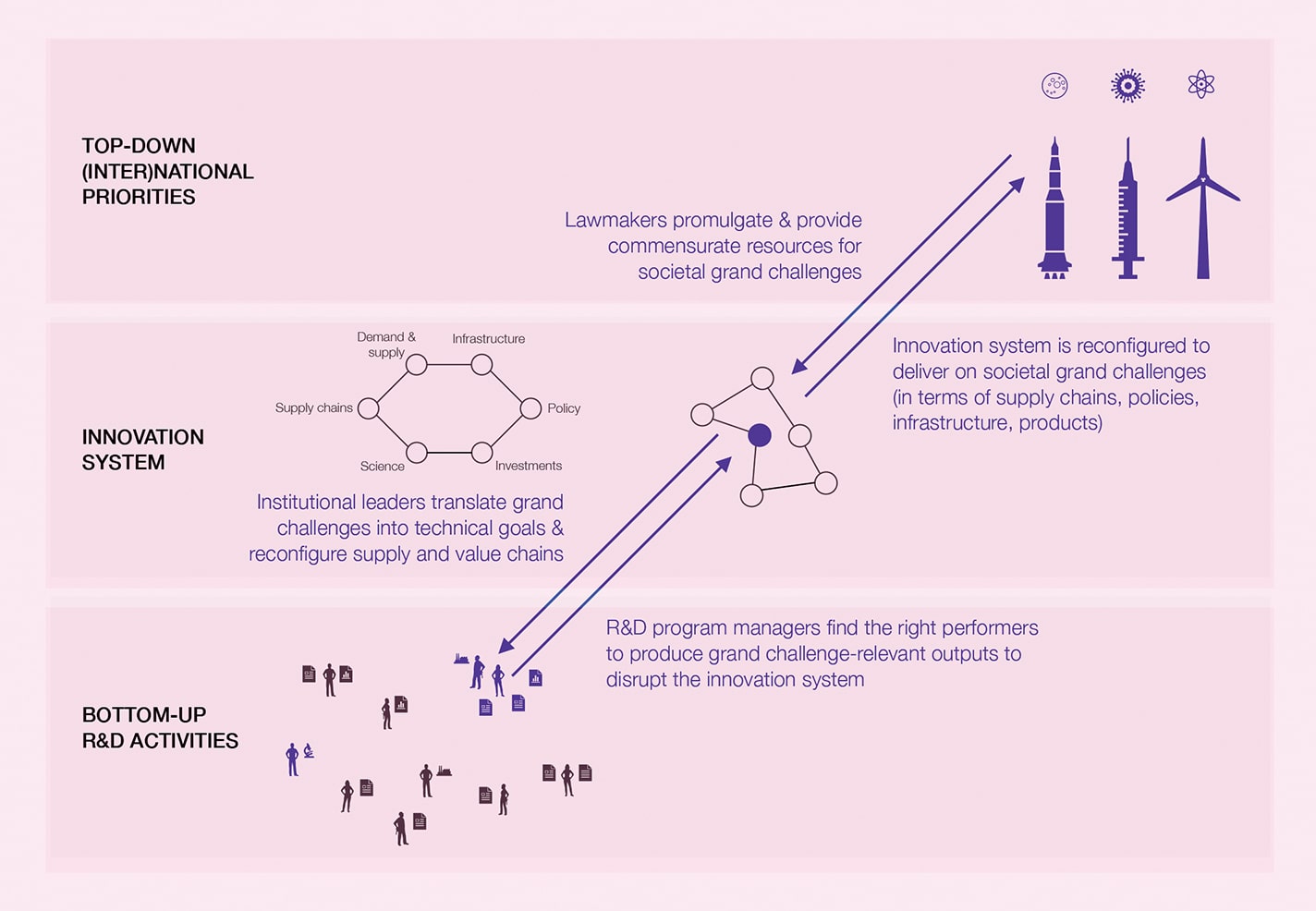
A systems view of where, when, and how to coordinate R&D grand challenges
Grand challenges demand distributed and decentralized collaboration, which in turn requires a collection of mechanisms that enable different actors to work together in the right way, at the right time, in the right place. These collaborations occur in three dimensions: at system levels (from lab-bench R&D to national policy), across timescales (from two-year research projects to decades-long transformations), and in innovation activities (from basic science to society-wide behavioral shifts).
Success depends less on who funds the work than on how effectively participants are able to align across institutional interfaces and technological lifecycles.
Figure 1 demonstrates the coordination challenge in the simplest way: top-level “Big Science” goals expected from and for society (e.g., ending cancer), the bottom-up “doers” who create new knowledge and technologies, and, in between, the innovation system which mediates and translates. The diagram also integrates concepts from studies of DARPA-type R&D program management, including the political economy of mission-oriented innovation. Effective mission framing at this top-down level mobilizes resources and political will, but rhetoric alone will not deliver results. Success requires continual connection to the realities of innovation systems and R&D performers below.
Operation Warp Speed (OWS), the US government’s public-private partnership initiative to develop and distribute COVID-19 vaccines, exemplified this kind of integrative top-down leadership. Its leaders, Moncef Slaoui (former GSK Vaccines chairman) and Gustave Perna (retired Army general), combined strategic management acumen with hands-on operational expertise, and were thus adept at bridging political urgency with practical execution. (Their background makes them what is sometimes called “And” people, because they span the domains of research and industry.) This enabled the program to strategically deploy $18 billion across eight vaccine candidates that were selected from more than a hundred options. The Army Corps of Engineers oversaw accelerated factory construction, and the first US vaccinations were administered just 11 months after the pandemic was declared.
The second layer in the diagram illustrates how innovation systems form the bridging layer. This is where R&D agencies, businesses, and philanthropies operate, doing the work of breaking down challenges into specific technical problems while providing funding and infrastructure. This layer’s critical function is the translation between grand, “wicked problem” visions and actionable, “tamed” innovation programs.
One contemporary example of this layer is China’s Manufacturing Innovation Centers (MICs). Launched in 2016, the centers act as a roadmap, establishing broad goals for manufacturing as well as key performance indicators for diverse stakeholders in response to the top-level goals of Made in China 2025, a US National Institute of Standards and Technology report found. The approximately 40 MICs demonstrate how innovation systems can be reconfigured. Each MIC operates as a for-profit entity with 10–20 equity partners who fund operations, receive government subsidies, develop workforce training, retain intellectual property rights, and collaborate with universities through national labs.
Another example of how innovation systems can go about identifying breakthrough opportunities is the Cancer Grand Challenges partnership between the National Cancer Institute, part of the US National Institutes of Health (NIH), and Cancer Research UK. This initiative uses a staged approach that starts with convening ideation sessions internationally to identify challenge areas, distilling consensus across broad cancer innovation communities (researchers, governments, funders, patients, and health care providers) into seven specific priorities, and providing pilot funding for interdisciplinary teams to work on these priorities, which have yielded discoveries traditional funding would have missed.
R&D happens at the lowest level of the diagram, illustrating the potential for “bottom-up” innovations that change the behavior or decisions of the other layers. Scientists, engineers, and program managers here make concrete technical advances to provide solutions to innovation challenges. Specialist agencies such as DARPA excel at decomposing complex goals into manageable projects with specific stretch goals and timelines. Our network science mapping work also showed these agencies have a distinctive division of labor among themselves when producing new technologies.
Enabling the kind of bottom-up innovation that can yield transformative platforms demands actively building research and innovation networks aligned with a vision for systems change.
DARPA’s Autonomous Diagnostics to Enable Prevention and Therapeutics (ADEPT) program, which ran from 2012 to 2020, illustrates how bottom-up innovation can develop key platforms that can be used to realize grand challenges. Initially focused on gene-encoded vaccines for military deployment, by 2018 the ADEPT program had funded proof-of-concept experiments on lipid-based mRNA delivery systems. This included a $700,000 seed grant to Moderna, which later grew into $24.6 million in clinical study funding and attracted external support for a Phase 1 trial of an mRNA-encoded chikungunya vaccine by 2019. That work laid the technical, regulatory, and logistical groundwork that proved crucial to the rapid development and distribution of a vaccine when COVID emerged. ADEPT’s eight-year investment in platform technology made it possible to meet the grand challenge of rapidly developing and distributing a COVID vaccine. Enabling the kind of bottom-up innovation that can yield transformative platforms demands actively building research and innovation networks aligned with a vision for systems change.
These examples reveal a pattern: Successful grand challenges require alignment across all three layers. Top-down vision without bottom-up capability fails; bottom-up brilliance without system-level support stalls in the “valley of death.” And innovation systems disconnected from either political priorities or technical realities waste resources on misaligned efforts. The new R&D ecosystem’s complexity—with its uncertain funding, diverse incentives, and fragmented authority—makes this coordination harder.
Rethinking how to coordinate for grand challenges
In a fragmented R&D ecosystem, success requires each actor in the system to recognize their role and coordinate with others who play complementary roles. In the absence of a central coordinating body or funding stream, taking a systems view can help R&D leaders across sectors identify where they fit and determine how they can coordinate with each other. In particular, a systems view can help build new collaborative mechanisms so that each actor’s unique capabilities contribute to accomplishing the grand challenge. A closer look at our three-layer framework reveals the specific coordination mechanisms needed at each level to enable success when the system itself is turbulent.
Coordinating national priorities from the top
At the national level, the central coordination challenge is aligning competing political and institutional objectives while sustaining momentum across political cycles and unstable organizational boundaries. Grand challenges can do this by invoking a shared sense of purpose and leveraging the convergence of seemingly disparate priorities. In energy innovation, for example, the goals of energy security, cost minimization, and environmental sustainability can provide framing for the development of various energy technologies. This framing enables agencies such as the Advanced Research Projects Agency–Energy (ARPA-E) to attract support from unlikely allies, including defense hawks, climate advocates, and economic competitiveness champions.
Of course, emphasizing aligned goals is necessary, but it is not sufficient for driving real grand challenge progress. The diverse actors must also be anchored to coordinating structures, and possibly new institutions, that have the authority, legitimacy, and flexibility to maintain and strengthen that alignment over time. Government agencies, for instance, can coordinate when crises demand centralized authority, as demonstrated by the success of OWS.
National coordination succeeds when competing or orthogonal priorities are reframed as complementary and when the coordinating anchor is strategically matched to the nature of the challenge.
Industry coalitions can provide coordination and leadership in areas of economic competitiveness and national security. A leading example is the Semiconductor Industry Association (SIA)—the US chip industry’s trade body—and its research arm, the Semiconductor Research Corporation (SRC). Founded in 1977 and 1982 respectively, SIA and SRC have aligned strategic R&D priorities, funded precompetitive university research, and convened the first National Technology Roadmap for Semiconductors in 1992, which evolved into the International Technology Roadmap for Semiconductors (1998–2013) and later the International Roadmap for Devices and Systems (from 2016). SRC pioneered the now-standard technology roadmapping process, providing a coordination device to reduce commercial and cultural friction among chipmakers and aligning a massive global industry. SIA also played a central role in shaping the 2022 CHIPS and Science Act, further galvanizing US semiconductor competitiveness.
More recently, philanthropic coalitions have played a special role in emerging technology areas addressing societal needs. For example, the Brain Research Through Advancing Innovative Neurotechnologies (BRAIN) initiative was motivated by challenges in neurological disorders and aging. Initially it was spearheaded by the White House Office of Science and Technology Policy, illustrating how government leadership can catalyse broader support for grand challenges. Launched with $100 million in federal funding, BRAIN then attracted major philanthropic commitments from several organizations. National coordination succeeds when competing or orthogonal priorities are reframed as complementary and when the coordinating anchor is strategically matched to the nature of the challenge—but such coordination increasingly includes actors other than the government.
Coordinating innovation systems in “the bridging layer”
Grand challenges depend on complex ecosystems of funders, performers, and intermediaries, and progress hinges on how effectively these actors work together. At the innovation system level, the challenge is less about forging a unified vision and more about translating between political ambitions and technical realities. This can be seen in the BRAIN initiative, in which the philanthropies translated the political vision into actionable research programs, enabling rapid progress. By 2023, BRAIN had mapped over 3,000 human brain cell types, created the first complete insect brain wiring diagram, and developed tools that advanced treatments for neurological disorders. With NIH investing $2.5 billion to date and leveraging philanthropies to multiply impact, this model demonstrates how bridging organizations can sustain decadal grand challenges by connecting top-down priorities with bottom-up technical capabilities. Similarly innovative breakthrough-oriented research models drive the United Kingdom’s ARIA and Sweden’s VINNOVA.
Increasingly in the global innovation ecosystem, empowered intermediary organizations are bridging the institutional gaps between government, philanthropy, academia, and industry.
Increasingly in the global innovation ecosystem, empowered intermediary organizations are bridging the institutional gaps between government, philanthropy, academia, and industry. This can be seen in joint ventures like China’s MICs, public-private partnerships such as OWS, and philanthropic consortia like the BRAIN initiative, which demonstrate how coordination across diverse sectors and actors can be structured. Newer models, such as focused research organizations, or FROs, backed by emerging philanthropies, push this even further by operating in the areas between universities and companies—tackling problems too applied for academia yet too exploratory for industry. Similarly, the Manufacturing USA institutes, the United Kingdom’s Catapult Network, and Germany’s Fraunhofer Institutes illustrate how innovation intermediaries—often referred to as research and technology organizations, or RTOs—can bridge the valley of death by providing shared infrastructure, technical expertise, and neutral ground for collaboration.
Equally essential is clarity in the division of labor between these actors and the way they hand off projects among themselves. Innovation systems work best when each participant plays to its strengths: Philanthropic alliances such as Science Philanthropy Alliance bring neutral convening power; specialist agencies like DARPA and ARPA-E contribute world-class program management; industry consortia provide market intelligence; and universities supply research capacity. With one-tenth of DARPA’s budget, ARPA-E demonstrates how smaller agencies can maximize impact through clever coordination. Beyond funding energy moonshots, ARPA-E’s Technology-to-Market team actively matches projects with private capital, ensuring promising prototypes advance beyond government funding. Their real-options approach—funding multiple competing solutions then doubling down on winners (while “folding” others)—has attracted $14.6 billion in private equity follow-on funding from $4.2 billion in government investment.
No single actor, however brilliant, can cover the entire innovation space. The art of coordination lies in strategically matching stakeholders’ resources to the specific nature of a challenge—its scale, time frame, and stage of technological readiness. Today, network-mapping tools make this easier by revealing gaps, redundancies, and latent opportunities within research ecosystems. Effective bridging at the innovation system level requires building the right connective tissue through intermediaries and orchestrating a coherent division of labor across a diverse and shifting landscape.
Coordinating R&D activities from the bottom up
On the ground, at the R&D level, effective coordination is about accelerating discovery through collaboration and rapid learning. Scientists, engineers, and program managers are closest to the technical frontier, but their efforts often remain fragmented, divided by their institutional, disciplinary, and organizational silos. Overcoming these barriers requires two closely linked strategies: improving the flow of information between silos and shortening iteration cycles.
First, to strengthen coordination, actors must be able to see and share the broader research landscape. Tools and governance mechanisms that enable this transparency can dramatically speed up progress. For example, Wellcome Leap’s Health Breakthrough Network uses a single master research funding agreement to give rapid access to 1.5 million scientists, aligning research priorities and accelerating the formation of networks of researchers to diffuse new discoveries at unprecedented scale and speed. China’s MICs mandate structured knowledge-sharing among competitors, reducing duplication and allowing shared infrastructure without sacrificing intellectual property rights.
Similarly, data sharing can build transparency. Large-scale programs such as Cancer Grand Challenges, the BRAIN initiative, and many philanthropic funders now make data sharing a condition of participation. And more recently, NIH launched the Data Sharing Index Challenge to reward researchers who make their data openly available. All these examples reflect the growing recognition that information flow is not an “add-on”; it is a structural necessity for scientific acceleration.
Effective R&D coordination is about not only accelerating science, but also embedding it in a dynamic, multidirectional system where information moves freely, iteration is fast, and the front lines of discovery remain strategically connected to broader societal goals.
Second, R&D coordination that compresses learning loops allows for faster movement from discovery to deployment. OWS demonstrated how running phases in parallel, rather than sequentially, can shrink vaccine development from a decade to under a year. DARPA fosters a culture where program managers are rewarded for taking bold bets, even when they fail, because quick failure yields actionable lessons. ARPA-E uses a real options funding model that quickly identifies promising projects to scale and cuts unpromising ones early, reducing wasted time and resources. The common thread among these programs is that building feedback mechanisms across organizational boundaries enables rapid course corrections and avoids bureaucratic drag.
Maintaining alignment, however, is necessary well beyond the lab or the program level. The greatest coordination challenge is system-wide coherence: ensuring that what happens at the R&D layer remains connected to both national priorities and the capacities of the innovation system. This requires multilayer feedback loops that allow information to flow both upward and downward. These loops between the layers are what enable transformations on a massive scale. For instance, the DARPA ADEPT program’s bottom-up technical breakthroughs in mRNA technology enabled top-down policy action through OWS. Conversely, the BRAIN initiative demonstrates how bridging organizations can translate political and philanthropic goals into actionable research programs and channel new discoveries back to shape higher-level strategy.
Effective R&D coordination is about not only accelerating science, but also embedding it in a dynamic, multidirectional system where information moves freely, iteration is fast, and the front lines of discovery remain strategically connected to broader societal goals. Solving tomorrow’s grand challenges will require new structures for coordination across all layers of the R&D ecosystem. In this increasingly turbulent world, leaders must frame missions in ways that unite very diverse stakeholders and identify politically viable coordination anchors. Innovation system leaders must think boldly as they design hybrid organizations that break out of silos to take advantage of all the possible capabilities of their ecosystem. And R&D performers must share information and accelerate iteration cycles. All levels need robust feedback mechanisms to keep efforts aligned. By applying these alignment strategies deliberately, the full strength of today’s complex ecosystem can be mobilized to achieve new levels of progress.
Turning complexity into a strategic advantage
The Apollo program, the internet, the Human Genome Project, and COVID vaccines succeeded within a relatively stable, well-funded R&D ecosystem with clear mechanisms coordinated by the federal government. Today, that clarity and stability are waning. Future success will come not from mourning the loss of that past, but from developing coordination mechanisms that ensure coherence across top-down missions, bridging organizations, and bottom-up experimentation—turning today’s complexity into a strategic advantage for solving society’s greatest challenges.
Our framework and cases show that success depends less on who funds the work than on how effectively actors align across institutional and technological boundaries. There is no one-size-fits-all model of coordination, but grand challenges will demand creative mechanisms that achieve this alignment in diverse contexts. Ultimately, each actor in the system should follow the classic motto: Think globally, act locally.