I touched down in Chhatrapati Shivaji Maharaj airport at 2:30 on a January morning wondering what version of Mumbai awaited me. Was this the city I lived in 30 years ago, or the futuristic Diamond Mumbai of Samit Basu’s “What Would Akanda Do?”
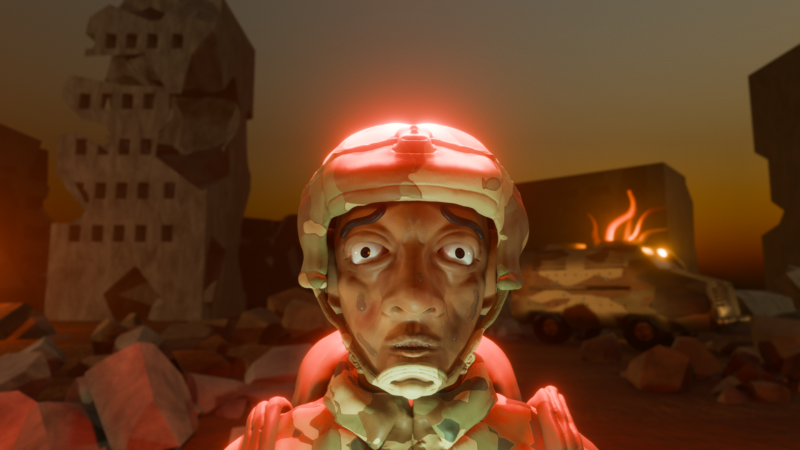
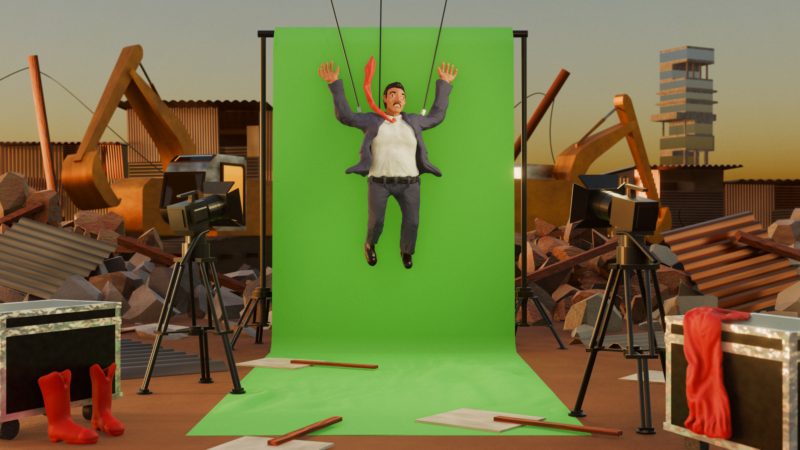
Basu’s story, the latest in the Future Tense Fiction series, is set in a future where the rich, connected, and famous live in towers that hover above the realities of extreme poverty and government oppression that dominate other parts of the city. These climate-controlled capsules filter out not just the stifling heat but also the hustle and bustle that gives the city its hyperactive character. Avi, Basu’s protagonist, is a movie star famous for patriotic roles in jingoistic, pro-government blockbusters. Long ago, Avi sold the legal rights to replicate, adapt, and AI-animate his likeness, and for years he has burrowed in the manufactured tranquility of the New Empire Complex, oblivious to how his hero image had been deployed to advance the ruling party’s political agenda. The Mumbai I encountered this winter hasn’t yet morphed into the possible future of Basu’s story, but it’s well on its way.
As I disembarked in Mumbai, I was struck by the scale of India’s digitalization. The massive crowd at passport control was processed faster than anything I’ve witnessed at JFK or LAX. There are dedicated sections for DigiYatra members, a system similar to TSA PreCheck, linked to your government-issued Aadhar card and biometrics. The residents of Basu’s Diamond Mumbai live in the sci-fi version of that passport hall, where people are branded with tattoos (for the well-off) and bulky implants (for everyone else) to track their activities and disseminate official communications.
Passport control was the stage for my first encounter with the new surveillance state. Upon scanning my passport, an officer asked me to accompany her to “secondary questioning,” where I was detained and asked whether I was there on business as a media executive or in a personal tourist capacity. Message received, I thought to myself. Over the next several days, my friends all revealed that when they gather they often turn off their phones and leave them in another room. Americans laugh nervously when we see Instagram ads related to products we mention in our cars or during family dinners; Indians take no chances with their private conversations, knowing well the extent of the surveillance they live with.
Mumbai is a conjured-up city.
Mumbai is a conjured-up city manifested out of seven islands that were connected by dredging the seabed. The urban land reclamation project that started in 1782 is still underway, and the scale of new construction is enormous, with modest plots sprouting 40-story high-rises towering above hutments and historic temples. As I traversed Mumbai meeting old friends from when I worked at MTV India in the late 1990s, I realized this is what it means to live in the future when the past is not dead. I thought of Avi’s experience visiting Madh Island, where he marvels at a soaring futuristic bridge juxtaposed with the modest ferry he used as a struggling young actor, “still running, and still dirty.” No longer an island thanks to the reclamation project, this was the site of raves and house parties where ganja and alcohol flowed even on dry days. It was on nearby Juhu Beach that I got my first tattoo, a solar eclipse representing the phenomenon that captivated India the weeks after I was born. Once a hangout for renegades and rebels, it’s gentrified now, replete with vacation homes and beachfront resorts.
I felt disoriented as I encountered Mumbai’s skyline from coastal roads and bridges that crisscross the bays, proffering vistas I’d never seen from the land, shrinking commute times and linking areas that once felt disconnected. If I went out after work for drinks and a performance at Prithvi Theater in Juhu, it used to take hours to travel there from Film Centre in Tardeo, where MTV’s office was located; now the trip can take 45 minutes by car.
I realized this is what it means to live in the future when the past is not dead.
Happily ensconced in the front seats of taxis with filmi music blaring, I chatted away in Hindi with my cab drivers, eager to hear about how the city has changed from their point of view. With the voice of Mohammad Rafi singing the iconic ode to Mumbai from the 1950s noir movie C.I.D., we bumped along:
Ae dil hai mushkil (Oh heart, it is difficult)
Jeena yahan (To live here)
Zaraa hat ke, zaraa bach ke (Watch your step, be careful)
Yeh hai Bombay meri jaan (This is Bombay, my love)
I arrived in Mumbai’s Central Station in 1996 from Delhi on the Rajdhani Express with a metal trunk and a backpack to begin my job at MTV India. I’d graduated from college two years before and had been interviewed by three executives in the lobby of a hotel where I used to sing Christmas carols to make extra money during the holidays. Back then, this overnight train was the most economical way to travel between major cities. As we reached the platform, the conductor played Rafi’s “Yeh Hai Bombay Meri Jaan” and the whole train sang along. Outside the station, I hailed a yellow-and-black cab to take me to my hostel.
Today, Mumbai’s cab drivers face stiff competition from rideshare apps like Uber and Ola. The drivers I spoke to feel the squeeze of a rapidly automating society. The big news on their minds is the redevelopment of Dharavi, one of Asia’s largest slums, which sits on one square mile of prime land at the intersection of many high-value enclaves. With more than a million residents, Dharavi is among the most densely populated places on the planet and has confounded policy experts for decades. Generations of migrants have fashioned tin sheets, tarps, and handmade bricks into homes for their families; it’s common for 250 people to share a toilet and 15 families to share a water tap. Despite these conditions, some Dharavikars have resisted the plans, fearing that rather than improve their lives, the redevelopment will evict them permanently from their community with no hopes of returning. The fear is not unreasonable—one relocation site is Deonar, a toxic dump site that has not been remediated.
The drivers I spoke to feel the squeeze of a rapidly automating society.
Adani Group, India’s dominant infrastructure and development conglomerate, is leading the redevelopment. The proposed master plan hinges on new high-rise apartment buildings, offering a walkable “live-work” lifestyle with rejuvenated open spaces. Marketing materials boast about more than 100,000 residential units that will be divvied up using a complicated allocation process to “eligible” residents. These polished selling points are meaningless to cabbies and their families, whose work takes them to the far reaches of the city. While they are desperate for a better life, they fear losing their toehold on an affordable home in the heart of town. Meanwhile, redevelopment is rolling along and resident relocations have begun.
Some four kilometers away, Bandra, where Avi makes his home, is a scenic neighborhood where movie stars live in seafront properties and do daily darshan for their adoring fans, like deities emerging from the inner sanctum of a temple. Bandra-Kurla Complex (BKC) is what I imagine the New Empire Complex in Basu’s story is modeled on. This area was also carved out of the sea as reclaimed land. Until the 1970s, it was a low-lying marsh prone to frequent floods; by the ’80s, BKC had transformed into a bustling commercial hub. Three decades ago, it was still mostly a business district, with apartments reserved for employees of powerful public-sector companies like IndianOil and State Bank of India. That changed in 2012, when construction began on the Jio World Centre and the Nita Mukesh Ambani Cultural Centre (NMACC), projects led by Asia’s richest family, the Ambanis, who helm a massive oil, telecom, gas, and retail conglomerate. The Ambanis themselves live in an equally impressive 27-story building called Antilia, which towers over Mumbai and was built to accommodate 600 staff, 168 cars, a temple, and a “snow room” complete with fake flakes. It is the most expensive home in the world.
A Bellagio-style fountain dominates NMACC’s main entrance. Inside, white marble, gold trimmings, and fluorescent lighting overpower the senses. Teenagers take selfies in mirrored hallways and families nosh on pizza in the pastel-toned café, attended by smartly uniformed staff. As you head to the upper level, a plaque announces that you are about to enter the world’s largest passenger elevator. The elevator is meant to send you up and away—but to where, and away from whom? What will it mean to live in the Diamond Mumbai, the future city—and who will be welcome? Mumbai is a city of contrasts, where architecture divides and collides its residents, and where many visions of the future battle at once.
In the immortal words of Mohammed Rafi: Zaraa hat ke, zaraa bach ke / Yeh hai Bombay meri jaan. Watch your step, be careful / This is Bombay, my love.