“Migration is one of the great events of our times and it deserves to be understood in all its complexity.” —Yuri Herrera
I’ve thought a lot about hands in my work as an investigative journalist covering the meatpacking industry. Workers’ hands are dry and scarred, hardened territories. If we are willing to hold those hands, to read them like maps, they have a story to tell us. The workers perform repetitive movements for decades at the pace of machines, until their bodies break, they are disabled, or they die.
Related Reading
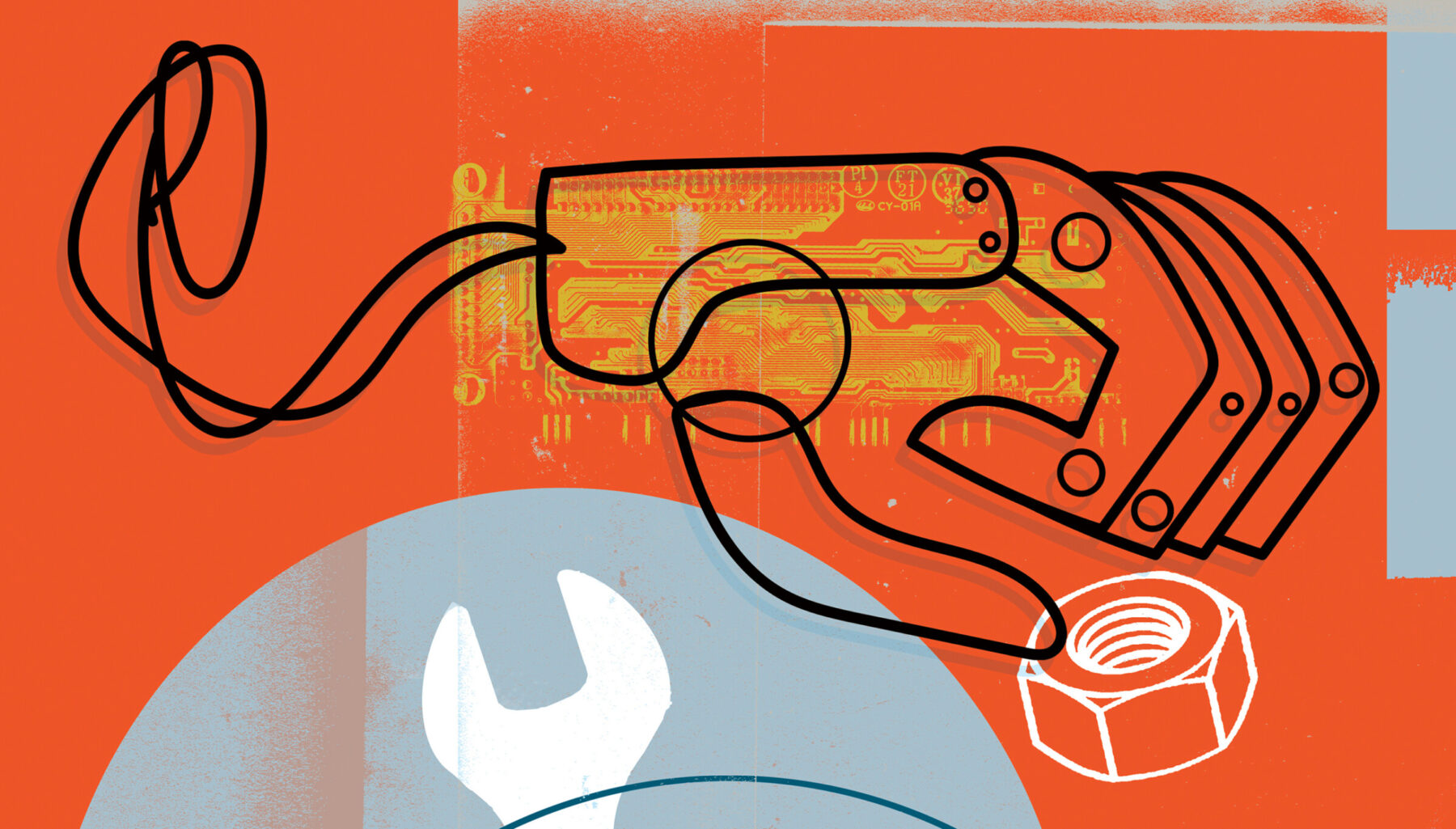
In “Coser y Cantar,” Gabriela Damián Miravete’s Future Tense Fiction story, we meet Trix, Marta, and Luisa, immigrant workers at a fast fashion clothing factory in Los Angeles. Trix, who is the last of the three women to arrive from Mexico, is surprised to find that a factory in Los Angeles looks the same as one in Juárez. When the factory where the women work collapses during an earthquake, workers are maimed and killed. One of the protagonists, Marta, loses her right hand.
In the aftermath of the accident, the company in Damián Miravete’s story replaces workers with robots powered by artificial intelligence, which it frames as a way to protect workers’ health. The workers, without jobs or money, are left to fend for themselves. As Luisa notes in the story, there are few laws regulating AI.
AI optimizes existing systems. When applied to fast fashion and factory farming, the technology increases exploitation, pollution, and overconsumption. We need to think, as Luisa does, about how AI should be regulated.
When applied to fast fashion and factory farming, AI increases exploitation, pollution, and overconsumption.
Hands can feel the softness and the tension of fabrics. They can do intricate needlework on delicate material. When I asked ChatGPT about the role of AI in fast fashion, it said, “Some garments require human hands to sew.”
Human hands do strong, precise, delicate work. In the meatpacking industry, they can distinguish between skin, fat, and bone, cutting through layers of animal flesh as needed. AI and robotic systems struggle to recognize parts of animal carcasses, and fragile tech set-ups have a hard time surviving the daily, harsh chemical cleanings at meatpacking plants. And so, for now, human hands are needed in slaughterhouses and processing plants.
In “Coser y Cantar,” AI robots replace the workers at the fast-fashion factory. What I appreciate about Damián Miravete’s work is that she centers the workers, the women who want to create a better workplace and a more environmentally friendly way to produce clothing. Damián Miravete’s story, in asking us to think about the workers who are replaced by AI, presents what will likely be the pressing issue of our time: What does it mean for society, in ethical and practical terms, when significant numbers of workers are replaced by AI?
In my own work covering the meatpacking industry, I am now seeing how AI technology is being sold as a way to increase animal care and efficiency. Facial recognition and remote sensors are being trained to tell us if cows and pigs are happy and healthy. AI recognizes patterns, but we need to question who is training the machines to focus on certain things and ignore others.
The women in Damián Miravete’s story discuss how there is enough clothing on the planet to dress the next six generations of humanity. In the second part of the story, the women organize around labor rights, creating their own technology to form a global collective. Trix, Marta, and Luisa form a union to recycle clothing in collaboration with traditional embroiderers. The women offer an ultimately hopeful, collective way forward.
What does it mean for society, in ethical and practical terms, when significant numbers of workers are replaced by AI?
Damián Miravete’s vision reflects the long history in her native Mexico of women being at the forefront of labor and social justice movements. Since the Mexican Revolution, women have organized to advocate for fair wages and safe work conditions. In Las soldaderas: Women of the Mexican Revolution, Mexican journalist Elena Poniatowska writes about how without women, there would have been no revolution.
In 2023, I interviewed Poniatowska at her home in Mexico City for the Library of Congress. Poniatowska, 93, has chronicled social movements across Mexico throughout her career. In the interview, she said, “I began to work as a journalist in 1953, and I realized that, in general, women were ignored. I started to do interviews but wasn’t conscious of what drove me, but it was the absence of women. The only woman talked about a lot in Mexico was Frida Kahlo, who was married to Diego Rivera, a couple constantly in the papers. I began to learn to interview women, factory workers, and manufacturers.”
In recent years, Mexican women have been at the forefront of fighting for legislation around femicide and reproductive rights. In her interview, Poniatowska said of recent social movements: “What is remarkable is, for example, the fight for abortion rights, which has been led by a brave feminist woman, Marta Lamas.” Lamas, an anthropologist, founded the Information Group on Reproductive Choice in 1992, and in 2005 she was nominated for a Nobel Peace Prize for her work. In 2024, when Mexican president Claudia Sheinbaum took office, she said, “Women have arrived to shape the destiny of our beautiful nation.”
The women in Damián Miravete’s story, in working together to produce recycled, handmade clothing, are organizing a revolution. They are rejecting fast fashion and AI, and presenting their own vision of the future. They create an open-source communication system that allows them to organize with others across the globe. Trix, Marta, and Luisa, through collective action, work to create labor conditions that honor dignity and humanity.