$249.99—on sale, no less. Not a bad deal at all, considering these things are usually $500 to $800 these days. I’d been contemplating getting one for the longest time and finally decided it was worth it. So, I added it to my cart, deliberated for a day or two, then in the final minutes of the sale, I clicked checkout. There was the post-Prime Day shipping delay, so my 24-hour delivery wasn’t honored—but it did arrive the following week.
It was bigger than I’d expected. I’d read the details and dimensions, but you can never really tell, right? My husband helped me drag it inside. It was strange to see something that was once so far beyond our collective comprehension just show up in a cardboard box at our doorstep.
I tore away the plastic and read the safety instructions. There was a surprising mundaneness to it all. Do not put the plastic wrapping over your head. Do not allow small children near it. Lift box with two people. No organic matter allowed inside. Do not leave it open. Do not place items inside without attachments. Do not close your fingers in the hinges. Blah, blah, blah.
The Pocket Box™: For all your storage needs.
I was afraid to open it at first. If you have one, I’m sure you know the feeling. Opening that lid for the first time and staring into … what? A void? A black hole? An abyss? I realize it’s called a “pocket dimension,” but I’m not a physicist and I don’t know what that means. To me, it just looks like … nothingness.
It was strange to see something that was once so far beyond our collective comprehension just show up in a cardboard box at our doorstep.
I was in college when I heard the story for the first time. We journalism majors always listened dutifully to Michael Barbaro on The Daily, and I remember him interviewing the scientist who is credited with discovering the pocket dimension. He called it “the biggest scientific breakthrough in the history of humankind.” Barbaro, for his part, uttered more than his usual share of incredulous “Huh’s.”
The thing that everyone was buzzing about back then was the fact that it brought us together. It was like a moon-landing moment for my generation. Of course, there were those who voiced major criticisms and worried about the implications of such a discovery. Some called it fake news. Others called it the devil. It challenged people in a way they’d never been challenged before. I mean, I was raised Lutheran. I was taught that mankind was created in God’s image and that God created Heaven and Earth. But the Bible never said anything about what else God may have created. So, who’s to say He didn’t create the pocket dimension, too?
Dr. Patrick Wertz was the scientist’s name. He became a kind of overnight celebrity. Like Einstein, minus the charismatic hair. He was kind and humble and spoke in a vocabulary and tone that made the concept easy to understand. Or at least made us think we understood it. Didn’t matter which side of the aisle you sat on, either—there was universal, bipartisan agreement that this was a big deal, to be dealt with seriously by world leaders and Congress, who would consider whether and how to regulate the newly discovered dimension. After all, the immediate implications of another world existing within our own were staggering.
Dr. Wertz was interested in the potential to reduce carbon emissions and reverse climate change. What if all carbon emissions could just be funneled into this other, seemingly empty dimension? What if all our waste—imagine every single plastic bottle—could just be scooped up and dumped into this other place? And that’s exactly what they did. Massive sites were erected around the world—well, in countries that could afford to build them. Since it was a “quick fix” for climate change, one that didn’t require any economic sacrifices or constraints on our capitalist way of life going forward, both left and right embraced the push to maximize the dimension’s potential. Most of these sites were privately funded, but there was some government funding, too.
That was around the time I met Ben. He was studying engineering, but even as a grad student he was still the most knowledgeable person I’d ever met. He had this ability—like Dr. Wertz—to explain things that I previously couldn’t comprehend or relate to. I told him he should be a teacher, and he told me he had bigger plans. Bigger plans indeed. He’s worked on everything from robots that assemble cars to a piece of a ballistic missile for the US government. But even Ben couldn’t fathom how Dr. Wertz had discovered the pocket dimension. I guess this is a good time to mention that Ben is now my husband and the father of my child.
The immediate implications of another world existing within our own were staggering.
It was one of those times when you don’t notice the difference until things are so different you can’t imagine how you’re just now noticing. One day we were in Central Park and we both looked at each other and said, “Is the sky like, really blue?” We were both on edibles at that moment, but it was extremely blue. And everything smelled different. They’d put these piping systems in the city about a year prior. Skinny white tubes that ran along the distance of the interstates and heavily congested roads that were designed to pull emissions out of the atmosphere and reroute them into designated pocket dimension hubs all over the country. There was a lot of buzz around it when the pipes were first laid, but ever since then, they’ve become easily overlooked. Now, they’re dirty and turning greyish, but still working, apparently.
There was a period when scientists were pushing for human exploration into the pocket dimension—although Dr. Wertz, as he started fading into obscurity, strongly opposed it. The notion of humans traveling through pocket dimensions held tremendous potential for danger. The military applications intrigued governments all around the world as well. Imagine if an elite team—or hell, an entire army—could just walk through a door, march through another dimension, and emerge on the other side of the world in enemy territory. Surely you understand how problematic that could be. The threat to national and global security was so great everyone unanimously agreed that there would be no human exploration of the pocket dimension. So of course, every country began considering doing just that.
The problem they ran into was the pocket dimension’s sheer vastness. Even if two doors were opened in the same room, whatever was inside was so massive they couldn’t see the other doorway. It was a dimension that operated outside of our reality and understanding of physics. Because of this, it was there to be exploited but not studied.
Not for lack of trying. There was a period when scientists sent in all sorts of probes and robots, but once the things were even a foot inside the pocket dimension, all audio and video communication went dark. It became clear that it was impossible to communicate from one dimension to the other, at least with any communication tool we’ve developed. They sent in a robot tied to a cable and used some sort of echo location to track exactly how big the pocket dimension was. They pulled the robot out and when they examined the findings, they were completely stumped. The hard drive on the robot was like that of a Mars rover; it was designed to be able to collect data for nearly a decade. The robot had gone into the pocket dimension for only 18 minutes, yet when it came out, its hard drive had run out of space.
As everyone quietly expected would happen, a human eventually went missing inside the pocket dimension: a Russian soldier on a covert operation seeking to weaponize it. The Russians built him a suit that literally looked like Ironman’s and sent him inside. The footage of the test leaked out on YouTube immediately after the story broke, and it’s really unsettling. They had built this doorway to the other place that looked kind of like a walk-in freezer. Russian Ironman gets screwed into his suit with a bunch of drills, they walk him up to the door, they salute one another, then Russian Ironman walks through the door and disappears into blackness. The generals and scientists just kind of look at each other for a moment, then they start to look at their computer monitors, then they start casually calling out for Russian Ironman. You can see the exact moment they realize they’ve fucked up. Then panic erupts, the camera starts shaking erratically, and the video ends very abruptly.
The 24-hour news cycle covered this incident with sickening attention. Times reporters went to Russia and spoke to Russian Ironman’s family. Fox News made little cartoons mocking his disappearance. Late night hosts did bits. TikTok conspiracy influencers churned out days of content. And for about a week, he was a worldwide phenomenon. Then, he came back.
It was one of those times when you don’t notice the difference until things are so different you can’t imagine how you’re just now noticing.
No one was there at the exact time he emerged, but the footage of him being taken out of the lab on a stretcher was everywhere. He looked the same for the most part. He hadn’t been mauled by some interdimensional beast or anything. But when the cameras followed him to the hospital, the changes become very clear. His eyes were white and milky, kind of like a dog that lives 10 years on borrowed time after the vet suggests you put him down. He was also completely catatonic. Speculation about what may have happened to him during his time in the pocket dimension ran rampant. Unfortunately, Russian Ironman was declared brain-dead and died soon after arriving at the hospital.
There was a knee-jerk reaction to his return. Governments around the world issued new regulations and vowed to crack down on all human experimentation and exploration into the pocket dimension. As a result, no new juicy stories about the pocket dimension came out, and the culture kind of shifted away from its collective fascination with this other place hidden within our world. Everyone seemed to move on.
Then, out of nowhere, this guy went viral on TikTok for living in a tiny house but storing all his belongings in a pocket dimension that had been retrofitted to open inside a Yeti cooler. People. Went. Crazy. This ushered in the new wave of pocket dimension mania, but this time, it wasn’t about science. This time, it was about consumerism.
Every major tech company lobbied for legislation that would allow them to provide easy storage for the American consumer. And it wasn’t just in the United States. Every country wanted in on the storage gold rush. And it wasn’t just storage, either. Some companies advertised waste-management solutions. Some companies even started offering burial alternatives. It was sheer madness, and it all culminated in the arrival of The Pocket Box™. It was pretty genius, I won’t lie.
The Pocket Box™ became the latest disruptive force to determine winners and losers in the economy and on Wall Street. Stocks of consumer and apparel brands soared as the phrase “Stock Your Box” became the latest retail catchphrase, inspiring plenty of Pocket Box™ flash sales. Shoe brands and the “made to last six months” H&Ms and Zaras of the world asked that you no longer let your limited closet space rein in your consumer impulses. Stocks of consumer and apparel brands soared. Infinite storage space was now on hand.
This time, it wasn’t about science. This time, it was about consumerism.
Building wholesalers and the home improvement industry, on the other hand, took a massive hit. Remodeling houses was becoming much more prevalent than building new homes, but with unlimited storage space in something the size of a laundry basket, most people opted out of adding that additional closet. The Container Store went the way of Blockbuster Video.
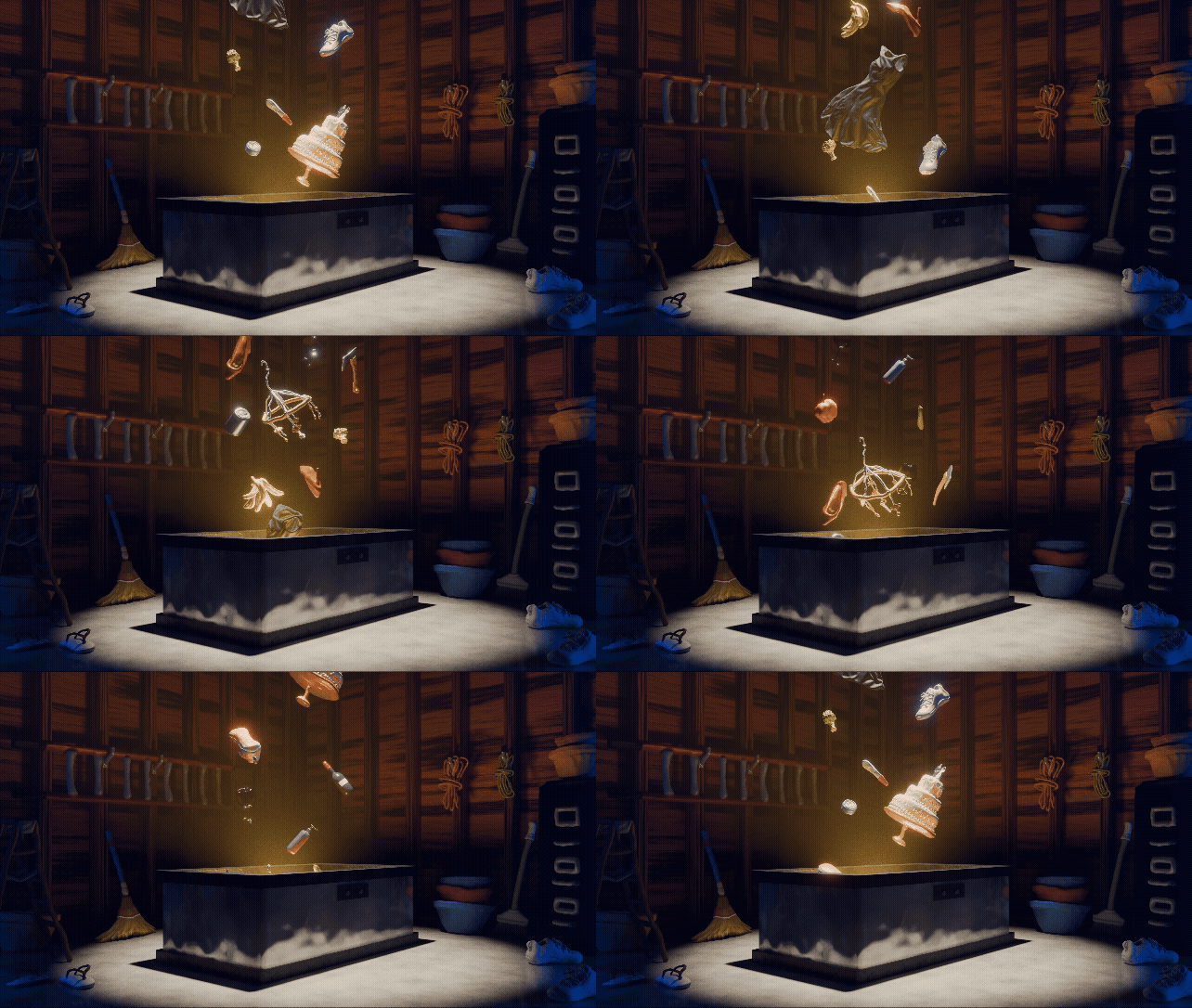
My Pocket Box™ looked like a big, rectangular cooler equipped with an electronic conveyer belt fitted with different hangers and clips that dropped down anywhere from 50 to 500 feet into the pocket dimension, depending on the model. The belt clipped to the inner edges of the box to lock your clothes or whatever you were storing in place. Two buttons on the side of the box operated the motor so that you could easily sift through your stuff. A glowing yellow sensor strip lined the perimeter of the very bottom of the box, just before it opened into the vastness that was the pocket dimension. The sensor made sure no organic matter was disposed of in the pocket dimension.
Some companies manufactured massive Pocket Boxes™ that were designed to accommodate construction equipment and all sorts of larger machines. They looked like shipping crates and had huge hydraulic lifts that could load equipment up and lower it down into the pocket dimension. The retail ones came in three sizes: One was about as big as a refrigerator, one was the size of a cooler, and one was the size of a large jewelry box.
I wanted the midsize. Who needs Carrie Bradshaw’s closet when you can have an entire other dimension to store all your shoes? Yes, I’ll admit, I fell headfirst into Pocket Box™ hysteria. I don’t even own that many shoes, but I was caught up in the excitement of it all. Ben and I had just purchased our first home, and we were eager for extra storage space without the pain of renovations. So, after wistfully reading all the reviews and marveling at those “how they made this” videos on YouTube, I was ready to pounce when I saw The Pocket Box™ was going to go on sale, for the first time, on Amazon Prime Day.
That was such a happy chapter of our lives. Everything was exciting and unknown: The joy and pressures of first-time home ownership, with the next milestone right around the corner. Our little boy Felix was born soon after.
Life changes fast with a baby. If you’ve had one, you know what I mean. Your life is no longer your own. Your job is now keeping another human alive. Ben and I promised each other that our relationship wouldn’t change, but it did. Of course it did. He was a wonderful father, but he was no longer a great husband.
Infinite storage space was now on hand.
There’s something in a man’s DNA—that’s not fair—there’s something in most men’s DNA that tells them once they’ve had a child, their work in propagating the human race isn’t done yet, and they must begin searching for a new mate to do the same thing all over again. That’s the lizard-brain talking, but once it creeps up the cerebellum into conscious thought, it makes some men do really dumb, hurtful shit.
I was now the mother of Ben’s child. I was no longer his wife. No longer his partner. The sexy little thing I’d been when we met in college wasn’t quite as little and didn’t feel as sexy these days.
Her name was Quinn. She was pretty. And younger. I get having a flirtatious relationship with someone of the opposite sex. In some ways, it’s probably good for both parties. For Quinn, it should have been a safe place to practice her game; for Ben, it should have been just enough to make him feel like he’s still got it. But then they crossed a line. I have a master’s degree in investigative journalism, so picking up on less-than-subtle hints wasn’t hard. And being the child of divorced parents, I guess I wasn’t surprised that my husband was having an affair. What did surprise me, however, was how much it hurt.
At first, I was angry. How could he do this? Not just to me, but to our son? I found myself disgusted that he would come home a little later than usual, then pick Felix up and love on him as if everything was normal. I started to resent his touch. But then I would get a rare moment to myself and think, “You don’t know he’s cheating. You just suspect it.” I would feel better for a week or so, then he’d come home late again and the whole spiral would start over. And then, one day, I came home from a work trip and found a bottle of lavender-scented lotion in our bathroom and long blonde hair in the shower drain. My suspicion had become a reality.
We talked about it. He cried and swore it would never happen again and did all the typical shit men do when they’re caught. It wasn’t even that I didn’t believe him. Our baby—our fucking child that we made together—was asleep upstairs while he was boning some barely legal homewrecker on our couch. I know it was on the couch because it was all sorts of crooked when I got home. I told him I needed time. It was true. As mad and as hurt as I was, I had this gut feeling that I would get over it one day. Maybe I’d never trust him again, but I wouldn’t be mad forever. But what does a relationship look like without trust? That’s what I needed time to think about.
It was a couple weeks later that I was invited to a black-tie event for work. I’d been working out four days a week ever since I was cleared by my OB-GYN postpartum, and I was looking damn good. What’s even better was that I had a plus one, and I invited a girlfriend. Figured I’d let Ben sit this one out.
I went to the garage and opened The Pocket Box™. I used the remote and shifted through the dangling conveyer belt of old clothes we’d put in storage. If you don’t have one, the best way to describe it is like one of those massive racks of clothes you watch move along the ceiling at the dry cleaners, except this goes down into the box and just sort of hangs there in space. It’s trippy to look at and kind of makes me feel unstable, like I might fall in. But before I lost my footing and tilted headfirst into the infinity that was sitting in my garage, I found the little black number I’d been searching for, snatched it off the rack, and shut the box.
As I was getting ready, I began to wonder how many people had committed murder and stuffed the body into their Pocket Box™. Surely it had to have been done before, right? And yet not one single story about it on the evening news. Not one Netflix documentary of the woman who was hacked to pieces and thrown into another dimension. Not even a Ryan Murphy series about it. It was a sick thought, but I couldn’t help it. Granted, there is the safeguard on all Pocket Box™ units: the inch-thick glowing yellow strip along the bottom of the box that detects organic matter. If something organic—say, a body—crosses the strip, an alert is sent to Pocket Box™ HQ. They advertise this as a feature to prevent young children from climbing inside, but maybe it’s to keep your Pocket Box™ from becoming your own personal Murder Box™. But damn, Quinn would make a great star for the first Murder Box™ documentary. You know it. I know it.
I sat in the Uber thinking about it. I could have her over for a drink, just to talk woman-to-woman. Let her know I was at peace and that there were no hard feelings. She’d apologize over and over, saying she wasn’t sure what she’d been thinking, and how the attention from an older man was so flattering, so overwhelming, that she’d lost her better judgment. I’d tell her I understood, and that Ben was a very special man. She’d tell me how lucky I was and how beautiful my life was. I’d accept this, but then she’d shift into telling me she knew her relationship with Ben was only a fling because she could never measure up to me. I’d scoff at this, but then she’d say, “No, but like, really. You’re so beautiful.” Then I’d make myself blush and say something about how after Felix was born, I just didn’t feel as pretty. Then I’d look her up and down and have a lightbulb moment. “You know what? You’re about the same size I used to be. I think I have some things that would look amazing on you.” We’d giggle about how we were becoming friends and ask each other if it was weird. Then after another glass of wine, I’d take her to the garage, open The Pocket Box™, let her start shifting through the racks, then take either a lead pipe or an axe and ram it into the back of her stupid little head, then shove that worthless bitch over the edge into oblivion.
Okay, that was a lie. I didn’t just think about it in the Uber. I thought about it at the dinner, through the awards ceremony, and every day and night for weeks thereafter. I thought about it while I was at work. I thought about it while I was on the toilet. I thought about it while I was changing Felix’s diaper. I thought about it while Ben was going down on me. I thought about it while I was in the shower afterwards. I thought about it when I went to sleep. I thought about it when I woke up. I thought about it every second of every day. I’d find myself opening The Pocket Box™ and staring into the abyss, imagining her body disappear like the video of the Russian Ironman.
So, I decided to stop thinking about it, and do it.
She lived in a bougie apartment complex on the other side of town. Gated entry, doorman, underground parking, laundry in each unit. The kind of apartment Ben and I used to dream about before we bought our house. After staking it out and surreptitiously studying her routine on four separate occasions, I felt I was ready to do the deed.
My plan was simple. I’d put The Pocket Box™ in the back of my SUV. I’d drive to her place and wait for someone to let me in, pulling the “I just moved into the building” card. I’d park in a visitor spot, then go up the elevator. Luckily, her apartment faced the street, so it’d be easy to find her door once I was inside. I’d knock. She’d answer. I’d hit her in the head with this little hatchet Ben bought when he was in one of his “I need to feel manly” phases, push her body inside, close the door, clean up the mess, find her keys, go downstairs with a dolly, bring The Pocket Box™ upstairs, dump her inside, wipe the place down, then bring The Pocket Box™ back down to my car and leave. It’s so easy to plan a murder.
The only issue? The organic matter sensor.
There were tons of Reddit threads about disarming it. Turns out, a lot of folks try to store food in their Pocket Box™. Dried fruit, canned goods, jerky, every organic food item imaginable that doesn’t need refrigeration could be stored in The Pocket Box™. A lot of people in the threads seem to be doomsday preppers. One lady, let’s call her Jan, put a bunch of organic matter—dried food, she claims—into her Pocket Box™. HQ was contacted and a report was filed. Officials from Pocket Box™ came out and conducted a search of her box, and when she showed them the amount of food inside, apparently that was all that they needed. Case closed. The next day I went to the store and loaded my cart to the brim with dried fruit, jerky, beans, and canned tuna. I figured the more organic matter I showed HQ, the stronger my case would be.
It was time to act. I nearly herniated a disc putting The Pocket Box™ in my car. Other than that, everything went according to plan. Some old fella let me in and welcomed me to Quinn’s building, not even bothering to ask my name. I drove down into the bowels of the parking deck and parked in visitor parking as planned. I got out and pretended to gather some bags, then took the elevator to the fifth floor. My breath was heavy as I walked down the hall to the corner unit. This was Quinn’s, I was positive. I listened at the door. I could hear her inside talking on the phone. Loudly and obnoxiously. I raised my hand to knock, holding Ben’s axe in the other hand.
Then it hit me … I’m not a killer.
The drive back home was silent. Weeks of fantasizing about murder. Murder! What the fuck was wrong with me? Had the affair really altered me at that deep a level? Was I even that mad at Ben? Was I that mad at Quinn? I mean, yes and yes, but come on now. Get a hold of yourself. And what about Felix? My little man? How could I ever look at him the same way again, knowing I’d risked going to prison for the rest of my life? Knowing I’d risked abandoning him in a jealous rage? I cried. It was ugly. Lots of snot.
I sat outside my house and watched Ben sitting on the couch next to our baby. Felix had just started walking, and I knew the moment I walked in the front door that Ben would help him to his feet so he could “walk to mama.” This made me cry harder. And when I opened the door, there he was. Just a little human wearing a fuzzy blue onesie, walking toward me like Frankenstein. Little fat arms outstretched, drool on his chin, making some sort of noise that remotely resembled “mama.” I picked him up and kissed his little head, then squeezed him so tightly for a second, I thought he might pop. But he just smiled and laughed. Ben came over to me, and we shared a group hug. A family hug. Maybe that’s all I needed.
I put The Pocket Box™ in the garage the next day. I could never let Ben know what I had planned to do. This was a secret I was taking to my grave. Part of me wanted to get rid of it. Part of me wanted to keep it, to remind me of what I almost did. It sat there for a month gathering dust. Stuff got piled on top of it, but nothing else was put inside. I just couldn’t bring myself to look into that black abyss again. The mental image of Quinn’s body floating through the void and the subsequent, inevitable unravelling of my life that would have followed was just too much.
I just couldn’t bring myself to look into that black abyss again.
We were in the process of building Felix’s first real bed when Ben got the text. We were laughing and being playful with each other, just like the old days. I heard the ding of the incoming text, and I saw Ben check his phone. His face turned white, and he looked like he might be sick. He set his phone down and excused himself from the room, leaving me and Felix alone. Naturally, I looked at the phone to see what was up. I guess he wanted me to since he didn’t take it with him. Maybe he was tired of keeping secrets. So, I looked. A photo from Quinn. Just “Quinn.” He didn’t have her last name stored. Her gaudily painted nails holding a positive pregnancy test.
We sat in the kitchen that night for a couple hours. It was like reopening an old wound, but the fact that Ben was immediately honest and up front about it this time made it easier. The affair had ended about a month prior, but she’d just recently found out. According to Quinn, she’d considered not telling him. But eventually she knew she had to. You can’t blame her. Looking beyond my own pain, her position sucked too. It was Ben’s fault. All of it was Ben’s fault.
I slept in the guest room that night. Slept is a generous word: I stared at the ceiling most of the night, going through all the potential pros and cons of getting a divorce. We hadn’t signed a prenup. We had joint accounts. Everything in our lives, from the house to Felix, was shared. I’d placed all my bets on Ben, and he’d gone and gotten another woman pregnant.
When I woke up the next morning, Felix was in his bed, but Ben was nowhere to be found. Normally I’d worry, but in that moment I was relieved. I didn’t want to pretend I was okay, but I didn’t want to give him the silent treatment, either. I just wanted all of it to be over. If we were going to get a divorce, fine. Let’s do it and move on. If we were going to make up and figure out how to move forward, cool, let’s start talking it out. It was the limbo that was making me crazy. Limbo that I was creating.
I worked from home all day. Just me and Felix. I couldn’t think of a day when we’d spent so much time one-on-one. I found myself hoping that Ben wouldn’t come home. That he’d just run off with Quinn to start his new family. I knew deep down there was a part of him that wanted that. If he could step into an alternate reality where he, Quinn, and their new baby were a happy family and he didn’t have to worry about divorcing me or abandoning Felix, I think he’d do it. As wicked as it sounds, somehow him just disappearing felt much easier than dealing with all of it. But alas, he came home around five.
Somehow, him just disappearing felt much easier than dealing with all of it.
He brought in takeout from my favorite Indian spot. Ben doesn’t like Indian food, so I knew there was a talk coming. The gesture was meant to soften the blow. He told me that Quinn had gotten an abortion. She’d put in her two weeks’ and was picking up to move to Seattle. She was only 27 and didn’t want to be the mother of a married man’s child. Ben told me this so calmly, but I could tell it was weighing heavily on him. It felt strange to ask him if he was okay with all of it. He said that he was relieved; that he thought he’d ruined her life along with his own, not to mention mine and Felix’s. He said he wished nothing but the best for her, and wanted to focus on us, and fix what he’d tried so hard to destroy.
I won’t say I forgave him quickly, but I could tell he was trying to make amends, and things started to feel normal again. When I was younger, normal was always a word that terrified me, but now it was bliss. Knowing when to expect Ben to be home. Knowing what nights he’d be making dinner. Knowing when he’d be giving Felix a bath and putting him to bed. I had no idea how long it would last, but in those first few days, it was wonderful. In some ways, we felt closer than ever. In others, I could still feel the distance between us, and I wasn’t sure that would ever change.
About a month later, Ben was invited to some swanky event for the launch of a new project he’d worked on. I looked through my closet, searching for that one dress. The black dress I wore to every fancy function because it magically hoisted my boobs and cinched in my waist. But it was nowhere to be found, which could only mean one thing … it must be in The Pocket Box™.
I thought about just buying a new dress. The thought of opening that thing again made me queasy—it was a reminder of the time I thought I was capable of murder. It was the same feeling you get when you’re afraid something from your past is going to land you in serious trouble. But I talked myself down. I reminded myself I hadn’t done anything wrong; I’d changed my mind. Considering killing someone isn’t the same as actually killing them. Most people do that, right? Think about killing someone, I mean. And then not actually go through with it? Surely that meant I was a good person, right?
I thought if I stared into it long enough, I’d go insane.
The Pocket Box ™ was right where I’d left it. I felt like by opening it, I was somehow betraying the trust Ben and I were trying so hard to repair. But I really needed that dress. I pulled it out from under the shelf, unhooked the latches and slowly opened it. The top thumped against the wall, revealing the other dimension. The nothingness. The oblivion. The black fucking hole. I thought if I stared into it long enough, I’d go insane. I used the remote to rotate the hanging rack as quickly as I could. After a couple minutes I found the dress; but in my haste to reach in and grab it, I scraped my arm on one of the hinges. Scraped is an understatement—I sliced myself. An inch-long gash in my forearm. I jerked back, startled. Blood oozed from the wound and down my arm. I collected myself, but when reached back into The Pocket Box™ to grab the dress, a drop of blood dripped from my arm into the gaping chasm just below the rack of clothes. I watched it disappear. A piece of me would now forever float around in that empty, hellish dimension.
Then I started to panic. The organic matter sensor. My blood. I was going to have to explain it to Pocket Box™ HQ. “I didn’t kill anyone; it was my blood. Look at my arm, sir!” The entire scenario played out in my head in a million different ways within the span of about five seconds, and it always ended with me confessing to once thinking about killing my husband’s mistress and disposing of her body in the box.
But the sensor never went off. No alarm. No call from HQ. No yellow light at the bottom of the box. Nothing. I looked inside, a sensation similar to looking down from the top of a very tall building. I pushed the dangling rack of clothes aside and examined the inner walls of the box. There was a groove around the bottom where the yellow strip had been, but it was gone. The organic matter sensor had been removed.
That was six months ago.
The organic matter sensor had been removed.
This morning, I sat in the kitchen drinking my coffee while I read the Times on my tablet. Ben strolled through, kissed me on the cheek, and headed out for work. I barely even looked up from the news. A war escalating in the Middle East. A predicted rise in housing costs as we rocket toward a recession. A new virus discovered overseas. A school shooting in Tennessee. All this felt perversely normal—but normal, nonetheless. All of this felt like it was in its place. I once again found myself embracing the mundaneness of it all, thankful for the familiarity in the chaos of the world. Maybe it justified the chaos of my own life.
The awe and reverence the pocket dimension once inspired has faded away almost entirely. That was bound to happen once The Pocket Box™ became available to the masses. A scientific discovery, once of such baffling importance, reduced to a place to store all our extra shit.
I know one day the other shoe will drop. I don’t know what it will look like when it does, or how it will happen, but I know it’ll blindside us. Whatever the outcome may be, it will be our fault. Not our fault for discovering the pocket dimension, but our fault for being so certain that we could control something we had no ability to understand. Our fault for having the audacity to offer something so dangerous as a mass retail product with minimal regulation … on sale, no less.