
A Century of Conflict Over Evolution Education
Review of
The Hundred Years’ Trial: Law, Evolution, and the Long Shadow of Scopes v. Tennessee
Baltimore, MD: Johns Hopkins University Press, 2025, 352 pp.
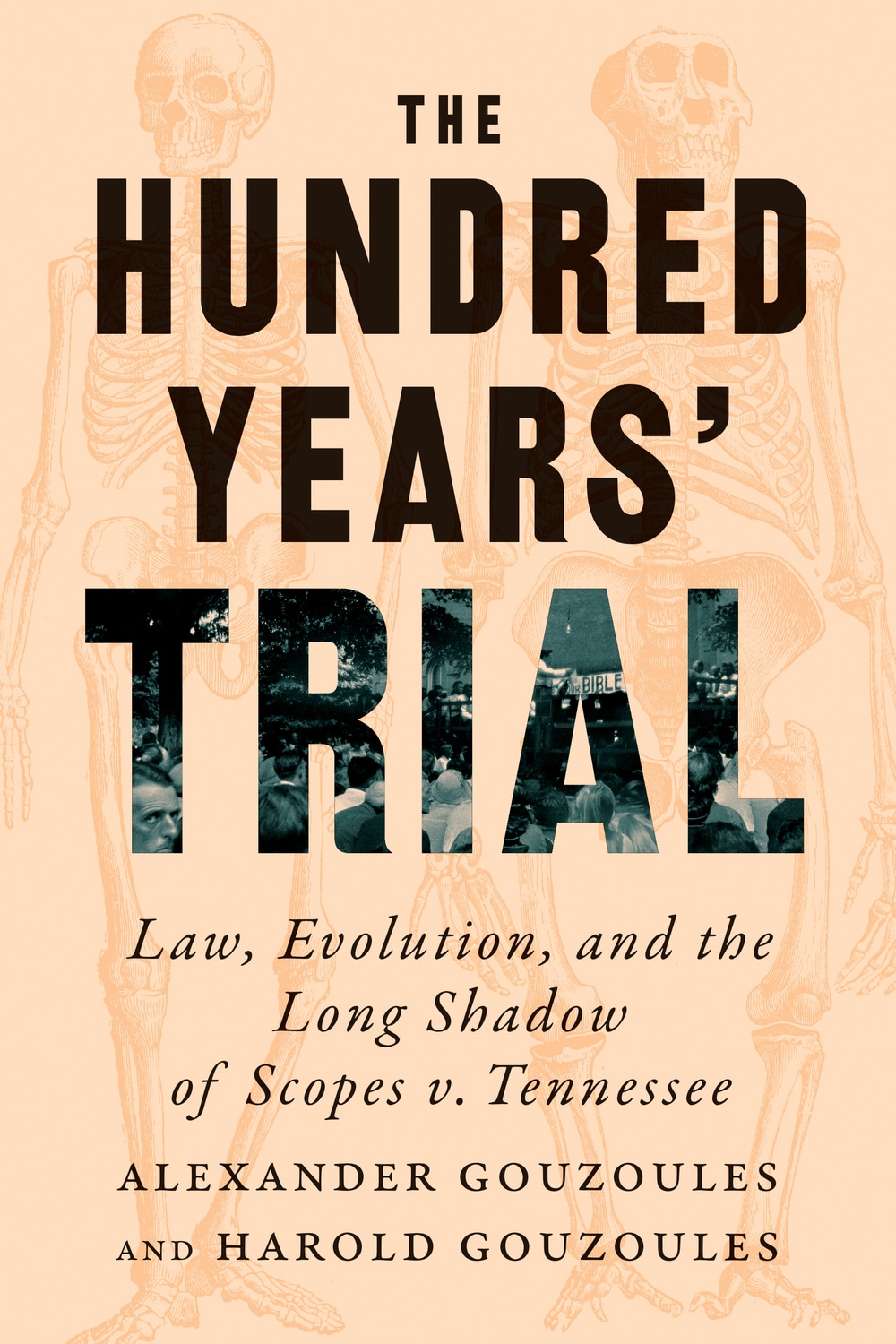
In July 1925, a young science teacher named John Thomas Scopes was on trial in Dayton, Tennessee, for violating a recently enacted state law, the Butler Act. The law forbade public school educators in the state “to teach any theory that denies the story of the Divine Creation of man as taught in the Bible, and to teach instead that man has descended from a lower order of animals.” Tennessee v. Scopes was therefore nicknamed the Scopes “monkey” trial. Appearing just in time to commemorate the case’s centennial, The Hundred Years’ Trial offers a new analysis of the legacy of the so-called trial of the century, culminating in a crucial warning about future litigation over the teaching of evolution in the United States.
The father-and-son authors bring complementary areas of expertise to the task: Alexander Gouzoules teaches at the University of Missouri School of Law, while his father, Harold Gouzoules, is a zoologist in Emory University’s psychology department. Playing to their strengths, they offer parallel narratives of changes in evolutionary science and American law from the Scopes trial to the present day. But because they conclude that scientific testimony was, and is likely to continue to be, irrelevant in litigation over the teaching of evolution, their discussion of changes in evolutionary science seems ultimately to be a distraction from their insightful and detailed legal history.
After describing the emergence and reception of the theory of evolution in the mid-nineteenth century, the Gouzouleses turn to the two titans at the center of the Scopes trial: the politician William Jennings Bryan and the attorney Clarence Darrow. Political allies around the turn of the century, Bryan and Darrow underwent a “divergence” (the title of chapter 5) over issues such as Prohibition, the entry of the United States into the First World War, and—foreshadowing the Scopes trial—science and religion. (A minor error here is the authors’ claim that both men rejected eugenics: While Darrow was critical of the contemporary eugenics movement, Bryan tolerated and occasionally endorsed it.)
Thanks in part to Bryan’s encouragement, the Butler Act was enacted on March 21, 1925. Shortly thereafter, a willing defendant—Scopes—was recruited, and the legal teams, which included Darrow for the defense and Bryan for the prosecution, were assembled. The Gouzouleses provide a remarkably illuminating account of the defense’s arguments on the second day of the trial to quash the indictment, identifying two chief approaches: appealing to free speech concerns and appealing to establishment of religion concerns. These approaches are in tension, as later cases would reveal: Would a public school teacher have a right to refuse to teach evolution or even to teach creationism?
Would a public school teacher have a right to refuse to teach evolution or even to teach creationism?
The judge presiding over the trial rejected not only the defense’s arguments to quash the indictment but also—to Darrow’s fury—its attempt to introduce scientific expert testimony. Then, in a bizarre twist, the defense called Bryan to the stand to testify about the Bible. With commendable restraint, the Gouzouleses devote only a few sentences to Darrow’s merciless interrogation of Bryan, often the centerpiece of accounts of the trial. Anticlimactically, after the jury deliberated for nine minutes, Scopes was convicted and fined $100 (about $1,800 today). Although Scopes’s conviction was later overturned on a technicality, the Butler Act remained on the books until 1967.
The issue of teaching evolution would not return to the national consciousness until the 1960s, thanks in part to the Hollywood blockbuster Inherit the Wind (1960), loosely based on the Scopes trial, and to increasing discussions of evolution in biology textbooks owing to a national Cold War-era effort to improve science education. In 1965, Susan Epperson, a biology teacher at Little Rock Central High School, challenged a Scopes-era ban on the teaching of evolution; like Scopes’s lawyers, her attorneys used both freedom of speech and establishment of religion arguments. The Supreme Court’s unanimous decision in Epperson v. Arkansas (1968) found that the ban violated the Establishment Clause of the First Amendment.
Establishment arguments subsequently dominated the field. The Supreme Court’s decision in Lemon v. Kurtzman (1971), a case not involving the teaching of evolution, echoed the reasoning of the Epperson decision. Lemon offered what the Gouzouleses describe as “a clear, direct, and straightforward mechanism for resolving cases implicating the separation of church and state”—although not all experts on constitutional law would agree with their adjectives. The Lemon test (and later the endorsement test, unmentioned in the book, which was variously regarded as a clarification of or replacement for the Lemon test) would play a substantial role in litigation over the teaching of evolution.
Lemon offered what the Gouzouleses describe as “a clear, direct, and straightforward mechanism for resolving cases implicating the separation of church and state”—although not all experts on constitutional law would agree with their adjectives.
It was the Lemon test that prevented Tennessee from requiring the inclusion of “the Genesis account in the Bible” in biology textbooks in 1975; Arkansas and Louisiana from requiring the teaching of “creation science” to balance the teaching of evolution in 1982 and 1987; and a local school board in Pennsylvania from requiring the teaching of “intelligent design” in 2005. But in 2022, after years of expressing unhappiness with the Lemon test, the Supreme Court declared that it in fact “long ago abandoned Lemon and its endorsement test offshoot” in favor of interpreting the Establishment Clause by “reference to historical practices and understandings.”
The Gouzouleses are understandably dismayed by the downfall of the Lemon test (and presumably its offshoots), writing, “The law undergirding the teaching of evolution in US schools now sits on a far less stable foundation than it has since the midcentury.” Even the Epperson decision is vulnerable, they suggest, because it provided the model for the Lemon test. Moreover, even in the absence of a specific attempt to overturn Epperson or subsequent cases, the tendency of the current Supreme Court to prioritize claims under the Free Exercise Clause at the expense of the Establishment Clause is likely to present incidental and perhaps even unintended obstacles to the teaching of evolution.
Already regarding scientific testimony as inconsequential in past litigation over the teaching of evolution, the Gouzouleses are pessimistic about the future, predicting, “The modern Court may simply decide that the Constitution has nothing to say about the proper place of science in the public curriculum,” reflecting its “growing skepticism toward administrative expertise and disengagement from scientific evidence” in general. The reelection of Donald Trump to the presidency, they add in a November 2024 epilogue, means that “the odds of Epperson being revisited and existing laws on evolution in schools being overturned have only increased.”
In their preface, the Gouzouleses allude to “the vast array of disciplines that have engaged with Scopes and its legacy” and acknowledge that “no single effort can fully engage with every dimension while maintaining coherence.” Yet a modicum of attention to education and sociology in particular might have tempered their pessimism about the legal future of evolution education in the United States. Although trends in litigation over the teaching of evolution are affected by changes in constitutional interpretation, as The Hundred Years’ Trial explains so well, they are also affected by changes in the educational system and changes in popular opinion.
A modicum of attention to education and sociology in particular might have tempered their pessimism about the legal future of evolution education in the United States.
The strife over teaching evolution in the United States persists in part due to local control over education, which places the primary responsibility for curriculum with the 13,300-odd local school districts. (In the rest of the developed world, in contrast, curriculum is generally determined at the national or the provincial level, resulting in fewer arenas for conflict over the teaching of evolution.) But starting in the 1990s, state science standards—especially those following the National Research Council’s A Framework for K–12 Education (2012)—have exerted a centripetal influence, helping to standardize and, crucially, normalize the teaching of evolution across the country.
Although the Gouzouleses are aware of the importance of shifting public opinion on evolution, they mention only a single public opinion poll on evolution, from 2019. But a series of national public opinion surveys conducted between 1985 and 2020 showed a surge of acceptance of evolution among Americans starting in 2010, with acceptance taking a solid lead from 2015 onward. Even among religious fundamentalists, acceptance of evolution rose from 8% in 1988 to 32% in 2019. With the proportion of Americans hostile to evolution dwindling, the chance of successful attacks on the teaching of evolution in the future is likely to dwindle as well.