
Building Bridges—Not Walls—for Technological Sovereignty
Today’s emerging economies need to carefully manage tradeoffs to achieve technological sovereignty and a globally competitive position.
After decades of economic policies favoring market-driven development, industrial policy is having a rebirth across high-income, emerging, and developing economies around the world. In the context of geopolitical rivalries, climate urgency, and supply chain fragility, governments are deploying a variety of policy tools—from subsidies and public research and development investments to trade policy and public procurement—to strengthen domestic capabilities in critical sectors.
Much of this activity, in high-income and emerging economies alike, is focused on achieving or maintaining technological sovereignty. Technological sovereignty is the capacity of a country to develop or consistently access essential technologies without becoming dependent on one or very few external partners. This capacity means possessing sufficient domestic technological capabilities or maintaining reliable foreign partnerships to ensure that economic, societal, and strategic needs are met effectively. Technological sovereignty is key to achieving core innovation policy objectives like international competitiveness.
Emerging economies… largely start from a position of dependency: on imported technologies, foreign direct investment, and international knowledge flows.
High-income economies use industrial policy to maintain their technological leadership. Often, doing so involves securing supply chains for high-tech, capital-intensive products and investing heavily in cutting-edge innovation. Emerging economies, by contrast, largely start from a position of dependency: on imported technologies, foreign direct investment, and international knowledge flows. For countries in this position—like South Korea in the 1970s or China in the 1990s—state-led planning, human capital investment, and institutional support have been crucial approaches to developing innovation capacity.
But these approaches, pursued successfully in the globalizing environment of the 1970s–2000s, cannot be replicated in today’s geopolitically contested and increasingly fragmented world. As the global economy evolves, the same tools and policies may no longer deliver the same results.
Today, emerging economies must contend with a shifting landscape of global technology governance. As fields such as artificial intelligence, quantum computing, and synthetic biology become subject to new national security concerns, access to knowledge and participation in the shaping of international trade, finance, and standards regulations are increasingly contested. Moreover, established conventions of international economic and technological collaboration are being challenged, and old partnerships may no longer be relied upon. Yet certain areas—notably health and climate—remain less fraught within the context of geopolitics, offering entry points for emerging economies even during times of heightened global tension. A recent example can be found in the successes of global effort to produce vaccines during the COVID-19 pandemic, even in a politically contested environment.
In this new geopolitical landscape, technology dependence still signals vulnerability. Emerging economies under political pressure to reduce dependence may encourage domestic production of goods to replace more advanced, imported ones: a policy dubbed import substitution. But, if pursued prematurely, before domestic producers are ready to compete, import substitution can backfire, allowing a small number of established firms to capture state resources and hurting domestic consumers.
These risks are intimately related to political forces that shape how industrial policy priorities are chosen and the state’s capacity for implementing them. For these reasons, industrial policy must be embedded in transparent, accountable, and performance-based governance mechanisms. Emerging economies, much like developed ones, must avoid the pitfalls of politically driven resource allocation when the government becomes involved in steering the country’s economic future.
Even as today’s geopolitical complexities put added stress on emerging economies, a targeted strategy for industrial policy—as well as international collaboration—continues to be essential in enabling national economies’ transition toward more advanced stages of technological development. Countries cannot attempt to “go it alone” before attaining sufficient capacity. Yet, when collaboration becomes fraught with uncertainty, policies should carefully address how to invest resources to catch up with leading economies. Only by tailoring strategies to each stage of development, investing in knowledge institutions, and navigating the geopolitics of technological governance with agility can emerging economies secure a path toward technological sovereignty.
Stages of technological development—through the catching-up lens
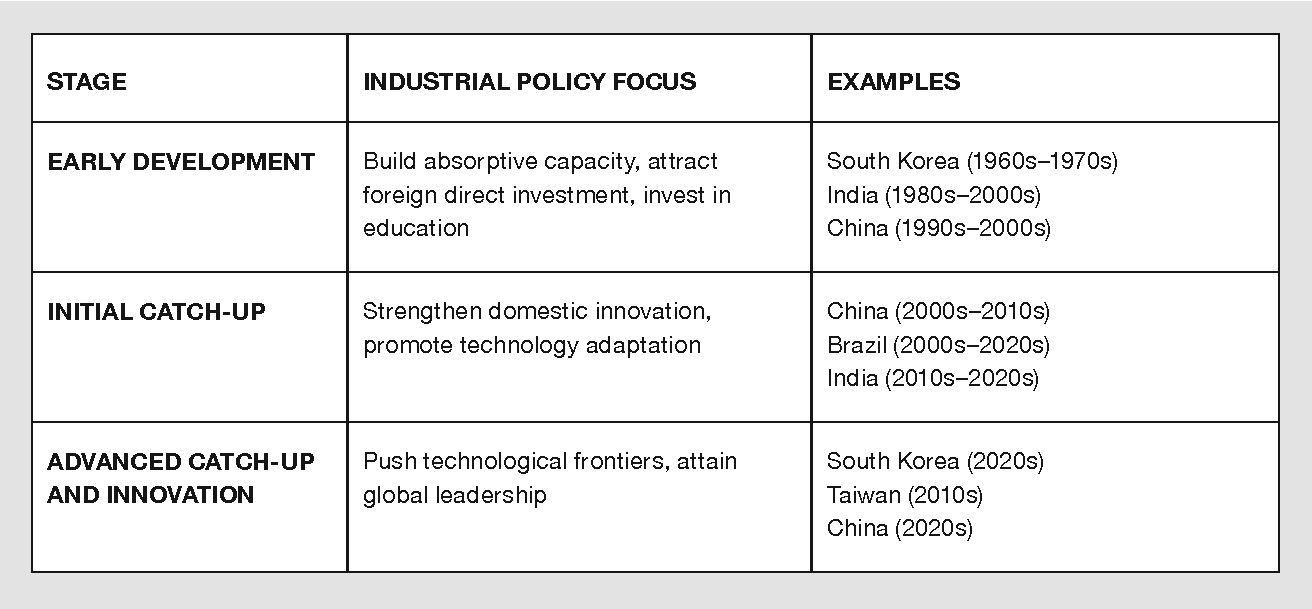
In the second half of the twentieth century, most economies that underwent economic transformation through leveraging technology and innovation—like Korea, Singapore, and, more recently, China—passed through three main stages (Table 1): early development, initial catch-up, and advanced catch-up and innovation. Each stage can be characterized by a different mix of policy objectives and tools. Understanding how this progression has worked in the past is essential for understanding the challenges emerging economies face today.
In the early development stage, the primary goal is building absorptive capacity—the ability of firms and institutions to learn from external, often foreign knowledge—which enables the economy to graduate beyond one built solely on cost advantage. Meeting this goal requires creating and growing institutions that enable learning from and incorporating foreign technologies. Industrial policy at this stage usually focuses on attracting foreign direct investment (FDI), facilitating technology transfer, and establishing a domestic industrial base able to incorporate learning even with limited capacity to innovate independently.
In the second half of the twentieth century, most economies that underwent economic transformation through leveraging technology and innovation.
South Korea in the 1960s and 1970s, for example, prioritized education, infrastructure, and selective investments to build its industrial base. The Korean government supported heavy and chemical industries and created institutions like the Korea Advanced Institute of Science and Technology to foster human capital development. China went through a similar phase during the 1990s and early 2000s. India’s early industrial policy during the 1980s emphasized education and infrastructure, although with less success due to regulatory constraints and limited integration with global markets.
In the middle stage, industrial policy objectives shift toward upgrading local enterprises through knowledge spillovers from foreign firms, strengthening domestic innovation capabilities, and promoting technology adaptation. Government policies focus on R&D subsidies, upgrading domestic firms, and fostering linkages between universities and industry. International collaboration remains vital—not only with firms, but also through science and technology partnerships that strengthen local innovation ecosystems.
China’s rise since the 1990s exemplifies this stage. The government invested heavily in R&D, promoted innovation policies, and encouraged domestic firms to capture the more profitable, knowledge-intensive aspects of production, particularly in electronics and telecommunications. The “Made in China 2025” strategy explicitly targeted technological sovereignty in key sectors. Brazil’s aerospace sector, led by Embraer, also illustrates the application of targeted policy to build indigenous capabilities. India prioritized investments in public research institutions and centers of excellence that co-develop technologies with international partners and multinationals.
By the third stage, advanced catch-up and innovation, the emphasis moves toward creating original innovations that stand the test of global markets and shape global standards. Industrial policy instruments at this stage include support for frontier R&D, venture capital investments, and university-industry linkages. At this stage, countries invest heavily in research, support start-ups and innovation clusters, and engage actively in shaping global technology standards. South Korea, Taiwan, and China have transitioned to this model. With policies targeting semiconductors, biotechnology, and artificial intelligence, they maintain strong innovation ecosystems well integrated into global networks and consortiums.
Table 1. Stages of Technological Development and Industrial Policy Focus
Lessons for emerging economies: strengthening domestic institutions and knowledge flows
Although it remains useful, this venerable three-stage model fails to completely account for the options available to today’s emerging economies. These economies now face intertwined domestic and international challenges that they must address in a coherent manner if they hope to progress through the stages of development toward technological sovereignty. Critical to this progress is matching industrial policy to the appropriate stage of development.
Sustained investments in higher education, vocational training, and applied R&D infrastructure lay the groundwork for technology absorption and innovation.
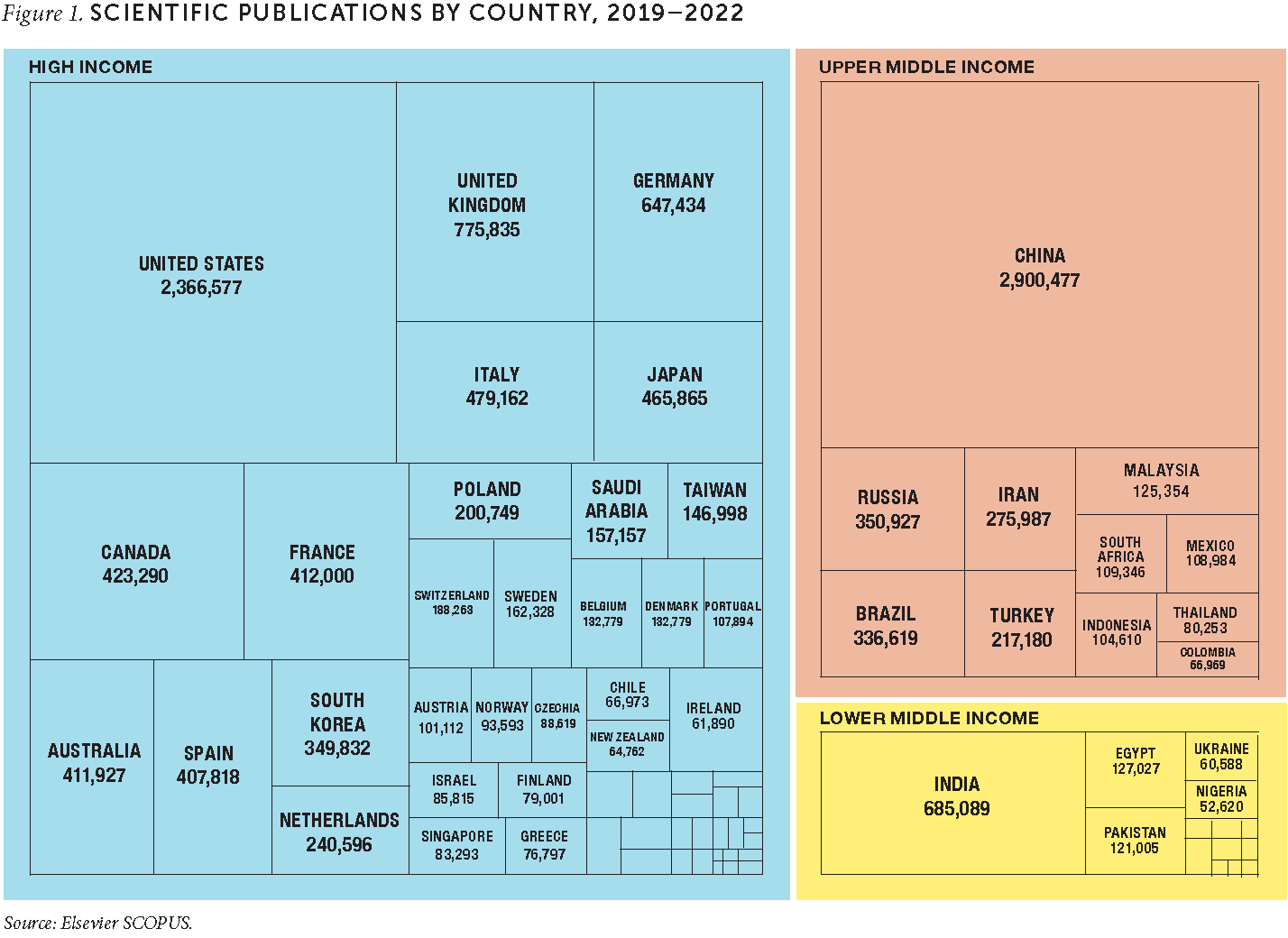
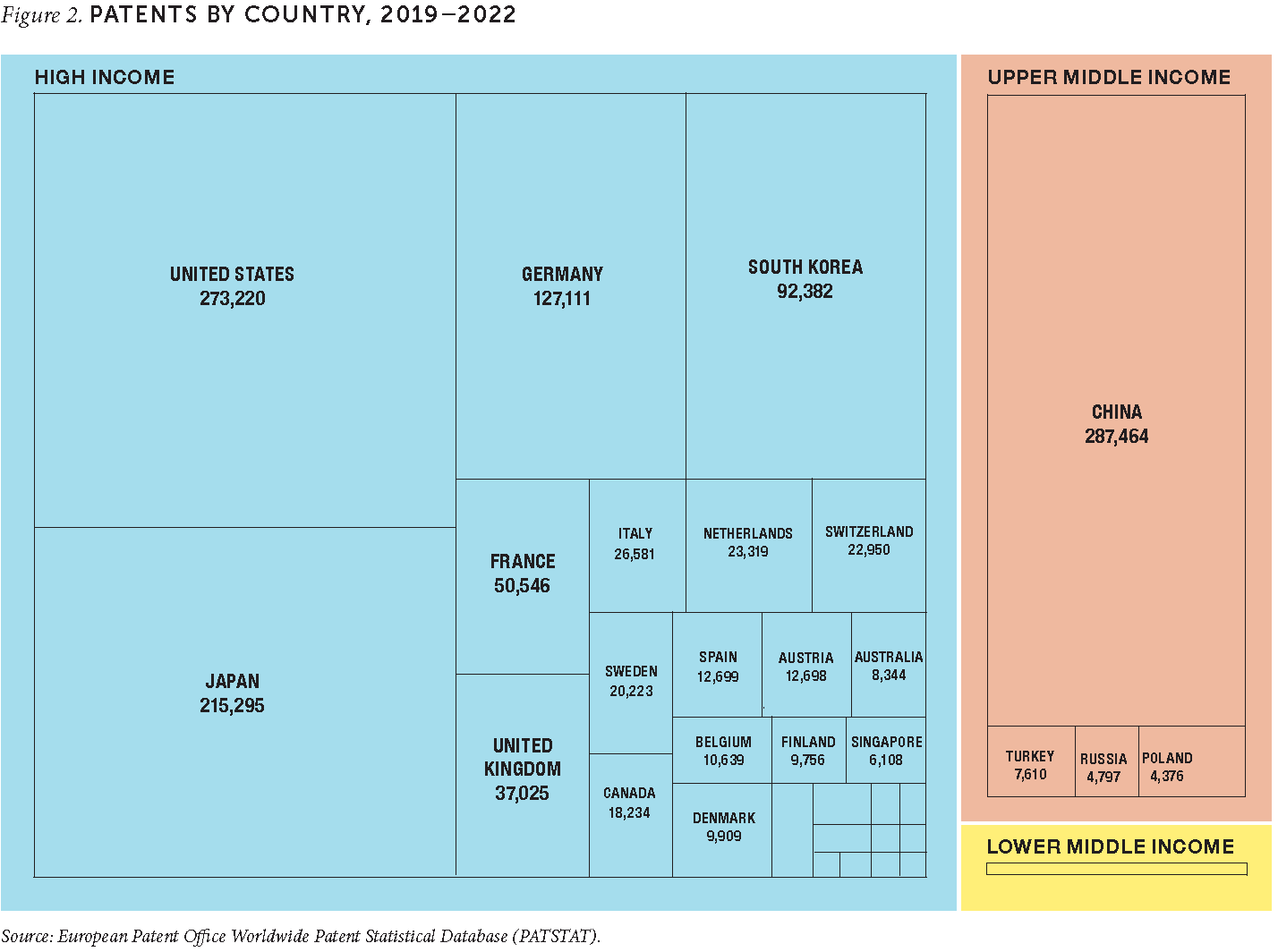
To understand why this matching is essential, it’s helpful to consider the disadvantages emerging economies face. Domestically, their institutions—universities, firms, and R&D centers—tend to have lower scientific productivity as measured by publications and patents than those in higher-income economies (Figures 1 and 2). Their institutions also tend to operate in silos, resulting in underdevelopment of domestic innovation ecosystems. Fragmented governance, low R&D investment, and weak linkages between academia and industry further constrain technological transfer and upgrading. For instance, in many African and South Asian economies, public research institutions are underfunded and disconnected from the needs of local industries. Without access to foreign technologies, domestic enterprises are unable to upgrade their capacities to compete. To overcome these disadvantages, emerging economies must invest early in human capital development and knowledge institutions. Sustained investments in higher education, vocational training, and applied R&D infrastructure lay the groundwork for technology absorption and innovation. Today, these investments must be accompanied by the promotion and adoption of digital technology in both the business and public sectors, including investments in upgrades of digital infrastructure such as network accessibility and the necessary bandwidth for technological activities. Emerging economies that fail to invest in these areas will struggle to benefit from international partnerships.
Emerging economies must also focus on empowering these local ecosystems. Developing a dynamic ecosystem for start-ups, encouraging high-growth and knowledge-intensive firms, and building regional innovation clusters help ensure that innovation is inclusive and grounded in local needs. Likewise, public-private-academic collaborations and partnerships across sectors to accelerate technology transfer and commercialization could provide fertile ground for locally grown solutions.
Even after domestic firms invest in human capital and ecosystem development, there is a risk that they will remain peripheral players in global value chains as potential collaboration partners themselves worry about maintaining technological sovereignty. Thus, even with “catch-up” mechanisms in place and heavy investment in workforce development, local capability-building may stall, and domestic talent may migrate to economies where opportunities are more lucrative. Those designing industrial policies today must consider deliberate strategies to mitigate these risks by expanding access to global knowledge networks.
Another hurdle in the path toward technological sovereignty occurs when an economy becomes overly reliant on FDI during its early stages of development. While FDI is useful, if not essential, as a source of knowledge and capital, too much FDI-driven growth can entrench dependency on multinational corporations, especially when domestic firms remain limited to low-value assembly tasks and lack capabilities to absorb and adapt external knowledge. In many emerging markets today, a substantial share of domestic patents and technological assets remain owned by multinational corporations, rather than domestic firms. Meanwhile, multinational corporations leverage the country’s cost-effective labor resources for production purposes. Bangladesh’s garments sector exemplifies such pitfalls: While the sector grew rapidly, domestic technological capacity remained weak due to limited integration with multinational technology providers. Thailand, too, managed to build a substantive production basis during the 1990s, but one that, even today, maintains limited links to the local research system. In today’s politically contested global environment, such dependencies could be more challenging to sustainable development than before.
Exceptions to this pattern exist, but they are rare. India has gradually built its pharmaceutical and IT sectors’ capabilities through technology transfer, although multinational firms still hold most of the patents. In China, targeted regulation has compelled multinationals to license technology to local firms, sometimes through joint ventures, which has improved the capabilities of domestic firms, grown their market share, and helped them compete globally. For example, China’s high-speed rail procurement in the 2000s mandated broad technology transfer from multinationals (e.g., Alstom, Siemens, Bombardier, and Kawasaki Heavy Industries) and led to measurable domestic innovation and capability upgrading in Chinese firms.
To mitigate the risk of continued dependency on multinationals, it has therefore become crucial for emerging economies to further diversify their FDI portfolios along with investing early in institutions that actively facilitate knowledge transfer from foreign to local firms. Some African countries are experimenting with industrial parks and special economic zones to drive FDI, while improving linkages to local economies. Ethiopia’s agro-industrial parks, though still in early stages, aim to integrate smallholder farmers with global food supply chains while improving domestic processing capacity.
The balancing act of international collaboration
No country can achieve technological sovereignty in isolation. Strategic international collaboration remains indispensable across all development stages. Nevertheless, as economies move through stages of technological development, they must alter how they collaborate internationally (Figure 3). At the early development stage, countries benefit from trade, FDI, and technology licensing. The primary mediators of international technological exchanges are foreign and multinational firms and their local subsidiaries, as well as domestic firms that take steps to upgrade by acquiring material technologies and licenses. As countries emerge from the earliest stages of development, this dependency markedly declines. Countries like Thailand and Turkey, for example, show decreases in net FDI inflows as a share of GDP over time, signaling an opportunity—and a necessity—for domestic firms to take on greater roles in driving the productivity growth of the economy through technology upgrading and innovation.
No country can achieve technological sovereignty in isolation.
During the initial catch-up phase, joint ventures and collaborative R&D help build absorptive capacity. Domestic firms increasingly participate in the global production system as collaborative partners, enhancing a country’s ability to generate and apply new knowledge. As an example, our analysis of data from the European Patent Office’s PATSTAT reveals that emerging economies have a higher than global average share of co-patented innovations—more than twice as high as those in high-income economies like Germany or Japan. This level of collaboration underscores the importance of international partnerships for learning and upgrading. Moreover, diversified partnerships help mitigate geopolitical risks. For instance, since the early 1990s, Brazil, while maintaining ties with the United States as a traditional aerospace partner, has partnered extensively with China for satellite development, launch services, and technology transfer. This dual engagement is an example of how a country can manage the risks, drivers, and outcomes tied to domestic sectoral growth.
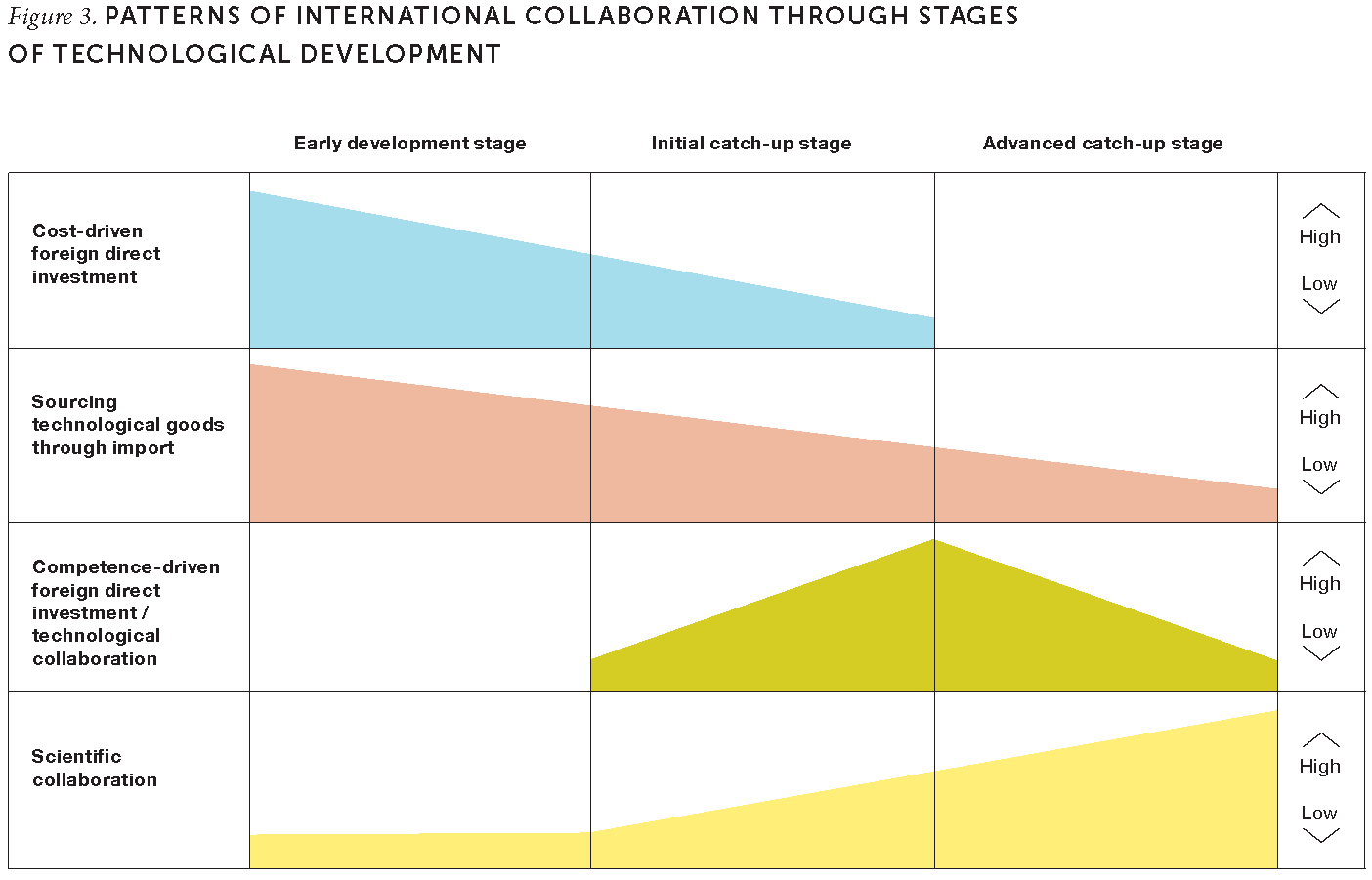
In the advanced catch-up and innovation stage, scientific collaboration and global research consortia are key to accessing frontier knowledge. At this stage, universities and research organizations expand their roles in sourcing and disseminating international expertise within the economy through skilled human capital and domestic collaborations. South Korea’s expanded participation in international semiconductor consortia and AI research exemplifies this. This collaboration reflects both dependency and openness: emerging economies remain embedded in global science networks even as geopolitical alignments shift.
Nevertheless, transitioning through these stages is neither automatic nor linear. Once the initial dependencies are overcome, countries with less developed research infrastructure may still find themselves at a disadvantage, participating mainly through data collection or implementation, while high-income partners dominate global scientific research agenda-setting. To address this imbalance, scientific capacity-building programs, like investments in universities and research organizations, must emphasize disciplinary excellence, leadership development, research management, and the design of collaborative research agendas geared toward domestic application and impact.
Today’s geopolitical tensions have made it harder to maintain diversified partnerships and, in extreme cases, may force countries to “choose sides.”
In an ideal scenario, emerging economies could pragmatically engage with multiple global partners, leveraging diverse sources of technology and investment. Yet, today’s geopolitical tensions have made it harder to maintain diversified partnerships and, in extreme cases, may force countries to “choose sides.” Geopolitical fragmentation may limit cooperation across political blocs. Export controls and investment restrictions may create complex risks to economic development in emerging economies. For example, the recent US restrictions on Chinese technology firms have prompted India and Vietnam to reconsider their input sourcing strategies, sometimes moving away from Chinese suppliers to reduce risk and capitalize on expanded US export opportunities.
A political falling out with key technology suppliers can result in higher costs or unreliable access to essential goods. While this potential poses a challenge to any country, emerging economies—whose competitive advantage often relies primarily on cost—face a particularly harsh trade-off between buying from the cheapest source and assuming the risks of buying from a single supplier. Although building redundancies in supply chains could cost a country some of its competitive advantage, global conditions could make it a necessity.
For example, the global semiconductor shortage during the COVID-19 pandemic exposed vulnerabilities in Southeast Asia’s transnational production networks. Indonesia and Vietnam, heavily reliant on imported semiconductors for electronics manufacturing and assembly, faced production bottlenecks. This vulnerability has prompted calls for regional solutions, including government investments in building semiconductor manufacturing hubs and enhancing domestic capacity despite higher costs and complexity.
Two lessons emerge from these examples. First, emerging economies must build multiple bridges, not walls. While reducing one-sided dependencies is essential, maintaining open channels for scientific and technological collaboration is equally important. Quality collaborations come with clear learning potential, and technological catch-up can’t be sustained without collaboration with the currently leading economies.
Second, emerging economies should maintain diversified international partnerships. For them, it is important for emerging economies to engage with multiple global partners to access diverse technologies and mitigate geopolitical risks. Consequently, it is worth investing in redundancies, even if it comes at a price: the risks of losing access to critical technologies before a country can source them locally often outweigh immediate monetary costs of maintaining multiple sources. South-South collaboration, regional innovation hubs, and knowledge exchange platforms can help pool resources and reduce dependency on a few dominant players.
As emerging economies position themselves within a new global order, their leaders and policymakers must navigate new challenges. While models exist for mapping industrial policies onto the developmental stages, current geopolitical tensions and a rapidly shifting technological environment make striking the proper balance trickier than ever. Investing in and connecting domestic institutions to improve absorptive capacity are critical to building a strong innovation ecosystem. But these actions must be balanced with a diverse and strategic set of international partnerships and collaborations. As webs of alliances and partnerships shift, it’s not clear what new types of collaboration will emerge. Will ever-changing geopolitical conditions give rise to regional blocs? Or will emerging economies band together through transnational collaboration platforms? Emerging economies will have to navigate these challenges with a steady eye on their economic development goals. Those that try to move too early risk wasting precious resources, while those that build local institutions late may risk too much dependency on partners. In this not-yet-realized global economic order, the path to winning is unclear, but those countries that manage to combine domestic capacity-building with strategic international engagement will have a better shot at success. Correctly striking this ever-changing balance is the only way to move toward technological sovereignty and the critical economic and social benefits that it promises.