
Making the Invisible Visible
Review of
Eggonomics: The Global Market in Human Eggs and the Donors Who Supply Them
New York, NY: Routledge, 2025, 326 pp.
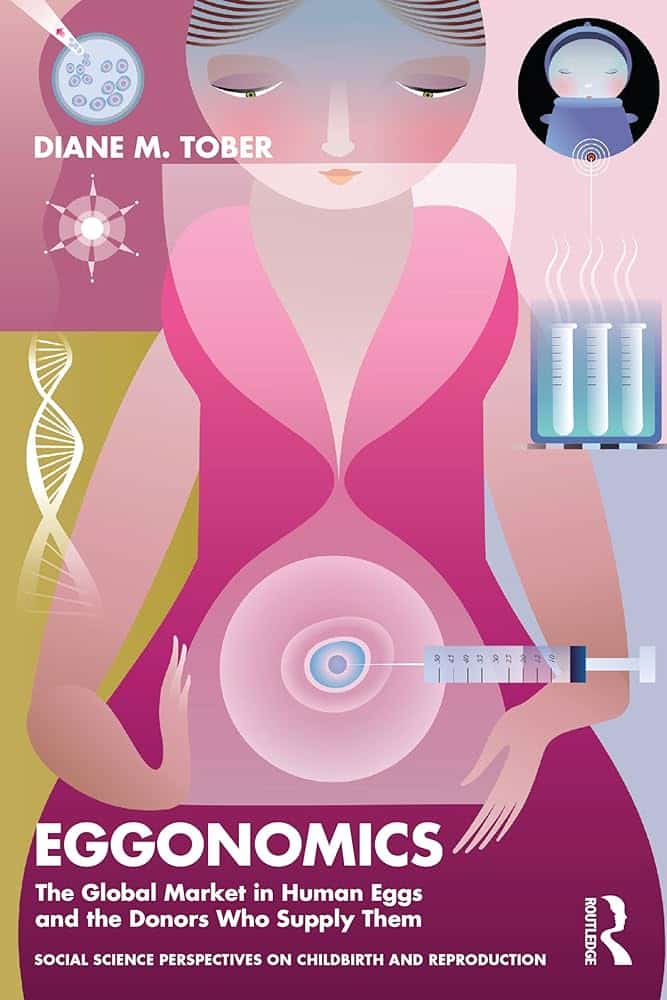
In glossy clinic ads and stock images, the story of assisted reproduction usually ends with a baby in someone’s arms—a vision of fulfillment, intimacy, and family. Eggonomics: The Global Market in Human Eggs and the Donors Who Supply Them, by medical anthropologist Diane Tober, asks us to look beyond that picture. Behind many births involving assisted reproduction are egg donors—individuals whose medical, emotional, and economic experiences remain largely invisible in public narratives and even in much scholarship. Drawing on nearly a decade of research, including hundreds of interviews and a survey of nearly 1,000 donors, Tober situates egg donors at the center of a sprawling, ethically thorny, and economically complex system. The result is one of the most detailed portraits yet of the hidden labor sustaining assisted reproduction.
Tober began studying egg donation in 2013, first in the nonprofit sector when she advocated for research on donor health outcomes. In Eggonomics, she draws on that background to assemble a sweeping, empirically rich account. As she notes in the preface, her work “centers egg donor narratives—the stories of people who have been relegated to the background and hidden behind the clinical veil of secrecy—to convey their range of experiences.” She includes accounts from practitioners and industry representatives, but these are primarily to contextualize donor perspectives rather than drive the analysis.
At the time of their first donation cycle, most US donors are single, in their twenties, and often students or recent college graduates
Who are the egg donors? While donors’ demographics and motivations vary, certain patterns emerge from Tober’s research. At the time of their first donation cycle, most US donors are single, in their twenties, and often students or recent college graduates. After matching with a recipient and undergoing psychological and medical tests, the cycle of hormone injections and egg retrieval takes about 3–6 weeks. Many donors cite both a wish to help intended parents and financial pressures as reasons for donating. Across these accounts, Tober identifies debt—particularly student debt—as the most consistent factor influencing donors’ decisions.
Placed in the broader literature, Eggonomics complements and extends earlier ethnographies such as Charis Thompson’s Making Parents, Laura Mamo’s Queering Reproduction, and René Almeling’s Sex Cells. These books focus more on intended parents, clinicians, queer families, and sperm donors. Tober updates this conversation for the vitrification era, in which eggs or embryos are frozen so rapidly that damaging ice crystals cannot form, preserving them much more reliably than earlier techniques. She traces how frozen-egg logistics and digital platforms to connect intended parents with donors intensify commodification—and how donors absorb the medical and relational consequences that follow.
After outlining her methodology, Tober examines the technological breakthroughs that have fueled the global egg trade—particularly vitrification, which has enabled long-term storage and transnational shipment. She then explores donor recruitment and compensation, cross-border fertility services, self-reported health experiences, and donor perspectives on the children conceived from their eggs, ultimately concluding with policy recommendations.
By setting the United States alongside Spain, another leading destination for egg donation, Tober shows how regulatory context shapes clinical practice, economic markets, and donor experience.
A notable strength of Eggonomics is its comparative approach. By setting the United States alongside Spain, another leading destination for egg donation, Tober shows how regulatory context shapes clinical practice, economic markets, and donor experience. In Spain, donor anonymity is required, matching is performed by clinical teams based on the appearance of the donor and intended parent, donors are paid less, and oversight is more consistent. In the United States, higher compensation and looser regulation permit aggressive recruitment of donors, repeated donations, and varied protocols. Tober initially viewed Spain’s system as “a model for what a reasonable, less commercialized system might look like,” she writes. But she also makes clear that market forces operate there too; regulation can mitigate but not erase commercialization.
While illuminating, this bilateral comparison only partly delivers on the book’s promised global framing. Tober addresses transnational markets and cross-border care, but these dynamics receive less sustained analysis than the United States–Spain pairing. This is partly a function of the dataset: The largest share of survey and interview participants were in the United States and Spain, limiting the book’s ability to fully represent donor experiences worldwide.
The book’s title signals one of its central concerns: the role of money in the transactional egg donation industry. Compensation can make egg donation financially appealing, but it also creates incentives that can be coercive. Donors describe aggressive protocols, which they perceive as aiming to maximize egg yield—sometimes producing 60–80 eggs in a single cycle (far above the target range of 15–20) because more eggs mean more potential embryos and more profits for clinics. Tober also notes pronounced disparities in payment: Donors with traits most sought by intended parents—whether ancestry, education, or physical characteristics—can command far higher fees, a pattern she argues risks reinforcing eugenic preferences in the marketplace.
Tober also notes pronounced disparities in payment: Donors with traits most sought by intended parents—whether ancestry, education, or physical characteristics—can command far higher fees, a pattern she argues risks reinforcing eugenic preferences in the marketplace.
Health complications appear throughout donor accounts: hormone reactions, ovarian torsion (a painful twisting of the ovaries that can cause infertility), or later fertility struggles, for instance. Some donors report ovarian hyperstimulation syndrome (OHSS), a response to hormone treatment in which the ovaries swell and leak fluid into the abdomen, occasionally at life-threatening levels—one donor suffered cardiac arrest; another experienced kidney failure. Donors self-reported OHSS in approximately 12% of cycles, far above the “less than 1%” risk many donors recall being warned of by clinics. This discrepancy may partly reflect methodological limitations: Because the study relies on retrospective, self-reported donor experiences, the findings are subject to self-selection bias (those with strong experiences being likelier to participate) and recall bias, particularly for long-term outcomes. Tober acknowledges these limits while underscoring that the gap points to the urgent need for longitudinal research.
This evidence, strong in breadth of personal experience but thin in prospective data and non-self-reported medical information, mirrors long-standing gaps in the scientific literature. Longitudinal studies that enroll egg donors at the time of donation and collect real-time electronic health record data over an extended period would provide a much clearer understanding of long-term health outcomes associated with egg donation. The last major review assessing the medical risks of human oocyte donation, a 2007 Institute of Medicine report, called for such studies. Nearly two decades later, the need remains unmet. Without long-term evidence, neither informed consent nor effective regulation is possible. For regulators, this is not an abstract problem but an urgent call to action.
One of the book’s most compelling contributions is its nuanced exploration of donors’ perspectives on family and donor-conceived children. Some egg donors feel an enduring connection, others maintain open contact, and still others express deep disappointment when promised openness did not materialize. One donor, a citizen of the Choctaw Nation, felt strongly that “kids do have a right to that knowledge of their heritage.” Her first donation experience was positive and included an ongoing relationship with the recipient family. But her third donation, she says, violated the agreed terms: “I was robbed. I was supposed to be a part of their lives.… I feel like I sold my children for three grand.”
Without long-term evidence, neither informed consent nor effective regulation is possible. For regulators, this is not an abstract problem but an urgent call to action.
These stories complicate tidy narratives of either altruism or commodification. Few donors regret their participation, but many note the uneasy, transactional nature: “No one cares,” a donor said. “The egg donation companies don’t care. The families don’t care. Because they all got what they wanted.”
For many donors, the medical relationship itself feels asymmetrical. The intended parents are the focal point; the donor, although medically indispensable, is peripheral. Some recall feeling like “a baby-making factory” or “a cash cow.” The clinical choreography reinforces this detachment: clinicians and others may use language to distance donors from the embryos created, told to think of their eggs as no different from blood or plasma, and encouraged not to dwell on the future children. Tober describes this as “clinically crafted alienation.” It may help some donors navigate the process, but it is not always sustainable. Over time, many find themselves thinking about the children born from their donations.
Eggonomics does not call for ending egg donation. Instead, Tober argues that regulation should be reasonable, empirically grounded, and attentive to both medical and relational dimensions. Tober’s recommendations include standardized informed consent for egg donors, long-term health monitoring, clear risk disclosure, and donor input on openness or anonymity. She also calls for adherence to professional guidance, such as the American Society for Reproductive Medicine’s recommendation of no more than six donation cycles—a limit she documents being exceeded in some cases. The Spanish model demonstrates how national coordination can yield consistent care, though its anonymity mandate faces practical challenges with the advent of direct-to-consumer genetic testing; the US model allows openness but leaves donors exposed to inconsistent standards and market forces.
Eggonomics will not hand policymakers a ready-made legislative package. But it offers a clear, evidence-rich account of the systemic gaps that must be addressed if donor welfare is to become central—rather than peripheral—to the governance of assisted reproduction.
Tober critiques the absence of federal oversight in the US fertility industry and its reliance on self-regulation. But her recommendations stop short of identifying which entities—federal agencies, professional societies, or new regulatory bodies—should take responsibility for implementing change. Tober’s recommendations would require overcoming both political fragmentation in the United States and entrenched commercial interests, obstacles the book acknowledges only briefly. Despite these barriers, most of her interlocuters favored a donor registry to track cycles and health outcomes. Today, the Centers for Disease Control and Prevention reports aggregate data on assisted reproductive technology cycles and outcomes but does not present data about egg donors themselves. In fact, no US system monitors donor numbers, long-term health, or the fate of eggs. Without systematic data, patterns in adverse outcomes remain invisible and donors often lack evidence-based guidance on medical risks.
Arriving in a fraught moment for reproductive rights in the United States, Eggonomics will not hand policymakers a ready-made legislative package. But it offers a clear, evidence-rich account of the systemic gaps that must be addressed if donor welfare is to become central—rather than peripheral—to the governance of assisted reproduction.