
“Community Colleges Have Become Central to How America Solves Its Problems at the Local Level.”
DeRionne Pollard, president and CEO of the American Association of Community Colleges, makes the case for community colleges as essential institutions that help individuals prosper, anchor civic life, and drive regional and national economic growth.
In 1947, the President’s Commission on Higher Education, convened by President Truman, published Higher Education for American Democracy, a report that called for the establishment of public two-year community colleges. Today, 1,015 public, tribal, and independent community colleges enroll 38% of the country’s undergraduate students. Community colleges play an essential role in training the science, technology, engineering, and medical workforce, while also anchoring tech-led regional economic development.
DeRionne Pollard leads the American Association of Community Colleges (AACC) and has served as president of three institutions of higher education, most recently Nevada State University. In an interview with Issues editor Sara Frueh, she talks about the unique role community colleges play in local economies and civic life, how their leaders are grappling with challenges facing higher ed, and why community colleges continue to be an integral part of building American democracy.
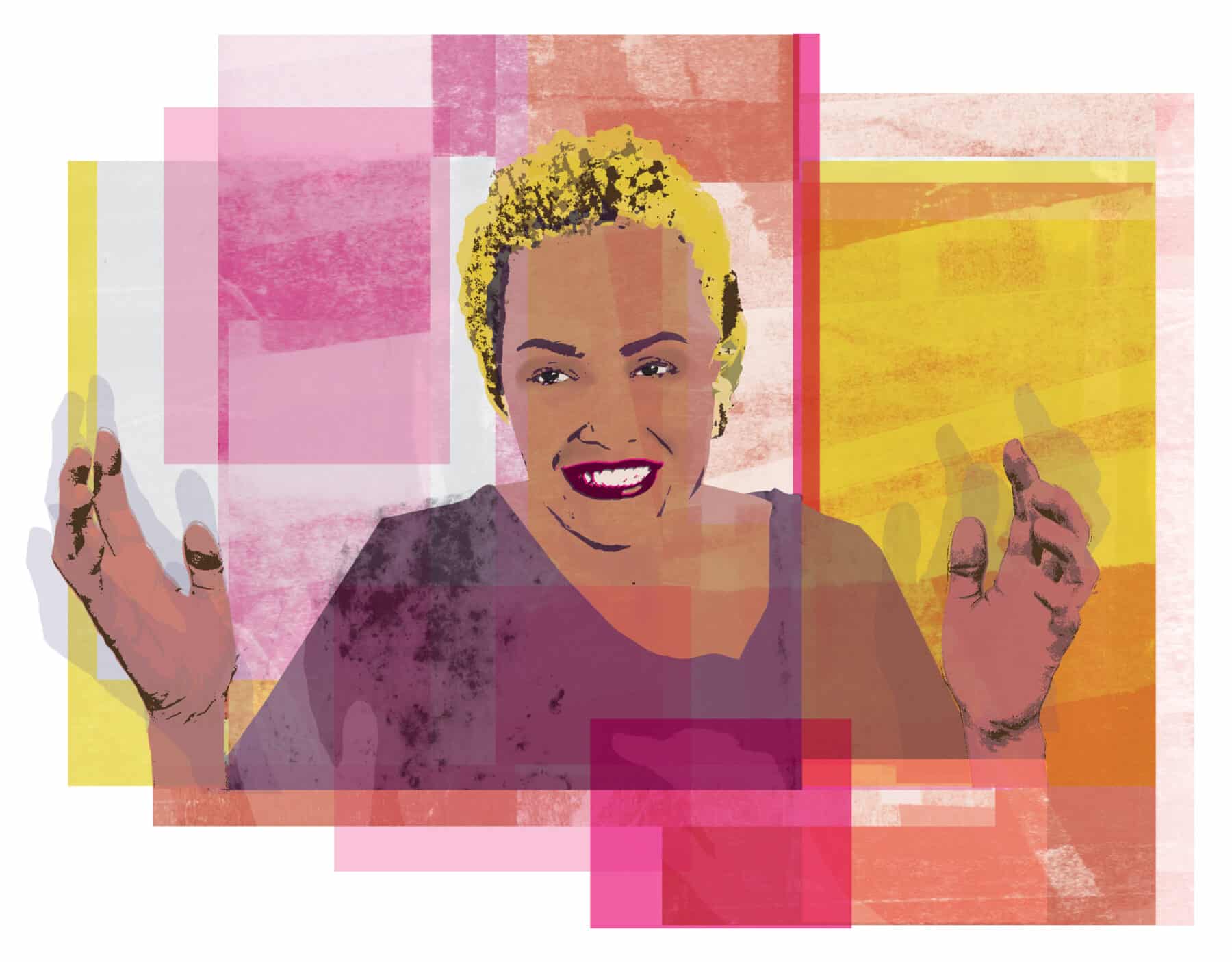
You’ve been zooming around to different community colleges at the start of this school year. It’s a rough job market and there’s a lot of anxiety about artificial intelligence and higher education. What’s the energy like?
Pollard: Over two weeks I was on six or seven campuses, speaking at convocations, either in person or virtually. One of the hardest parts of my job leading AACC has been not being on a campus. I miss that energy that comes from students and faculty and staff.
Our campuses are incubators of what’s happening in the community. There is all of that anxiety that you have described. And right now there’s a laser-like focus around mission—making sure they stay relevant, ensuring that they are redesigning themselves intentionally.
There’s an institutional memory about how to survive in moments like this. This isn’t the first time community colleges have experienced a rough economy. In fact, it’s not the first time folks have questioned the very existence of higher education. So, when we hunker down and focus on our mission, the mood for us becomes upbeat. We don’t have the luxury of getting discouraged, even in moments like this. We are built to be resilient by design and that’s what I’m seeing.
You say that community colleges have an institutional memory that helps them survive. What have they learned from navigating past challenges and crises?
Pollard: First is that we need to stay intimately connected to our community. That has served us well. When our community is thriving, we thrive, and when our community is suffering a challenge, we suffer as well. There’s an intimacy and a mutuality to that awareness. Most of our institutions know their communities better than the community knows itself, because we understand what the influences are, what levers are affecting people, and what demography may portend for that community.
Second, while most communities do the best they can, community colleges have never enjoyed robust funding structures, so the reality is that they’ve oftentimes been asked to do more with less. And often they’ve had to redesign very quickly. We’ve had to launch new programs in ways that could be most effective for evolving needs, whether on the curriculum side or for student services.
We don’t have the luxury of getting discouraged, even in moments like this. We are built to be resilient by design and that’s what I’m seeing.
All these things impact the way that we think about our work. We look at the things we need to stop doing because we want to focus on mission-critical elements. We look at the ways in which our community is responding and we try to see where the gaps are. We look at the ways that our community is doing really well and we ask, “How do we turn up the volume on that?”
Another thing that community colleges have always done well is making sure that no one is being left behind. I see a lot of our institutions deeply connecting with social service entities to accomplish that and spending time with local government entities. We’ve got some powerful muscle memory that we’re leaning on in this moment.
You’ve been a leader at three community colleges and now you lead the AACC. How did you become involved in community colleges?
Pollard: My earliest memory is literally clapping cymbals at Kennedy King College in Chicago at three years old. My mother was taking classes at that institution to become a library technical assistant, so I got to go to the childcare center a couple of days a week. That is my first memory. I remember standing there and thinking, “This is the best thing since sliced bread. I am here with my friends and I get to come back.”
Community colleges continued to figure prominently for me because about a year after that, my mother passed. So my father asked his older sister to help take care of us. During the week, we would go live with her, and on the weekends we’d be back with him. Then my aunt and some of my cousins took classes to get certified to do in-home childcare at Prairie State College.
For me, it is probably providence that I have been leading this work in community colleges around the US for almost 30 years. It is a part of my DNA. It sits in who I am, and I understand the potency of this mission. What the Truman Commission recognized in 1947 was a need to create opportunity broadly, to protect the nation, and to create pathways to the workforce.
How has the role of community colleges transformed over the last few decades?
Pollard: We have always been seen as an access engine. But right now, what you’re seeing us do is play a much more complex and robust role. We’re certainly continuing to be a place where everyone who wants to pursue higher education or adult basic education has the opportunity.
We’re increasingly becoming the primary infrastructure of our communities. We are workforce developers; we are economic engines; we are civic support structures—we do all of that. We are not a kind of secondary add-on. We are as intimate as local government and the K–12 system.
When the community has problems that they’re trying to solve, whether it be childcare, a workforce delivery strategy, mobility issues, or public transportation, they look to the local community college to be, if not the genesis of the ideas to solve that problem, at least the community convener. They certainly see our colleges as active and robust supporters of their needs. We haven’t just grown up as a sector—community colleges have become central to how America solves its problems at the local level.
How do community colleges support economic mobility for students?
Pollard: Most community colleges and technical colleges don’t see mobility as something that happens after graduation. Economic mobility is built into the design of how they function, whether through stackable credentials, credit for prior learning, internships, or work-based learning. We embed these elements directly into our curriculum, and that’s done along with data about local workforce needs.
We’re increasingly becoming the primary infrastructure of our communities. We are workforce developers; we are economic engines; we are civic support structures—we do all of that. We are not a kind of secondary add-on. We are as intimate as local government and the K–12 system.
As institutions, we’re deeply connected to our students and to the communities that we serve. You need robust support structures to give students living in the lowest economic quartile access to robust opportunities. But we’re not just helping that individual student; we’re also helping their American dream for their family. We are helping to break up generational poverty.
Community colleges are increasingly recognized as anchors of regional economies and enablers of innovation in STEM. How is that role evolving?
Pollard: The National Science Foundation, in its latest Science and Engineering Indicators report, indicated that about half of all America’s recent STEM bachelor’s degree earners and nearly two-thirds of those who are in STEM-related fields have attended a community college. The institutions that serve the most people are oftentimes not as recognized and valued as those who serve the most elite.
For 30 years—through partnerships such as one with the National Science Foundation’s Advanced Technology Education—community colleges have been training those people who support the scientists who are going to find the next cure for cancer and other folks working in high-technology fields. All across the country, from North Carolina and Virginia all the way to Arizona, there are lots of examples of projects and programs that we’re doing in those spaces.
At the same time, playing that central role in economic development requires trust. And employers trust community colleges. When they come into a community where they need workers, they come to us. So, we have to have an awareness around how our community is evolving, which requires robust data systems and intelligence gathering to understand how to adapt. We also have to be very intentional in connecting with K–12 systems. And, we have to be deeply connected to those adult learners who are being retrained—we want them to see themselves within our institutions.
Community colleges are also innovating. They are going deeper around apprenticeship work—not just in construction, but in health sciences and biotechnology and advanced manufacturing spaces.
How is AI challenging community colleges? Do you think it requires a larger reorganization of the educational landscape?
Pollard: That’s a profound question. AI is dominating the conversations in our spaces in lots of ways. Certainly, we’re talking about what curriculum adjustments we have to make so that our students are able to navigate these changes.
Some of our institutions are going beyond curriculum changes to developing whole programs—Miami-Dade College, for example, and also rural colleges like those in the Appalachian Regional Commission.
Of course, AI is forcing us as institutions to change. How do we gain greater efficiencies? We’re going to have to interrogate our own traditional orthodoxies in very intentional ways.
But we also have to continue as a sector to think about how we preserve the civic value and engagement that our institutions have. AI can do a lot, but it is not human. I think there’s something very valuable that happens in our interactions with each other, the way we take responsibility for caretaking.
As of recently, new Workforce Pell Grants will let students in shorter-term vocational programs apply for federal aid that was previously reserved for longer degree programs. What do you think is needed to make that policy successful?
Pollard: It took more than a decade for us to get Workforce Pell on the table, and we are very grateful. State governments need to move rapidly to identify where the need is and to help approve programs. Employers will have to be deliberate so that programs can be developed to respond to workforce needs.
We’re going to need some patience. Oftentimes when something new gets launched, if it’s not totally successful within two years—people will say, “Oh, it was a failure.” That’s not the case at all, and we’re going to need a little bit of patience so this can be done well.
Another important thing to keep in mind is that this isn’t a new pot of money; what we got is additional regulations to extend Pell eligibility to short-term educational programs—called Workforce Pell. At the end of the day, more money in Pell would ensure that students can get short-term credentials, and those short-term credentials can stack on to additional long-term credentials like an associate degree or a bachelor’s degree. Without more money in Pell, opportunities for long-term employment, earnings, and economic mobility will continue to be limited. That funding increase is the thing we have to see happen and spend time advocating for.
As you look to the future, what red flags do you see for community colleges and their missions?
Pollard: I don’t think I would use that term, because I think there is so much potential. I’m a forever optimist. However, I do think a lot about volatility in funding, because when you see the federal government constrain its resources, that inevitably trickles down to state and local levels.
We have to continue as a sector to think about how we preserve the civic value and engagement that our institutions have. AI can do a lot, but it is not human. I think there’s something very valuable that happens in our interactions with each other, the way we take responsibility for caretaking.
Second, I think we have to do a better job of telling our own story. We have to connect these national narratives about the work of the sector to local stories, so that people understand who we serve, why we serve them, and how we do it.
Third, I am attentive to the leadership strain. Community college presidents have to respond to so many evolving issues in this moment—policies, changing board expectations, demographic shifts, and financial challenges. There’s also concern about who’s coming in the leadership pipeline. Are there enough people ready, capable, and passionate about doing this work?
The work of community college presidency has become more complex than it ever was before. Character formation work has become so essential—understanding when to say no, when to negotiate, and how to navigate today’s environment. A president can have a toolkit for how to reduce a budget, but how do they communicate about it? How do you decide what values the institution is going to carry forth? How do you respond to people who offer both praise and critique for those decisions? Who are you ensuring is not being left behind? That type of leadership is going to matter.
At a time of seemingly irreparable political polarization, community colleges have bipartisan support. Why do you think that is?
Pollard: I think there is a profound recognition that what we do is apolitical. We help build communities and we help communities transform. There’s little room for ideology on our campuses and our classrooms. We’re deeply engaged around what communities need.
I also think that there’s a recognition that when we have economic strain, when we have warfare, when we have labor market shifts, when we see that there is a rift in the fabric of who we are, this nation turns to higher education—specifically community colleges—to help do the healing.
When I walk around the Hill and talk to elected officials, they understand that we’re trying to help people get work. We’re trying to help communities prosper and drive regional economic stability.
In addition to teaching students practical things, community colleges have been described as anchors of democracy. Is that still accurate?
Pollard: Belonging is what makes a democracy work. When people feel like they belong, they are invested in civic life, they want to make their communities better. Community colleges build that belonging because we are open to everyone—we turn no one away. Community colleges are supported by states, but also by their local apportionment. We need our communities to be healthy. And there is mutuality: As institutions, we connect people to civic life and work to increase participation, while also building economic vitality. Ideally, our communities function better just because community colleges exist.