
Celebrating the Quantum
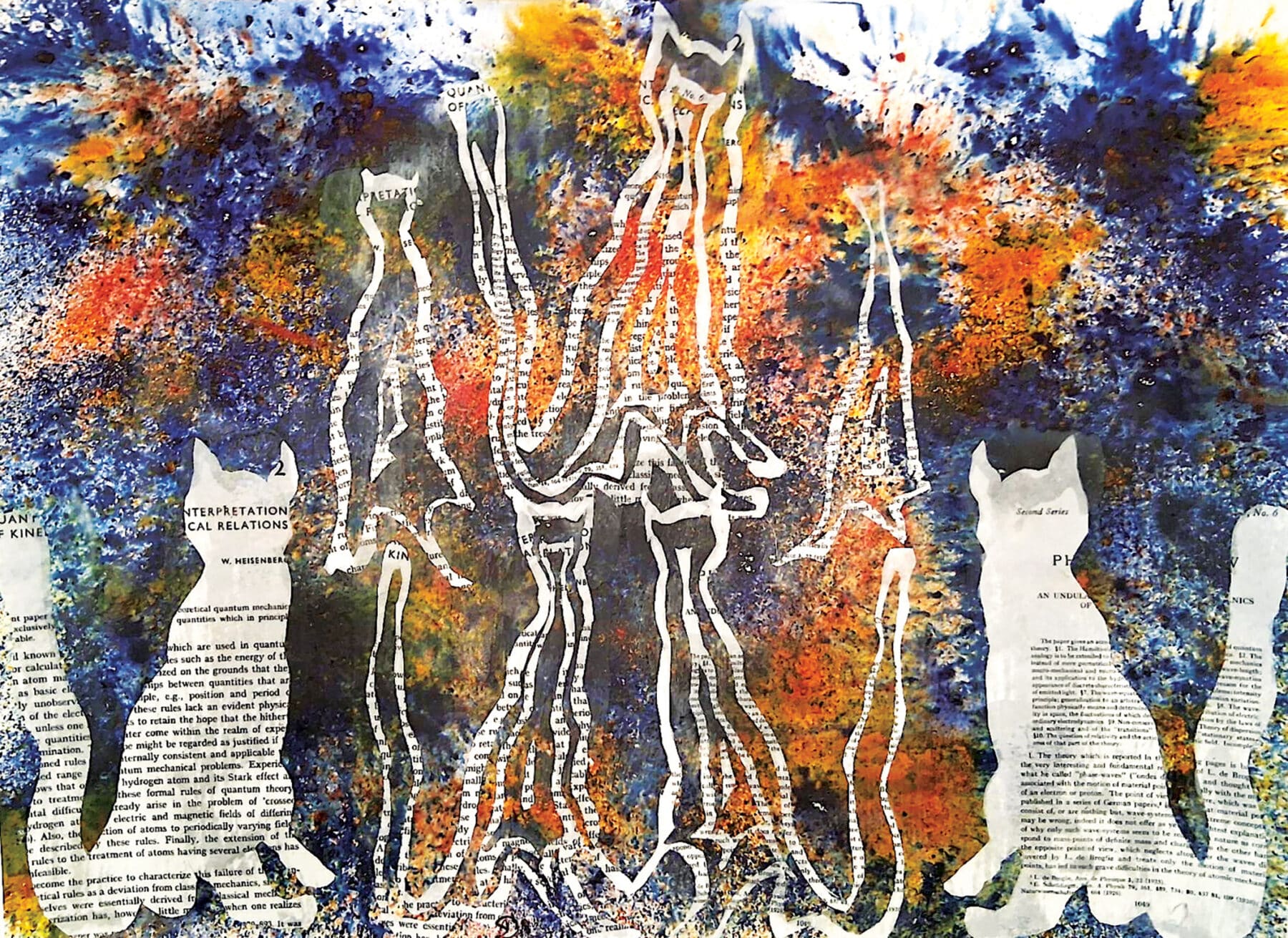
Beginning in 1925, several landmark papers introduced quantum mechanics and heralded a new understanding of the physical universe, based not on a deterministic understanding of physical events but on a probabilistic one. Marking the centennial of this scientific revolution, UNESCO has proclaimed 2025 as the International Year of Quantum Science and Technology.
Emerging technologies suggest we are only just beginning to realize the quantum revolution and its myriad applications. Quantum computing and encryption, for example, provides enormously greater computing power and encoding processes that cannot be hacked. Beyond its applications, quantum mechanics has changed how humanity perceives reality and reveals a strange nondual beauty.
Art can help us conceive complex ideas like quantum mechanics. I believe that when art and science converse with humility and openness, transformative creativity can emerge. Heisenberg and Schrödinger’s Cat #3 uses the first pages of papers by Werner Heisenberg and Erwin Schrödinger to illustrate the concept of wave–particle duality. The pages are made into paper cutouts of waves in the shape of cats, based on the Schrödinger’s cat thought experiment; in the central cat, these waves are interspersed to show that the wave and particle models are interchangeable, and both describe a fundamental truth of the universe.