
Beyond Earthrise: Artemis and the Work of Richelle Ellis
In December 1968, Apollo 8 became the first crewed mission to leave Earth’s orbit and circle the Moon. Although the mission carried cameras, photographing Earth rising above the lunar horizon was never part of the scientific plan. Then, during the spacecraft’s fourth orbit of the Moon, the crew saw Earth suddenly appear outside the window—small, luminous, suspended in darkness. Astronaut Bill Anders reacted instinctively, scrambling to capture the moment. The resulting photograph, later known as Earthrise, was not carefully staged or anticipated. It was a human response to awe. Yet that unplanned image transformed human perception almost instantly.
For the first time, humanity saw Earth not as territory or backdrop, but as a fragile sphere suspended in darkness. Emerging during an era of war, social upheaval, and growing environmental awareness, Earthrise compressed borders and distance into something shared. It became more than a photograph. It became a new way of seeing.
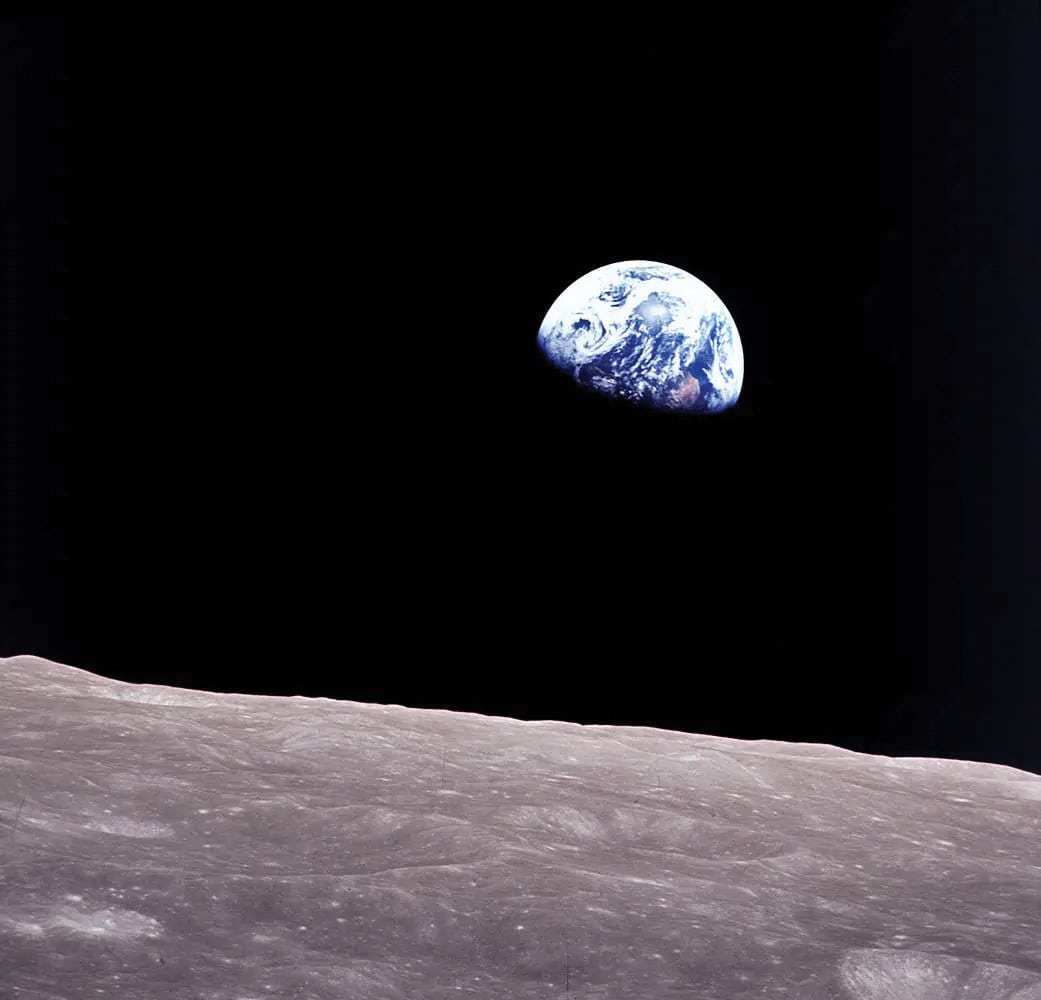
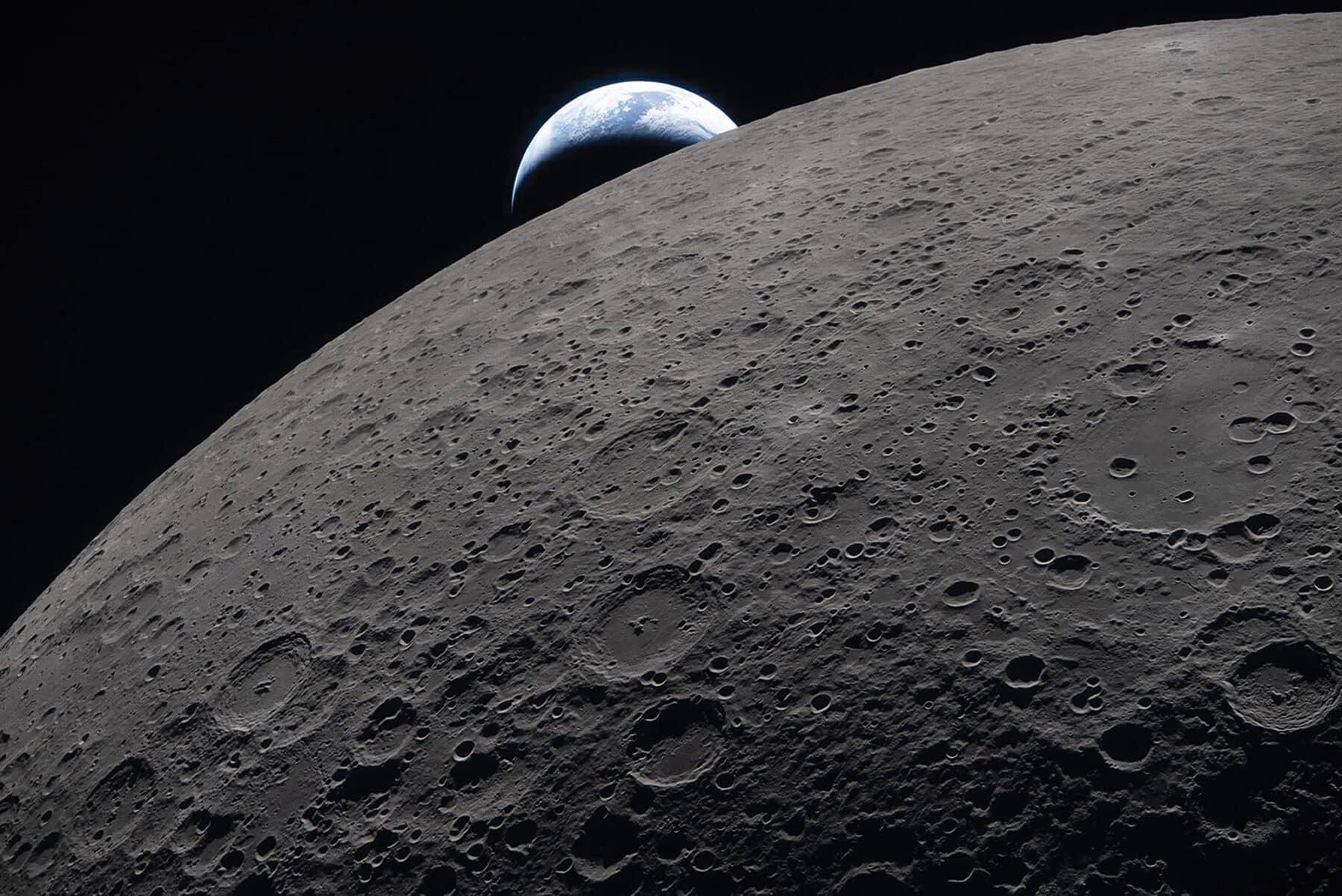
The imagery produced by the recent Artemis II mission belongs to a different moment. Unlike Apollo 8, nothing is accidental. The astronauts aboard Artemis trained in photography over several years with full awareness that their images would carry scientific, cultural, and symbolic meaning. If Earthrise was revelation, Artemis is reflection: a return to a planet we already know yet still struggle to fully understand.
That shift—from discovery to reflection—also defines the work of Richelle Ellis, an expeditionary artist, curator, and analog astronaut (that is, she participates in simulated space missions on Earth that help NASA prepare for long-duration space missions). Through satellite imagery, orbital installations, lunar archives, and works shaped by the perspective of spaceflight, Ellis asks how seeing Earth from above changes the way we understand life below. Her practice treats space as a vantage point for reconsidering ecology, technology, memory, and human connection. If Earthrise taught humanity to look back at Earth, Ellis’s work asks what it means to keep looking carefully, consciously, and collectively: “Looking back at Earth from space is not an act of distance,” Ellis argues, “but of intimacy. It reminds us that everything we build, imagine, and hope for begins here.”
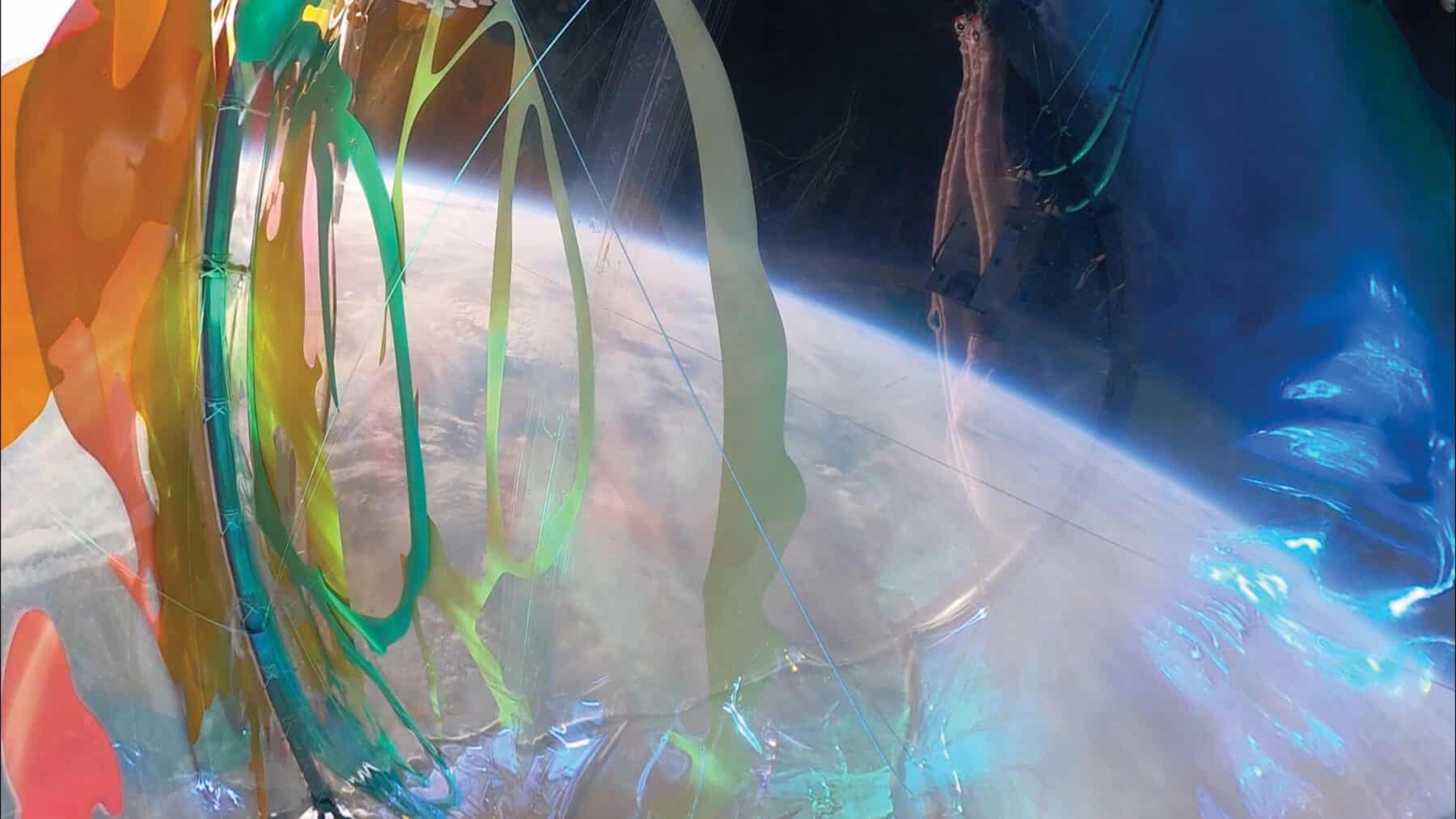
Ellis’s project Living Light connects two of Earth’s most mysterious frontiers: the deep ocean and the edge of space. Inspired by bioluminescent marine organisms, Ellis created a translucent sculptural installation with the Beyond Earth artist collective that was carried to an altitude of approximately 120,000 feet aboard Space Perspective’s Neptune One test flight. Seen against the darkness above Earth’s atmosphere, the work echoes the glow of life in the ocean depths while highlighting Earth’s own fragile radiance from above. By bringing an ocean-inspired artwork into near space, Ellis suggests that the search for discovery does not begin beyond our planet; it begins with learning to see the extraordinary systems that already exist here.
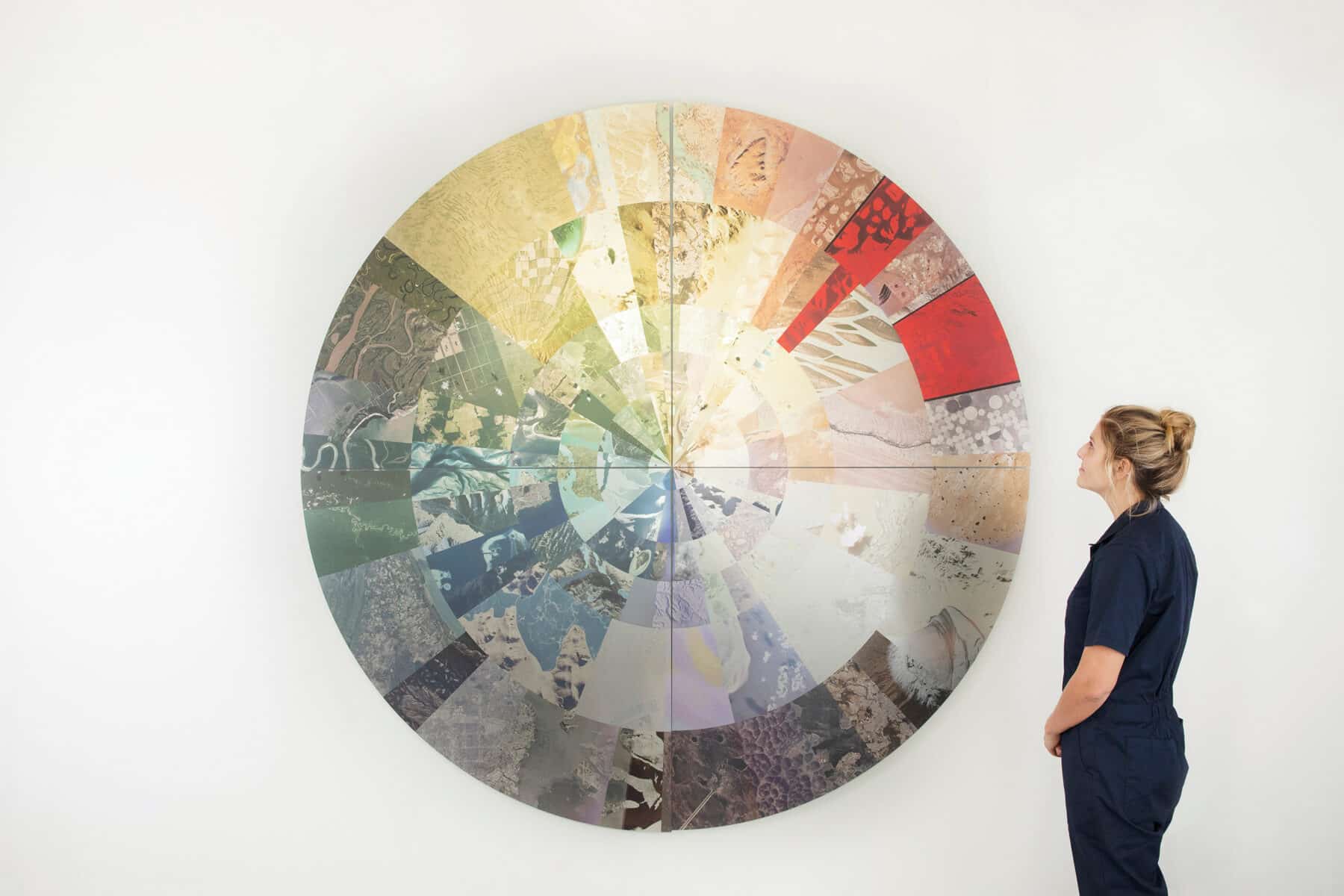
Earth Tones begins with color. Created from satellite images sourced during Ellis’s residency with Planet Labs, an Earth observation company, the work transforms hundreds of orbital views into a reimagined color wheel. The colors are drawn directly from Earth itself: deserts, oceans, forests, ice fields, mineral landscapes, and atmospheric phenomena seen from above. Printed on a mirrored surface, the work folds the viewer into the image, making it impossible to look at the planet without also encountering oneself. Earth Tones becomes both a portrait of Earth and a mirror of perception, reminding viewers that every system of color, beauty, and meaning begins with the living planet.
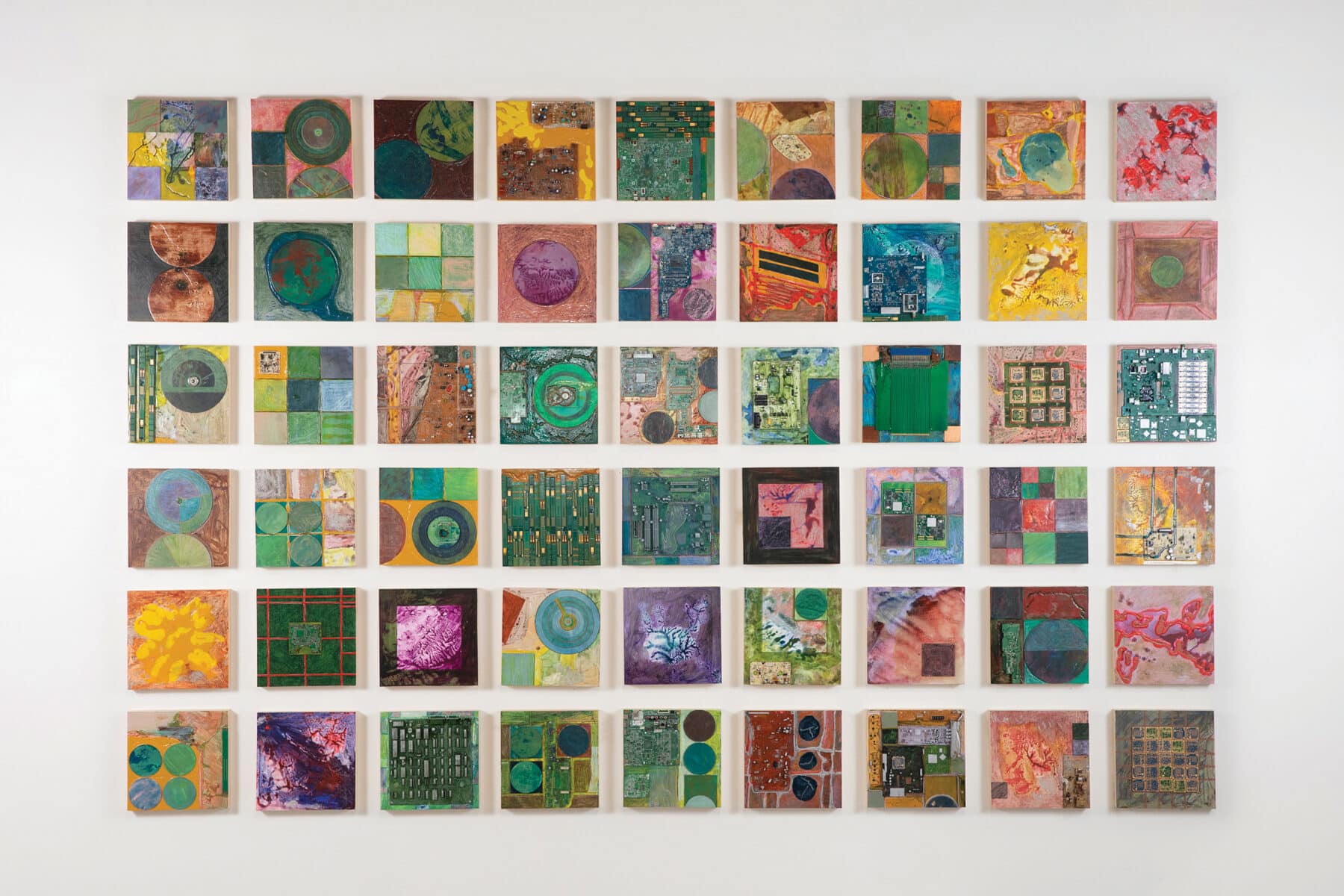
Where Earth Tones expands outward to the planetary scale, Life on the Grid returns to the ground beneath our feet. Across 54 mixed-media panels, painted farmlands are joined with circuit boards, collapsing aerial landscape and technological infrastructure into one visual language. The Jefferson grid, the system once imposed on the American landscape to organize land for property, agriculture, and expansion, reappears here as the hidden architecture of the digital age. Fields, computer chips, borders, and networks begin to echo one another.
The grid enabled cultivation, settlement, and growth, but it also introduced rigid borders, ecological disruption, and extractive modes of progress. Today, similar systems shape the technologies that connect us, surveil us, and reorganize the world at unprecedented speed. Ellis reveals that the logic used to divide land is not so different from the logic used to structure information. In Ellis’s hands, the grid becomes a pattern of thought, a way of seeing, dividing, measuring, and controlling. By bringing circuits and farmlands into direct contact, she asks whether humanity can imagine forms of progress that are less extractive, less divided, and more attuned to the living systems they depend on.
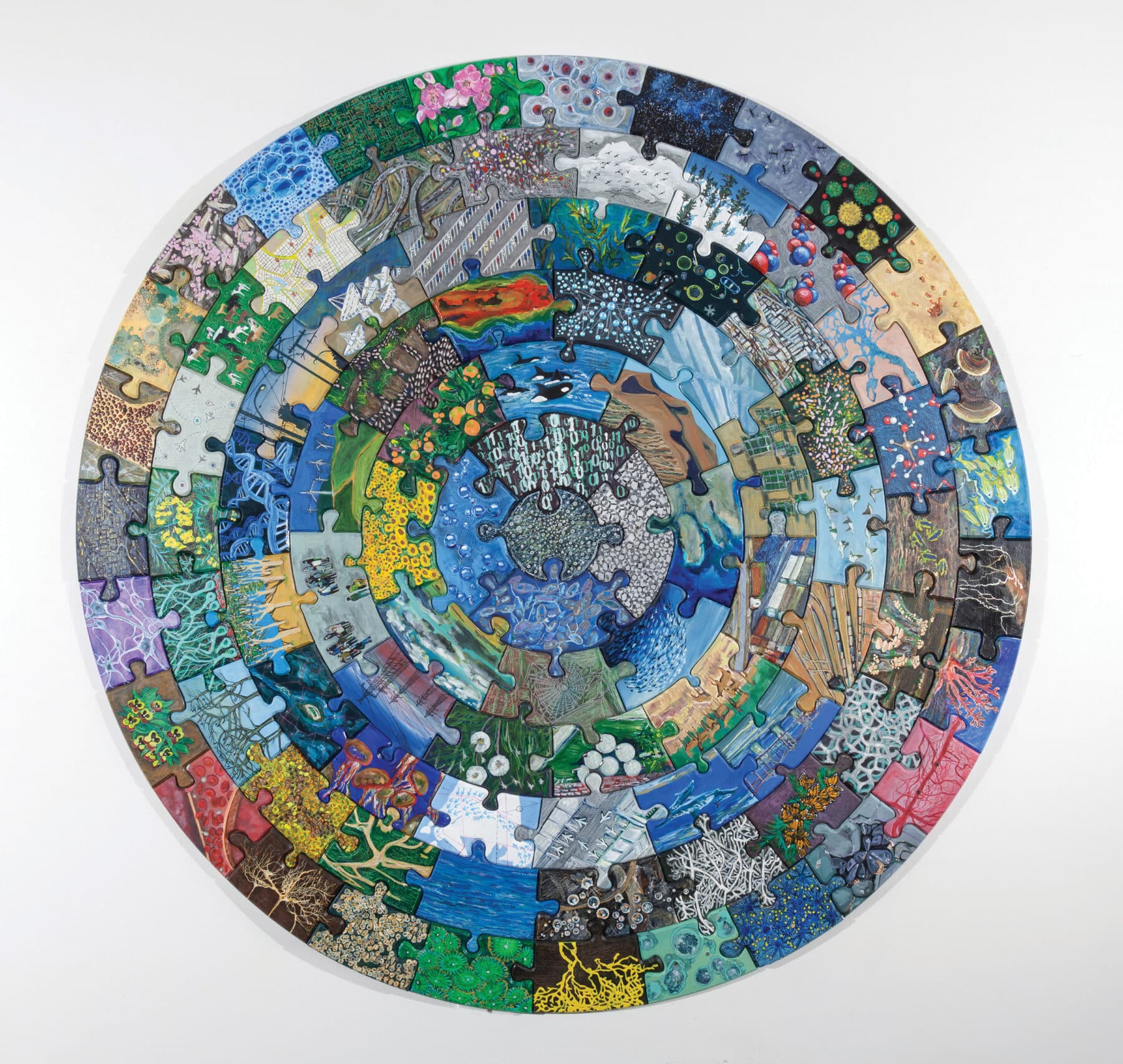
That question reaches its most expansive form in ONE, a large-scale puzzle composed of 91 small paintings of organisms, social systems, and ecosystems that together form a portrait of our complex Earth. Each piece holds its own image, yet none is complete alone. Only when assembled does the larger whole emerge. The work becomes a visual model of interdependence: species, habitats, cultures, infrastructures, and planetary processes all participating in a single living system. ONE recognizes that each fragment matters because it belongs to something larger than itself.
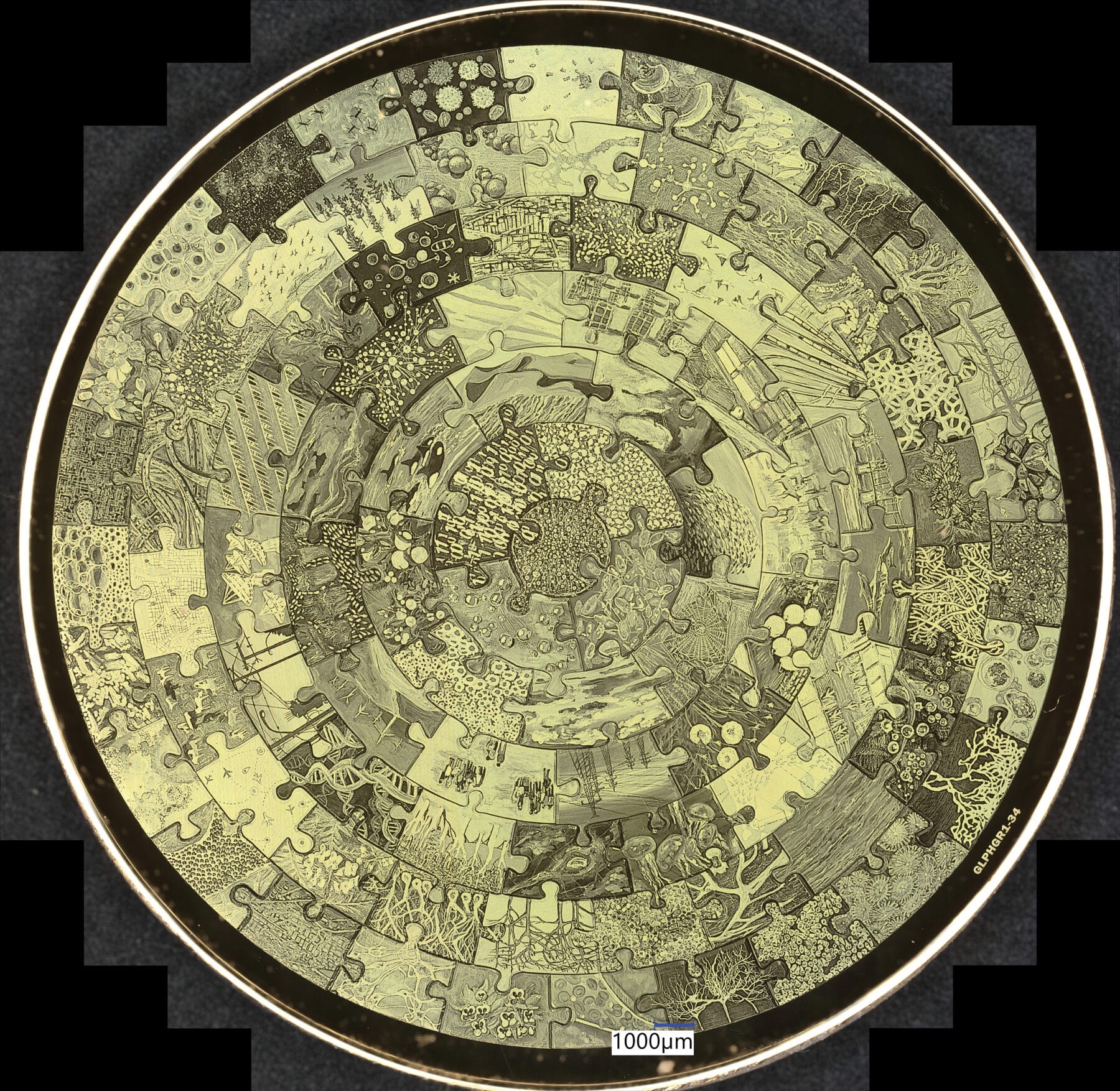
A miniature version of ONE extends this idea beyond Earth. Etched onto nickel-based NanoFiche, the world’s densest analog storage medium, the work becomes part of the Galactic Library Preserve Humanity, or GLPH, a NanoFiche archive of literature and art designed to endure on the Moon for millions of years. Slated to launch as a payload aboard Astrobotic’s Griffin-1 mission on a SpaceX Falcon Heavy rocket from Cape Canaveral, Florida, in July 2026, the lunar version of ONE transforms an artwork about planetary interconnection into a cosmic artifact. It carries an image of Earth’s complexity to the Moon—not as conquest, but as care; not as escape, but as remembrance.
Ellis’s work treats space as a vantage point from which Earth becomes more vivid, more precious, and more inseparable from human responsibility. From satellite collage to gridded farmland, from circuit boards to lunar archives, Ellis traces the patterns that bind technology, ecology, memory, and imagination. The planet is not a backdrop to human ambition, but the source of all life, memory, and possibility. Perhaps the true achievement of looking back from space is not that humans can leave Earth behind, but that we are capable of finally learning how to belong to it.