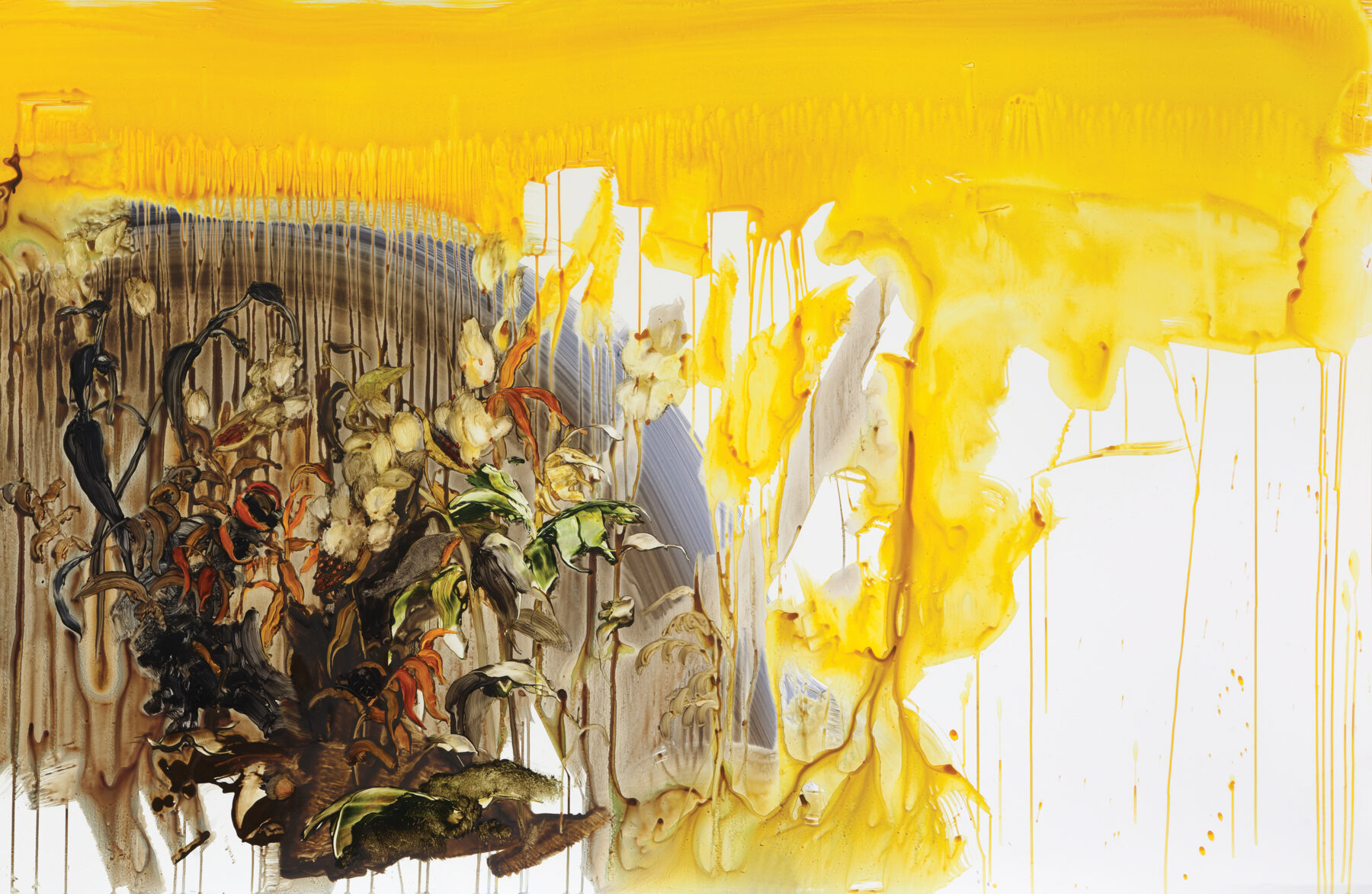
The Air We Share
Landscape paintings usually freeze a snapshot in time. However, in my practice as a naturalist turned visual artist, the only constant in nature is change. My paintings of nature capture succession and evolution. In my work, the elements of the natural scenes from which I draw inspiration are linked, whether weeds in Massachusetts or the Rocky Mountains in Canada or roiling rivers in Vermont.
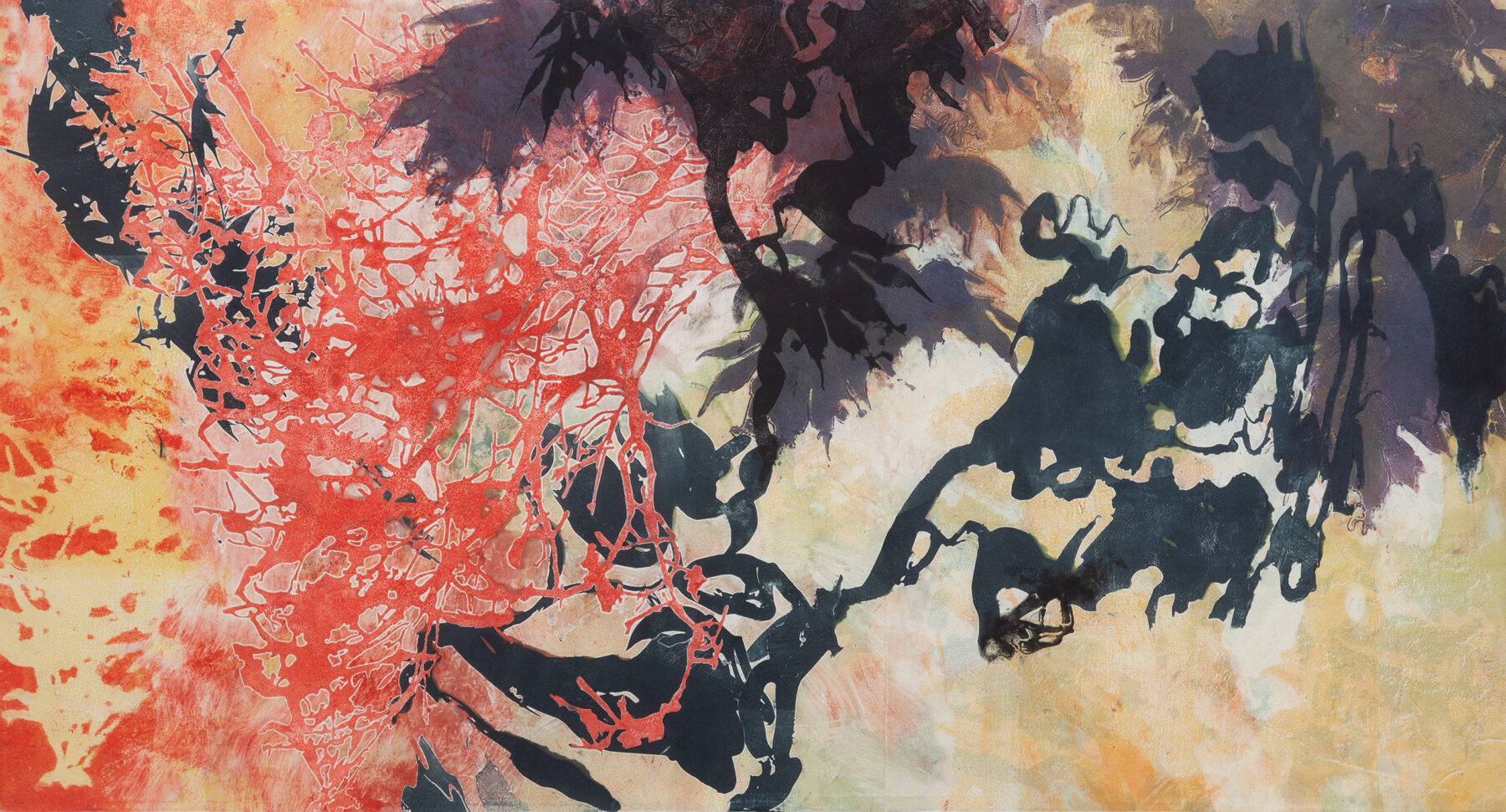
In my most recent show at the American University Museum at the Katzen Arts Center in Washington, DC, I focused on those weeds—the plants we step over, pull up, and spray. My paintings give them the scale and attention usually reserved for mountains. My surfaces move between the intimate and the immense: A swath of fluid color reads as an entire watershed from across the room, then resolves, up close, into the capillaries of a single leaf. The pictures are about plants, but they are also about what connects them. Each is bound to the water that feeds them, the air they trade, and the larger systems in which nothing stands alone.
That double vision—of the minute and the monumental—grows out of how I was trained to see. I studied botany and worked as a naturalist at Parks Canada before studying printmaking and painting at the Rhode Island School of Design. The science came first, and it never left. Today I live in Concord, Massachusetts, on the banks of the Assabet, one of the rivers Henry David Thoreau once paddled. Here, it feels as though I have moved into one of my paintings. I walk and kayak the river’s edges daily, checking the ground for what’s growing, then looking at the birds and the ducks.
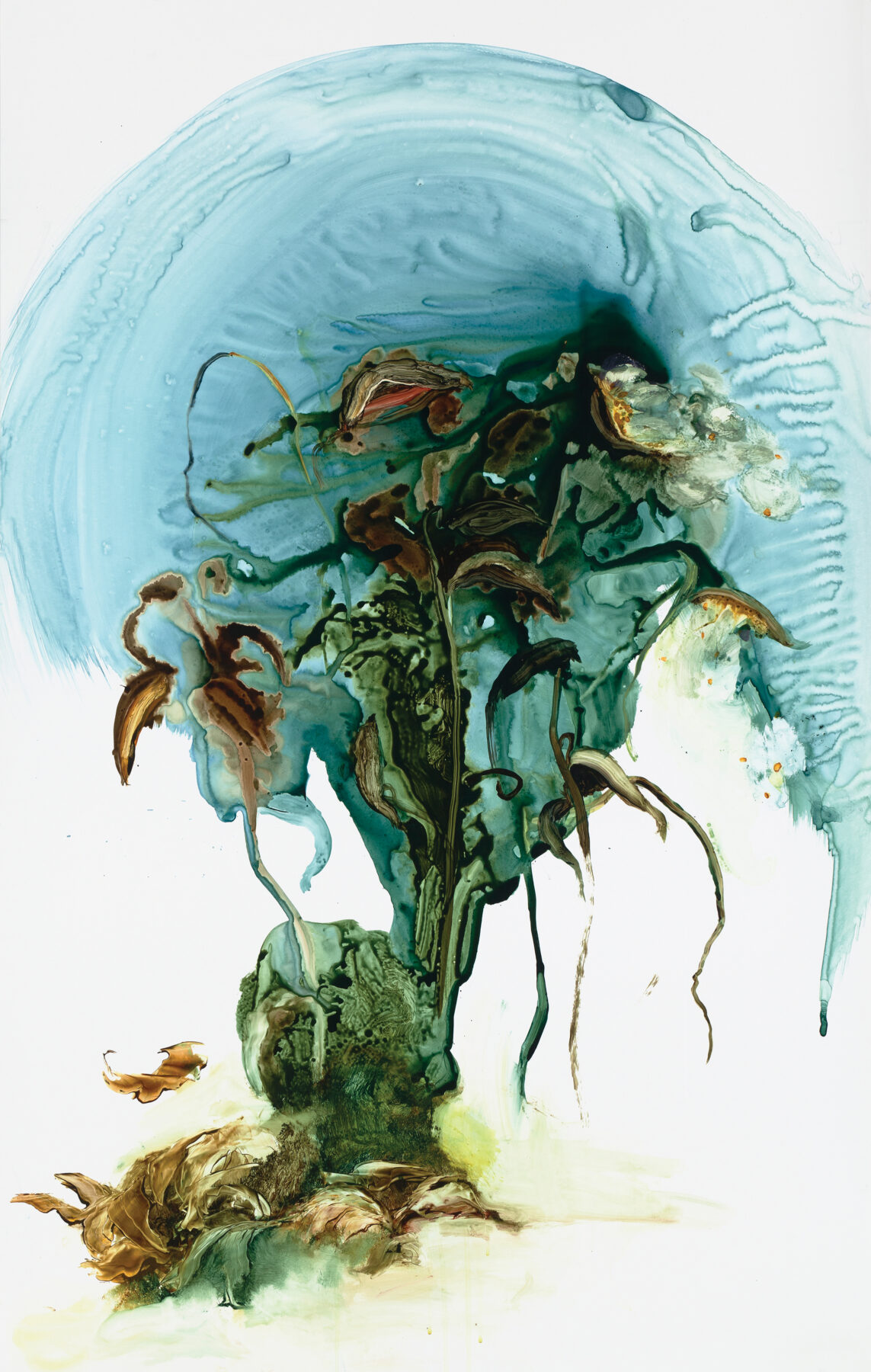
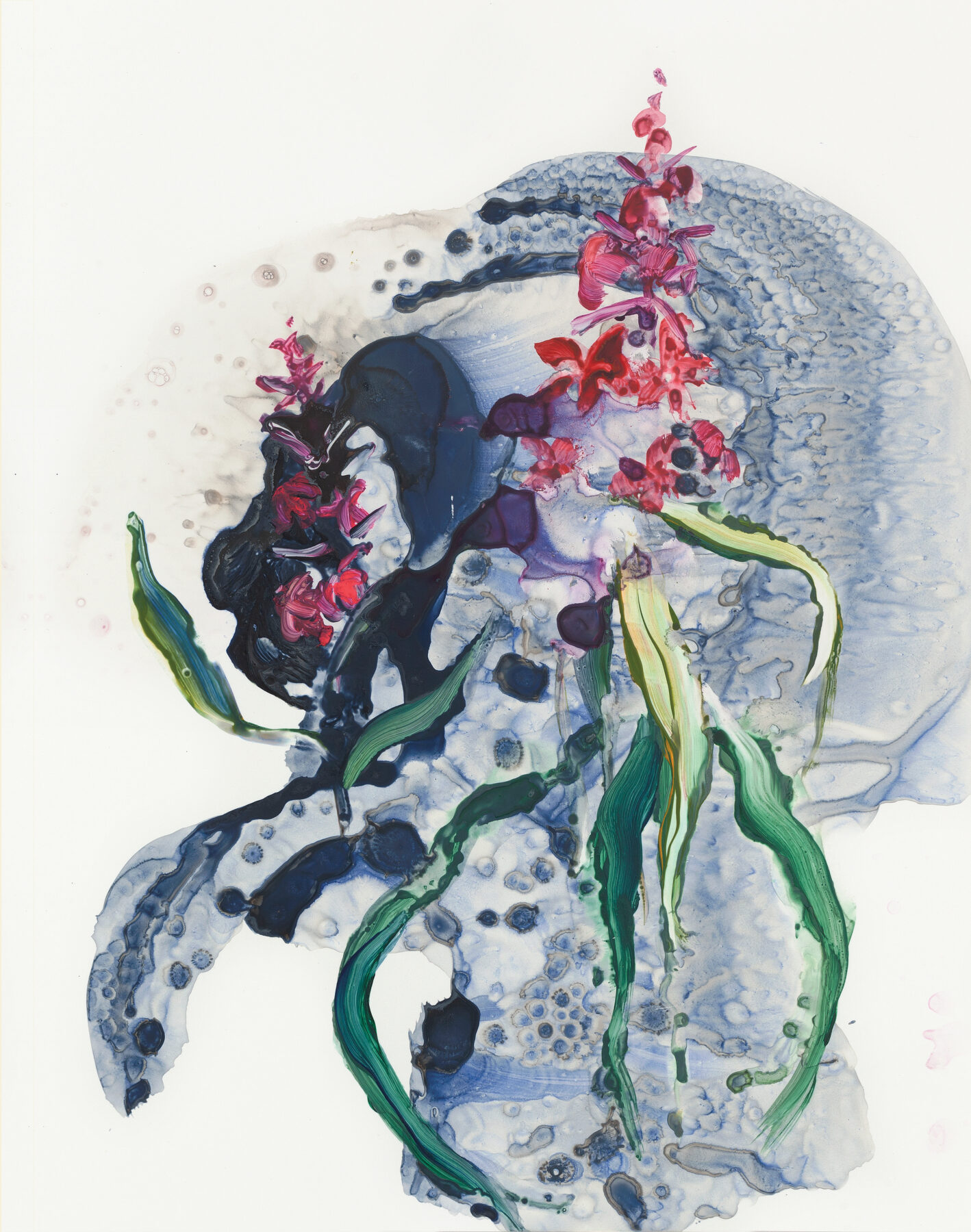
What happens next is the heart of my practice: When a plant takes hold of my attention, I draw it, over and over, crouched in the field and again back in the studio, accumulating hundreds of botanical studies I never exhibit. I consider them a gift to myself because they’re my time with a plant. In them I work out the structure most people never register: the venation of a leaf, the way it joins the stem, the geometry by which a seed is thrown to the wind. Only once I understand a plant from the inside do I loosen into the sweeping, half-abstract gestures of my finished work, adding the essence of what’s not seen. The freedom is earned; the abstraction rests on accurate observation.
One thing I’ve learned is to look closely at the minutiae in order to see something much larger, to see the whole. A milkweed is also the monarch caterpillar that has evolved to cut the plant’s leaves and drain the toxic latex before feeding; a dandelion is a nitrogen factory whose taproot aerates the soil for the plants around it. Every aspect of this plant gives. To paint one weed truthfully, I must paint its relationships; those connections are what my work depicts. In Exhale-Inhale, I render roots, stems, and air as a single continuous red web, deliberately echoing neural and capillary networks.
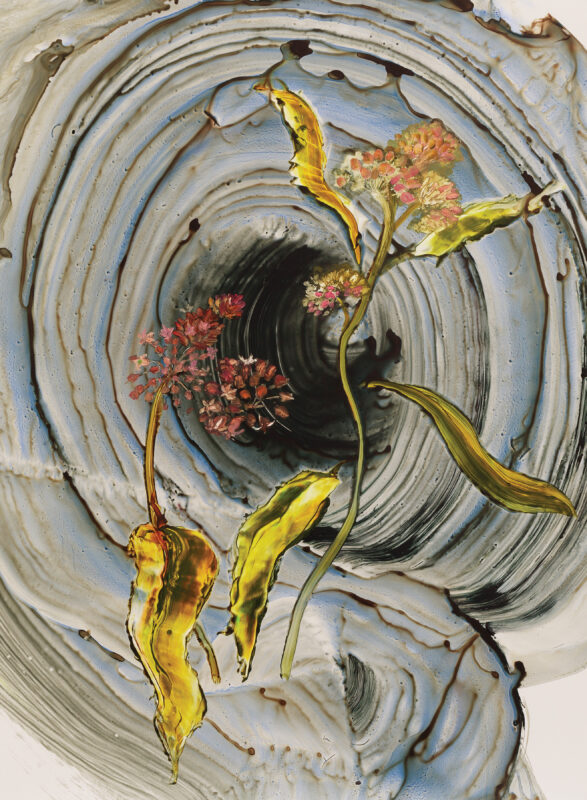
Nature as Mentor, a collaboration with the biologist Janine Benyus, reads four intact natural systems—milkweed, mangrove, mycelium, and gravel-bed rivers—for the design lessons they hold. This perspective represents a shift from protecting nature to learning from it, from seeing a wetland as a resource to seeing it as a working model refined over millions of years of evolution. That reframing makes the humble plants I paint a form of accumulated intelligence humans have only begun to read.
There is an argument folded inside the beauty. To hang a dandelion or a stand of loosestrife in a museum at the scale of a landscape is to ask why people have sorted these plants into “weeds” at all. I resist the tidy binary of native and foreign, valued and disposable, and hold that the overlooked deserves the closest possible look. My daily ritual at the river’s edge is that whole conviction in miniature: Day after day, I pilgrimage to this forgotten river’s edge. I sink low away from the horizon line. At this union of water and soil, I inspect the most humble, incidental happening, and back in the studio with a brush, a spatula and paint, I grab its essence. I work in a world of visions for which there are no words.