
The Map and the Territory: Mining and Renewable Energy in the Atacama Desert
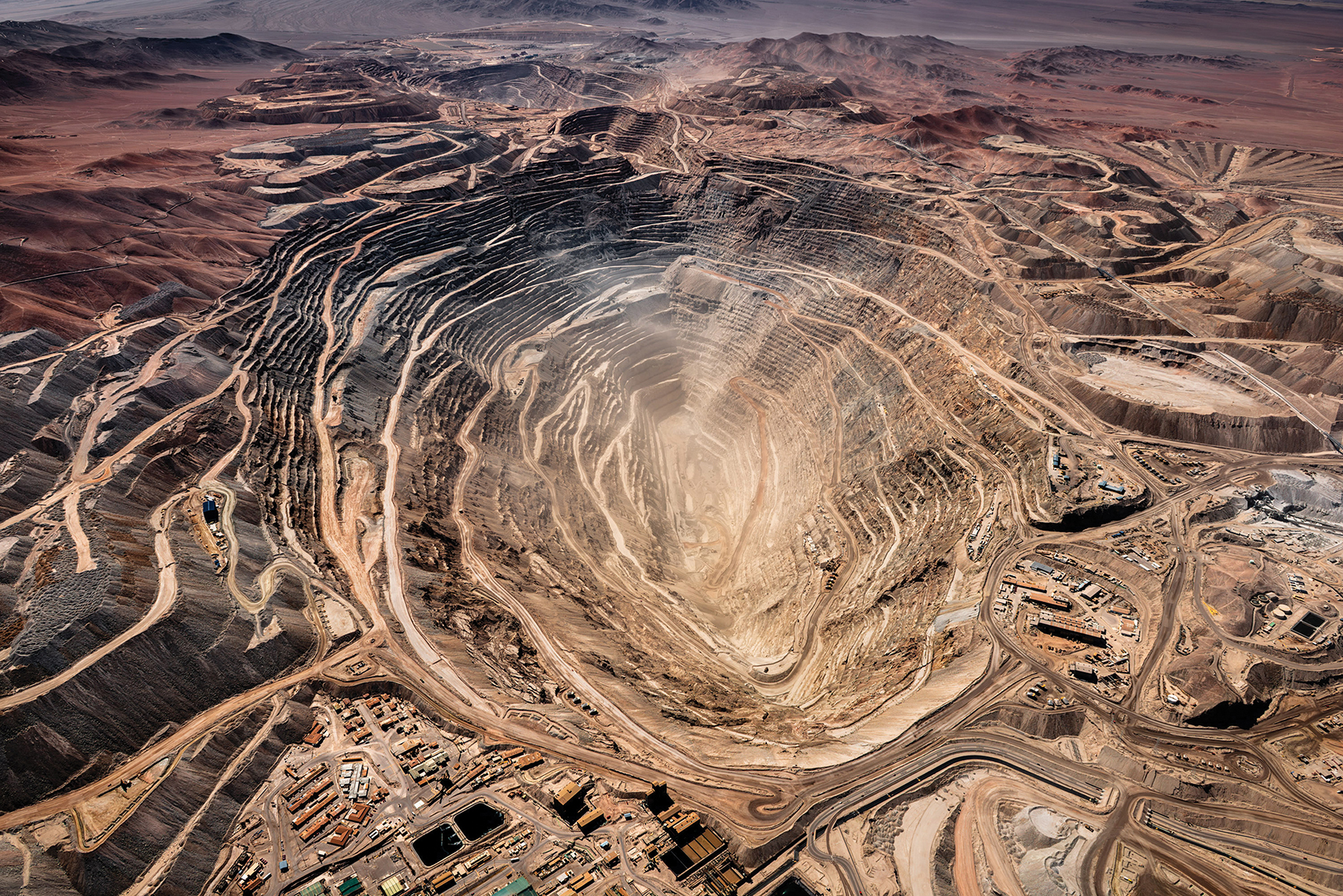
The desert overwhelms the senses. As noontime approaches, the sun’s glare softens the contours of things, like an overexposed photograph. It is only at dawn and dusk that the sun’s rays fall more obliquely, bringing into relief the landscape’s volumes and dramatic colors. By night, the Milky Way sweeps across the firmament almost at arm’s length. From the air, as photographer Jamey Stillings points out, the desert feels like a landscape that has been stripped of its skin—forests, pastures, lakes—to expose the essential, geological stratum of the planet. No wonder the Chilean poet Gabriela Mistral talked about “flayed lands.”
For several years, photographer Jamey Stillings has been documenting renewable energy projects. From high in the sky and on the ground, his work has explored the nuances of a very basic tension: Green energy is crucial for addressing climate change, but its large-scale implementation also has consequences for the environment. In ATACAMA: Renewable Energy and Mining in the High Desert of Chile, Stillings focuses his lens on the synergetic yet complex relationship between these two industries in Chile’s Norte Grande.
The driest place on Earth, the Atacama Desert is home to a wealth of mineral resources, among them nearly one-third of the world’s copper and lithium reserves. With the most intense solar radiation in the world, and almost no humidity or light pollution, the Atacama has become the global nerve center for astronomical observation. For this project, Stillings has gone up to the sky to look down on Earth, specifically the place where most people come to look up at the sky.
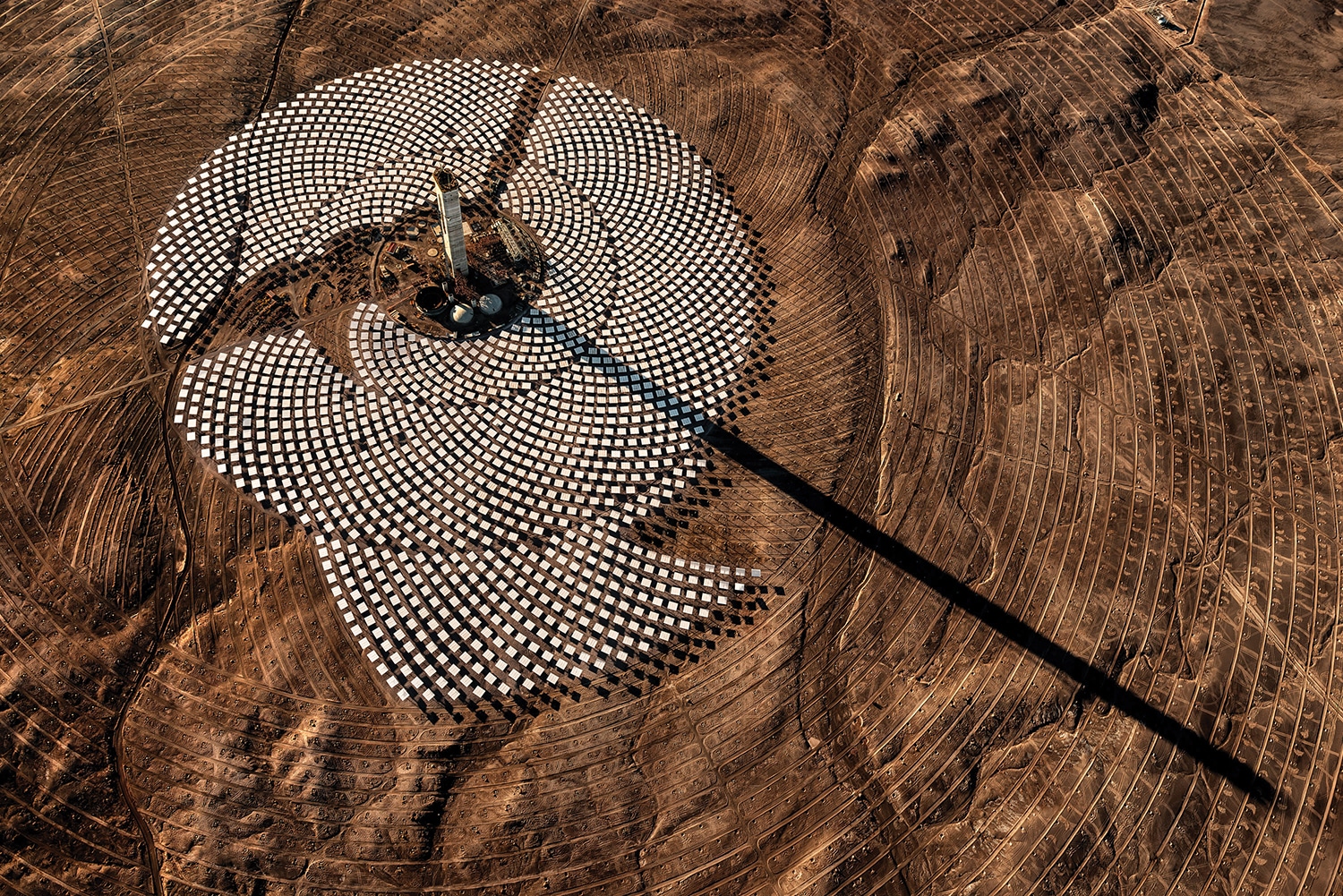
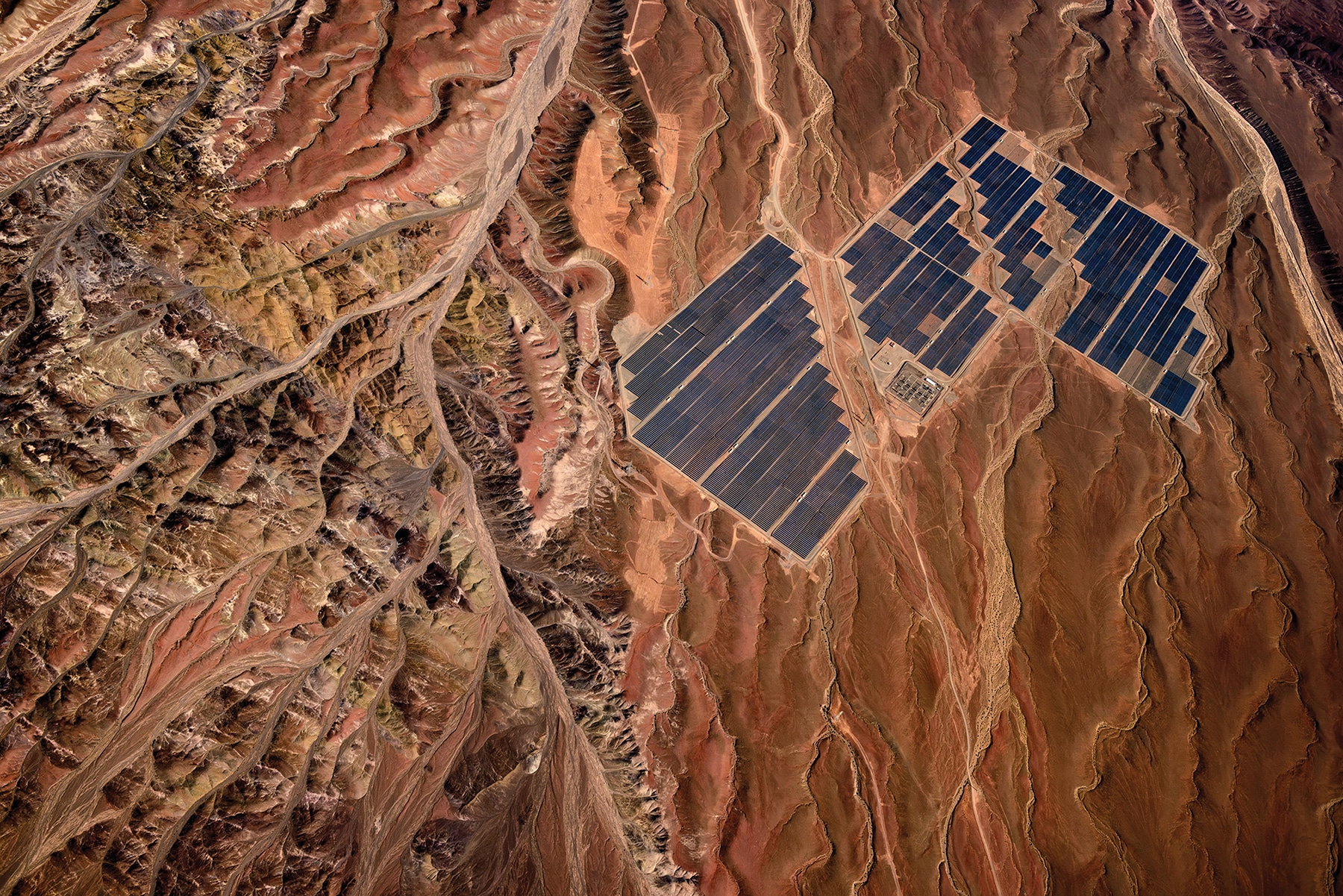
Further north in this same desert are the Nazca geoglyphs. Intended as invocations for water and fertility, they were created to be studied from above, not by extraterrestrials but by gods and, as chance would have it, by the humans of the future. The Chilean desert is also home to countless geoglyphs; scattered across mountain slopes, they are visible from the Earth and, particularly, the trade routes that connected the pottery and agricultural communities of northern Chile to the civilizations of the central Andes region, first Tiwanaku and later the Inca Empire.
Jamey Stillings’s images offer an eloquent exploration of many crossroads, contrasts, and contradictions. Through them, viewers may contemplate a kind of superimposition, between the entropic “disorder” of nature and the order of reason, between the geological past and the technological present. Stillings’s camera documents the scars that are visible and alludes to other, deeper ones.
The Uruguayan thinker Ángel Rama explored the contrast between the organic medieval city and the geometric, grid-based cities of Latin America. The organized city, which is the result of rational urban planning, is the spatial reflection of a hierarchical order based on administrative, military, and commercial priorities. It was the dream of an order that was imposed upon reality, that imagined a tabula rasa and denied the existence of indigenous cultures. Indigenous architecture, in contrast, was based on a concept of place quite different from that of utilitarian reason.
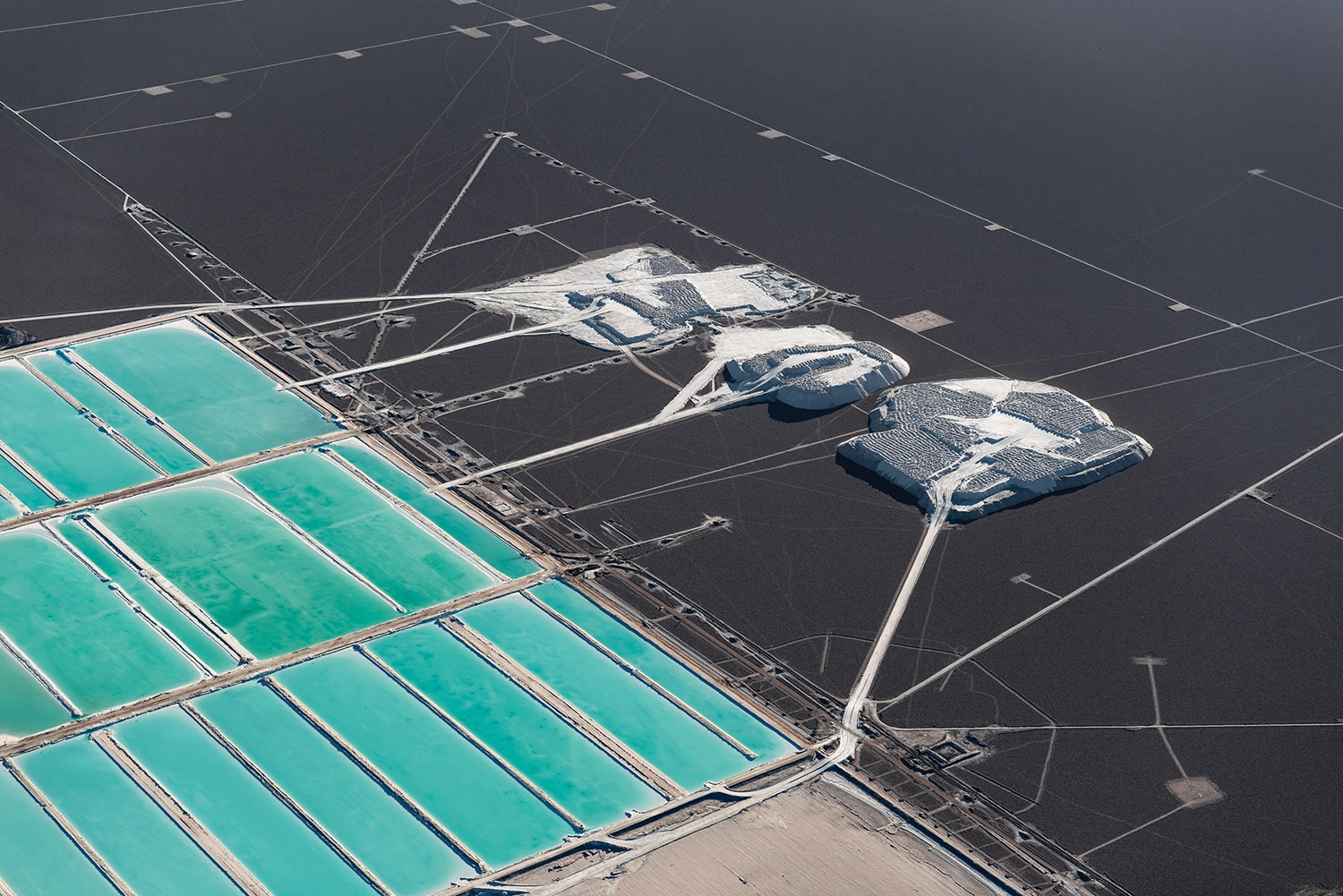
In the best minimalist art—I am thinking of the painter Agnes Martin, adoptive daughter of the desert—one finds a kind of breath, a heartbeat beneath a seemingly monotonous surface. In Stillings’s photographs, the patterns, lines, and geometric forms seem to suggest something similarly impossible to put in words. As Jorge Luis Borges wrote, “There is an hour just at evening when the plains seem on the verge of saying something; they never do, or perhaps they do—eternally—though we don’t understand it, or perhaps we do understand but what they say is as untranslatable as music.”
I would venture to say that these images offer a visual representation of connections, intersections, and invisible lines that come together to form a complex grid, suggesting that beyond the flow of electrons all things are very much interconnected: raw materials, technology, innovation, humanity’s patterns of consumption, ecological degradation, the haves and have-nots, cities and nature, the living and the dead.
—Sergio Missana
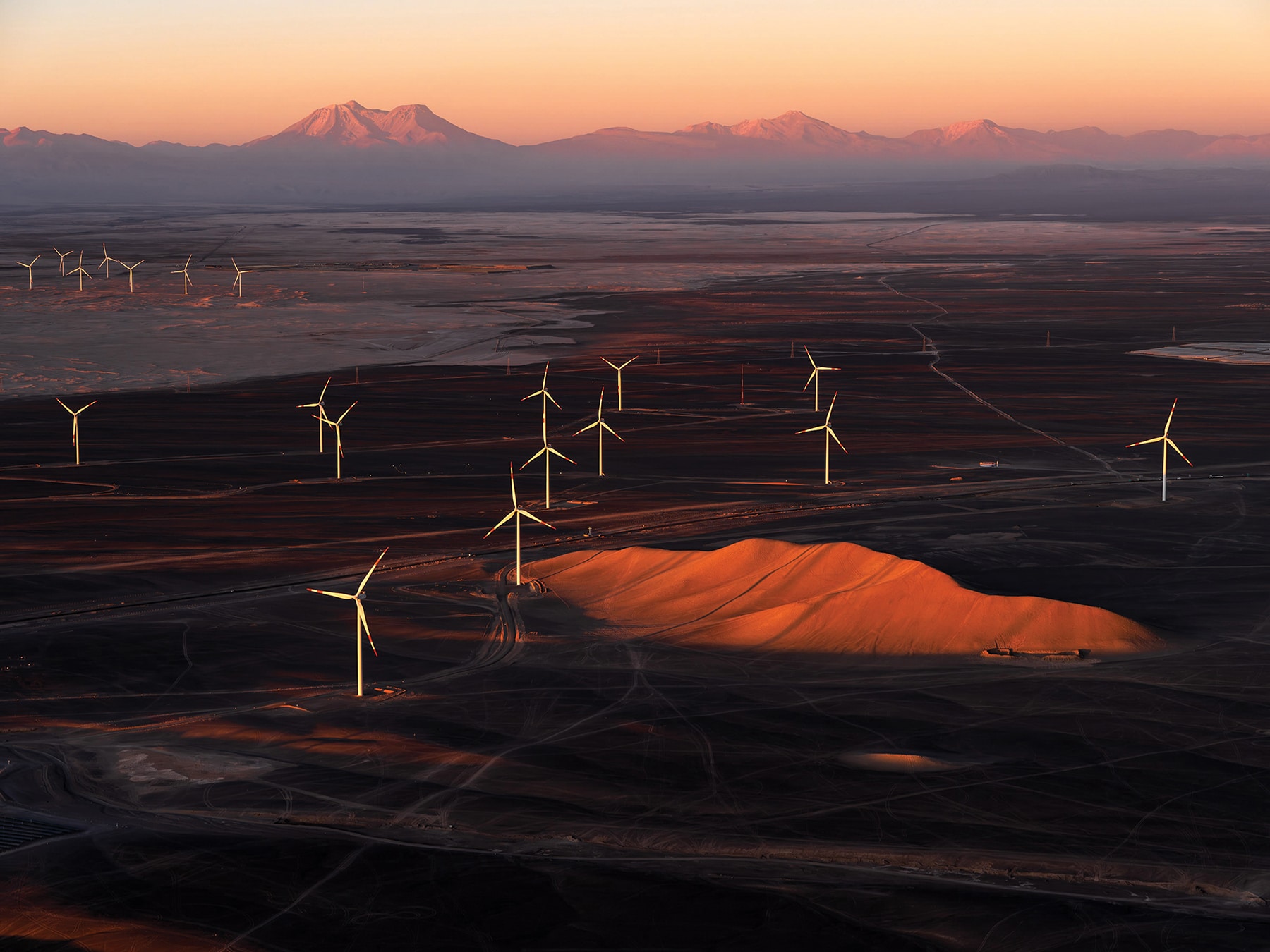
ATACAMA: Renewable Energy and Mining in the High Desert of Chile, An Exhibition of Photographs by Jamey Stillings is on view through March 4, 2027, at the National Academy of Sciences, 2101 Constitution Avenue NW, Washington, DC. Organized by Cultural Programs of the National Academy of Sciences, the exhibition is viewable during NAS building tours and special events.