Three electronic musicians, quarantined in different cities across the globe, record a series of short rhythmic loops. Each loop is subsequently cut into a lock groove on a vinyl record and played back on a turntable in each location. Video and audio from the turntables are streamed to a Zoom meeting so that the rhythms can be heard together, but only as transformed by the temporal distortions inherent to Zoom and to online relationships in general. Each day, new lock grooves are selected after the previous ones begin to physically degrade from continuous playback.
Created during post-pandemic lockdown that called for constant hand-washing and limited human-to-human contact, “A Virtual Lotioning Session” (Video, 3min 13sec, 2020) is about noticing and attending to one’s own body-to-body. Through an intimate yet public presentation of applying lotion to one’s own hand(s), the video performance positions self-care as a doubling act, one that is for others as much as it is for oneself. With a humorous spin on a daily ritual that is simultaneously mundane and absurdly sensual, an emollient-for-skin morphs into oil paint and a hand transforms into a “sensorial canvas,” waiting to be touched by all felt-experiences. As noted in the video, “Time to give your hand(s) some loving that only hugs your hand and no other human’s.”
An Artist a Day… was a live, online show for 15 minutes every day, that ran from June 18 -September 13, 2020. An Artist a Day… is currently presenting the project “What Are You Looking Forward to in 2021?” to examine a paradigm shift in our time through artists’ voices and their creations.
Pandemic Papers is an experimental archive logging my feelings within the context of news headlines, painted on the Sunday editions of my local paper, The San Francisco Chronicle. The project consists of over 44 paintings ranging in size from 10 x 12 inches to 1 x 1 inch, created from November 2019, when COVID-19 first appeared in Wuhan, China, to July 2021, when San Francisco finally (hopefully?) retired its emergency order. Pandemic Papers gave me a way to store and recall my own personal experience of the pandemic despite my long term memory loss due to my brain injury.
March 2021
Additional Details
About M Eifler
I am an artist with a pile of intersectional identities including being disabled, neurodivergent, non-binary, queer, and Jewish. I make archives, prosthetics, and simulations. My projects usually start in the waste streams of capitalism, sifting thru junk mail and newsprint, mining exhaust data and free apps, and sorting old clothes and hand-me-down yarn. From these sources I experiment with ways to understand myself and the world around me including:
Paintings, books, and sculptures made from reclaimed paper and plastic
Computational Interactives, wearables, performance, and AR/VR
Digital collage, including AI, GIF, Drawing, Photography, and Video
Handmade textiles, including garments, blankets, pillows, and sculptures
My themes: waste proliferation, speculative archives, computational prosthetics and others, stem from my brain injury which lead not only to my long term physical disability but also my severe memory loss.
I’ve exhibited work or performed at DHMD Museum, BOZAR, Ars Electronica, SomArts, TED, the Exploratorium, SFMoMA, the YBCA, and the Wattis Institute in San Francisco, XOXO, Wiensowski & Harbord in Berlin, Laurie M. Tisch Gallery and Armory Show in New York, Seattle International Film Festival, the Smithsonian Institution and Kennedy Center.
Sedalia writes, “We learn more about ourselves during times of conflict. These works express this time in history. A time that will be rewritten in history forever.”
The convergence of a worldwide pandemic, the cacophony of responses to the unrelenting murders of Black people, the call to heal the planet, the anniversary of the women’s suffrage movement, occurring simultaneously while the world looks on in astonishment as the corrupt United States government removes its mask of civility, have coalesced to create one of the most challenging years in US history.
Nine mature Black women artists gathered to share our individual observations, responses, and insights to this moment through our art practice, personal experiences, and research; our project demonstrates that Black women artists are not monolithic in our thinking or expressions. We understand that the narratives of white people may take precedence in the gestation of traumatic events taking place. However, we reject the attempts of white neutrality to define our realities. In transforming our trauma, we created visual narratives to document our images, our words, and our assessments of this era; a transgressive act.
As seasoned Womanist artists we have acquired skills over decades sharpened by profound life experiences. Our decision was to each create a unique artist’s book with space for the other eight artists to express their views. Once a month over a period of nine months we contribute to an artist’s book, handing them off to the next artist in our circle every 30 days. We began our mother books in September 2020, and the gestation period ends nine months later, in May 2021. At the end of the nine months, the books will return to their original creator filled with images, text, and objects that reveal insights into the year 2020–2021 from the hands and minds of nine mature blackwomenartists. During the ninth month each artist finalizes their book. Additionally, each month we hold fellowship meetings, both in person and virtually, to swap books, critique our process, and document the experience in a group blog. Each of us has also committed to creating at least two works of art tied to our individual studio practice and/or inspired by our fellowship in dialogue with artists’ books.
Additional Details
The proposed Nine Artists/Nine Months/Nine Perspectives: Birth of 2020 Visions exhibition will provide blackwomenartists whose intersectional identities (Black, women, mature) rarely provide them with group or solo exhibitions showcasing their work. The proposed exhibition will provide a much-deserved opportunity for mature blackwomenartists to share their inner visions. The exhibition comprises nine completed artists’ books and a minimum of two additional works each, created by our blackwomenartists sistahood.
In exhibiting our impressions of this tumultuous moment, we also propose an interactive component in which gallery visitors can contribute their experiences, images, words, actions, and responses to events that shaped 2020–2021 in a collaborative artists’ book in the gallery and/or a digital media narrative they can access from home.
The Coronavirus Anagramme Stories, Five Imaginary Coronavirus Artworks
Brian Reffin smith
Over a period of five days, I wrote five short stories with a constraint: the title of each must be an anagramme of the word ‘Coronavirus’.
Over the following five days, I described, as if an art critic, five imaginary artworks by five imaginary artists (each of whose names is an anagramme of my own) in five imaginary shows in five imaginary galleries, ranging from multi-media to interactive installations, with the virus at their centre. Images of or coming from the work were also constructed.
RESPIRATION:RESTORATION is a project that began by recognizing that if the problems of police violence, pandemics, and the climate crisis are connected, then the solutions must be connected as well. Creating more green spaces with plant life leads to cleaner air. Connecting to local food source-”including our own backyards or community gardens-”reorients us towards reciprocity with non-human relatives. Defunding militarized racist police means refunding investments into Indigenous land sovereignty and stewardship, public parks, gardens, libraries, and services for the people. These solutions begin to transform an extractive and exploitative economy into a sustainable and regenerative culture. RESPIRATION:RESTORATION is an ongoing invitation to breathe together. The opening performance of music for mutual flourishing began on Saturday, September 26, 2020, when music collective Spooky Action Labs created music featuring PlantWave—a technology that converts the electromagnetic waves of plant life into musical sounds. The act of listening to plants as creative musicians encourages a radical shift in consciousness: the realization that these beings who provide us with oxygen have their own messages to share. This initial performance launched a multimedia webpage at www.makaracenterarts.org, creating a source of art and educational resources related to these intertwined themes. An ongoing call for submissions by nonprofit organization Makara Center for the Arts is now exchanging free plants for art works, creative responses and/or educational resources from members of local communities, prompted by the following question: What does it feel like to breathe in a world without police violence, pandemics, and climate disasters?
Inspired by spending extended time in lockdown due to the pandemic, Ceremony Shadows is a dark ambient electronic music project. I’m currently releasing a few tracks that are part of a forthcoming album and live experience titled “Inception, Bloom, and Decline”, chronicling my creative cycle during lockdown.
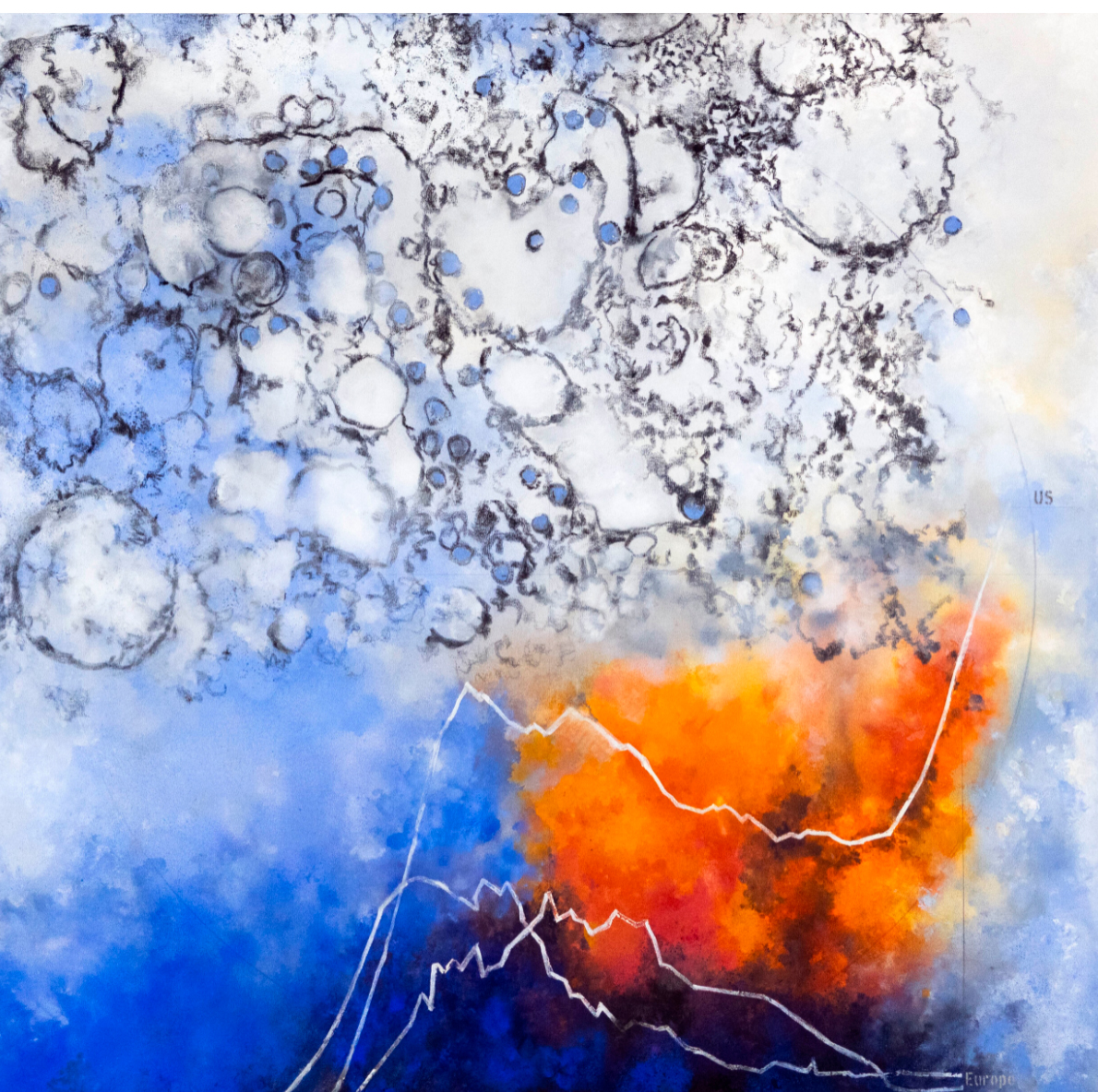
Burko writes, “working on multiple projects, with various combinations of materials, using images from past and present – reflecting my personal struggle as I vacillate from a sense of morass/anxiety to a struggle to hold onto hope for a more positive future – sharing such with fellow creatives for mutual support.”
Diane Burko, July 2020, Mixed Media on Canvas, 60″X60″, 2020
All the pieces here were made between March and July 2020, so they were all shaped by the extraordinary events of the past few months. The beginning of 2020 was marked by a growing anxiety about the pandemic which was taking shape in Asia and Europe. Life went on somewhat normally here in DC, except for the swelling sense that the pandemic would soon arrive here and that we were not prepared. All I could think about was coronavirus, so that’s what I painted dozens of ink paintings of the pathogen that was suddenly the focus of the whole world’s attention. When lockdown was imposed in mid-March, normal life came to an abrupt halt. All my art exhibitions, science meetings and trips were canceled. I stayed home as instructed, only going out for long daily walks around my neighborhood. I’ve lived in DC for more than 20 years, and this was the first year I was unable to see the cherry blossoms at the Tidal Basin. Fortunately, there are some cherry trees in Rose Park, near my home. And by visiting those trees daily, instead of seeing a dramatic, once-a-year show, I witnessed the gradual transformation of the trees, from bare branches to buds to blossoms to fruit – tiny, inedible cherries, but fruit nonetheless! The tree paintings reflect this loss and gain: the trees under strain, but standing, flowering, producing; the roots digging deep and seeking nourishment and connection. The Mandala, Vessel, and Connectome paintings explore similar themes enclosure, isolation and connection expressed as neurons, blood vessels, roots and branches, and the patterns of contact-tracing diagrams. And then, into this time of anxiety and isolation but also of quiet contemplation, came the murder of George Floyd, unleashing a torrent of rage and grief across the country and through my city. The Trauma Brain paintings are a piece of my response to the other epidemic we confronted this year – police brutality. Finally, as the epidemic worsened in the US, I painted “Covid Lungs,” which is a sad, simple reflection on illness and death.
Michele Banks, Indigo Coronavirus, Ink on Yupo, Spring 2020, Collection of the National Academy of Sciences
The “Scuffed Computer Improviser” is a new musical work for computer improviser and live improvising musician for networked performances via internet livestream or video. The separation of chamber musicians and the hiatus of playing music with others during covid-19 has heightened my desire to interact with a digital musical “other.” This project builds on two of my recent works: “Set” for Bassoon and electronics, and “Pileup” for improvising trio and computer improviser. In these two previous works, I developed computer improviser software in the MAX/MSP programming language. This software is being further developed to become more musically flexible as it encounters a variety of musical styles as well as integrate networking so that the software may be operated remotely. The computer improviser is audio-corpus based, meaning that the improviser “learns” how to improvise by analyzing incoming audio and then altering, rearranging, and creating something new from the analyzed audio. The computer improviser then reacts to a live musician with a series of musical behaviors may adapt over the course of a performance. My recent work in algorithmic music, AI composition, and computer improvisation is motivated by an exploration of musicality and an attempt to expand my aesthetic sensibilities through interaction with a digital “other” toward new musical styles. My artistic stance on the inclusion of AI is antithetical to commercial approaches as represented by Google Magenta, AIVA, Pandora, and many others that are designed to iterate on pre-existing styles. This relates to the title of the project: “scuffed computer improviser,” the term “scuffed” used to suggest a certain roughness and DIY aesthetic that stands in relief to the gloss and marketability associated with a commercial end use that is typically associated with AI and machine learning.
“Through my practice I explore ways that we work with or against nature; how we react and intervene, and how nature responds back at a domestic level and beyond.”
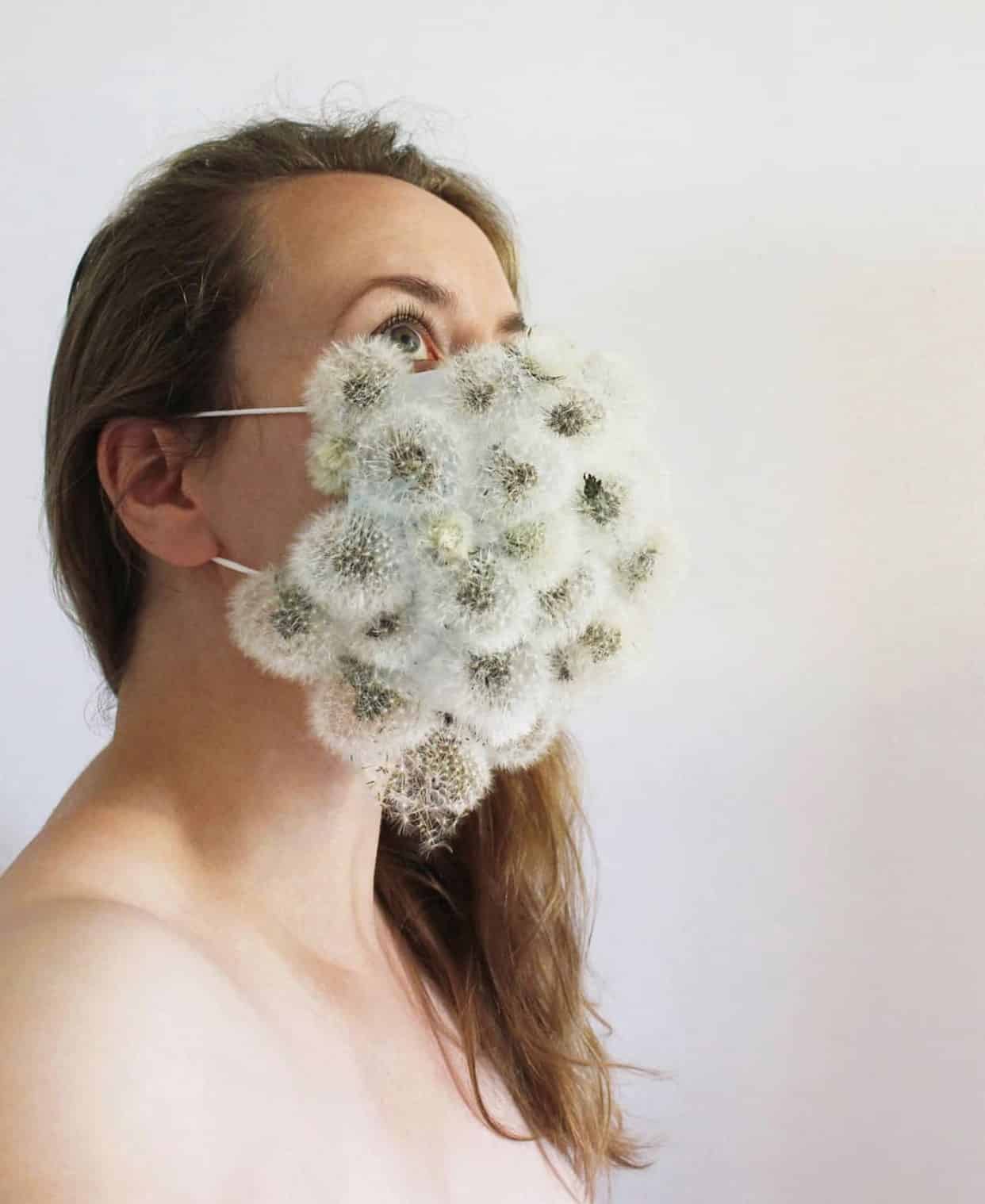
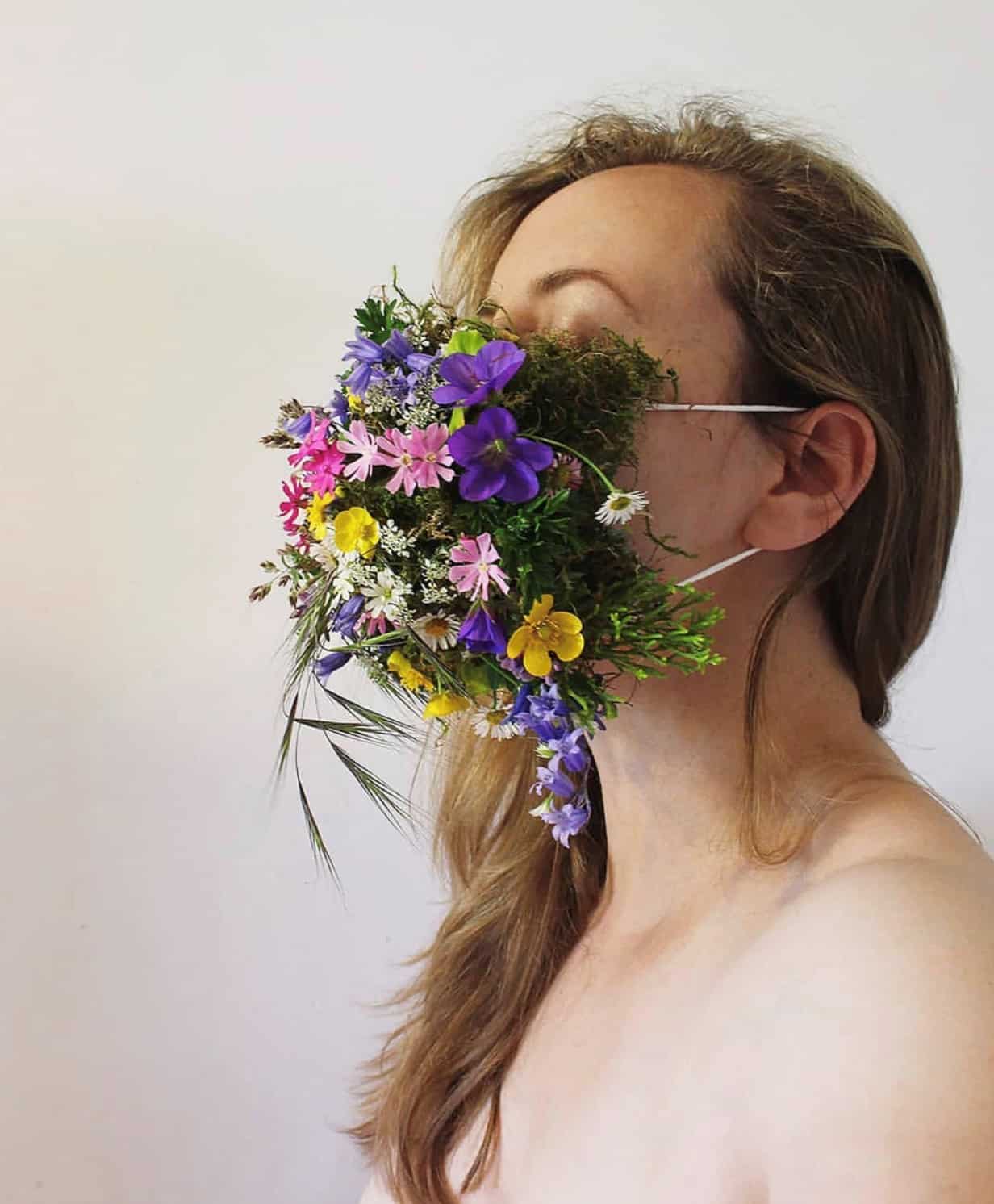
At the beginning of the initial lockdown Estelle Woolley returned to her family’s farm in Cheshire (UK), finding nature therapeutic and inspiring in adverse times. She was commissioned by Chester Virtual Bandstand to create a series of pandemic inspired facemasks from foraged, natural materials. These were collected from her daily walks, where she has been homing in on her immediate surroundings, paying close attention to the plant life coming in and out of season.
The materials chosen are collected with a sense of purpose. A colourful rainbow meadow represents the amazing work of the National Health Service during the pandemic; Dandelion clocks delicately parallel the invisible nature of the virus spreading; Nettles and thistles remind us to keep our distance otherwise there will be consequences. Plants act as a natural filter; they give us oxygen so that we can breathe through them; they give us life. The masks also aim to question whether the spread of the virus is nature’s way of retaliating and teaching us to care for our environment more, to slow down and pay attention to the world.
The images have since gained a lot of national and international recognition, from being featured on the front cover of The Sustainability First Art Prize where she gained Highly Commended, featured in The Wales Arts Review, selected as Axis art highlight of the week, selected as the poster image for the Ty Pawb Open Exhibition, and featured in the New York Magazine, and the Danish newspaper Politiken. She won first place in The Art of The Mask exhibition with Bluegirl Gallery, and gained the Ty Pawb Open People’s Choice Prize. The self portraits have been exhibited both online and in New York, Denver, Miami and London.
Performed simultaneously in Ireland, London and Milton Keynes, older non-binary live art gang FBI+A perform individual responses to the theme. Soundtrack also created from a mix of individual responses.
Social Distance Performance – Rendimiento a Distancia Social
Victoria Gibson
Video documentary of solo guitar and dance performance in a park. Victoria uses effects a lot so the videos are imaginatively edited, then posted to her website.
I created a composition challenge on social media, for myself and anyone that would like to follow. The challenge consists in creating and posting one minute of music (any kind of music) on a weekly basis, during June, July and August, 2020.
In these days of quarantine, when a touch is a wave from six masked feet away, we turn again to language, to the essence of language, to the art of language, to poetry.
The “Poetry Is Like Bread” Ghazal is a collaborative poem created by a world of poets to nourish us all through the Pandemic and to envision the world After. We take our inspiration from Pablo Neruda: “On our earth, before writing was invented, before the printing press was invented, poetry flourished. That is why we know that poetry is like bread, it should be shared by all, by scholars and by peasants, by all our vast , incredible, extraordinary family of humanity.” This collaborative poem was created with the idea that each poet’s unique voice would join together as one, and that the result would be shared by all. There is no poetic form better suited to do this than the Ghazal.
“POETRY IS LIKE BREAD” GHAZAL.
If, as Neruda thought, poetry is like bread, Then let it leaven this dark time and be my bread. [ Christopher Merrill ]
Struggling (and losing) in this Antipoem, ghosted thread, Spreading cool butter, sweet jam on homemade toasted bread. [ Bob Holman ]
No one waits to forgive the dead don’t pardon the dirt, nor the psalm palms, this celebration of bread [ Mahogany L. Browne ]
Distracted by detonating deadlines and demonstrations, I couldn’t meet your request for peaceful bread. [ Sandra Cisneros ]
Offered an exercise for people to do at home, on invitation by galleria Milano in Italy.
Instructions
PURPOSE: to regain one’s path of attachment to the domestic place.
CONTEXT: Attachment to a place, was defined by Rubstein (1992) as “a set of feelings that refer to a geographical place, which emotionally binds a person to this place according to their role or as an experiential setting”. Awareness of our relationship with the place is essential to wellbeing. At this time for many, the home place has coincided with the workplace. For many of us, the home is also, as it was before, the workplace: that of taking care of oneself, and of caring. At this time the coordinates have changed, the referential paradigm is being reversed, the roles are often shared. The opportunity here is to welcome this shift in position, unhinging patterns and rules, including those of geometry and geography applied to measuring and controlling place. Let’s get rid of the specific reference of how the body occupies the physical space and follow the indications of how the soul reveals our own micro-geographies to us!
100,000: They Were Not Simply Names on a List, They Were Us
Anna Foer
collage A decision was made, as a first in “modern times” that there would be no picture on the front page of the New York Times on Sunday, 24 May, 2020. The significance of the moment was the number of Covid deaths in the United States reached 100,000. The list of names and brief descriptions represents only a one-hundredth of the deaths, as there are only 1000 names on the page. I obtained a hard copy of the front section of the paper to use for a collage. The use of newspaper copy to commemorate this moment connects my new work to the collage I made as a memorial to 9.11.01, also incorporating a newspaper list of the victims. In lieu of basing the composition on hand drawn interior spaces, I opted to work more directly on photos, a first for my approach to collage. The choice of photos represents the ubiquity of the coronavirus’ spread and those spaces that are off limits to the public; the New York subway, a morgue, a library and an art gallery. The upper floors are a home environment and at the top are hospital ICU units, complete with ventilators. The interior spaces we inhabit now are reflected with an overlay of virtual viewing commands, superimposed on those rooms. The commands of “Next”, “Previous”, “Read More” and “Share” take on new meaning and significance in these confines. At the time of this writing, six weeks after 24 May, the number of deaths in the US is 130,000.
I am doing two narrative responses. First is Vintage Card Tiny Stories. Being isolated and alone, I decided that mail was a way to give a unique narrative experience and for me to connect in a meaningful way to a reader. I found a bag of vintage postcards and I write a unique short micro story and mail it off to an audience of one. This unique story for an individual is akin to a message in a bottle both for myself and for the reader. The other project is the Exquisite Birth, which I have instigated as a collaborative narrative game based on the surrealist Exquisite Corpse game. Only this story goes from End to Start. I’ve recruited novelists and comics creators to contribute a paragraph or art panel to the story game. It’s a way of connecting creatively with colleagues in a time when we are flung apart. Collaboration and conversation are key to artistic nourishment.
I used the colors and patterns of flowers of this captured by my this year on my long pandemic walks to create energetic mosaics containing hundreds of images. I use the energy contained within these mosaics to merge with photographic portraits of people amidst the pandemic to help restore balance, calm and peace. This is a form of quantum energetic alchemy. The responses for those who have contributed their portraits have been incredible. I have used mostly those wearing masks, from all walks of life; homeless, local political leaders, protestors, and friends. I offer the service for free, but ask for a donation to the project.
Starting on 24th March 2020, I started writing a daily public diary logging the first 100 days of lockdown in Stirchley, Birmingham, UK. Guest posts have also become a regular feature offering different perspectives and experiences. The diary is an important part of my writing practice and rather than keep it in a private diary, I decided to write more publicly as a matter of social/historical record. The digital artefacts also included photos, video, collaged artworks and a walk map.
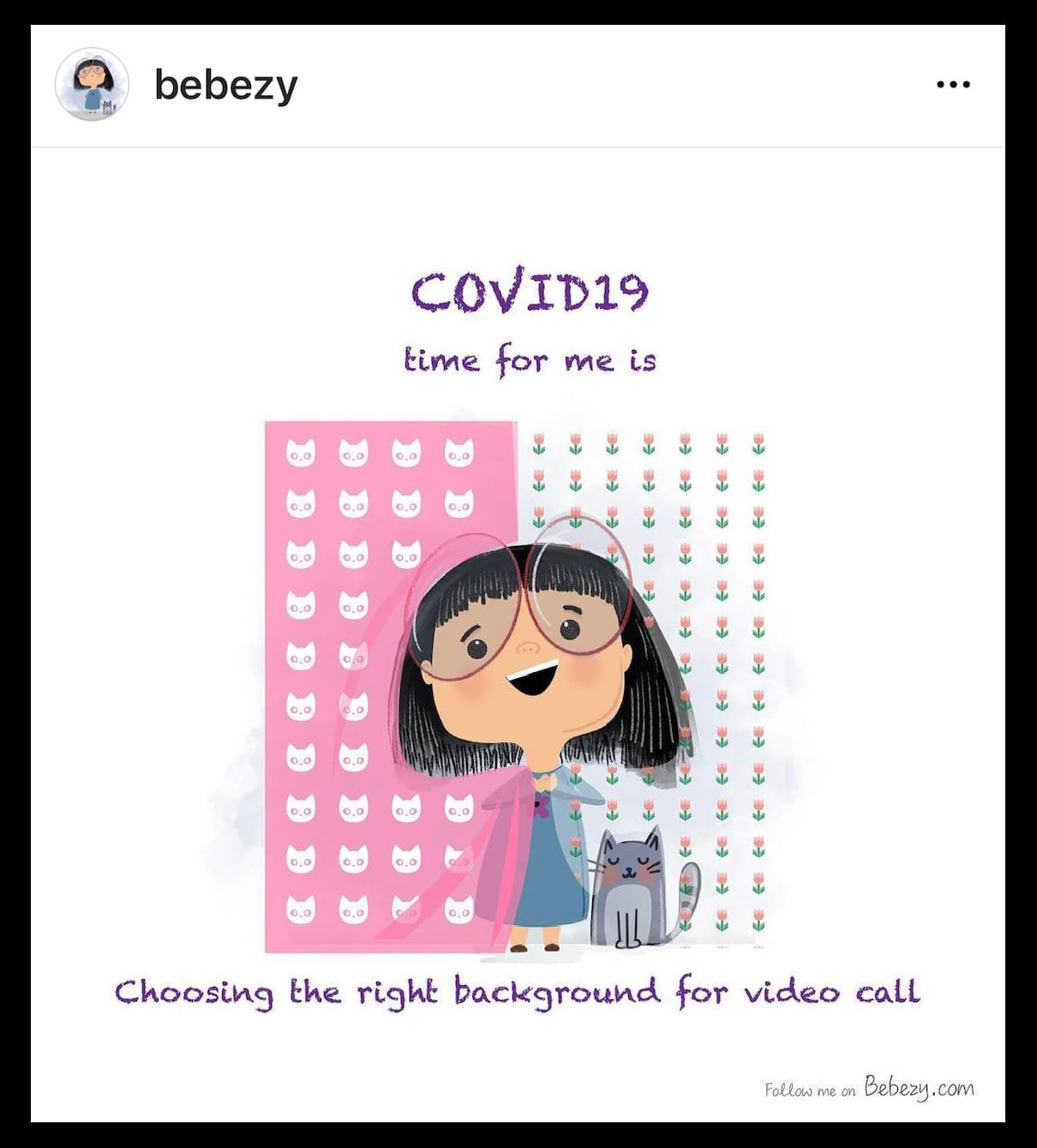
COVID-19 Time for Me is (Bebezy the Happiness Champion)
Kadambari Sahu, Viswatej Kurma and Sandeep Mulagapati
Bebezy: Bebezy is an empathetic happiness champion to fight negative contagion caused by Covid-19. She champions safety and emotional well being. She is a collaboration between Kadambari Sahu, Viswatej Kurma and Sandeep Mulagapati. Covid-19 time is unprecedented. A big part of this battle is fighting the ill effects of isolation. Modern technology has provided some means of coping with this. Art in this context becomes a solution where it can be used to create togetherness by giving a platform for expression and sharing the commonalities. It also becomes one of the effective channels which when used in the service of people can create positive emotions more infectious and break the negative contagion. In an article by HBR tilted The Contagion We Can Control “While medical and public health leaders are working as hard as they can to control the spread of the novel coronavirus, we, of course, listen to and heed their advice. But experts in emotional intelligence also have something powerful to offer” a way to help us manage a different type of contagion that, if we let it run rampant, will only make things worse. Stemming negative emotional contagion” and making positive emotions more infectious” will make us feel more prepared and in control during this frightening period.” [1] To fight this negative emotional contagion some of the methods described are to have empathy, gratitude, express emotions (art therapy), and help others. The “Covid-19 time for me is” becomes a social platform for people to send short expressions of their time which can be documented. It will also give people a chance to get creative and send us their time phrase which we will illustrate. The collection of such illustrations will create positivity, common global spirit to stay on this fight. It will become an archive preserved through illustrations. It will encourage people to stay safe and it will also spread common empathy and positivity. To create a positive, solidarity-based content we will filter the ones and create it emotionally intelligent so it can offer people to think on lines of empathy, gratitude, and positivity.
Fase 0 took place from 2 to 10 May 2020. Confinement restrictions were partially lifted after 48 days of near-total lockdown due to the coronavirus pandemic in Spain. Walks and other physical exercise were allowed from 6am to 10am and from 8pm to 11pm. Pedestrians aged between 14 and 70 could take a walk within a one-kilometer radius of their homes. I went out every morning. I documented each walk.
Lockdown in Lancaster and Morecambe (and Area): Walk, Run, Pedal, Push, Map by Louise Ann Wilson
Lancaster Arts at Lancaster University, UK and Louise Ann Wilson Company
Have you discovered new places and routes to walk, run, pedal or push due to the recent Stay at Home (Stay Aware) restrictions we are experiencing due to COVID-19? Places and routes that give you a breathing space – mentally, emotionally and physically. If so, can you record them so they can be added to a map/artwork: Lockdown in Lancaster and Morecambe (and area): Walk, Run, Pedal, Push, Map? Since the COVID-19 Lockdown, I have been running and walking every day from home. Gradually, I have found and followed new paths that have taken me to parts of Lancaster that I didn’t know were there and had not explored!! I am now becoming more aware of how the city connects; where tracks, streams, waterways, roads and the river meet and cross. I have found allotments, prisons and graveyards, followed narrow bluebell-lined tracks through woods and into high-up places where the view across The Bay or The Lakes open up and lorries on the motorway push past. I wave at Ingleborough Fell and glimpse Clougha and Pendle Hill in the distance. I’ve gained fitness, am running more regularly and a little further than usual. The pull of fresh air, warm sun or the whip of the wind is irresistible as is the need to stretch my legs and body, and clear my mind – and have some physical, emotional and mental breathing space. I am not alone in these findings and revelations – lots of others have told me they are doing exactly the same as me. Whether it be on foot or bicycle, with pushchair or wheelchair we are still venturing out from home. Those who can’t leave the house, move very far or easily are walking indoors, in yards, squares, gardens, streets and parks. So, can you start recording the route/s you are finding and share them with me? Walks from all parts of Lancaster and Morecambe AND the surrounding areas can be shared RECORDING AND SHARING YOUR ROUTE/S You can record and share your route/s via GPS, email or post. From hand drawn to digitally captured GPS, all maps are welcome! All of the mapped routes will be combined in to a single Lockdown in Lancaster and Morecambe: Walk, Run, Pedal, Push, Map map. This map will then become a bespoke artwork that abstracts and stitches the routes and paths into a made-at-home PPE intensive care gown. Please note, walks can be share from all parts of Lancaster and Morecambe (UK) AND the surrounding areas. Digital GPS maps and hand drawn maps can shared, please email: louise@louiseannwilson.com This project has been commissioned by Lancaster Arts, which was devised a support programme called ‘Breathing Space’ to connect people with each other and support the freelance arts community in Lancashire (UK) during the current pandemic.
Walks to Remember During a Pandemic: ‘With memory I was There’
Louise Ann Wilson
Is there a walk that you long to do but can’t due to the current stay at home restrictions we are experiencing due to COVID-19? If so, could you make a memory-map of that walk? Your memory-map could be of: a spring-time or a winter walk, a walk in a garden, a walk to a place you never thought you’d reach!, an every-day or local walk, a walk in a distant place, a once-in-a-lifetime walk, a work-related walk, a family walk, a friendship walk, a group walk, a celebratory walk, a pilgrimage, a solitary walk, a scientific walk, a creative activity walk, a therapeutic walk, a childhood walk, an indoor walk … It could include: stopping places, viewing places, picnic places, sleeping places, swimming places, narrow places, lying-down places, herding sheep places, orienteering places, grafting places, scattering places, recovery places … MEMORY-MAPPING The activity of drawing a memory-map is the most important thing – not the finished product. Through remembering you can be transported beyond the physical limits of a room or a house. Your memory-mapping can be undertaken alone or as a shared activity with others of ALL ages – family, friends, groups. It can be done in person or at a distance. I’ve done memory-mappings via Skype and at times people have drawn a map on behalf of a person unable to mark-make themselves. You can create as many memory-maps of as many walks as you wish – this could be a one-off or a daily or weekly activity. Your memory-map can include words, lines, symbols. It can be pictorial, graphic or abstract. It can be drawn in pencil, crayon, felt tip or a combination of materials. Please draw your memory-map on one side of a sheet of paper only – this will make it easier for me to upload, if you’d like to share it. PROMPTS Here are a few prompts designed to help you think about your ‘walk to remember’ and things you could include in your memory-map: • Where (place, region, country) is your walk to remember? • Where does your walk begin and end? • What route does your walk follow? • When and how often do you walk your walk? • Is there a specific reason or a purpose for your walk? • Do you walk alone or with others – if so, who and why? • Are there any specific landmarks along the way that are important? • Are there any particular stopping places on your walk? • Are there any actions/activities/jobs associated with your walk? • What sights, sounds, smell might you notice on your walk? • Why are you no longer able to walk your walk? • Do you have any photos relating to your walk? • Do you have an object associated with your walk? SHARING YOUR MEMORY MAP Your memory-mapping can be a private exercise. However, it would be great to create a collection of Walks to Remember During a Pandemic: ‘With memory I was there’ So, if you are happy to share your walk please scan/copy it and upload it to a Drop Box folder I’ve created. Just email me (louise@louiseannwilson.com) and I’ll invite you to that Drop Box. Please include a short 80-word description of your ‘walk to remember’ (the prompts could help with this). Plus, if you have them, photo/s that relate to your walk (3 photos max.). Before you upload it, please title your ‘walk to remember’ in the following way: [Name/s of the walker/s] [place] Walk: [A few words to describe the walk] e.g.: Margaret Crayston’s Upper Eskside Walk: ‘As a Child, I walked this valley everyday’ Please write this title on the memory-map itself and on any files and the Drop Box folder. I will then add your walk to remember memory-map, description and photo/s to the website page that I’ve created. See, https://louiseannwilson.com/work/walks-to-remember-during-a-pandemic-with-memory-i-was-there BACKGROUND Walks to Remember During a Pandemic: ‘With memory I was there’ is inspired by a ‘surrogate’ walking project I’ve been working on over the last few years in which I re-walk walks people can no longer do but long-for – a process that involves participants drawing a memory-map. That project is inspired by Dorothy Wordsworth who, when living at Rydal Mount, became bedroom-bound, relying on memory to transport herself back into the landscapes she once walked: No need of motion, or of strength, Or even the breathing air: – I thought of Nature’s loveliest scenes; And with Memory I was there… Extract from the poem “Thoughts on my Sick-Bed” by Dorothy Wordsworth. See, https://louiseannwilson.com/work/womens-walks-to-remember
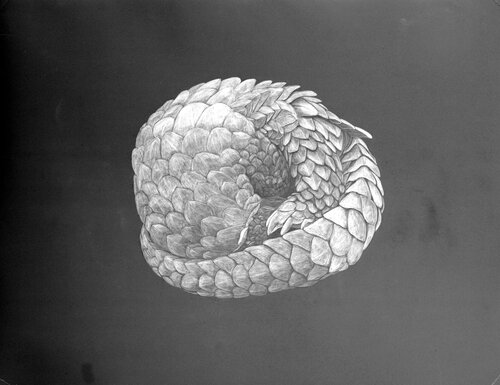
Artist Sarah Ronald, based in Port Coquitlam BC, Canada writes, “I am an animal artist, I focus on creating educational artwork about human behavior and our treatment of wildlife. With the Covid-19 pandemic, I began reading a lot about potential causes, and learnt about Zoonotic viruses – that this virus is thought to have come from bats, to pangolin, to humans via the wet markets. This has inspired a whole new body of work, which I have titled Pandemica. The work is (so far) focused on bats and pangolin, but after absorbing Merlin Tuttle’s talk about covid-19 and bats, the arc of this work has shifted and will soon include humans (we will find deadly viruses wherever we decide to look, including humans), and will eventually include other host animals that have been thought to pass viruses onto humans. My entire message with my art practice is to re-present wild animal information in an effort to educate and bring self-awareness to individuals, and the fact that we are all part of nature, not separate from it. I embrace the concept that when we fight with nature, we are fighting with ourselves (ref. GA Bradshaw’s book ‘Talking With Bears, Conversations with Charlie Russell’)”
Pangolin (II), 2020, Pencil crayon on drafting film, black paper backing, 17″X22″ digitally enhancee contrast
A narrated short film of a walk I took on the day the UK Government announced Lockdown. It was a beautiful spring day and it really didn’t feel like The Apocalypse but there were some signs…
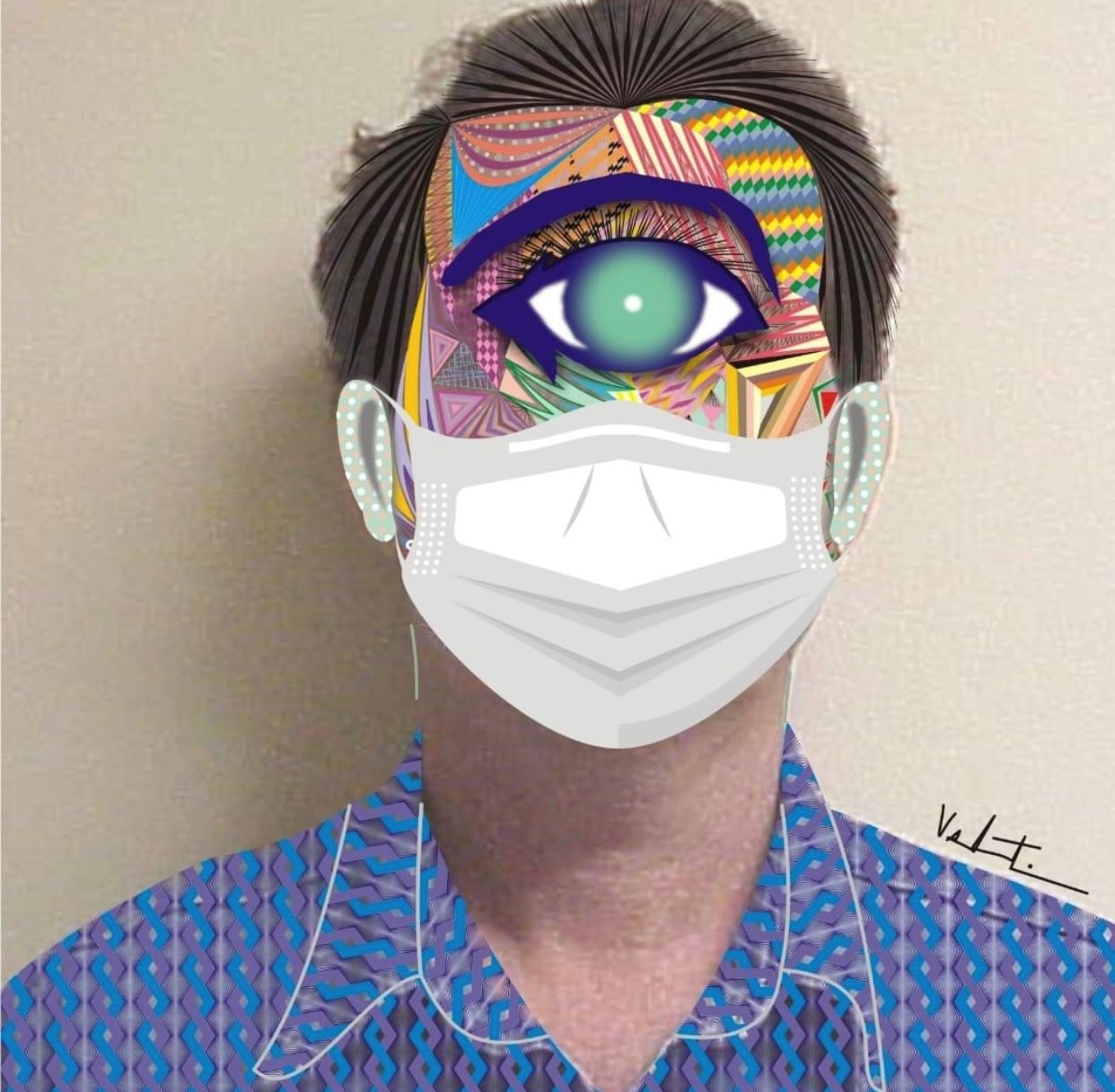
Alexandre Valentim is a digital artist Rio de Janeiro – Brazil. He writes, “In times of seclusion, I realized the great opportunity that I was given to pay a visit to my interior. A trip inside, another angle of observation (multidimensional, maybe …). Sometimes pleasurable, sometimes painful. Sometimes enlightening, sometimes disturbing. Reflect on the act of observing more and talking less. To be more attentive to perceptions, to the information that arrives via our intuition. Allow our connection to the Universe to guide us in our actions.”