
Keep Calm and Draw Together
New York Times
With assists from Shepard Fairey and Maira Kalman, graphic designers and illustrators are creating striking visual messages of safety and gratitude.

New York Times
With assists from Shepard Fairey and Maira Kalman, graphic designers and illustrators are creating striking visual messages of safety and gratitude.
(reported by) Artnet
With churches and other houses of worship closed to maintain social distancing measures, Brazilian archbishop Orani Tempesta conducted an Easter service at the feet of the Christ the Redeemer statue overlooking Rio de Janeiro and projected a special message onto the 125-foot-tall statue. For the second time since the coronavirus escalated to a global pandemic, the statue appeared illuminated with images of the flags of countries hardest hit by the virus, including the United States, China, Spain, Italy, and Brazil, and the words “hope,” “thanks,” and “stay home” written in various languages. The statue, depicting Christ with outstretched arms, was also dressed up in a doctor’s scrubs, lab coat, and stethoscope as a tribute to the healthcare workers on the front line of the pandemic. Projected images of doctors and nurses also intermittently appeared on the figure, putting individual faces to that vital workforce.
Deveron Projects
Our annual Slow Marathon art-walking event this year will be done remotely, yet together. People can join us from across the world to walk across the globe. Whatever our different circumstances, we all live under the same sky. The sky, like the virus knows no borders. As an act of hope, solidarity and resilience, we will cumulatively walk as many miles and marathons as we can and as slow as we like. In our small pockets of outdoor access, from our living rooms and around our homes, we will together symbolically walk around the globe. For Under One Sky, artist Iman Tajik will forge a digitally collaborative relationship with many people in their many varied experiences of taking part. For this he is collecting photos of the sky people see while walking. These will be brought together in a massive artwork of all of us under one sky. The 2020 Slow Marathon will finish when we jointly have walked the 40,000km/25,000miles around the world.
Lancaster Arts at Lancaster University, UK and Louise Ann Wilson Company
Have you discovered new places and routes to walk, run, pedal or push due to the recent Stay at Home (Stay Aware) restrictions we are experiencing due to COVID-19? Places and routes that give you a breathing space – mentally, emotionally and physically. If so, can you record them so they can be added to a map/artwork: Lockdown in Lancaster and Morecambe (and area): Walk, Run, Pedal, Push, Map? Since the COVID-19 Lockdown, I have been running and walking every day from home. Gradually, I have found and followed new paths that have taken me to parts of Lancaster that I didn’t know were there and had not explored!! I am now becoming more aware of how the city connects; where tracks, streams, waterways, roads and the river meet and cross. I have found allotments, prisons and graveyards, followed narrow bluebell-lined tracks through woods and into high-up places where the view across The Bay or The Lakes open up and lorries on the motorway push past. I wave at Ingleborough Fell and glimpse Clougha and Pendle Hill in the distance. I’ve gained fitness, am running more regularly and a little further than usual. The pull of fresh air, warm sun or the whip of the wind is irresistible as is the need to stretch my legs and body, and clear my mind – and have some physical, emotional and mental breathing space. I am not alone in these findings and revelations – lots of others have told me they are doing exactly the same as me. Whether it be on foot or bicycle, with pushchair or wheelchair we are still venturing out from home. Those who can’t leave the house, move very far or easily are walking indoors, in yards, squares, gardens, streets and parks. So, can you start recording the route/s you are finding and share them with me? Walks from all parts of Lancaster and Morecambe AND the surrounding areas can be shared RECORDING AND SHARING YOUR ROUTE/S You can record and share your route/s via GPS, email or post. From hand drawn to digitally captured GPS, all maps are welcome! All of the mapped routes will be combined in to a single Lockdown in Lancaster and Morecambe: Walk, Run, Pedal, Push, Map map. This map will then become a bespoke artwork that abstracts and stitches the routes and paths into a made-at-home PPE intensive care gown. Please note, walks can be share from all parts of Lancaster and Morecambe (UK) AND the surrounding areas. Digital GPS maps and hand drawn maps can shared, please email: louise@louiseannwilson.com This project has been commissioned by Lancaster Arts, which was devised a support programme called ‘Breathing Space’ to connect people with each other and support the freelance arts community in Lancashire (UK) during the current pandemic.
Louise Ann Wilson
Is there a walk that you long to do but can’t due to the current stay at home restrictions we are experiencing due to COVID-19? If so, could you make a memory-map of that walk? Your memory-map could be of: a spring-time or a winter walk, a walk in a garden, a walk to a place you never thought you’d reach!, an every-day or local walk, a walk in a distant place, a once-in-a-lifetime walk, a work-related walk, a family walk, a friendship walk, a group walk, a celebratory walk, a pilgrimage, a solitary walk, a scientific walk, a creative activity walk, a therapeutic walk, a childhood walk, an indoor walk … It could include: stopping places, viewing places, picnic places, sleeping places, swimming places, narrow places, lying-down places, herding sheep places, orienteering places, grafting places, scattering places, recovery places … MEMORY-MAPPING The activity of drawing a memory-map is the most important thing – not the finished product. Through remembering you can be transported beyond the physical limits of a room or a house. Your memory-mapping can be undertaken alone or as a shared activity with others of ALL ages – family, friends, groups. It can be done in person or at a distance. I’ve done memory-mappings via Skype and at times people have drawn a map on behalf of a person unable to mark-make themselves. You can create as many memory-maps of as many walks as you wish – this could be a one-off or a daily or weekly activity. Your memory-map can include words, lines, symbols. It can be pictorial, graphic or abstract. It can be drawn in pencil, crayon, felt tip or a combination of materials. Please draw your memory-map on one side of a sheet of paper only – this will make it easier for me to upload, if you’d like to share it. PROMPTS Here are a few prompts designed to help you think about your ‘walk to remember’ and things you could include in your memory-map: • Where (place, region, country) is your walk to remember? • Where does your walk begin and end? • What route does your walk follow? • When and how often do you walk your walk? • Is there a specific reason or a purpose for your walk? • Do you walk alone or with others – if so, who and why? • Are there any specific landmarks along the way that are important? • Are there any particular stopping places on your walk? • Are there any actions/activities/jobs associated with your walk? • What sights, sounds, smell might you notice on your walk? • Why are you no longer able to walk your walk? • Do you have any photos relating to your walk? • Do you have an object associated with your walk? SHARING YOUR MEMORY MAP Your memory-mapping can be a private exercise. However, it would be great to create a collection of Walks to Remember During a Pandemic: ‘With memory I was there’ So, if you are happy to share your walk please scan/copy it and upload it to a Drop Box folder I’ve created. Just email me (louise@louiseannwilson.com) and I’ll invite you to that Drop Box. Please include a short 80-word description of your ‘walk to remember’ (the prompts could help with this). Plus, if you have them, photo/s that relate to your walk (3 photos max.). Before you upload it, please title your ‘walk to remember’ in the following way: [Name/s of the walker/s] [place] Walk: [A few words to describe the walk] e.g.: Margaret Crayston’s Upper Eskside Walk: ‘As a Child, I walked this valley everyday’ Please write this title on the memory-map itself and on any files and the Drop Box folder. I will then add your walk to remember memory-map, description and photo/s to the website page that I’ve created. See, https://louiseannwilson.com/work/walks-to-remember-during-a-pandemic-with-memory-i-was-there BACKGROUND Walks to Remember During a Pandemic: ‘With memory I was there’ is inspired by a ‘surrogate’ walking project I’ve been working on over the last few years in which I re-walk walks people can no longer do but long-for – a process that involves participants drawing a memory-map. That project is inspired by Dorothy Wordsworth who, when living at Rydal Mount, became bedroom-bound, relying on memory to transport herself back into the landscapes she once walked: No need of motion, or of strength, Or even the breathing air: – I thought of Nature’s loveliest scenes; And with Memory I was there… Extract from the poem “Thoughts on my Sick-Bed” by Dorothy Wordsworth. See, https://louiseannwilson.com/work/womens-walks-to-remember
the AHRC funded ART/DATA/HEALTH Project /Dr Aristea Fotopoulou at the University of Brighton
“Shielding” explores the impact of the the COVID-19 quarantine on women facing domestic abuse and the paradoxical meaning of home as shelter. News stories around the world have highlighted the significant upsurge in violence and the need for increased support for victims of abuse from both governments and the charity sector, a time when support has been much harder to access because of infection control measures and reduced capacity, especially in the early stages of the pandemic.
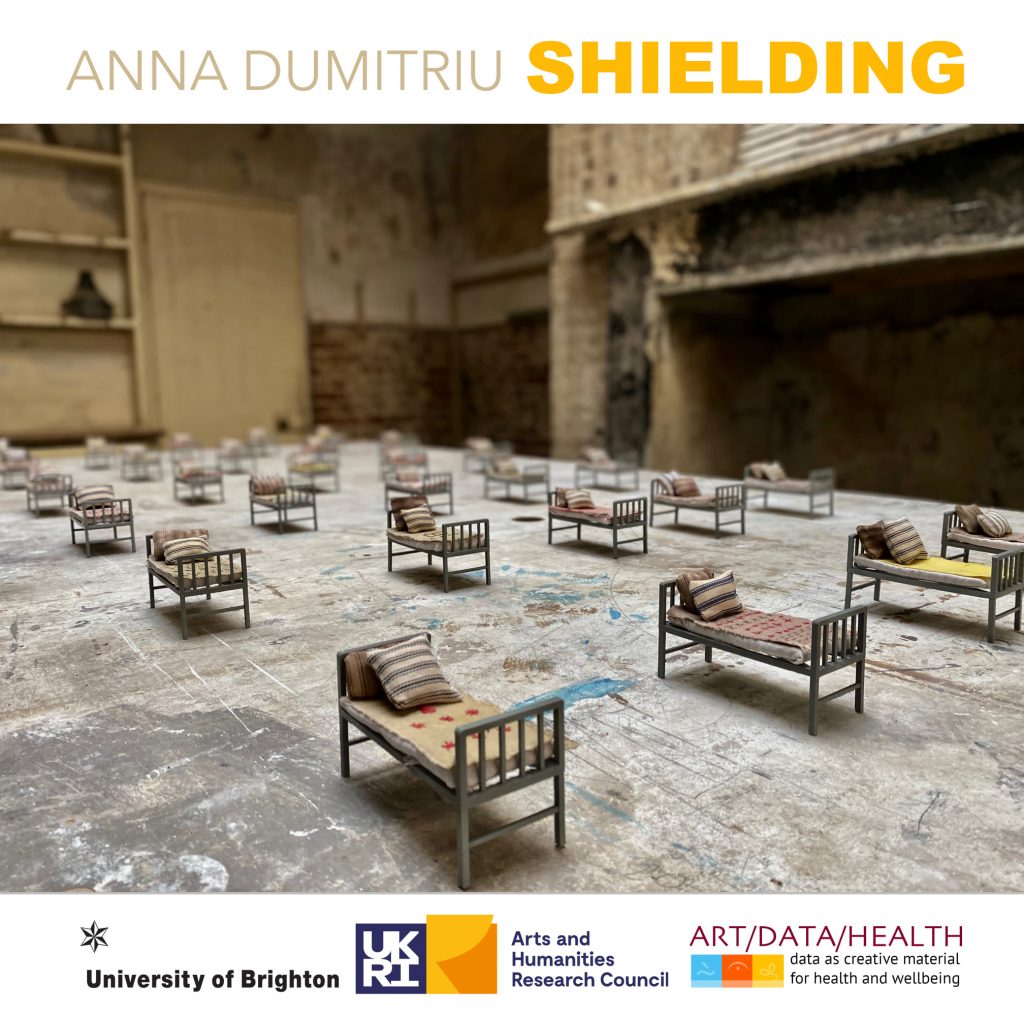
The artwork is inspired by Virginia Woolf’s feminist essay “A Room of One’s Own” (1929) which states that women need their own safe space in order to flourish and be creative. This notion of a safe space is set against the stark image of the hastily constructed temporary hospital ward that has become such a familiar image in the news stories of 2020. Those locked down with abusive partners have no safe space in which to escape. Movement restrictions aimed to stop the spread of COVID-19 are making violence in homes more frequent, more severe and more dangerous. “Shielding” has become a familiar term for protecting those vulnerable to COVID-19 who are asked to stay home but the reality is for those at risk of domestic abuse the home is not a place of safety and care, and helplines globally are facing an increase of up to one third. The final installation combines traditional feminine crafts such as sewing, embroidery and natural dyeing with healing plants (such as turmeric), with 3D printing based on digital reconstructions of hospital beds from the first temporary hospitals in Wuhan with their rows of identical beds, often with a bizarre jumble of colourful makeshift bedding sourced at speed from nearby factories. The doll sized beds also remind us of Henrik Ibsen’s play “A Doll’s House” (1879) which deals with the fate of a married woman in a male dominated world. In the context of Dumitriu’s BioArt practice the aim is also to safely incorporate biomaterial related to the pandemic in the work. This Art/Data/Health commissioned artwork by Anna Dumitriu is particularly relevant in the current crisis where numbers of domestic violence cases have been rising globally, while under-resourced civil society organisations struggle to remain accessible to those who need them most. The commission initially aimed to represent and creatively explore data around domestic abuse through hands on art workshops with staff from Brighton-based charity RISE, but has been adapted to respond to the global pandemic situation in light of the limitations that social distancing has brought. Since the creative workshops planned by the ART/DATA/HEALTH project were cancelled due to the pandemic, Dumitriu prepared an art kit for the participants instead, which they were able access online. The creative activity prompted them to imagine an ideal a room of their own or a safe and cosy space for a service user, reflecting on Woolf’s writings. It is hoped that in due course participants can work with artist to create miniature bedcovers to be incorporated into the artwork with embroideries that bring their own meaning to the piece. Dumitriu said in an interview for SENSORIUM in March 2020: “An important aspect is to let this situation inspire work and I am relieved that I have been able to adapt one current art commission to explore the impact of self-isolation and quarantine due to the COVID-19 pandemic on the issue of domestic abuse and violence from a global perspective.” This work is commissioned as part of the AHRC funded ART/DATA/HEALTH Project led by Dr Aristea Fotopoulou at the University of Brighton 2018-20. Anna Dumitriu’s project is inspired by the work of community domestic abuse and violence charity RISE.
New York Times / Mauricio Lima
PARIS — For much of the last two months, Paris has been empty — its shops and cafes shuttered, its streets deserted, its millions of tourists suddenly evaporated.
Freed of people, the urban landscape has evoked an older Paris. In particular, it has called up the singular Paris of Eugène Atget, an early 20th-century father of modern photography in his unsentimental focus on detail.
In thousands of pictures, Atget shot an empty city, getting up early each morning and lugging his primitive equipment throughout the streets. His images reduced Paris to its architectural essence.
Mauricio Lima has followed in Atget’s footsteps, shooting images of the same scenes his famous predecessor captured. But this time those streets are deserted because of the coronavirus pandemic. Mr. Lima’s recreations offer new insight into Atget’s work — and into the meaning of a city unique in its beauty but also in its coldness.
Penn State University
Seeking to create a communal capturing of art and design responses to the Covid19 crisis, including activities that can be shared for anyone to use.
The Arts & Design Research Incubator (ADRI) at Penn State seeks to improve lives through research and application of arts and design practices to health and well-being. The ADRI is part of the College of Arts and Architecture at Penn State. We constructed this repository of arts-based wellness activities and resources in response to the COVID-19 global pandemic, as many of us struggle to navigate the uncertainties of this reality, now and into the future. This is a work in progress. Please look around, download and share, and do feel welcome to reach out to us with feedback, questions, and additional content suggestions. We hope you stay safe and well.
Center for Arts in Medicine, University of Florida
The Remote Cultures Conversation Series documents various interpretations and practices of how artists and arts communities are supporting public health efforts. We recently hosted our first conversation centered on experiences of uniquely precarious artists in performing public health (please see project website for further details), i.e. the lived-experiential knowledges they possess of how best to combat social isolation, shifts in social routines, creative practices to engage and maintain well-being, and/or statements/discussion of the lack of any change to routine whatsoever. This project is part of a larger effort in collaboration with the University of Florida’s Center for Arts in Medicine’s COVID-19 Arts Response, which houses the Performing Public Health initiative, as well as a COVID-19 Arts Repository, advisory briefs, and links to a white paper entitled “Creating Healthy Communities: Arts and Public Health in America.”
In this context, “Remote Cultures” refer to the cultures evolving in response to the public health measures implemented due to the Coronavirus pandemic. Remote Cultures vary among different populations and communities, including Unique Precarities (particular experiences, knowledges, needs, and abilities of marginalized groups) and individuals’ adaptations to the novel public health measures implemented during this pandemic.
Betty Sargeant PluginHUMAN
[ i miss your touch ] transports two people who are in seperate locations into a shared virtual environment. This unique online space launched in March 2020 as a rapid response to pandemic conditions. This award-winning interactive video artwork helps people maintain meaningful social and physical connections with each other, and provides a personalised art experience. [ i miss your touch ] is a live collaboration between the participants and PluginHUMAN (Dr Betty Sargeant and Justin Dwyer, the artists). The artwork responds to people’s movements. PluginHUMAN affect, in real-time, live video streams from participants’ webcams. People can instantly see the creative effects of their movements and interactions. They can also experience virtual touch. [ i miss your touch ] makes people feel as if they are together in one space. It allows friends, who are in separate locations, to dance, to virtually hug and to interact in a shared online environment. During 2020, many people have been without physical contact with others due to pandemic lockdown and physical distancing rules. [ i miss your touch ] provides a way to maintain meaningful connections with others and meaningful engagement with art during this unprecedented global situation. Participants don’t need specialist equipment of software, there are no logins or passwords. People use their computer webcam and internet; they enter their unique URL and are instantly transported into the [ i miss your touch ] experience. This ephemeral artwork is freely accessible to broad audiences.