One morning, I woke in the middle of a lucid dream where I was playing this game. The object is to use medical supplies to fight the covid virus particles before time runs out. To develop the game, which runs in a browser, I integrated a javscript physics engine (matter.js) into my code. I drew the particles illustrations with a glass dipping pen, scanned the drawings, and integrated them into the graphics of the game.
Social Distance Performance – Rendimiento a Distancia Social
Victoria Gibson
Video documentary of solo guitar and dance performance in a park. Victoria uses effects a lot so the videos are imaginatively edited, then posted to her website.
I created a composition challenge on social media, for myself and anyone that would like to follow. The challenge consists in creating and posting one minute of music (any kind of music) on a weekly basis, during June, July and August, 2020.
A fast moving musical journey made on 3 continents by a diverse team of actors, dancers, musicians, cinematographers, and regular folks sending their made in quarantine/social distance videos from around the world. Then assembled into a unique film. An incredible array of talent on display to raise spirits and bring a smile. Creative within science guidelines. Building community through art.
Additional Details
Directed by Ashley Maria Composed by David Raiklen Edited by Crystal Lentz Cinematography by Autumn Palen Produced by David Raiklen and Ashley Maria
(social distancing and PPE used during production and post)
In these days of quarantine, when a touch is a wave from six masked feet away, we turn again to language, to the essence of language, to the art of language, to poetry.
The “Poetry Is Like Bread” Ghazal is a collaborative poem created by a world of poets to nourish us all through the Pandemic and to envision the world After. We take our inspiration from Pablo Neruda: “On our earth, before writing was invented, before the printing press was invented, poetry flourished. That is why we know that poetry is like bread, it should be shared by all, by scholars and by peasants, by all our vast , incredible, extraordinary family of humanity.” This collaborative poem was created with the idea that each poet’s unique voice would join together as one, and that the result would be shared by all. There is no poetic form better suited to do this than the Ghazal.
“POETRY IS LIKE BREAD” GHAZAL.
If, as Neruda thought, poetry is like bread, Then let it leaven this dark time and be my bread. [ Christopher Merrill ]
Struggling (and losing) in this Antipoem, ghosted thread, Spreading cool butter, sweet jam on homemade toasted bread. [ Bob Holman ]
No one waits to forgive the dead don’t pardon the dirt, nor the psalm palms, this celebration of bread [ Mahogany L. Browne ]
Distracted by detonating deadlines and demonstrations, I couldn’t meet your request for peaceful bread. [ Sandra Cisneros ]
Offered an exercise for people to do at home, on invitation by galleria Milano in Italy.
Instructions
PURPOSE: to regain one’s path of attachment to the domestic place.
CONTEXT: Attachment to a place, was defined by Rubstein (1992) as “a set of feelings that refer to a geographical place, which emotionally binds a person to this place according to their role or as an experiential setting”. Awareness of our relationship with the place is essential to wellbeing. At this time for many, the home place has coincided with the workplace. For many of us, the home is also, as it was before, the workplace: that of taking care of oneself, and of caring. At this time the coordinates have changed, the referential paradigm is being reversed, the roles are often shared. The opportunity here is to welcome this shift in position, unhinging patterns and rules, including those of geometry and geography applied to measuring and controlling place. Let’s get rid of the specific reference of how the body occupies the physical space and follow the indications of how the soul reveals our own micro-geographies to us!
Willson Center Micro-fellowships in the Arts and Humanities
The University of Georgia Willson Center for Humanities and Arts, in partnership with the UGA Graduate School, Arts Council, Franklin College of Arts and Sciences, and Flagpole magazine, awarded 34 micro-fellowships in its Shelter Projects program. The $500 fellowships supported graduate students and community-based artists and practitioners in the creation of shareable reflections on their experience of the pandemic through the arts and humanities. Projects were shared publicly in a virtual exhibition, and continuing phases of the program have provided further support for UGA graduate student research in the arts and humanities.
Sean Dunn is a photographer and musician originally from New Orleans and currently based in Athens, GA. View “Everyone In My Dream Is You,” Coronavirus Portraits 2020 Athens GA
Humanizing Epidemiology: Non-medical Investigations into Epi/Pandemic Phenomena
Nature
Since the current global outbreak has emerged, most of the prestigious scientific publishers including ours (Springer Nature) have raised open-calls and free material in order to fight COVID-19. all these efforts logically are addressed to the medical societies and related disciplines. However, we are convinced that the contributions of academics, policymakers and other stakeholders from other areas, including the humanities, arts and social sciences (HASS), should not be overlooked. Therefore, I am pleased to announce this open call for research article collection that aims to examine the innovative role and contributions of Humanities, Arts, and Social Sciences -HASS- disciplines, as well as interdisciplinary efforts, in shaping the global response to public health crises. To this end, this collection intends to bring together a range of perspectives, empirical and theoretical, qualitative and quantitative, which draw on methods and approaches from, among other areas: cultural studies, new-media arts, history, digital humanities, law, media and communication studies, political sciences, psychology, sociology, social policy, science and technology studies. Further, Interdisciplinary perspectives are welcomed, whether between HASS disciplines, or at the interface between HASS scholarship and the physical and clinical sciences, or engineering, mathematics, computer science.
Additional Details
Prospective authors should submit a 200-word abstract and a short biography to the Collection Editors in the first instance. Authors whose proposals are deemed suitable will be invited to submit full papers at any point up until the end of June 2021.
Guest Editor: Diaa Ahmed Mohamed Ahmedien (Faculty of Art Education, Helwan University, Cairo, Egypt)
Co-Guest Editor: Michael Ochsner (ETH, Zurich, Switzerland)
Advisory board: Jon Hovi (University of Oslo, Norway), Adele Langlois (University of Lincoln, UK), Tony Waters (California State University, Chicago, USA), Merryn McKinnon (Australian National University, Australia), Chisomo Kalinga (University of Edinburgh, Scotland, UK), Ann H Kelly (King’s College London, UK), Jochen Buechel (Charite Berlin, Germany), Lin Wang (University of Cambridge, UK), Shinichi Egawa (Tohoku University, Japan).
Pandemic outbreaks as public health crises have the potential to reshape human life, from herpes, and Legionnaires’ disease to HIV and Ebola. Each virus or bacteria has its unique biological properties by which it interacts with and affects populations. Human coronaviruses, for instance, have been known since the 1960s. In the past two decades, however, several new dangerous human coronaviruses have emerged, namely, SARS-CoV in 2002, MERS-CoV in 2012, and currently, SARS-CoV-2 is the cause of the disease known as COVID-19, which has put global public health institutions on high alert. Each pandemic brings its own political, economic, cultural, social and ethical challenges. Although efforts to combat such outbreaks are primarily driven by clinical and medical professionals, the contributions of academics, policymakers and other stakeholders from other arenas, including the humanities, arts and social sciences (HASS), should not be overlooked.
Against this backdrop, this research collection aims to examine the role and contributions of the HASS disciplines, as well as interdisciplinary efforts, in shaping the global response to public health crises. To this end, this collection intends to bring together a range of perspectives, empirical and theoretical, qualitative and quantitative, which draw on methods and approaches from, among other areas: cultural studies, new-media arts, history, digital humanities, law, media and communication studies, political sciences, psychology, sociology, social policy, science and technology studies.
Covid-19 – I can’t live without you 36×36” Nihonga Pigment Painting on Kozo Washi paper wrapped on birch panel. During my quarantine days.
Additional Details
This painting is Japanese style distemper on paper. The colors are from organic dye and mineral pigments. The binding agent is collagen (glue) called nikawa, which usually comes from deer or rabbit, and then leveled with water. The paper surface is treated with alum and nikawa leveled with water and then as gesso, sun dried oyster shell white that is calcium carbonate is used to treat the surface before paint colors. The pigment gives its own personality. The colors are from velvet mat finish to dazzling sparkles, which are best seen under lights. Each color and texture is mixed with nikawa, by hand with fingers in small dish, and leveled with water to change its strength of luminance. This method has been traditional way in large area of Asia, but the method has particularly been preserved by Japanese art culture for over 1000 years. The substrate is durable hand-skimmed paper Kozo Washi. This Washi is made from mulberry bark, wrapped twice on a birch wood panel. If you wish, you can separate the art from the wood panel and use a different kind of framing.
Like the 1st-century sacred Buddhist text that inspired it, the latest project from renowned theater director Peter Sellars is a call to community to learn and heal together during a time of sickness. In the Vimalakirti Sutra, Buddha sends his disciples to the sickbed of an enlightened lay person to hear his reflections on the fragility of physical being and the liberation of conscious awareness. A foundational scripture of Zen Buddhism, it is the resonant center of this body is so impermanent…, a multi-disciplinary performance film born of a remarkable international collaboration between Sellars and a trio of acclaimed artists as COVID-19 washed over the globe. Working virtually across continents under quarantine, South Indian devotional singer Ganavya, master calligrapher Wang Dongling and improvisatory dancer Michael Schumacher engaged with the Sutra and each other in an ensemble act of creation and healing. Sellars orchestrates breath and brushstroke, movement and mindfulness into a visual poem of stunning power. At a moment when grief persists and hope seems more possible, UCLA Film & Television Archive is honored to present the world premiere of this timely work in collaboration with the producers and UCLA program partners. Digital, color, 79 min. Director: Peter Sellars. With: Wang Dongling, Ganavya, Michael Schumacher.
Going Viral is an interactive artwork that invites people to share COVID-19 informational videos featuring algorithmically generated celebrities, social media influencers, and politicians that have previously spread misinformation about coronavirus. In the videos, the influencers deliver public service announcements or present news stories that counter the misinformation they have spread. Viewers are invited to share the videos on social media to help intervene in the current infodemic that has developed alongside the coronavirus.
Going Viral was commissioned by the NEoN Digital Arts festival. It was created by Derek Curry and Jennifer Gradecki as part of their research into the spread of misinformation and neural networks.
Mary Savig, the Lloyd Herman Curator of Craft at SAAM’s Renwick Gallery, has been collecting firsthand accounts of the dual pandemics, COVID-19 and systemic racism, from artists working with craft-based materials and techniques. In this series, “Making the Most: Craft Practice during the Dual Pandemics,” artists share personal insight into how they responded to the cascade of canceled or delayed programs, workshops, and exhibitions, as well as the demands of social distancing and social justice. Each account brings new understanding to the import of the studio as a space of reflection, creation, and collaboration.
We’re kicking off the series with Julia Kwon, an artist who sews interpretative bojagi—Korean object-wrapping cloths—and wraps figures with them to comment on the objectification of Asiatic female bodies. The museum recently acquired a face mask by Kwon from her series Unapologetically Asian. Kwon, whose studio is located in Northern Virginia, stitched a vibrant patchwork of Korean silk to honor her ethnic identity during the rise of anti-Asian racism in the United States, and emphasize the importance of public mask wearing to stop the spread of COVID-19. Unapologetically Asian is an extension of Kwon’s interactive art projects that facilitate solidarity and community in the throes of violent social and political unrest.
How do you plan for a catastrophe? Virologist Nathan Wolfe, named one of TIME’s 100 Most Influential People in the World for his work tracking viral pandemic outbreaks, proposed pandemic insurance years before the novel coronavirus outbreak. No one bought it. Now, in a post-COVID world, we hear his story. A time-jumping tale based on the life and work of Nathan Wolfe (who also happens to be the playwright’s husband). Though not a play about COVID19, it is a true story of a pandemic expert. An deep dive into the profundities of scientific exploration, the lengths one goes for love and family, the bracing truths of fatherhood and discovery, and the harrowing realities of facing your own mortality, The Catastrophist is a world premiere theatrical experience built of and for this moment in time.
Lockdown Yields First Global Sound Map of Spring Dawn Chorus
The Guardian
Scientists and artists have used the drop in noise pollution during the coronavirus lockdown to create the first global public sound map of the spring dawn chorus.
Throughout May, people around the world have uploaded about 3,000 early morning bird recordings made on their phones to the Dawn Chorus website, where they are being shared to help conservation and to create public art.
The soundscape project is inspired by the pioneering work of the bioacoustician Bernie Krause and is led by Prof Michael John Gorman, the founding director of the Biotopia museum in Munich, Germany.
Gorman said the idea was created rapidly after Covid-19 led to lockdowns around the world: “Suddenly the natural world could be heard more clearly. It is a moment to stop and listen, to record and share the unique acoustic fingerprint of the bird species of your local area.”
The Covid-19 lockdown silences the noise of civilization around the world.
Rushing traffic, airplanes, industrial noise – all this has come to an almost full standstill and is bringing the otherwise often drowned out sounds of nature to the foreground. We are experiencing a historical moment that makes us stop and consider, feel, and above all hear!
Hundreds of bird species are welcoming the Spring sunrise with their songs every morning. Now is the time to listen to them.
Under the unique circumstances of this memorable spring of 2020, the idea for this Citizen Science and Arts project was born – inspired by the work of the American musician, bio-acoustician and artist Bernie Krause, the founding father of soundscaping.
How Artists Are Trying to Solve the World’s Problems
New York times
A cohort of 30 artists have received funding to find creative solutions to 21st-century problems like surveillance, digital inequality and inherited trauma.
AIDS Quilt and Masks for COVID-19: A Brief but Spectacular Take on Turning COVID-19 Grief Into Action
PBS News hour
Mike Smith co-founded the Names Project AIDS Memorial Quilt in 1987. Now living through his second pandemic, Smith is finding ways to help out amid COVID-19 — and to inspire others to do the same. He shares his Brief But Spectacular take on turning grief into action.
The Magik Theatre is a professional theatre in San Antonio and one that is dedicated to youth and promoting literacy through the arts.
With our theatre closed due to COVID-19 and with many children at home due to school closures, Magik made the pivot to creating online materials for our young audiences. This has ranged from online story time and Madlibs to full-scale videos of our productions. On the 4th of July, we launched the premiere of “Jack and the Beanstalk.”
Starting on 24th March 2020, I started writing a daily public diary logging the first 100 days of lockdown in Stirchley, Birmingham, UK. Guest posts have also become a regular feature offering different perspectives and experiences. The diary is an important part of my writing practice and rather than keep it in a private diary, I decided to write more publicly as a matter of social/historical record. The digital artefacts also included photos, video, collaged artworks and a walk map.
Rio de Janeiro Used Cutting-Edge Technology to Transform Its Giant Jesus Statue Into a Doctor to Honor Healthcare Workers
(reported by) Artnet
With churches and other houses of worship closed to maintain social distancing measures, Brazilian archbishop Orani Tempesta conducted an Easter service at the feet of the Christ the Redeemer statue overlooking Rio de Janeiro and projected a special message onto the 125-foot-tall statue. For the second time since the coronavirus escalated to a global pandemic, the statue appeared illuminated with images of the flags of countries hardest hit by the virus, including the United States, China, Spain, Italy, and Brazil, and the words “hope,” “thanks,” and “stay home” written in various languages. The statue, depicting Christ with outstretched arms, was also dressed up in a doctor’s scrubs, lab coat, and stethoscope as a tribute to the healthcare workers on the front line of the pandemic. Projected images of doctors and nurses also intermittently appeared on the figure, putting individual faces to that vital workforce.
Fase 0 took place from 2 to 10 May 2020. Confinement restrictions were partially lifted after 48 days of near-total lockdown due to the coronavirus pandemic in Spain. Walks and other physical exercise were allowed from 6am to 10am and from 8pm to 11pm. Pedestrians aged between 14 and 70 could take a walk within a one-kilometer radius of their homes. I went out every morning. I documented each walk.
Lockdown in Lancaster and Morecambe (and Area): Walk, Run, Pedal, Push, Map by Louise Ann Wilson
Lancaster Arts at Lancaster University, UK and Louise Ann Wilson Company
Have you discovered new places and routes to walk, run, pedal or push due to the recent Stay at Home (Stay Aware) restrictions we are experiencing due to COVID-19? Places and routes that give you a breathing space – mentally, emotionally and physically. If so, can you record them so they can be added to a map/artwork: Lockdown in Lancaster and Morecambe (and area): Walk, Run, Pedal, Push, Map? Since the COVID-19 Lockdown, I have been running and walking every day from home. Gradually, I have found and followed new paths that have taken me to parts of Lancaster that I didn’t know were there and had not explored!! I am now becoming more aware of how the city connects; where tracks, streams, waterways, roads and the river meet and cross. I have found allotments, prisons and graveyards, followed narrow bluebell-lined tracks through woods and into high-up places where the view across The Bay or The Lakes open up and lorries on the motorway push past. I wave at Ingleborough Fell and glimpse Clougha and Pendle Hill in the distance. I’ve gained fitness, am running more regularly and a little further than usual. The pull of fresh air, warm sun or the whip of the wind is irresistible as is the need to stretch my legs and body, and clear my mind – and have some physical, emotional and mental breathing space. I am not alone in these findings and revelations – lots of others have told me they are doing exactly the same as me. Whether it be on foot or bicycle, with pushchair or wheelchair we are still venturing out from home. Those who can’t leave the house, move very far or easily are walking indoors, in yards, squares, gardens, streets and parks. So, can you start recording the route/s you are finding and share them with me? Walks from all parts of Lancaster and Morecambe AND the surrounding areas can be shared RECORDING AND SHARING YOUR ROUTE/S You can record and share your route/s via GPS, email or post. From hand drawn to digitally captured GPS, all maps are welcome! All of the mapped routes will be combined in to a single Lockdown in Lancaster and Morecambe: Walk, Run, Pedal, Push, Map map. This map will then become a bespoke artwork that abstracts and stitches the routes and paths into a made-at-home PPE intensive care gown. Please note, walks can be share from all parts of Lancaster and Morecambe (UK) AND the surrounding areas. Digital GPS maps and hand drawn maps can shared, please email: louise@louiseannwilson.com This project has been commissioned by Lancaster Arts, which was devised a support programme called ‘Breathing Space’ to connect people with each other and support the freelance arts community in Lancashire (UK) during the current pandemic.
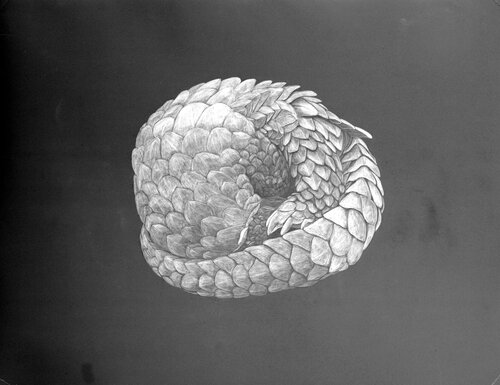
Artist Sarah Ronald, based in Port Coquitlam BC, Canada writes, “I am an animal artist, I focus on creating educational artwork about human behavior and our treatment of wildlife. With the Covid-19 pandemic, I began reading a lot about potential causes, and learnt about Zoonotic viruses – that this virus is thought to have come from bats, to pangolin, to humans via the wet markets. This has inspired a whole new body of work, which I have titled Pandemica. The work is (so far) focused on bats and pangolin, but after absorbing Merlin Tuttle’s talk about covid-19 and bats, the arc of this work has shifted and will soon include humans (we will find deadly viruses wherever we decide to look, including humans), and will eventually include other host animals that have been thought to pass viruses onto humans. My entire message with my art practice is to re-present wild animal information in an effort to educate and bring self-awareness to individuals, and the fact that we are all part of nature, not separate from it. I embrace the concept that when we fight with nature, we are fighting with ourselves (ref. GA Bradshaw’s book ‘Talking With Bears, Conversations with Charlie Russell’)”
Pangolin (II), 2020, Pencil crayon on drafting film, black paper backing, 17″X22″ digitally enhancee contrast
A narrated short film of a walk I took on the day the UK Government announced Lockdown. It was a beautiful spring day and it really didn’t feel like The Apocalypse but there were some signs…
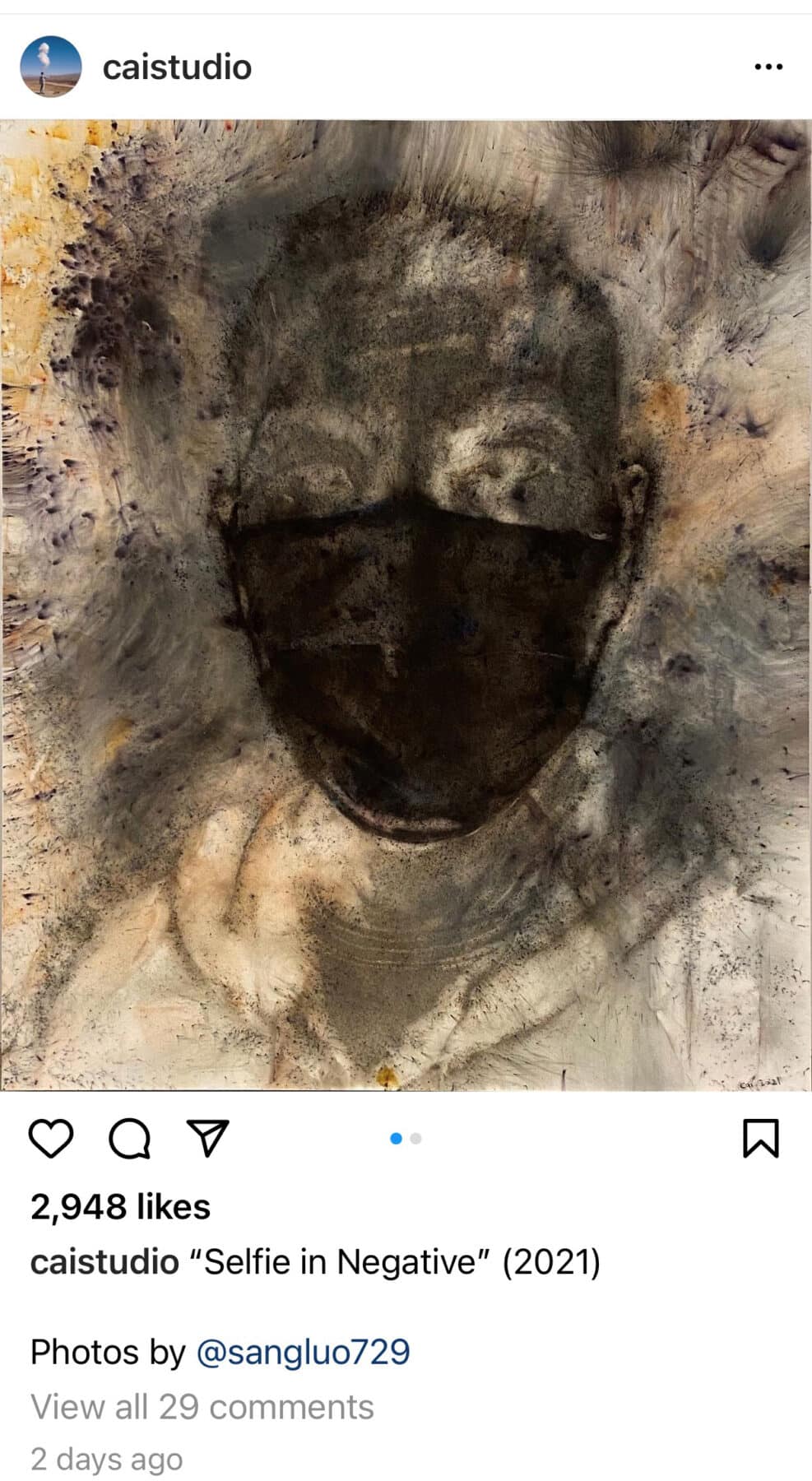
This selfie, done in Cai’s signature style using gunpowder was posted by @caistudio instagram account.
Cai Guo-Qiang (b. 1957, Quanzhou, China) was trained in stage design at the Shanghai Theatre Academy, and his work has since crossed multiple mediums within art including drawing, installation, video, and performance. Cai began to experiment with gunpowder in his hometown Quanzhou, and continued exploring its properties while living in Japan from 1986 to 1995, which led to the development of his signature outdoor explosion events. Drawing upon Eastern philosophy and contemporary social issues as a conceptual basis, his often site-specific artworks respond to culture and history and establish an exchange between viewers and the larger universe around them. His explosion art and installations are imbued with a force that transcends the two-dimensional plane to engage with society and nature.
PARIS — For much of the last two months, Paris has been empty — its shops and cafes shuttered, its streets deserted, its millions of tourists suddenly evaporated.
Freed of people, the urban landscape has evoked an older Paris. In particular, it has called up the singular Paris of Eugène Atget, an early 20th-century father of modern photography in his unsentimental focus on detail.
In thousands of pictures, Atget shot an empty city, getting up early each morning and lugging his primitive equipment throughout the streets. His images reduced Paris to its architectural essence.
Mauricio Lima has followed in Atget’s footsteps, shooting images of the same scenes his famous predecessor captured. But this time those streets are deserted because of the coronavirus pandemic. Mr. Lima’s recreations offer new insight into Atget’s work — and into the meaning of a city unique in its beauty but also in its coldness.
Reimagine Hope With Music: Paul Miller aka DJ Spooky – Multimedia Artist, Composer, Author
Direct Talk
Reimagine Hope With Music: Paul Miller aka DJ Spooky / Multimedia Artist, Composer, Author. Spooky writes, “Japanese National TV did a documentary on me where they hung out with me in NY at the height of the Pandemic to see how artists and creatives were coping with the situation (socially distant, of course…)”