COVID-19 can take some credit for the co-creation of this site. It felt necessary to to do something positive together in the face of this ongoing and frightening tragedy. We are a collective of ecological artists and activists who interpret, celebrate and defend water. These invited artists have experienced the effect that art can have upon ordinary perception, and how it can open us to new ways of being. They have chosen water as their subject matter or medium.
Nothing alive exists without water. Our bodies are mostly water, and our eyes are 95% water. It is no surprise that water has always called artists to it. These water journeys cover many disciplines. Through art, we can begin to think as water, rather than simply about it.
Think About Water is excited to learn about all ideas, projects, artists and organizations that align with our mission, especially under-represented and minority groups in the US and around the world.
We hope that all visitors to this site will fill out the contact form which adds you to our mailing list.
Three electronic musicians, quarantined in different cities across the globe, record a series of short rhythmic loops. Each loop is subsequently cut into a lock groove on a vinyl record and played back on a turntable in each location. Video and audio from the turntables are streamed to a Zoom meeting so that the rhythms can be heard together, but only as transformed by the temporal distortions inherent to Zoom and to online relationships in general. Each day, new lock grooves are selected after the previous ones begin to physically degrade from continuous playback.
Created during post-pandemic lockdown that called for constant hand-washing and limited human-to-human contact, “A Virtual Lotioning Session” (Video, 3min 13sec, 2020) is about noticing and attending to one’s own body-to-body. Through an intimate yet public presentation of applying lotion to one’s own hand(s), the video performance positions self-care as a doubling act, one that is for others as much as it is for oneself. With a humorous spin on a daily ritual that is simultaneously mundane and absurdly sensual, an emollient-for-skin morphs into oil paint and a hand transforms into a “sensorial canvas,” waiting to be touched by all felt-experiences. As noted in the video, “Time to give your hand(s) some loving that only hugs your hand and no other human’s.”
Despite the perceptibility of the effects they impart on their hosts, the most incredible capacity of viruses is in their invisibility. Invisibility is the most frightening side of the current pandemic, and invisible is also the work of the scientists striving to find a solution. This proposal presents a data visualization that aims to give visibility to those scientists working on COVID-19. Their scientific publications have been computationally analyzed and transformed into a relational structure based on lexical similarity. The result is a network of scientists whose proximity is given by their closeness in writing. An innovative visual method that hybridizes network visualizations and word clouds presents the scientists in deep space, explorable through keywords. In such a space, individuals are situated according to their lexical similarity, and keywords are used to clarify their proximity. By zooming, the visualization reveals more information about scientists and their clusters. While a lot of visualizations during the pandemic focused on showing the spread of infection, causing anxiety among the readers, this visualization reveals the efforts of science in eradicating the virus. Making visible the enormous number of scientists working on COVID-19 research will contribute to coping more positively with the pandemic.
An Artist a Day… was a live, online show for 15 minutes every day, that ran from June 18 -September 13, 2020. An Artist a Day… is currently presenting the project “What Are You Looking Forward to in 2021?” to examine a paradigm shift in our time through artists’ voices and their creations.
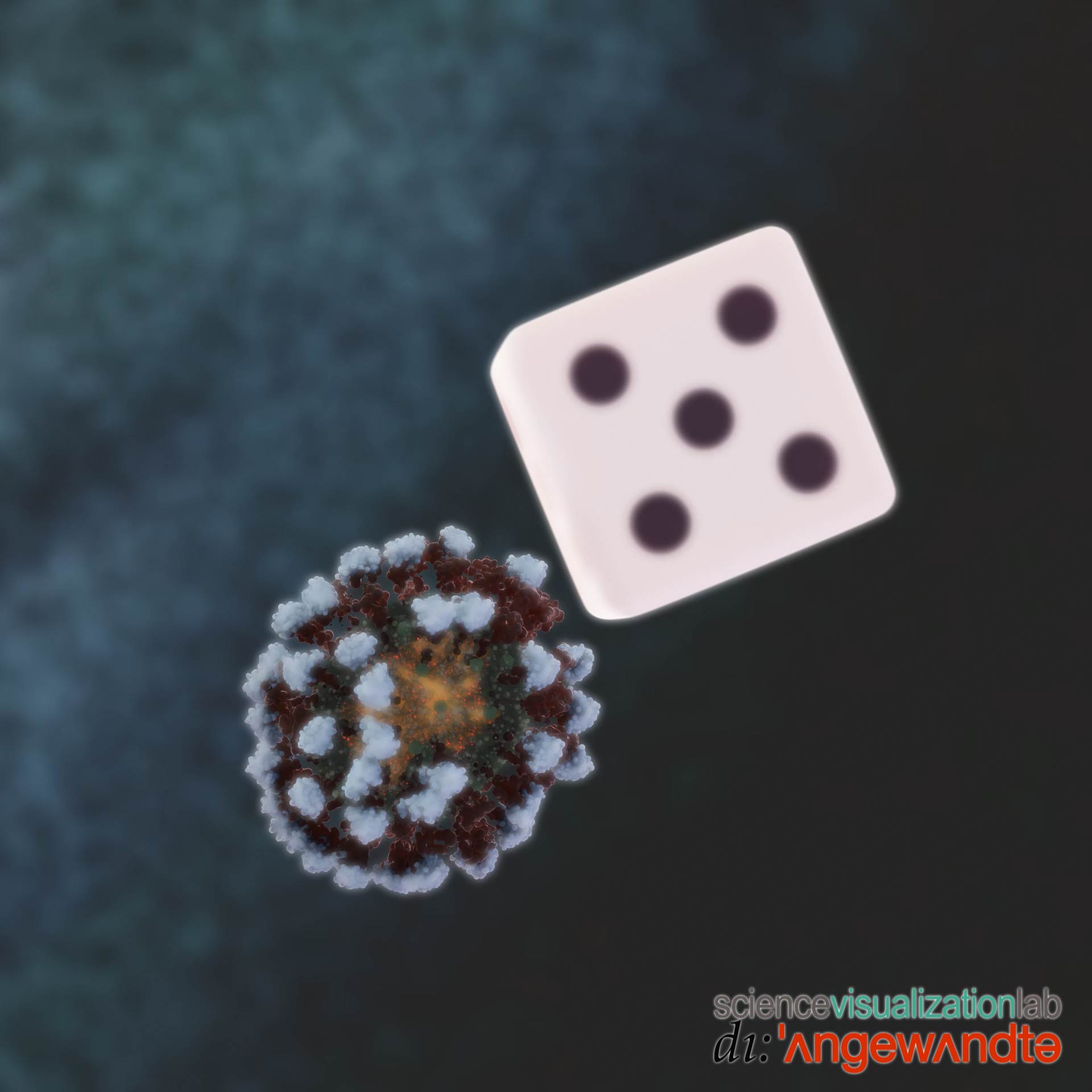
Virus Dice is an artistic and scientific visualization project. It features videos and an interactive installation. The project informs about the infection pathway and how medications work. The project makes the delicate, extremely vulnerable state of human health visible in a metaphorical way.
Our multimodal and multilingual collective diary of imagination, “Imaginarios de cuarentena,” has become a place for us to share our feelings and desires, with ourselves and with others. The diary has since developed into a larger project called “Errant Imaginaries: Possible Utopias,” which unites the diary with an inquiry into existing inspiring models and practices of change.
As artists, activists, grassroots organisers, mothers, scholars, educators, and citizens, we are all working for a better world in many different ways. For almost three years, the network Mujeres Errantes has been a space where we have supported each other in this mission. Via our collective diary, we are able to focus on the dreams that fuel our desire for change.
As part of the “Errant Imaginaries: Possible Utopias” project, we are contacting other collectives that inspire us and that work on some of the desires and challenges that the collective diary expresses. Through an online encounter that we will record on video, we will create an occasion for sharing their experiences and dialogue through art. In the summer, we will hold in-person and hybrid arts residencies, drawing on a shared methodology and in collaboration with other women’s groups.
Trove is a durational ambient musical project created by Mutantrumpeter/Composer Ben Neill and Producer/Composer Eric Calvi. Trove originated during the Covid-19 crisis of 2020, and is created in direct response to the isolation and self-reflection that were forced by the unique circumstances of the pandemic. The project launched with the release of 5 pieces on November 24, 2020, and continues as an ongoing series of 2 releases per week for one year. Neill performs Trove playing only his self-designed Mutantrumpet – no synthesizers are used. The acoustic sound of the Mutantrumpet is captured and processed in real time by Neill’s custom system using the instrument’s 28 onboard electronic switches, joysticks, and knobs. Each piece is recorded as a single improvised performance with no overdubs. The process of making the pieces was a meditative, restorative activity for me personally, and gradually developed as the pandemic went through different stages. The compositions move through a series of chords whose pitches are based on a Fibonacci series matrix. Other aspects of the music including rhythm, melody, and formal structure are based on Fibonacci sequences, which model the forces of growth and reproduction in the natural dynamical systems of plants and animals. Trove uses this fundamental structure of lifeforms to create grounding, restorative music intended as an accompaniment to everyday life activities in these difficult times.
Pandemic Papers is an experimental archive logging my feelings within the context of news headlines, painted on the Sunday editions of my local paper, The San Francisco Chronicle. The project consists of over 44 paintings ranging in size from 10 x 12 inches to 1 x 1 inch, created from November 2019, when COVID-19 first appeared in Wuhan, China, to July 2021, when San Francisco finally (hopefully?) retired its emergency order. Pandemic Papers gave me a way to store and recall my own personal experience of the pandemic despite my long term memory loss due to my brain injury.
March 2021
Additional Details
About M Eifler
I am an artist with a pile of intersectional identities including being disabled, neurodivergent, non-binary, queer, and Jewish. I make archives, prosthetics, and simulations. My projects usually start in the waste streams of capitalism, sifting thru junk mail and newsprint, mining exhaust data and free apps, and sorting old clothes and hand-me-down yarn. From these sources I experiment with ways to understand myself and the world around me including:
Paintings, books, and sculptures made from reclaimed paper and plastic
Computational Interactives, wearables, performance, and AR/VR
Digital collage, including AI, GIF, Drawing, Photography, and Video
Handmade textiles, including garments, blankets, pillows, and sculptures
My themes: waste proliferation, speculative archives, computational prosthetics and others, stem from my brain injury which lead not only to my long term physical disability but also my severe memory loss.
I’ve exhibited work or performed at DHMD Museum, BOZAR, Ars Electronica, SomArts, TED, the Exploratorium, SFMoMA, the YBCA, and the Wattis Institute in San Francisco, XOXO, Wiensowski & Harbord in Berlin, Laurie M. Tisch Gallery and Armory Show in New York, Seattle International Film Festival, the Smithsonian Institution and Kennedy Center.
The Rose River Memorial is a grassroots community art movement that honors and grieves the many lives lost during the COVID-19 pandemic in the United States. We aspire to create a felt rose as a symbol of grief for every life lost. This has been a time in which so many have been devastated by the loss of a close relative, compounded by the inability to say final goodbyes and to freely grieve for loved ones. Rose River Memorial helps with the grieving process by encouraging these families to create roses for their loved ones, while at the same time inspiring the rest of the community to show their support by also contributing with hand-crafted roses. Why the Rose? We chose the rose as a symbol of mourning as it is used in the context of funerals throughout the US, The red rose symbolizes courage and valor and is the national flower of the US. The roses are hand-crafted by the community out of red eco-felt and mounted on recycled fishing nets, including some that have been extracted from marine preserves. We are partnering with Building Bridges, Marked by Covid, and Let’s Reimagine, and believe in inclusivity in all our collaborations by working with communities and age groups of all backgrounds. The project has been supported officially endorsed by mayors, lawmakers, and spiritual leaders from around the country. The Rose River Memorial has been exhibited in many places including Los Angeles, Orange County,. St. Louis, Topeka, Maui, Ojai, Rio Grande Valley, and many upcoming venues. We aim to create a national-scale memorial that will be exhibited in Washington DC. How can I get involved? Schools, churches, museums, art centers, universities, senior citizen centers, and groups including the Kiwanis and Girl Scouts of America have generously contributed thousands of roses and yet we have many more to make. If you are interested please check on the Making Roses tab or contact us to get involved, We are seeking partners to bring this project to full fruition, either by making roses or helping to host a memorial in your hometown.
The project was initiated in August 2020 with Dr. Tilly Hinton
And includes the collaboration of many key contributors and supporters including:
Marisa Caichiolo, Petra Eiko, Mary ‘Happy’ Price, Kristin Urquiza, Cynthia Campoy Brophy, Yi-Ping Hou, Robin Hanna, Tracy Hull, Angela Kender, Anna Newcome, Jennifer and Bettina Gonzales, Stuart Perkins, Jill Bernshouse, Edith Romero, Julia Johnston, Yuval Ron, Tim Garcia, Keri Meyer, Claudia Huiza, Endy Trece, Cassandra Coblenz, Mary Anne Kessler, Marvella Muro, Jasper Lutyens, Tina Calderon, Michelene Cherie, Brad Wolfe, Kuna Gordean Bailey, Carolyn Freyer-Jones, and many, many more!
As well as friends at the Orange County Museum of Art, Building Bridges Art Exchange, Ojai Retreat, Hui No’eau, Christ Cathedral, Self Help Graphics, City of Santa Monica, Heartfelt Foundation, The Friday Minute, LACDA, Create Protest, The Awesome Foundation, Burbank Tournament of Roses, Ep[iscopal School of Los Angeles, Ocean Charter School, Kiwanis, Girl Scouts of America, Elysian Valley Arts Collective, LA Breakfast Club, Orange County Autism.
PRIYA — India’s first female superhero, embarks on a mission to stop the spread of Covid-19 in the comic book “Priya’s Mask.” She befriends a little girl named Meena to show her the sacrifices made by frontline healthcare workers and instill the power of courage and compassion during this difficult time. Along with her tiger Sahas, Priya explains the importance of wearing a mask and working together to help end the pandemic around the world. She teams up with Pakistan’s female superhero, Burka Avenger, to foil her arch enemy from infecting her city with the potent virus. Released as an online comic book, the edition reached millions of people in India and the worldwide.
The short animated film, “Priya’s Mask” is an important testament to the courage of women healthcare workers and will help educate people about the virus. An international array of actors and leaders lend their voices to this important film including Vidya Balan, Mrunal Thakur, Sairah Kabir and Rosanna Arquette.
Additional Details
This first story was specifically constructed to address the problem of blaming victims of sexual violence and provided a character, Priya, who could inspire change throughout communities by appealing to audiences — especially youth — with an empathetic narrative. Priya’s story became a powerful voice a in the global movement for women’s rights and a symbol of solidarity against gender-based violence and continuing with the #MeToo movement. The creators of the comic book were honored by UN Women as “gender equality champions.”
The Guggenheim is Proving That Museums Aren’t Just to Be Seen
New York Times
The famed Guggenheim institution and other museums are reaching out to audiences who cannot connect to art in typical ways.
Although many major art institutions have programs for people with disabilities, the pandemic has forced museums to recreate them in a digital space. In-person tours incorporating verbal descriptions for visitors with low vision, or American Sign Language interpretation for the hearing-impaired, have often transformed into Zoom sessions about specific artworks.
This article is part of a special report on museums, which focuses on reopening, reinvention, and resilience.
In 2021, OK Go Sandbox invited the world to help create a new video and remix of “All Together Now.” The #ArtTogetherNow project ended up creating 6 films and 5 new versions of the song, thanks to approximately 15,000 global collaborators.
Additional Details
OK Go Sandbox is an online resource for educators that uses OK Go’s music videos as starting points for integrated guided inquiry challenges allowing students to explore various STEAM concepts.
Developed as a collaboration between OK Go and the Playful Learning Lab at the University of St. Thomas (led by Dr. AnnMarie Thomas), OK Go Sandbox is about bringing different ideas, disciplines, and people together to explore creativity and learning. Director Geoff Shelton is creating new videos specifically designed to inspire classroom discussions and projects.
We are particularly looking forward to interacting with even more educators as we work to expand the OK Go Sandbox offerings. We encourage you to reach out to us (hello@okgosandbox.org) with your feedback and ideas. The best part of a sandbox is that we can try building lots of new things and improving them based on your input- even if we occasionally need to knock down a castle and start over!
Taxonomy of Breathing is a project that investigates our current societal moment through the lens of breath—its vulnerability, its oppression, and its power of transformation. The fragility of the body—and breath as its sine qua non—is a manifestation of our environment, our historical moment, and our political and social context. It is at once foundational and aspirational, embodied and symbolic.
This current moment—a watershed that without a doubt will serve to mark the passage of eras—can in many ways be crystallized, condensed, illuminated, through the lens of the breath. The breath—our respiratory system—is the primary target of this virus that has swept and is still reshaping the world. It is the site of the transgression, the violence, the oppression that catalyzed a racial justice uprising that has not been seen in a generation: ‘I CAN’T BREATHE.’ Wildfires choking the West. Blue skies in Beijing and Delhi. Must we choose between livelihoods and the black lung? Pandemic, racial injustice, environmental cataclysm—the breath connects them. Last but not least, however, the breath as site, as promise of transformation. In the midst of the despair, the desperation, the dissolution, and depression that pervades this slow-moving unraveling of life as we knew it, there is an expanding of movements towards mindfulness and meditation, anchored by and centered around a simple observation of the act of breathing. Grounding us, slowing us, silencing us, giving us space to expand, offering us distance and perspective on what we can and cannot control. In some ways, it seems that perhaps the breath is all we control…except when we can’t. Back to pandemic, police brutality, and environmental catastrophe.
There is an expression used in some Spanish-speaking countries concerning memory and conflict: “respirar por las heridas,” which translates to “breathe through wounds.” In this moment, it can also help us locate breath as both the site of the wounds and the redemptive possibility inherent in them—the promise of healing, faith in the regenerative power of life, our ability to survive. This project explores the “act of breathing” as an archive of fleeting moments. A road trip across the USA to capture the breathing moments of people with a specialized microphone, presented as a sound archive; videos documenting conversations with writers and poets about what it means today, in the current context, to “breathe through wounds.”
The project generates ten Respiratory Portraits, grounded conceptually within the scientific, the biological: the act of breathing, particularly the respiratory rate, as one of the four main vital signs. Respiratory rate is the number of breaths a living being takes in one minute, and the standard respiration rate for an adult at rest is 12 to 20 breaths per minute. The Respiratory Portraits capture the respiratory rate of people who have endured the effects of systemic racism, who have recovered (or are still suffering after-effects) from COVID-19, who have lived through the wildfires of the west, and who are engaged in the act of meditation. Recordings are made through the measurement with a stethoscope, information is transferred through programming to 100 artificial respirators—wall-mounted artifacts in the museum. The aesthetic and sensory impact of the project is based on the assembly of these mechanical elements of the sound that is generated in the compression of the air, which creates the sensation of listening to someone’s breath and the physical effect of the air that moves in the room. It aims to generate in the viewer, the listener, the breather, an embodied effect that redirects awareness to the centrality of this simple, most foundational vital act and expands to the political, social, environmental, and, yes, intellectual and spiritual, ripples that expand from it and touch the entire world.
Additional Details
IceBox Collective – a community of creative alchemists dedicated to creating platforms for conscious conversations, sacred space for creative exchange, inspiration for civic engagement, and healing connections.
Covid Artifacts was an attempt to document the objects, people, and events that suddenly became infused with cultural relevance due to the pandemic. Each day I followed the news and searched the internet, discovering unexpected new artifacts—each artifact illustrating a new page in the global pandemic narrative. As the pandemic progressed, layers of social dysfunction were exposed; I tried to capture those moments in the archive of the times that Covid Artifacts became.
The project became a way to cope. Focusing on painting kept me from spinning out in the face of an uncertain future, and, by posting an image a day on my social media it allowed me to stay connected to friends, fellow artists, and eventually strangers. After a full year I stopped the manic daily painting as I had to return to my job in a fulltime capacity. I still paint an occasional artifact as we wait for the world to right itself.
Additional Details
COVID Artifacts Chronicles Our Shared Crisis at SFMOMA
Artist James Gouldthorpe paints a record of the pandemic.
It would be difficult to select one artwork to represent the last year’s heartbreaking and sometimes absurd tragedies, but those of us at SFMOMA needn’t look far to find a worthy installation of them.
Conservation technician James Gouldthorpe, a museum employee of 25 years, is the prolific artist behind COVID Artifacts, an ongoing project that distills our time’s calamities and controversies into postcard-sized paintings. Taken together, his profound vignettes depict the real-life heroes and villains, political upheavals, hospital scenes, and newly charged objects — from toilet paper to Goya beans — that became headline staples in a year of mostly bad news.
Gouldthorpe makes each COVID Artifact in his Richmond studio using a mixture of watercolor, gouache, and ink, sharing the finished pieces on Instagram in cadence with the furious news cycle that inspires them. An installation comprising more than 80 Artifacts is now on view in the exhibition Close to Home: Creativity in Crisis on Floor 3. He says it’s a surreal experience to have his artwork shown in the same galleries he has long prepared for others.
A short film documenting an attempt to cope with the uncertainty of the COVID-19 pandemic and the isolation by walking, which became a transformative meditation on life by mapping of the inner life to the outer landscape. The material was recorded on iPhone SE between March 2020 and March 2021, and an early cut was screened at the Hampshire College’s Time & Narrative Learning Collaborative Spring Forum, on April 5, 2021.
Sedalia writes, “We learn more about ourselves during times of conflict. These works express this time in history. A time that will be rewritten in history forever.”
The convergence of a worldwide pandemic, the cacophony of responses to the unrelenting murders of Black people, the call to heal the planet, the anniversary of the women’s suffrage movement, occurring simultaneously while the world looks on in astonishment as the corrupt United States government removes its mask of civility, have coalesced to create one of the most challenging years in US history.
Nine mature Black women artists gathered to share our individual observations, responses, and insights to this moment through our art practice, personal experiences, and research; our project demonstrates that Black women artists are not monolithic in our thinking or expressions. We understand that the narratives of white people may take precedence in the gestation of traumatic events taking place. However, we reject the attempts of white neutrality to define our realities. In transforming our trauma, we created visual narratives to document our images, our words, and our assessments of this era; a transgressive act.
As seasoned Womanist artists we have acquired skills over decades sharpened by profound life experiences. Our decision was to each create a unique artist’s book with space for the other eight artists to express their views. Once a month over a period of nine months we contribute to an artist’s book, handing them off to the next artist in our circle every 30 days. We began our mother books in September 2020, and the gestation period ends nine months later, in May 2021. At the end of the nine months, the books will return to their original creator filled with images, text, and objects that reveal insights into the year 2020–2021 from the hands and minds of nine mature blackwomenartists. During the ninth month each artist finalizes their book. Additionally, each month we hold fellowship meetings, both in person and virtually, to swap books, critique our process, and document the experience in a group blog. Each of us has also committed to creating at least two works of art tied to our individual studio practice and/or inspired by our fellowship in dialogue with artists’ books.
Additional Details
The proposed Nine Artists/Nine Months/Nine Perspectives: Birth of 2020 Visions exhibition will provide blackwomenartists whose intersectional identities (Black, women, mature) rarely provide them with group or solo exhibitions showcasing their work. The proposed exhibition will provide a much-deserved opportunity for mature blackwomenartists to share their inner visions. The exhibition comprises nine completed artists’ books and a minimum of two additional works each, created by our blackwomenartists sistahood.
In exhibiting our impressions of this tumultuous moment, we also propose an interactive component in which gallery visitors can contribute their experiences, images, words, actions, and responses to events that shaped 2020–2021 in a collaborative artists’ book in the gallery and/or a digital media narrative they can access from home.
SIR Model of Infectious Diseases: A Dance Film Project Part of Evolve Dynamicz’s Mathematical Methods Series
Evolve Dynamicz / John Straub
Mathematical Methods is a collaboration project with Boston University Chemistry Professor John Straub. The project is a choreographic research of the spatial dynamics of applied mathematics at the collegiate level. The members of Evolve are currently working with Professor Straub to both learn concepts of applied mathematics presented in his new text book “Mathematical Methods for Molecular Science” and interpret them through movement and choreography. In the time of COVID, Professor Straub and the company have worked together to create a film based on the concepts presented in Straub’s Supplement on Kinetic Models of Infectious Disease. The film titled “SIR Model for Infectious Diseases” can be seen below.
Viruses are invisibly small and some, including SARS-CoV-2, can be dangerous to us. The role of viruses as an ‘invisible enemy’ can make it hard to form a clear mental image of them, or to understand how they behave as part of our natural environment. This papercraft exercise adapts traditional paper snowflake designs to introduce the natural world at the scale of a virus. It explores the often beautiful symmetries of a wide variety of virus structures, and explains how understanding virus structures has guided the design of the vaccines that are now being used to control SARS-CoV-2.
Working on the Formations Series During the Pandemic
rosalie Lang
In the time of the pandemic: My painting life has been strongly influenced by the power of rock formations-their lace-like patterning, their incredible toughness, and their weathered beauty. These icons of our vast geological history still evoke within me a sense of wonder each time I look at them. Visiting places filled with rock formations imparts a deep feeling of “safe being” quietly promising to be there in times of risk or danger. Their enduring qualities both aesthetic and functional move me beyond the ever-present peril and uncertainty of this pandemic, once again underscoring the intrinsic role of rock materials in the evolution of our earth’s structure. Such longevity, such remarkable fortitude quietly conveys to me a positive message of security and safety. That deep-rooted concern for rock formations plays a key role in the subjects I choose for my oil paintings. Consistent with that interest, my current painting series entitled Formations offers a magnified view of intricate patterning etched in California coastal rock specimens. I closely examine the various kinds of interlaced details of each rock’s markings in photographs that I have taken and evaluate their feasibility for subject matter in upcoming paintings. What is the meaning of my work? In each painting I offer the viewer a gateway to enter a private, complex world of patterning and forms that would ordinarily remain unseen. This deep involvement with studying and painting rock formations shelters me from real-life dangers and strengthens my perseverance to stay safe and secure in an unpredictable time of grim realities.
I am scared of breathing. This year, I became fearful of inhaling, and guilty when exhaling. My new work explores how we can easily visualize and map our breathing, and learn to play with our own breath and the breath of another person.
Titled Geometry of Breath, this is my exploration of how to breath freely again. I investigate how the symmetry and proportions that Vitruvius applied to architecture, and that da Vinci considered with the exterior human body, also apply to our breath – as well as our consciousness. My geometric models are based on the geometry of a unit circle, polar curves and the roulettes of epicycloids. This work is on paper, acrylic on canvas, NFTs, and bronze. In addition, I invite everyone – especially artists – to share new ways to breathe freely again.
Artists Mami Kato, Trish DeMasi and Reynold Rodriguez, already known for producing labor-intensive, handmade artwork, were able to harness the moment to carefully refine their work or to experiment with techniques that were formerly beyond the constraints of their normal circumstances. Trish DeMasi has been able to defy previous confines of scale and space to create her largest functional ceramic works yet. Mami Kato took advantage of the many hours of solitude to create her precise and intricate sculptures. Reynold Rodriguez was able to reshape and rework his first publicly debuted series of playful and functional collectible design. A burden to some, a source of anxiety for many, the fluctuation and fluidity of time over the past eight months has been an opportunity for these three artists. They have cultivated their latest creative achievements, now exhibited together -“over time.
Additional Details
Over Time NOVEMBER 16, 2020 THROUGH JANUARY 24, 2021 Mami Kato / Trish DeMasi / Reynold Rodriguez on view by appointment November 16, 2020 – January 24, 2021 Wexler Gallery at The New York Design Center, 200 Lexington Ave #413, New York, NY 10016 This exhibition examines how three artists- Mami Kato, Trish DeMasi and Reynold Rodriguez – made use of the time granted them by the unexpected changes brought by the Covid-19 pandemic.
Live video tours of the Garden during lockdown when public were not permitted on grounds, and other entities of the Garden created video and other online material to share via social media feeds
Live from WCRB’s Fraser Performance Studio on Sunday, May 24 2020, Yo-Yo Ma offered Bach’s iconic works in memory of those lost to the global pandemic and in tribute to the resilience of all who are confronting the challenges of these times.
Today’s world moves quickly. The ways we travel from place to place, or communicate with each other; the pace at which we consume news and binge-watch our favorite TV shows – everything is optimized to give us the fastest way to move from point A to point B. So there is something special about the things that endure. There is no better example of this, I think, than the music of J.S. Bach, which has enchanted us for hundreds of years, and yet still offers new discoveries.
Yo-Yo Ma understands this – not just Bach’s lasting power in history, but in his own career, too. In 2018, he released a recording of Bach’s six cello suites, called “Six Evolutions;” it was his third time recording the suites over the course of his life, and, he’s said, it will be his last.
‘Passeggiata’: A Paradigm for the Times in Which We Now Live
terry trickett
We are now caught up in a complex metabolic whirlpool where systems of free-living equilibrium have collapsed to a radically disordered state. Viruses like COVID-19 are not free-living entities; they are parasites which invade and inflict harm on life as we know it. Cosmologists believe that such chaotic states are an inevitable consequence of life on earth where, at intervals, we must suffer the consequences of parasitic disorder. Such thoughts were not in the back of my mind when, last year, I created ‘Passeggiata’, which is based on Luciano Berio’s Sequenza IXa for solo clarinet, but on reflection and although there is no comparison in terms of scale or impact, the piece does appear to represent a composer striving to present music as a continual compromise between order and chaos. When you think of it, all music is concerned with selecting, molding and refining notes and phrases that enables complexity to seemingly spontaneously generate order and beauty. Berio, as one of the last century’s most experimental composers, gives some insight into how this magic is achieved. My own contribution, in producing a visual interpretation of Sequenza IXa is to hold up a mirror to a piece which, retrospectively, appears to provide a paradigm for the times in which we now live. Berio wrote Sequenza IXa In 1980, midway through his life-long exploration into the idiomatic potential of instrumental sound. It makes extreme technical demands on the performer and, at the same time, invents a musical language that gives the clarinet a completely new mode of expression. In the piece, Berio explores, at length, one specific harmonic field but avoids repetition by springing constant surprises in terms of speed, pitch and rhythmic variety. It slips easily between moments of orderly quiet and bursts of hectic notation when virtuosity becomes an essential element of the Sequenza’s theatricality. All in all, it’s an exercise in musical discovery that has required me to dig deep in finding visual imagery that seeks to enter the mind’s eye of the composer. My approach has been to place some reliance on the use of Deep Dream artificial intelligence, inspired by neural networks in the brain and nervous system, to produce pictoralist imagery that, at least to my mind, reflects Berio’s journey of musical discovery. The resulting images, slightly out of focus and dream-like, provide moments of equilibrium and calm in an other-worldly ‘passeggiata’ in and around a mountain village in Liguria -“ the province in Italy where Berio was born and lived. By contrast, the visual patterns that I’ve used to ‘train’ my dream-like images are given free rein in providing a visual interpretation of Berio’s moments of surprise when he weaves fast and furious note patterns which collapse the piece, at intervals, into a radically disordered state. Of course, I can never know whether or not my images convey an accurate impression of the visual mental imagery that Berio experienced in his mind’s eye when composing Sequenza IXa; it’s only in my imagination that I’m putting myself into the mind of the composer. Often the creation of Visual Music demands taking such creative leaps into the unknown where, as in Passeggiata, I’ve tried to produce intimations of a natural world familiar to the composer. If, in the process, I’ve succeeded in adding to the emotional impact of the piece and aided an audience’s understanding of a formidable work, so much the better. For me, in the light of today’s parasitic invasion, a visual interpretation of Passeggiata reveals not only a work of art but, also, life itself poised precariously on the edge of chaos. When life becomes unbalanced, as now, we search for ways to restore it to a natural state somewhere nearer the order we remember although, inevitably, still finely balanced on the edge like Berio’s Sequenza IXa. Terry Trickett, May 2020.
The Coronavirus Anagramme Stories, Five Imaginary Coronavirus Artworks
Brian Reffin smith
Over a period of five days, I wrote five short stories with a constraint: the title of each must be an anagramme of the word ‘Coronavirus’.
Over the following five days, I described, as if an art critic, five imaginary artworks by five imaginary artists (each of whose names is an anagramme of my own) in five imaginary shows in five imaginary galleries, ranging from multi-media to interactive installations, with the virus at their centre. Images of or coming from the work were also constructed.
Translations: Chains of Positive Energy (c.o.p.e.)
Tova Speter, Maya Bernstein, Emily Bhargava, and Maria Beatriz Arvelo
Translations: chains of positive energy (c.o.p.e.) was launched in April 2020 in direct response to the isolating effects of the Covid-19 crisis. After experiencing the powerful connections created by participating in chains of art as part of a physical art exhibit), I started this project to help others connect as well. We may be socially distancing, but we can still be connected. Participants are invited to sign up to be a part of a chain of art where they can receive work created by someone else and then create work in response in order to then inspire someone else in the chain. Each chain in Translations: chains of positive energy (c.o.p.e.) was started by someone offering a word/phrase/quote that describes a quality or mindset they have that allows them to move forward through these challenging times. The word was then sent to another artist to “translate” into their own modality. Once complete, that new artwork was sent to a different artist to translate into a different modality, and on and on, with each artist ONLY seeing the one translation immediately prior to their own. The seven links in the completed chain are a nod to the seven days in each week that feel so long right now.