The MIT Press & UC Berkeley launched an open access, rapid-review overlay journal that accelerates peer review of COVID-19-related research and delivers real-time, verified scientific information that policymakers and health leaders can use. Scientists and researchers are working overtime to understand the SARS-CoV-2 virus and are producing an unprecedented amount of preprint scholarship that is publicly available online but has not been vetted yet by peer review for accuracy. Traditional peer review can take four or more weeks to complete, but RR:C19’s editorial team, led by editor-in-chief, Stefano M. Bertozzi, Professor of Health Policy and Management and Dean Emeritus of the School of Public Health at University of California Berkeley, produces expert reviews in a matter of days. Using artificial intelligence tools, a global team identifies promising scholarship in preprint repositories, commission expert peer reviews, and publishes the results on an open access platform in a completely transparent process. The journal strives for disciplinary and geographic breadth, sourcing manuscripts from all regions and across a wide variety of fields, including medicine; public health; the physical, biological, and chemical sciences; the social sciences; and the humanities.
Authentic Learning of Clinical Skills Through AIMST University Model of Ambulatory Care and In-patient Care Simulation.
AIMST University, Malaysia
The lockdown in Malaysia since 18th March 2020 has created a sudden vacuum in the face to face learning opportunity of clinical skills. We had to design and deliver authentic learning of clinical-skills in a simulated environment in the faculty of Medicine, AIMST University, for the under-grad medical students studying in the MBBS program. This is a gist of the principles we have followed to achieve that to the best of the collective ability of the faculty. Guiding Principles in Brief: Structuring of Clinical Teaching-Learning (through years 3 to 5 of MBBS) has been done by adopting RIME framework. We have been following the RIME model since 2019. Briefly, it is to teach and learn, — recording (R) clinical history and physical examination in year-3; — interpreting (I) the clinical case details and the investigation reports in year-4; and — planning management (M) of the case; — how to give follow up advice by patient education (E) in year-5 of the MBBS course. Choice of the Mode of Teaching-Learning: This has been based on the predominant domain as per the revised Bloom’s taxonomy and Miller’s prism/pyramid. Academic freedom was given to each clinical unit to base their choice of the level of clinical experience based on availability of resources, feasibility and priorities. The guiding principle for the choice of learning experience was Dale’s cone of experience. For example, the clinical units with access to real ambulatory cases arranged to get the cases to the simulated bedside discussions. Other units, used hybrid models to the extent possible combining, i) standardized patients, who could give clinical history in a consistent manner, ii) normal volunteers for the students to practice physical examination, and iii) high fidelity simulators to learn perceptual skills of visual, auditory and tactile senses. Ambulatory Care Simulation: Ambulatory (outpatient) care is medical care provided on an outpatient basis, including diagnosis, observation, consultation, treatment, intervention, and rehabilitation services. The goal is to learn the skills of focused case assessment and advising the patient on home based management of the problem. It is feasible to use some of the clinical students to play the roles of ambulatory cases with a bit of guidance and coaching on key features of the case scenario. The others would then interact with them in layperson’s language to elicit the case history. Several symptoms do not have any abnormal physical findings and are diagnosed based on history alone. These are easy to begin the program of ambulatory care simulation. “AIMST University Model” of simulated In-patient environment: Cognitive realism is more important than physical realism in creating authentic learning environment. Therefore, each clinical unit has planned sustainable and practicable in-patient simulation based on the principles of design stated earlier. We have created a 4 bedded in-patient cubicle to create a realistic milieu. On day-0, the briefing is done on the objectives of the in-patient simulation exercises, which would spread over 3 to 5 days. The students who play the roles of in-patient cases will be initially coached on case details. From day-1, they would plan to narrate their daily progress until they are discharged. The clinical conditions are chosen from the common diseases prevalent in Malaysia. On day-1, the rest of the students are allotted a new patient for clerking. Appropriate Mannequins or videos will be supplemented to present the physical findings of the patient allotted. After an hour of clerking, the clinical instructor will take ward rounds and analyze each case presentation in detail, especially focusing on differential diagnosis, further investigations and initial treatment plan. On day-2, the daily progress report, and the lab reports & images will be the basis for discussions. The focus will be narrowing the diagnostic possibilities, planning further work up if needed, and modifying treatment plan based on test results. This may go on for a day or two more as planned by the unit. On the final day of the simulation exercise, the students will discuss discharge plans and instructions to the patients. Evaluation of the Ambulatory and In-patient simulation: Evaluation of the learning outcomes are assessed daily, using the RIME evaluation format already available with the major clinical units. In addition, feedback has been obtained from the students, from the role-players and from the clinical instructors on the usefulness of the simulated clinical environment in achieving the expected outcomes. The encouraging feedback has consolidated our efforts to persist with the AIMST-model during 2021, the second year of pandemic-associated disruption in face-to-face learning in real-life clinical settings. In conclusion, to the best of our knowledge, our model of longitudinal clinical-clerkship simulation over 4 to 5 days, is an original contribution to Medical Education.
The Curb Center for Art, Enterprise & Public Policy at Vanderbilt University
When the COVID-19 pandemic catalyzed a sudden shift to online and virtual platforms for classrooms, exhibits, and other communal gatherings, it offered a unique opportunity for the Curb Center for Art, Enterprise and Public Policy and The ArtLab Studio to collaborate on See You Again: Students Respond to COVID-19, an exhibit of Curb Scholars’ artwork on the pandemic and the vaccine rollout, which is currently showcased through virtual reality on ArtSteps and augmented reality on the Mezzanine level of Vanderbilt University Adult Hospital at Vanderbilt University Medical Center. Additionally, the exhibit is currently being reconfigured to be displayed via augmented reality on Zapworks. The Curb Scholars’ paintings, graphic designs, collages, music, films, and poetry featured in the exhibit, as well as the ArtLab Studio’s VR and AR designs, exemplify what it means to identify as a “creative” rather than an “artist.”
Design Innovation Initiative Uses Creativity to Help Medical Proffesionals Fight COVID-19
Kent State Today
Kent State University’s Design Innovation (DI) Initiative is responding to the COVID-19 crisis by prototyping and producing face shields and masks to help fill the gap being experienced by medical personnel on the front lines.
The team is utilizing the 3D printing and laser-cutting resources in place at Kent State to produce much-needed and increasingly scarce personal protective equipment (PPE) to donate to Kent State’s first responders at the Kent State Police Department and DeWeese Health Center. The remainder will go to the Cleveland-based nonprofit MedWish International, which will distribute the supplies to Northeast Ohio’s hospital workers and first responders who are in dire need. MedWish repurposes medical supplies and equipment.
Early artistic responses to Covid-19 offer fascinating insights into key issues arising from the crisis, argue ART/DATA/HEALTH researchers Elodie Marandet, Harriet Barratt, and Aristea Fotopoulou.
In response to the Covid-19 surge, Boston Hope Hospital was created. This field hospital based at the Boston Convention Center was designed to care for patients recovering from Covid after hospital discharge, as well as homeless patients who were Covid+ in need of respite care and isolation. Boston Hope Music project brought over 100 musicians from the around the city together who submitted “musical doses” of electronically. These were curated into over 25 playlists that patients could access via Samsung tablets three times a day to promote healing. These playlists are now available to the general public on a dedicated website. In addition, musicians visited the Boston Hope Hospital to play music for the healthcare providers to help promote wellness and wellbeing for the front line.
Humanizing Epidemiology: Non-medical Investigations into Epi/Pandemic Phenomena
Nature
Since the current global outbreak has emerged, most of the prestigious scientific publishers including ours (Springer Nature) have raised open-calls and free material in order to fight COVID-19. all these efforts logically are addressed to the medical societies and related disciplines. However, we are convinced that the contributions of academics, policymakers and other stakeholders from other areas, including the humanities, arts and social sciences (HASS), should not be overlooked. Therefore, I am pleased to announce this open call for research article collection that aims to examine the innovative role and contributions of Humanities, Arts, and Social Sciences -HASS- disciplines, as well as interdisciplinary efforts, in shaping the global response to public health crises. To this end, this collection intends to bring together a range of perspectives, empirical and theoretical, qualitative and quantitative, which draw on methods and approaches from, among other areas: cultural studies, new-media arts, history, digital humanities, law, media and communication studies, political sciences, psychology, sociology, social policy, science and technology studies. Further, Interdisciplinary perspectives are welcomed, whether between HASS disciplines, or at the interface between HASS scholarship and the physical and clinical sciences, or engineering, mathematics, computer science.
Additional Details
Prospective authors should submit a 200-word abstract and a short biography to the Collection Editors in the first instance. Authors whose proposals are deemed suitable will be invited to submit full papers at any point up until the end of June 2021.
Guest Editor: Diaa Ahmed Mohamed Ahmedien (Faculty of Art Education, Helwan University, Cairo, Egypt)
Co-Guest Editor: Michael Ochsner (ETH, Zurich, Switzerland)
Advisory board: Jon Hovi (University of Oslo, Norway), Adele Langlois (University of Lincoln, UK), Tony Waters (California State University, Chicago, USA), Merryn McKinnon (Australian National University, Australia), Chisomo Kalinga (University of Edinburgh, Scotland, UK), Ann H Kelly (King’s College London, UK), Jochen Buechel (Charite Berlin, Germany), Lin Wang (University of Cambridge, UK), Shinichi Egawa (Tohoku University, Japan).
Pandemic outbreaks as public health crises have the potential to reshape human life, from herpes, and Legionnaires’ disease to HIV and Ebola. Each virus or bacteria has its unique biological properties by which it interacts with and affects populations. Human coronaviruses, for instance, have been known since the 1960s. In the past two decades, however, several new dangerous human coronaviruses have emerged, namely, SARS-CoV in 2002, MERS-CoV in 2012, and currently, SARS-CoV-2 is the cause of the disease known as COVID-19, which has put global public health institutions on high alert. Each pandemic brings its own political, economic, cultural, social and ethical challenges. Although efforts to combat such outbreaks are primarily driven by clinical and medical professionals, the contributions of academics, policymakers and other stakeholders from other arenas, including the humanities, arts and social sciences (HASS), should not be overlooked.
Against this backdrop, this research collection aims to examine the role and contributions of the HASS disciplines, as well as interdisciplinary efforts, in shaping the global response to public health crises. To this end, this collection intends to bring together a range of perspectives, empirical and theoretical, qualitative and quantitative, which draw on methods and approaches from, among other areas: cultural studies, new-media arts, history, digital humanities, law, media and communication studies, political sciences, psychology, sociology, social policy, science and technology studies.
Our goal is to identify specific domains of pandemic preparedness and response that benefit from an applied medical humanities approach, and produce detailed descriptions of the forms of output that result from this engagement. Applied Medical Humanities for Public Health will identify, synthesize, and translate humanities-based responses to COVID-19 from around the world so that these projects may together provide a blueprint for education and research on pandemic preparedness and response in humanities disciplines.
Longevicity: Social Inclusion for the Elderly Through Walkability
University of Milano-Bicocca
The LONGEVICITY project is based on a strong collaboration among Artificial Intelligence and Design, developing new research and solutions allowing an active aging through the fruition of walkable cities. Because of the Covid 19 emergency, many elderly have been forced to stop an active fruition of the cities. The purpose of the project is to extend our research on affective walkability issues, measuring the level of stress (via wearable sensors and an Affective Computing approach) of aged walkers during the preservation of interpersonal distances, joint with the design of new public areas coming from architecture and design.
While NASA’s Jet Propulsion Laboratory usually works on Mars Rover Perseverance and redirection of asteroids, in times of crisis they focus their collective energy for the greater good. Learn about what it was like when NASA had to pivot during the pandemic. Dan Goods is passionate about creating moments in people’s lives where they are reminded of the gift and privilege of being alive. He leads an extraordinary team of creatives, called The Studio, at NASA’s Jet Propulsion Laboratory transforming complex concepts into meaningful stories that can be universally understood. Their work is seen in public spaces, art museums, and is in outer space.
Additional Details
Dan Goods was recently honored with NASA’s Exceptional Public Service Award. In the past he was selected as “One of the most interesting people in Los Angeles” by the LA Weekly. In 2002, he graduated valedictorian from the graphic design program at Art Center College of Design. He currently lives in Altadena, CA with his wife and three kids. This talk was given at a TEDx event using the TED conference format but independently organized by a local community. Learn more at https://www.ted.com/tedx
Minibinders, Small Antiviral Proteins for SARS-CoV-2 Therapeutics
Baker Lab, Institute of Protein Design
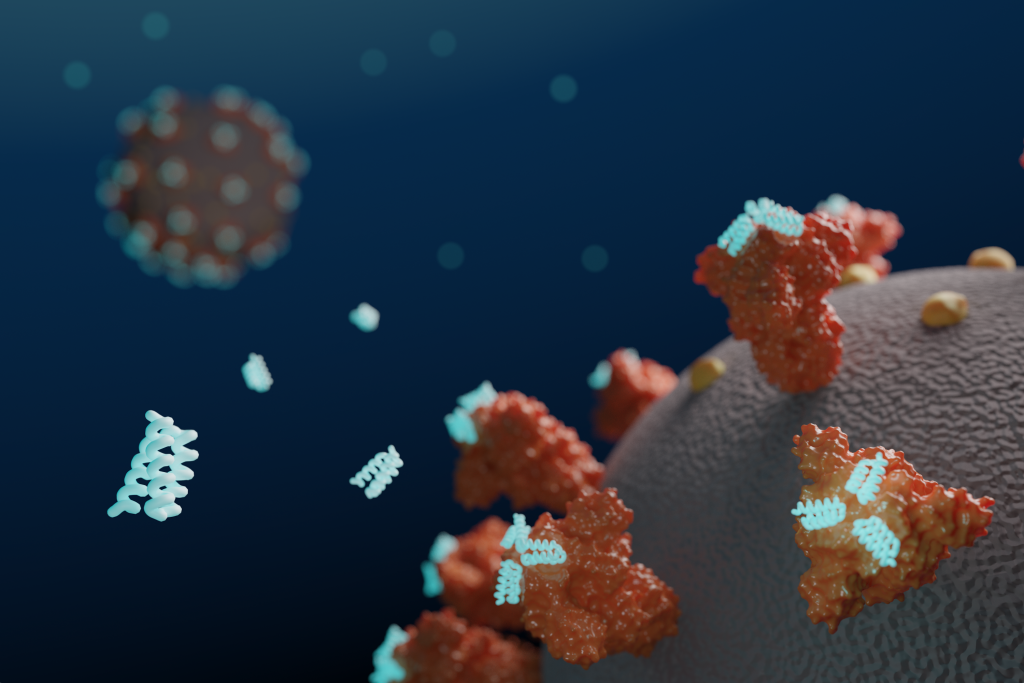
This artwork shows a comparison between minibinders (small antiviral proteins, shown in shades of red) and antibodies (blue) that bind to the spike proteins on the surface of the SARS-CoV-2 virus. Prof David Baker’s group at the Institute of Protein Design commenced the computational design of minibinders in January 2020 around the time when community transmission of the virus began. By the end of May, they had identified minibinders that were able to strongly bind the spike proteins and neutralize the virus. Minibinders are 20-fold smaller than antibodies, and can be scaled up in production at a lower cost. While antibodies have only two binding sites to its target, minibinders in an equal mass offer 20-fold more potential neutralizing sites. The small size and higher stability of minibinders offer a possible advantage of nasal formulations for drug delivery and eliminating the need for refrigeration during storage and transport. These minibinders are currently in development for their potential use as SARS-CoV-2 therapeutics. This example highlights the power of computer-generated protein design, especially during a pandemic when time is critical.For more information refer to https://www.bakerlab.org/index.php/2020/09/09/covid-minibinders/