Blog with practical advice regarding how to use music as a coping strategy to enhance wellbeing at this stressful time.
Suzanne Hanser writes, “In Greater Good Magazine, Dacher Keltner provides an answer. He says, ‘Choose awe: Wander outdoors looking for awe, reflect on people whose courage and kindness give you the chills, listen to music that lifts you up. If you open yourself up to feeling awe, our research suggests you’ll gain strength for facing our collective challenges. And perhaps lead us out of the toxic dimension of these times, to an age of awe.’
I like to think that we can do this – enter the age of awe – when we really listen and allow ourselves to feel the awe of music. Music can echo our feelings, helping us identify and acknowledge how we feel. It can also change our moods, soothing or exciting us, validating or empowering us. Back in March, my first blog post after learning about COVID-19 addressed how to use the “iso-principle” to create music playlists to modulate emotions and manage moods. This concept is based on matching your feelings with music and slowly changing the music with the intention of changing your mood.”
Additional Details
Suzanne B Hanser, EdD, MT-BC is Professor and Chair Emerita of the Music Therapy Department at Berklee College of Music. Dr. Hanser is Past President of both the World Federation of Music Therapy and the National Association for Music Therapy. She established the music therapy program at the Leonard P. Zakim Center for Integrative Therapies at Dana-Farber Cancer Institute, and is also a Resident Scholar at the Women’s Studies Research Center at Brandeis University. Dr. Hanser is the author of The New Music Therapist’s Handbook, and co-author of Manage Your Stress and Pain, book and CD, with Dr. Susan Mandel, and Integrative Health through Music Therapy: Accompanying the Journey from Illness to Wellness. In 2006 Dr. Hanser was named by the Boston Globe as one of eleven Bostonians Changing the World. She is the recipient of a National Research Service Award from NIA, the Sage Publications Prize, and the American Music Therapy Association’s Lifetime Achievement Award.
The initial inspiration for this collage was a scene I saw while driving down MLK Blvd in Baltimore. There are always homeless panhandlers and squeegee boys on the boulevard, in between cars waiting at the stoplight. One day, when coronavirus was new to all of us, my focus was on an empty chair near an intersection. I imagined this chair on the median, emptied by a homeless person who died from the virus and I knew, at that moment, that any art I would make about the virus would include an empty chair to represent all those who have succumbed to the pandemic. In my collage, the chair’s upholstery is spiked to represent virus outbreak data graphs. Often, I use scientific images in my work; collage made in a traditional way; constructed with cut paper and adhesive and to play with distortions between visual perspective and surface image. I started this collage with a sketch of the composition. Visualizations of the corona virus are, by now, ubiquitous and easily recognized. I found the most straightforward and graphic of these images and printed multiple copies in different sizes and colours and cut them out to use in the collage with the empty chair. The large watercolour shapes that define the sky and ground are repeated, large scale drawings of the outline of the virus visualization: https://www.nytimes.com/2020/04/01/health/coronavirus-illustration-cdc.html These forms, in relation to the smaller scale versions in the collage, become fractals. At this time, I was, as were many others, watching the Netflix series “Unorthodox” which reminded me of the concept of an eruv; an urban area enclosed by a wire or geographic boundary which symbolically extends the private domain of Jewish households into public areas for shabbat observance. The eruv in this case, is made of cut up copies of visualizations of the coronavirus, thereby making it the defining element that is keeping us seperated in our dwellings, united by a common threat. Now the public space is transformed into our private spheres. Some of the virus images depict hot air balloons tethered to the eruv; reminiscent of strings of decorative lights, defining the quarantined space. A nod to the political implications of the spread of the virus and how it is being mitigated and manipulated is in the upper left corner.
This project involves a team of about 25 art, medical and instructional support faculty and staff plus art students. The project lead is Lynsey Ekema. Initially we 3D printed 1000 face shields. Now we are printing a version of the reusable (can be sterilized) Montana Mask for the health care workers at Augusta University Hospital.
Additional Details
Link to the project page: https://www.augusta.edu/innovation/covid19
Link to 2nd story in campus online newspaper: https://jagwire.augusta.edu/augusta-university-and-local-companies-team-up-to-develop-500-reusable-medical-masks/
University of Maryland College of Arts and Humanities
Keep Creating is a College of Arts and Humanities (ARHU) virtual initiative that creates spaces for University of Maryland’s community to share their works and for anyone to experience UMD’s arts offerings from home. As a college of arts and humanities, it was important for us to create an online space to continue to share, engage and celebrate creativity. Engineers are artists. Scientists are artists. Teachers are artists. The hope is that everyone across campus will respond with how they’re creating. We want to encourage people to continue to think about new ways to explore creativity given the challenges of our day. The space features a digital stage, virtual events, news items about how the UMD community is staying creative and more.
Additional Details
During this time of uncertainty, the arts and humanities can help us create new approaches and insights for empathy and for understanding our rapidly changing world. More than ever, they also connect us to our shared humanity. We invite all members of our creative community to join our movement to keep creating.
Bonnie Thornton Dill Dean, College of Arts & Humanities
The Arts & Design Research Incubator (ADRI) at Penn State seeks to improve lives through research and application of arts and design practices to health and well-being. The ADRI is part of the College of Arts and Architecture at Penn State. We constructed this repository of arts-based wellness activities and resources in response to the COVID-19 global pandemic, as many of us struggle to navigate the uncertainties of this reality, now and into the future. This is a work in progress. Please look around, download and share, and do feel welcome to reach out to us with feedback, questions, and additional content suggestions. We hope you stay safe and well.
Based on the poem by Pablo Neruda, “Keeping Quiet”, this film is a portrait of my experience from April 23 to 28 2020 during the COVID-19 Pandemic. I shot it entirely by bicycle on an iPhone in my west end Toronto neighborhood. Read by Sylvia Boorstein, with music by Ólafur Arnalds, “Only The Winds.”
Collaborative videos initially planned to be created in shared physical space that have been adapted due to quarantine. These updated micro-films describe the shared experiences of isolation by recording live streamed simultaneous activities performed in the home by 2 friends on either side of the Atlantic. Audio is created from WhatsApp phone chats, and visuals streamed via Zoom, though future work may use different platforms
Additional Details
Brener and Imara are locked down in London and New York during the corona crisis. Y&I Lockdown was performed simultaneously via online streaming. It highlights the loneliness and confusion of isolation, and also the connectedness of all who are separated in physical space due to the crisis. Audio from a phone chat.
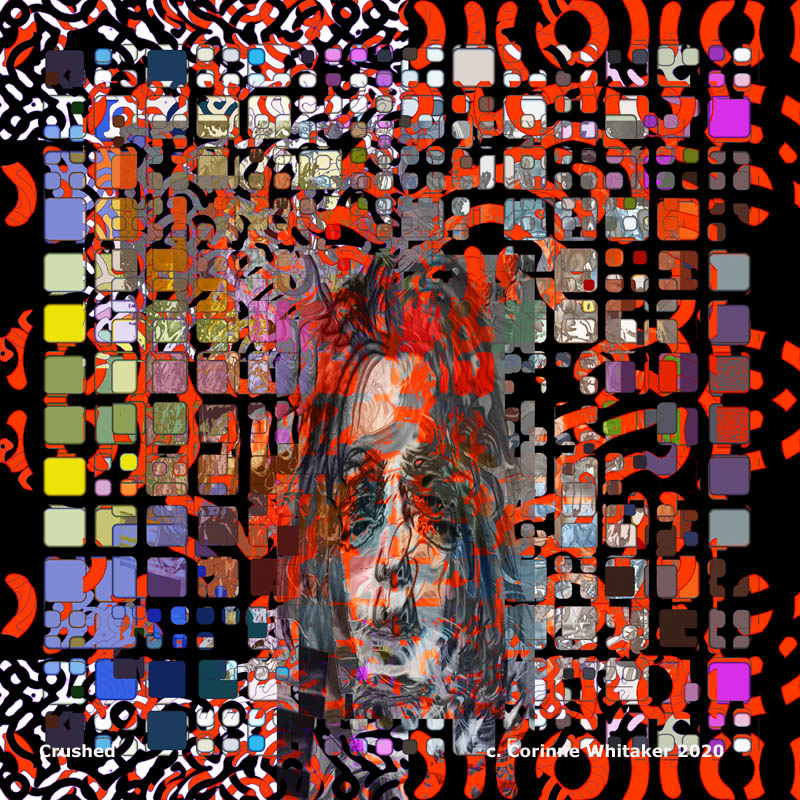
We created 187 cover images in 2020 to reflect how it feels to live through a pandemic. You can see those cover images online, then change the number to see others.
Additional Details
“As the covid 19 virus sweeps the globe, it is difficult to underestimate the dismay and disarray visited upon us all. In recognition of that worldwide affliction, giraffe.com will offer a new cover image every day, reflecting how it feels to live with a global pandemic. Some of the images are based on A.I. transcriptions of my selfie. I cannot ease the terror, the pain, the chaos. But I can at least offer one artist’s view of what is happening to the human species right now, right here and everywhere. We have abused nature’s gifts to us. Now, perhaps, she is shedding her tears in reply.” Corinne Whitaker 2020
Mediated 2.0 The Air We Breath (working title) Mediated 2.0
The Air We Breath is about our collective environment. Our microbiome, collectively speaking and individually. How our presence in a space, within our shared environments is felt and what we leave behind. With COVID-19 and other potential hazards in our air streams, the concept here is towards visualizing our multi species entanglements, our interactions and our awareness or unawareness of how we impact the nonhuman world. [Still in conceptual phase] the installation can be purely a VR/AR environment, web-based and/or with physical elements that employ haptic sensors within a space along with the mixed reality. The physical elements are soft circuit/soft sculptures. Everything in the environment is visualized in its microscopic forms. From the bacteria and fungi that populate our tissue, hair, exhales, the floors, other organisms in this environment; birds, cats, how our microbes intermingle when we come close to one another, when we touch. In order to make the subjects in the space more ‘clear’ human and other life forms are outlined, however, the biomes spill over and out -they are not confined (as in reality) the outlines here are used as a marker of sorts. Air readings are taken from within the space as well as the surrounding area this installation might take place in. This data is shown in percentages as well as in the virtual space. In some circumstances some of this data will be sonified towards creating a soundscape within the installation. Kinect sensors map visitors in the space to project their microbiome, TouchDesigner will be used for some of these visuals.
In 2012/13/14 I started building large and small scale phytoplankton, fungi and bacteria out of glass and sometimes metal: copper/sterling. In 2013/14 I received grants from the Glass Art Association of Canada and the Ontario Arts Council towards creating the working space to do so, supplies, and time to create sketches in flame-worked and cast glass. The concept being to create macro versions of pollens, fungi, bacteria, dust/dirt, phytoplankton and other particulate found in our airstreams. Using a Vitrigraph kiln arraignment I started building up murrini- glass cane that would create the textural elements. It was amazing to create custom colour palletes, and work in my super small studio similarly to working in a Hot shop (aka glass blowing studio). For the most part this initial stage was successful, however, the kiln and space required to create large renderings was out of my means, and the only available studio is in Brooklyn, NY and I am in Toronto so, I created a foundation that could potentially be utilized at a later date. VR/AR: Since the 90’s I have been fascinated with the concept of Virtual worlds and creating them! The work of Jaron Lanier only added to this. Plus, he coined the term or maybe William Gibson did or? Who knows! It sounded amazing. Add to that my dreams as a small child in the 70’s of cars that had windscreens like televisions (for lack of a better word then) and motorcycles that turned into robotic suits around the rider (think Transformers but in 71/72 and I don’t think that even existed yet!) I have always been a child of SciFi. In 2015/16 I participated in workshops that taught Unity gaming and AR. I believe now that a mixed reality, maybe working with Magic Leap, Holo Lens or similar (like a AR contact lens!) is the way to create the visualizations I am considering.
Infodemic is a neural network-generated video that questions the mediated narratives created by social media influencers and celebrities about the coronavirus. The term ‘infodemic’ can be traced back to the SARS outbreak in 2003, but gained popularity in February of 2020 when the WHO Director, General Tedros Adhanom Ghebreyesus stated: “we’re not just fighting an epidemic; we’re fighting an infodemic. Fake news spreads faster and more easily than this virus, and is just as dangerous.” The speakers featured in the video are an amalgam of celebrities, influencers, politicians, and tech moguls that have contributed to the spread misinformation about the coronavirus by either repeating false narratives, or developing technologies that amplify untrue content. The talking heads are generated using a conditional generative adversarial network (cGAN), which is used in some deepfake technologies. Unlike deepfake videos where a neural network is trained on images of a single person to produce a convincing likeness of that person saying things they did not say, we trained our algorithms on a corpora of multiple individuals simultaneously. The result is a talking head that morphs between different speakers or becomes a glitchy Frankensteinian hybrid of different people that contributed to the current infodemic speaking the words of academics, medical experts, or journalists that are correcting false narratives or explaining how misinformation is created and spread. The plastic, evolving, and unstable speakers in the video evoke the mutation of the coronavirus, the instability of truth, and the limits of knowledge.
Additional Details
Jennifer Gradecki is an artist and theorist who aims to facilitate a practice-based understanding of socio-technical systems that typically evade public scrutiny. Using methods from institutional critique, tactical media, and information activism, she investigates information as a source of power and resistance. Her work has focused on Institutional Review Boards, social science techniques, financial instruments and, most recently, intelligence agencies and technologies of mass surveillance. She teaches Game Design and Media Arts courses at Northeastern University.
Performing Public Health: Remote Cultures Conversation Series
Center for Arts in Medicine, University of Florida
The Remote Cultures Conversation Series documents various interpretations and practices of how artists and arts communities are supporting public health efforts. We recently hosted our first conversation centered on experiences of uniquely precarious artists in performing public health (please see project website for further details), i.e. the lived-experiential knowledges they possess of how best to combat social isolation, shifts in social routines, creative practices to engage and maintain well-being, and/or statements/discussion of the lack of any change to routine whatsoever. This project is part of a larger effort in collaboration with the University of Florida’s Center for Arts in Medicine’s COVID-19 Arts Response, which houses the Performing Public Health initiative, as well as a COVID-19 Arts Repository, advisory briefs, and links to a white paper entitled “Creating Healthy Communities: Arts and Public Health in America.”
Additional Details
What are “Remote Cultures”?
In this context, “Remote Cultures” refer to the cultures evolving in response to the public health measures implemented due to the Coronavirus pandemic. Remote Cultures vary among different populations and communities, including Unique Precarities (particular experiences, knowledges, needs, and abilities of marginalized groups) and individuals’ adaptations to the novel public health measures implemented during this pandemic.
[ I Miss Your Touch ] – Staying Connected During COVID and Beyond
Betty Sargeant PluginHUMAN
[ i miss your touch ] transports two people who are in seperate locations into a shared virtual environment. This unique online space launched in March 2020 as a rapid response to pandemic conditions. This award-winning interactive video artwork helps people maintain meaningful social and physical connections with each other, and provides a personalised art experience. [ i miss your touch ] is a live collaboration between the participants and PluginHUMAN (Dr Betty Sargeant and Justin Dwyer, the artists). The artwork responds to people’s movements. PluginHUMAN affect, in real-time, live video streams from participants’ webcams. People can instantly see the creative effects of their movements and interactions. They can also experience virtual touch. [ i miss your touch ] makes people feel as if they are together in one space. It allows friends, who are in separate locations, to dance, to virtually hug and to interact in a shared online environment. During 2020, many people have been without physical contact with others due to pandemic lockdown and physical distancing rules. [ i miss your touch ] provides a way to maintain meaningful connections with others and meaningful engagement with art during this unprecedented global situation. Participants don’t need specialist equipment of software, there are no logins or passwords. People use their computer webcam and internet; they enter their unique URL and are instantly transported into the [ i miss your touch ] experience. This ephemeral artwork is freely accessible to broad audiences.
As the Covid-19 epidemic emerged, so too did an abundance of how-to hand washing videos. Starting in late January 2020, one in particular played on a continuous, hypnotic loop in the dining hall that my partner and I shared with hundreds of others in Singapore. Always running, hands in motion, suds, instruction, rinsing, sensation, ablution. My partner’s and my time as artists-in-residence in Southeast Asia transformed into one of sheltering-in-place for months on end. With a hazard so invisible and communicable, and within a global mesh where everything is shared, the significance of safety, of self, and of contact became more pressing and at the same time more difficult to discern. The ritual choreography of hand washing became deeply embedded in our bodies and minds over those months, while forms of protection, isolation, and communion continue to mutate.
My partner’s and my time as artists-in-residence in Southeast Asia transformed into one of sheltering-in-place for months on end. With a hazard so invisible and communicable, and within a global mesh where everything is shared, the significance of safety, of self, and of contact became more pressing and at the same time more difficult to discern. The ritual choreography of hand washing became deeply embedded in our bodies and minds over those months, while forms of protection, isolation, and communion continue to mutate.