
Beauty in Every Body
Review of
Queer Anatomies: Aesthetics and Desire in the Anatomical Image, 1700–1900
New York, NY: Bloomsbury Visual Arts, 2024, 280 pp.
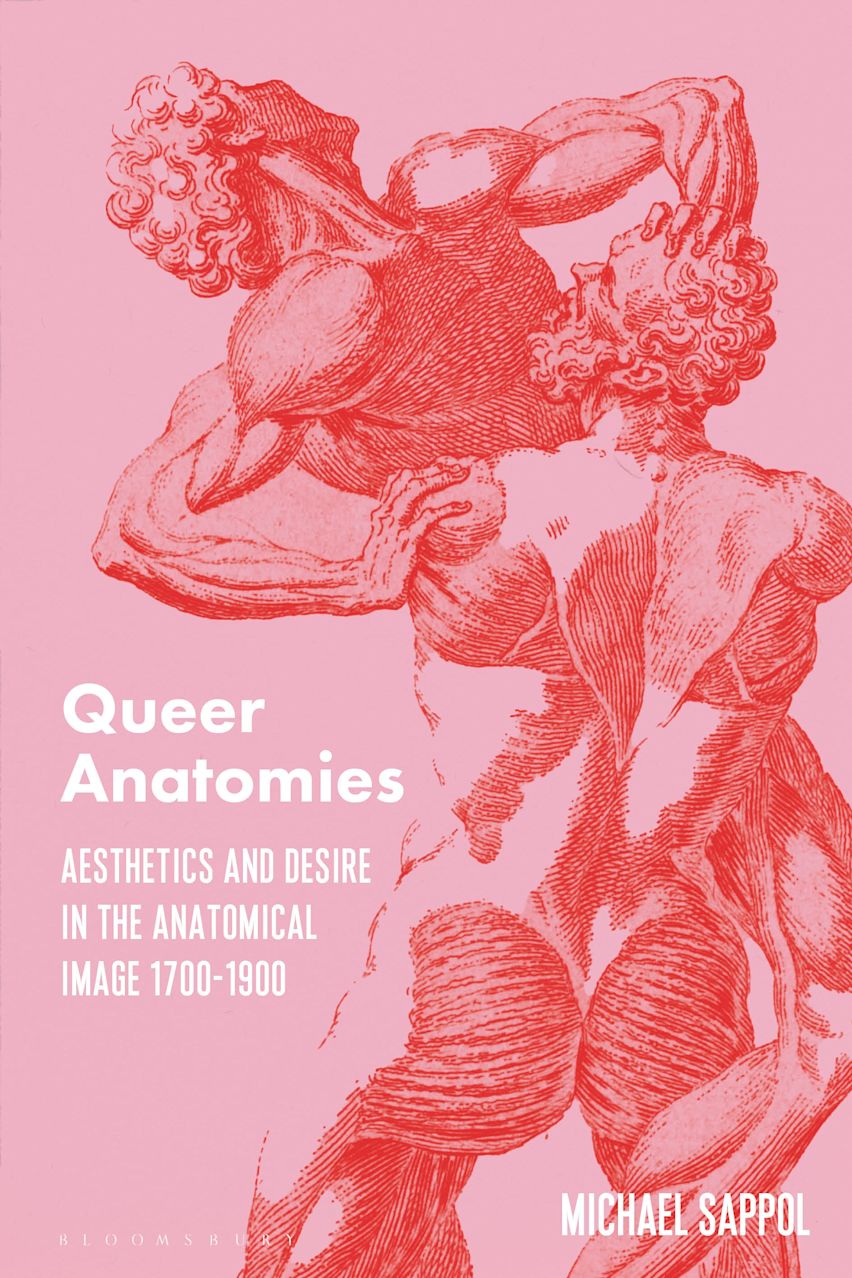
From indigenous preservation techniques to the Mawangdui medical texts written in 300–200 BCE China, exploration and categorization of the human body have a deep and rich history. For a subject frequently represented by Leonardo da Vinci’s anatomical sketches or by the Victorian-era Gray’s Anatomy (a ground-breaking anatomy text long before it inspired the name of the hit TV show), it can be challenging to convince the layperson that anatomy is a dynamic and evolving field.
But static, anatomy is not. Or, as Michael Sappol demonstrates in Queer Anatomies: Aesthetics and Desire in the Anatomical Image, 1700–1900, the human interpretation of anatomy is not static. This dissection and depiction of cadavers has long been recognized as a field at the crossroads of politics, medicine, crime, taboo, professionalism, modesty, racism, sexism, and much else. And anatomy’s intersection with numerous aspects of human society is a core component of anatomical instruction today—including the bioethics of body donation, accurate representation of the diverse spectrum of human anatomy, and continued professional respect for those who donate their bodies for anatomical education.
Sappol goes beyond these issues in exploring anatomy’s past, asking if anatomical illustration and dissection in the period of 1700–1900 could have been a space for the exploration of homoerotic desire, hidden in plain sight. Were anatomical illustrations a way for men (the only individuals, for the most part, allowed in medical spaces at the time) to explore their attraction to and sexual curiosity about the male form? Sappol explores the possibility that the study and teaching of human anatomy served not only as a metaphorical closet in which desires were hidden from the outside world, but also as a space to explore one’s homoerotic desires under the guise of professional and scientific inquiry.
Interpreting sexual identity and queer behavior of the past is difficult. Category mistakes can be introduced when using modern terms (e.g., gay, lesbian, transgender) to describe relations, behaviors, and events in history. Sappol acknowledges this, but he asks the reader to find a middle ground between a direct comparison and neutral scrutiny. He argues that there must be some commonalities in the human experience that we can recognize while exploring historical evidence, asserting, “Because we’re not entirely worlds apart—otherwise societies, cultures and persons, past or present, linguistically or geographically distant, would be utterly undecipherable, inaccessible to historians, anthropologists, translators, and go-betweens.”
Were anatomical illustrations a way for men (the only individuals, for the most part, allowed in medical spaces at the time) to explore their attraction to and sexual curiosity about the male form?
Sappol’s discussion of temporality segues into a discussion of the gaze, or the exchange between an observer and the object of observation. This exchange can lead to the objectification of the person or thing being looked at, but by beginning a conversation between the observer and the observed, it also allows a path for an object to regain agency. For example, an illustration by seventeenth-century Flemish physician Adrianus Spigelius features a standing figure, abdomen open, with the figure holding their own transverse colon aloft allowing the viewer to fully see the intestinal mesentery as their small intestine spreads across their lap like a miniskirt. Sappol reflects on how Spigelius’ illustrations possess authority as scientific diagrams but at the same time ask the viewer to see the poses and movements of theater and burlesque. This theatric performance and agency of the illustration is almost unheard of in modern anatomical imagery, which aims to reduce the view to relevant anatomy for that illustration’s purpose. The scientific authority may be the main goal of the Spigelius image, but the design (intentionally or not) still beckons the viewer to think of topics outside the anatomical realm. This conversation and the occasional dissonance between viewing anatomical imagery with a scientific lens versus a queer lens raised questions for me as a reader. Are we bringing into focus something that wasn’t there?
On one hand, anatomical images are a daily part of my life as an anatomy professor; I rarely see them as transgressive in the way they may be to people outside the medical field. There is an objective and clinical aspect to my gaze that has been developed through my training and teaching. On the other hand, no such objective scientific lens can completely silence the queer lens with which I view the world as an openly queer individual. But on occasion, these two lenses felt incompatible to me, particularly when Sappol describes examples of flirtatious looks and erotic natures in anatomical illustrations.
Scottish dissector and illustrator Joseph Maclise’s 1844 illustration of a deep dissection of the perineum (the area of the human pelvis that includes the anus and external genitalia) provides an excellent opportunity to examine these clashing perspectives. The image depicts a male cadaver with hands and feet bound together and spread apart to reveal the dissection of the perineum. I don’t entirely disagree that Maclise’s imagery is stark and has erotic undertones referencing sexual bondage. But I struggle to see what Sappol sees—“that sensual hand, gently grazing the outside of the thigh! Is that caress just another proxy for Maclise’s desirous touch?” My scientific lens focuses on the mechanics and logistics of displaying this part of the body for dissection and learning, as this is an ideal way to display the perineum—regardless of its similarity to an erotic BDSM scene. Although Sappol does recognize the logistics and pedagogical value of the perspective, I find myself struggling to hold these two different ideas in my mind as plausible.
Sappol’s concluding review of Maclise’s work introduces a concept that resonated with both my queer and my scientific perspectives: beauty. Maclise was a master of detail, and he gave so much care and life to his illustrations. The shading and detail of an arm and hand in an illustration of the abdominal blood supply glow with a sense of life that modern atlases have lost. Maclise’s detail in even “extraneous” parts of his illustrations was noteworthy to reviewers of his time. Sappol points out that Maclise continually violated convention and did not cover the penis when it was irrelevant to the (medical) focus of the image, creating a library of penises showing more variation in penile anatomy than many modern atlases. Sappol wonders if this exposure and attention to irrelevant details was possibly an expression, either knowingly or unknowingly, of Maclise’s homoerotic exploration.
My colleagues and I have frequently used the term beautiful to describe an anatomical illustration or dissection view. The beauty we appreciate is in the demonstration of the anatomy, revealing something that is usually hidden, showing it in detail or from a perspective that illuminates the hidden mystery. The beauty is in the pedagogical value, not so much in the possible flirtatious look. The irony is that this pedagogical beauty is still queer—it’s just more in line with the other definition of queer that Sappol explores: weird, oppositional, or transgressive. The beauty that I see is in a resource for my students to learn, a resource that was donated by someone no longer with us, who also saw the power in understanding anatomy and medicine, all facilitated by the violent act of dissection.
My colleagues and I have frequently used the term beautiful to describe an anatomical illustration or dissection view.
This is the fascinating aspect of utilizing a queer lens in a scientific field. We may never know if Maclise had homoerotic desires that were translated to his anatomical illustrations, as so few details of his personal life remain. But I believe this is part of the experience of viewing the world through a queer lens that Sappol is trying to show. A queer lens asks us to look beyond the boxes and labels that science is so good at sorting our world into. In my opinion, queerness has little to do with defining; rather, queerness offers the opportunity for expansion beyond.
Sappol’s joy in the nuanced and macabre nature of human anatomy, dissection, and illustration brings readers into his playful conspiratorial exploration. For queer readers especially, this invitation is affirming. It is rare to see such open discussion of queer issues and theory in the exploration of a biomedical science, especially with references to iconic queer culture such as Paris Is Burning and drag. However, this is more than a mere collision of two very different worlds. Sappol is opening a realm of possibilities for the interpretation of classic human anatomy imagery to include perspectives that have long been relegated to the closet.
Sappol is opening a realm of possibilities for the interpretation of classic human anatomy imagery to include perspectives that have long been relegated to the closet.
By opening up this perspective, Sappol also highlights the constraints of anatomical imagery from a time when a goal of the discipline was to control through definition. Anatomical experts in the eighteenth and nineteenth centuries believed that Man—the cisgender, white, male body—was the template for the human species (a concept dating back to Ancient Greece). This belief precluded anatomical illustration of the female form outside the presentation of anatomy specific to the female body. Combined with minimizing imagery of genitalia in the name of modesty, this practice has continued informally into the twenty-first century. Sappol suggests that the policing of the male gaze on the female form in anatomical illustration created a fertile ground for homoerotic discourse to grow. And while that may be true, we are still witnessing its long-term effects in anatomical texts.
The exclusion of the female form and intersex anatomy has led to a severe delay in the exploration of women’s health and anatomy. For example, nerve endings supplying the clitoris were not formally mapped until the early 2020s. Furthermore, unlike some of the images in Sappol’s text, anatomical variation in human genitalia is rarely shown today, as depictions of genitalia have become more censored and standardized in anatomical texts. A lack of representation of variation filters down to the general public, which sees these typical instances of anatomy as the only measure of what is normal and healthy. Such limited definitions then inform various debates, from legislation such as the so-called bathroom bills to who can play on which sports teams.
But the truth of the human form is that just as much as we are similar, anatomical structure is a spectrum of presentation that makes each of us unique. Anatomy is—and has always been—queer. “Queer explains everybody,” Sappol writes, “including the very straightest, self-identified (even homophobic) (especially homophobic) straights.” In other words, one side of the spectrum reflects and defines the other, creating one large queer illustration of a human being. In such times of intense divisiveness, that is a cause for celebration.