
Coda
Ray’s earliest memory is of a disembodied theater mask, floating above a swamp. She doesn’t know how old she was in the memory. The mask would appear at various times for the rest of her life, in moments she could never predict. Though she understood it was a hallucination, it didn’t feel like one. Sometimes it would be smiling, other times it would be frowning.
From that first memory onward, she somehow knew, The mask must be kept a secret. She did not cry at it, did not laugh at it. Eventually Ray would name the mask Janus, and consider it her first friend. At times, later in her life, she would consider it her only friend.
Related Reading
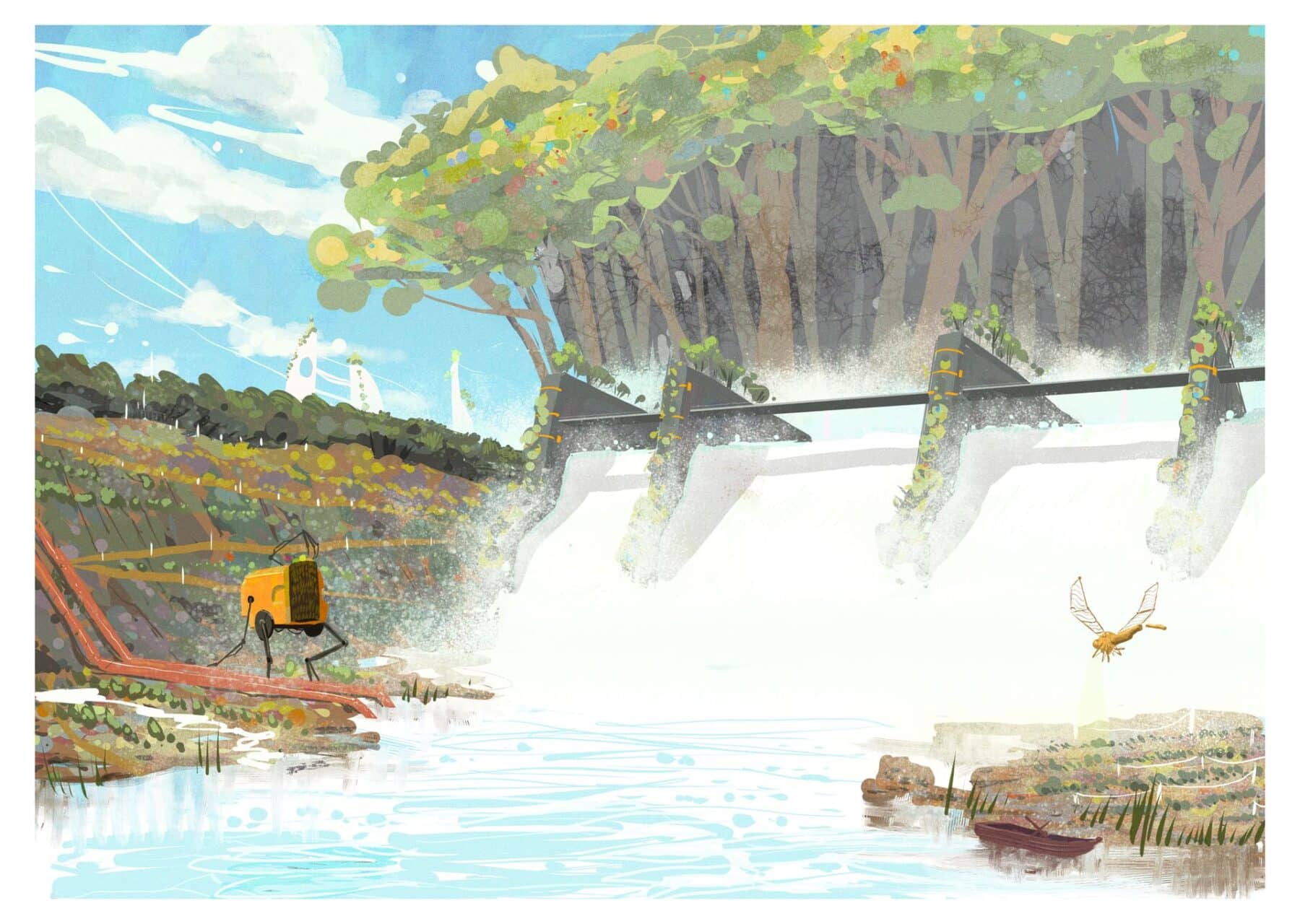
“If it is known that a very large number N is the product of two primes p and q, how do you find p and q? You can use integer factorization, but for large N it takes classical computers so long that the world’s cybersecurity was built on the assumption that nobody could find a shortcut. Until 1994, when Shor’s algorithm was created and cast doubt on that plan, showing that given a powerful and stable quantum computer, integer factorization was almost guaranteed to be solved within a few attempts.”
Fragments of computer science lectures she once gave would often pop into Ray’s thoughts. Memories from when she was still invited to give public talks and seminars.
That was before she began to notice things about the world: a mailbox, a flickering fluorescent light bulb, a particular wrinkle on someone’s shirt. Something felt off about each of them. One day, looking at the marigolds she was growing on her windowsill, she wondered, What if something is controlling what I see? Setting some initial conditions and letting my life unfold? Mapping out some region of its stable fixed points and forcing me to fall toward them?
The paranoia had started soon after she disproved Cristopher Moore’s conjecture that there is no structurally stable, finite-dimensional dynamical system that can simulate a Universal Turing Machine. Universal computation, known since the 2030s to exist in biology, could arise via such a dynamical system. It could be described by a set of evolving differential equations—and they would be resilient to additive perturbations to the system.
What if something is controlling what I see?
The thought, once planted, grew deep roots within her, embedding itself into her consciousness, until she decided with an intuition so strong she mistook it for a conclusion that those around her must certainly be actors, and that a director, like a programmer, must be scripting all their actions.
She felt uncomfortably watched in her neighborhood, so she moved away from other people, found a property by a local marshland to live in, where there were too many mosquitoes for anyone else’s comfort. At least, anyone other than Ishaan.
“The Truman Show Delusion, that’s what they call it. Like the movie.” Ray would tell Ishaan after the psychotic break she had at work and her stint in the psychiatric ward. “A delusion of control. I’m lucky they’re just moving me to a different building and team, not kicking me out of KH altogether.”
“They can’t lose you,” Ishaan replied. “You cracked Moore!”
Ray worked in the emerging field of polynucleotide cryptography at The Keystone Harmon Corporation. It had become the largest defense manufacturer for the United States in 2035 when it invented Blossom, the world’s first quantum computer powerful and stable enough that any encryption system based on integer factorization was rendered useless.
Related Reading
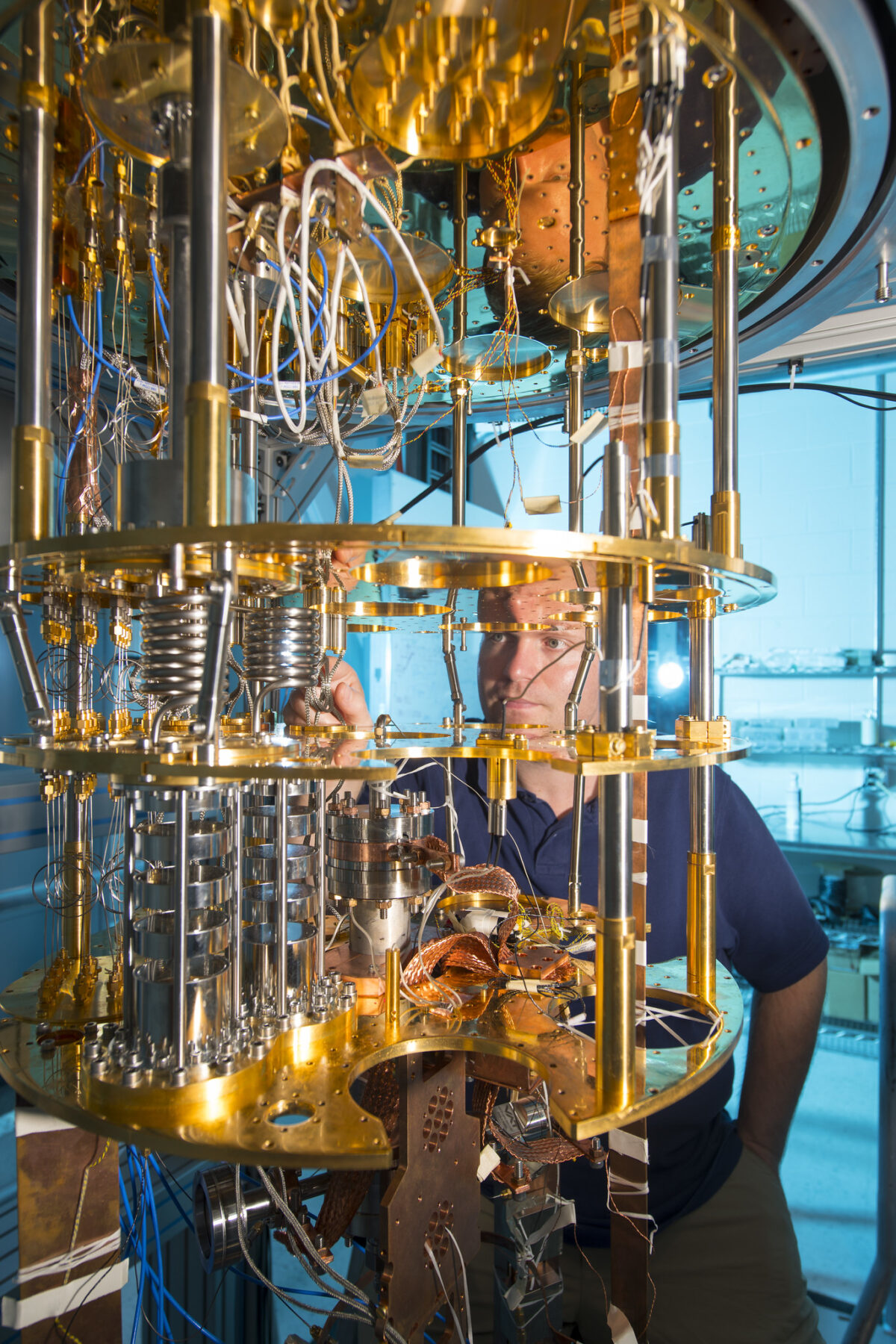
Of course, this discovery was kept private. Only Keystone Harmon’s biggest clients, the US government and its allies, knew about Blossom. They swiftly and secretly switched over to lattice-based, “learning-with-errors” security systems for which even a quantum solution wasn’t known to exist. Ray’s job at the company was to study attacks on these lattice-based systems and look for weaknesses in the new postquantum setups.
Ray had become convinced her coworkers and boss were hiding vital information regarding the truth of the reality around her—it seemed only natural to her after she discovered the company had been selling access to Blossom to wealthy nongovernment clients who had the means to pay.
Ishaan once confessed to her, months after she was hospitalized, “I always worried it was my fault that you started believing you were in some play. Because I talked to you about Conscious Turing Machines and Baars’ theater analogy. The reason I began looking into CTMs was a lecture you gave once that inspired me to develop an entirely different perspective on dynamical systems that led to my current research. But you had a strange look on your face when I told you … I’d never seen you like that before.”
Baars’ theater: The conscious, aware portion of a mind is like a performer on a stage, broadcasting information to a dark sea of an audience, the subconscious. Once the broadcast completes, the audience members compete for attention until one is able to present its unique information to the performer, who broadcasts it out to the whole subconscious and the cycle starts again.
Ishaan’s research at Keystone Harmon involved self-organization of neurons and other cells, and a mathematical framework inspired by the theater analogy called Blum’s Conscious Turing Machine, or CTM. The CTM was a simple model defining consciousness, analogous to Turing’s simple model defining computation. Ishaan believed there was a way to blend the two into a kind of simple consciousness that could be engineered with networks of real cells.
“No, it wasn’t because of you,” Ray had told him, looking up at Janus smiling down onto the two of them.
Ray had become convinced her coworkers and boss were hiding vital information regarding the truth of the reality around her.
Through even the worst of times, Ishaan had been there. Ray had said awful things to him in the depths of her psychosis—that he was an actor, that she had no human friends, that he and Keystone Harmon were controlling her, lying to her—but he never stopped being there, hearing her out. After Ray lost almost every other human connection in her life, Ishaan stayed.
It’s why—when she began having suspicious thoughts again, long after the psych hospitalization and her recovery from the previous bout of paranoia—she decided to trust him. This time she was concerned that higher-ups at the company were hiding the true results of her work. She proposed a plan to him as they sat on her porch, the marshland around them showing a quiet beauty in the twilight.
“I can’t do that, Ray. Yes, I have full access to a genome printer, but it would risk my job to add anything out of the ordinary to the organoid cell genomes, especially some strange new library of DNA functions that would get transcribed as god-knows-what RNA program within the cell. It’s not just against company policy, it’s probably illegal! And … well, you’ve said this before. Last year you thought you cracked your lattice vector—”
“The hidden subgroup problem for non-abelian finite groups … I really thought I’d nailed it. That would solve the shortest vector problem these postquantum cryptosystems rely on. I can’t believe Bruce isn’t letting me use the genome printer.”
Ishaan said, “Yes, that. You thought you cracked it with your RNA program six months ago, but it failed. Your cells died and your program failed, even after you ran a cell stability check in Blossom and everything was cleared. Maybe that’s why Bruce isn’t letting you have access to the genome printer again.”
“Well, maybe Bruce lied to me, Ishaan.”
Blossom should have predicted the cellular failures. Ray never figured out what went wrong. Are all of my thoughts that sound paranoid, actually paranoid? I know my work, I trust my work …
“Anyway, I’ve updated it,” she told Ishaan. “And I ran a check on the newest version through Blossom. There’s no way a cell population containing my program would die this time unless someone tries to sabotage it. Listen, I’ve sent you the files. And the file for the indicator protein that’ll be expressed if my algorithm works. If you can just look at them …”
“I’m sorry. I can’t risk my job for you,” Ishaan said.
“Fine. Forget it.” Ray watched a grasshopper that had climbed onto her porch. It stood out to her with an uncanny clarity; something was strange about the way it looked at her. And floating above the grasshopper, Janus frowned. It’s just in my head. A dopamine issue. Unnecessary value given to random things. Right?
Baars’ theater: the conscious, aware portion of a mind is like a performer on a stage, broadcasting information to a dark sea of an audience, the subconscious.
She said, “I’ve been thinking … How many people do you think actually know about Blossom?
Ishaan smiled, “You’re the numbers person. But not a lot of people, I’d say.”
She lowered her voice, watching the grasshopper. I know we’re alone … but still. “And how many people within that set know that KH sells access to Blossom to their billionaire friends? Who because of that access, can use quantum algorithms to break into data that most people think is secure?”
“That hasn’t been confirmed.”
“You know they’re doing it, Ishaan.”
“What are you getting at?”
Ray looked into his eyes. “If my program works, we can crack quantum encryption systems that use learning-with-errors. It puts their lattice-based systems at risk. Their strategy to add a small error to a lattice under the assumption it would become uncrackable in polynomial time, even with quantum speedups to find the shortest nonzero vector of the lattice, no longer works. Their billionaire friends are screwed, their government clients are screwed … they wouldn’t want an algorithm like that to exist. Or they’d want to get ahead of it, classify it, keep it away from … someone like me. They’d want it kept within some trusted inner circle.”
Ishaan contemplated this. “Why wouldn’t they want you to succeed? It would benefit them to be the first ones to have the program.”
“Oh, I agree.” Ray watched the grasshopper jump back toward the marsh. “But what if I already succeeded, months ago? What if they have a working program? And what if they simply don’t want me to know?”
“It’s kind of like dream logic,” Ray once told Ishaan after she recovered and when he had asked how she could believe such strange and clearly untrue things. “If you’re flying in a dream, it’s so obviously possible to you. It’s how the world works. The ability to fly is an indisputable truth of that reality, and you don’t remember a time when flying was impossible. If you inhabit a universe built on certain axioms, your being will be built from those axioms as well. You can’t remember that there was a universe you once inhabited with different axioms because your fundamental ground truth has altered, no other truth is possible. You, my old boss before Bruce, my neighbors … it was a ground truth for me that these people were acting from a script. Indisputable. I couldn’t remember thinking any other way. Do you understand?”
“If you’re flying in a dream, it’s so obviously possible to you. It’s how the world works.”
She thought about that conversation as the random Keystone Harmon VP, a woman she’d never met, told her she was being let go from the company. Is this just coincidence, that I’m being laid off after I showed Bruce a much better algorithm? Or is it something more … Would thinking it’s something more shift me into a delusional reality? A bad set of axioms incompatible with the real world I’m in?
Ray found it exhausting, constantly keeping track of reality and delusion, worrying about unknowingly slipping between the boundaries of these countless possible mental axiomatic structures.
Ray asked the VP, “Why?”
“Company logistics, dear. Hundreds at Keystone Harmon are getting laid off today, don’t take it personally. Please pack your things. And remember your NDA.”
Ray walked out of the meeting in a daze, out of the building in a daze. She saw Ishaan standing nearby outside, but couldn’t tell if he saw her. Why is he right outside? Her mind raced. No, he works here. It’s not odd.
He looked up—Did he see me? But then he averted his eyes, which sparked a suspicion about Ishaan within Ray that broke her heart.
What if he’s the one who told them? About my idea to put the RNA program into his organoids …
And she instantly felt, deep down, it was the truth.
“And so, even though I might have disproved the conjecture, one can still ask the question of when this phenomenon manifests. Biology is a natural area of exploration for finding structurally stable dynamical systems that result in universal computation. We already know from recent discoveries that biology certainly implements universal computation, validating Akhlaghpour’s theory from back in 2022.”
Ray found it exhausting, constantly keeping track of reality and delusion, worrying about unknowingly slipping between the boundaries of these countless possible mental axiomatic structures.
Ray paused the recording of a seminar she gave when she was applying to Keystone Harmon, to get up and find a bottle of vodka to drink from. The seminar happened before any psychosis had started, when her mind had been fixed within an immutable, concrete reality. Things are so blurry now. I can’t remember what it used to be like.
She pressed play.
“Nesting is done through RNA stem loops, with open and closed parentheses being complementary sequences that come together. Swapping elements uses cleavage and ligation operations that were fleshed out in the ’30s, and deletion works the same way. A system of addressable memory that utilizes two ligations after one cleavage and complementary ‘address’ and ‘reference’ sequences allows for recursion. With these three ‘primitive combinators’ of nesting, swapping, and deletion, along with a system of addressable memory, universal computation is achieved.”
Ray drank from the bottle.
“Now, for example, in my field of polynucleotide cryptography and the larger field of polynucleotide computing, we can write libraries of static DNA functions to be transcribed into RNA algorithms, and add them to a cell genome. Imagine using the scope of multicellular interactions to run attacks on cryptosystems. It would be highly efficient. Unfortunately, we would need to be running ‘stability check’ simulations to see if and how they interfere with the rest of the cell’s processes, and without quantum computing this would take immensely long amounts of time, so this is all still in the realm of theory … Oh! I see a question?”
“Yes, I have a question.” Ishaan’s voice was loud and clear in the recording. Ray saw herself smile warmly at him.
“I’m a theoretical neuroscientist working on adapting networks of biophysically detailed Hodgkin-Huxley model neurons for quantum computation, so for most of my career I have eaten, slept, and breathed dynamical systems theory.” The audience laughed, and so did Ray. “My question is, do we know if universal computation is what governs biology? Your talk is about your work on Moore’s conjecture, and on how programming cells to utilize their natural computing mechanisms could solve cryptography problems. But how are these things useful for understanding how biology works?”
He used to be so trustworthy. Ray kept listening to her response.
“We already know from recent discoveries that biology certainly implements universal computation.”
“Good question. And it’s not an easy answer. It feels like an art, to write programs that wouldn’t kill the cell or its interactions with other cells. But that’s not the only useful part of RNA computation. It plays a role in everything from developmental biology—the zygote’s formation and modification of information from one generation to another—to the storage of memories in neurons. But not all biological processes use computation in this way. It is, as I said earlier, all about finding the balance, the love story, really, between these languages of theoretical computer science and dynamics, to complete the full picture.”
Ray paused the recording again when she heard Ishaan’s voice and knocking at her door.
“Go away!” she yelled.
“Ray, I heard what happened—I can’t believe they fired you, what the fuck.”
How could he do this to me? Ray begins to cry. She takes another swig of vodka, then stumbles to the door and opens it.
“How could you?” She looks at him. “Why did you tell them, Ishaan? I trusted you. You were the only person left in this world that I fully fucking trusted and you betrayed me.”
“What? What are you talking about?” Ishaan frowned, then stepped back. “Woah, Ray, you’re very drunk.”
“And you need to LEAVE.” Ray shut the door between them and sat on the floor. She could tell he hadn’t left.
“Ray, I didn’t tell anyone anything,” Ishaan said gently.
Don’t trust him. That’s what he would claim. You can never trust him again.
She said back to him, “Why are you the only one who fucking stayed, Ishaan? That whole network of friends, colleagues, who used to come to all my seminars and shit, tell me how ‘promising’ I was, got dinner with me, invited me to things … all of them are gone. I live alone in a fucking mosquito-infested marsh, Ishaan. Why are you even still here? It just makes sense that you’re with them, telling them everything I tell you. Why else would you be here? Leave. Please. Just go.”
He was quiet for ages; Ray wondered if she was wrong that he’d stayed. But then she heard his voice, speak quietly.
“I love you, Ray. That’s why. I’ll leave you alone.” Then footsteps, and Ishaan was gone.
“It feels like an art, to write programs that wouldn’t kill the cell or its interactions with other cells.”
Ray spent the next couple days in a vodka-fueled daze, watching old recordings of herself and passing in and out of consciousness. At one point she fell asleep against the door, and woke up to what she thought was a knock … but nobody was outside. She saw Janus floating above the marigolds, smiling at her.
Janus, you’re the only friend I’ve got left.
She opened the door and found a sealed foam box on the porch, with a note attached. She brought it inside and drank more vodka before reading the note.
Ray,
I promise, I didn’t tell anyone about our conversation. I dug into what happened and you were right about your algorithm. They’re using it. They don’t want you to know.
Take this as evidence that I’m on your side, that you can trust me. I put your RNA program into a type of algae. It was too risky to put it into the organoids, and too risky for me to run a cell stability check through Blossom for the algae myself. But your indicator protein was expressed.
You should have this.
Love (I truly do),
Ishaan
When she opened the Styrofoam box, she found a dish of cells packed in ice. And as soon as Ray touched the dish of cells, she heard the voice of Janus for the first time, in her head, filling every corner of her mind, so loud and pervasive that she could think of nothing other than the words it said.
Bury it.
Janus was still above the marigolds, frowning now.
Bury it. Bury it.
“Okay, okay!” Ray cried out, stumbling over to the marigolds, the world spinning around her from the vodka and the piercing voice.
Bury it. Bury it. Bury it.
Ray poured the contents of the dish into the soil holding the marigolds and passed out with her hand in the flowerpot. The last thing she heard was the voice of Janus in her head, Janus smiling above her, not frowning any more.
Now I will help you plant it.
Ray wasn’t fully aware of what happened over the next hour. She was walking, carrying the marigolds with her. She slipped in and out of a drunken blackness, but every time she opened her eyes, she noticed the mask of Janus floating right in front of her face as though she were wearing it, holes where its eyes should be that she can see through, her breath curling back to her from the indent of its nose and mouth, which were hovering just in front of hers. Looking out at the world through Janus’s face and eyes, she felt strange.
Ray realized she was walking into the marsh, waist-deep in water, and then her world went dark again.
When she woke up, she was lying next to a pond, covered in mud. The marigolds seemed to be growing from the pond’s center. That is so strange…
Janus was switching endlessly between smiling and frowning, floating above the marigolds.
Pluck a blossom.
The piercing voice called her to enter the pond, swim toward the flowers, pluck a marigold …
As soon as she plucked a flower, Ray was thrown into memories: of being a child, of taking some university exam, of a family, loves, losses … She saw her face in one of them, laughing —she looked radiant. I’ve never seen myself look like this. What is this?
Then she realized, these memories belonged to someone else.
Ishaan.
Then she realized, these memories belonged to someone else.
She saw him stand next to her. He was an old man, several decades older than how she saw him last, when he was outside her door. When he told me he loved me…
She tried to interact with him, but he didn’t seem to perceive her. Then the old Ishaan began to speak.
“The day I found you, Ray, face down in the marsh … it was the worst day of my life. I would spend the rest of mine wondering how things might have been different, if I hadn’t left you that day. They found a flowerpot from your house with some marigolds in it, near the pond. For a while, I found it hard to visit that pond, after you died.”
I died? What is this? Where am I?
Ishaan continued to talk. “I would think and ruminate and imagine all sorts of different scenarios playing out, spiralling from various initial conditions—if I hadn’t told you I loved you, If I hadn’t left you with the algae and that note … And then when I learned that you had left me your house, in your will …” He wiped tears from his face. “Did I really mean that much to you?”
Yes, of course. Ishaan, you were my only friend. More than that, Ishaan. Much more than a friend. Ray tried to touch his arm, but the Ishaan next to her did not react. It was just an illusion.
I believe you. I believe you didn’t tell them anything. I should have let you in that day, I should have told you …
Ishaan continued, “I moved into the house on the marshland. I published your algorithm, Ray. You’re known for more than just disproving Moore’s conjecture, now. The world has moved forward, we’re decades past the public revelation that Blossom and other quantum computers like it exist. The cryptographic algorithms that have developed now in this postquantum world are wonders I can’t explain, but I wish you could see. And … well, maybe someday, you can.”
Ishaan gestured in front of him, and the two of them appeared to float above the pond. Ray saw a massive algae bloom across the marsh, covering swaths of the place.
“Ray, this is your home now. Eventually, when I walked by the pond, I found a sizable population of algae blooming, spreading into the neighboring marsh. I tested it, and it had the indicator protein from your algorithm. It was the last piece of you, my last memory of you. As I continued to visit the pond, I started seeing patterns in the algae. Pieces of code, of information, that seemed to come from you. And reading your notes on RNA programming, I began to wonder if maybe you truly did exist, in some way, within these cells. So I began to develop an idea.
The cryptographic algorithms that have developed now in this post-quantum world are wonders I can’t explain, but I wish you could see.
“If you are able to perceive what I’m showing you at all, it means that some conscious version of you is being simulated, running within this still-growing population of countless modified algal cells that have learned to create something that would understand this. It would take decades and several neuroscientific, technological, and mathematical breakthroughs before I could develop this, but I have found a way to encode a playthrough of some of my memories into a multigenerational RNA program for the algae. And hopefully within that code, a set of initial conditions that can approximate the person who would be best suited to witness this message … you, Ray. There were pieces of you in there already, they just had to be consolidated, brought on stage. The ‘you’ that arises will not be exactly the Ray I knew … but I hope she gets close to a similarly stable fixed point, a version of you that represents what your life was evolving toward. And I hope these memories will help you see who I loved, regardless of who you are.
“This memory package, and likely your entire experience, are going to be just a small part of the entire universe that exists within these algae. I’ve been studying them, and programming them. They seem to work like a complicated system of nested Conscious Turing Machines, and they interact in ways I am still learning. You might feel conscious, and you yourself have many subconscious processors that result in your being. But you, in this place, are also a component processor to something else. Your being is also sitting in the subconscious audience for something bigger, competing to get information up onto a stage that can actually perceive the outside reality.”
Ishaan … What became of your life? Did you spend it making this for me?
As if he read her thoughts, he said, “I lived a life, Ray, do not worry about me. I loved more, I had children, I found joy in my work. But I want to show you what I have made. Take the marigold from my hand, and you will absorb my memories of you. I want you to have them, I’ve worked for decades to bring them to you. I want to be able to say goodbye, Ray, and … I love you.”
A marigold appeared in his hand, and Ray, tears streaming down her face, took it. In an instant she absorbed all of Ishaan’s memories, from the years they worked together, became friends, became something more without even realizing it. She saw herself through his eyes, the lecture she gave that changed his life, the long conversations about existence and mathematics, the concern during her psychosis, the happiness sitting with her on the porch of that house by the marsh.
There were some differences, of course, even though the lives were evolving along a similar trajectory—as to be expected by such a complicated dynamical system. The quantum computer in the world the old Ishaan occupied was not called Blossom, the company was not named Keystone Harmon. When he asked her if it was because he told her about Baars’ theater analogy that she developed her delusions, Ray confessed to Ishaan that it was a contributing factor, which suggested that Janus did not exist out there either.
“If you are able to perceive what I’m showing you at all, it means that some conscious version of you is being simulated.”
There were other changes, here and there. But when the memories finished playing through, when the old Ishaan faded away and she was left sitting by the pond again, looking at Janus floating over the marigolds growing from its center, Ray felt a deep sense of clarity. The blurriness to the axiomatic structure of the reality around her was no longer a terrifying unknown, but a space of countless waiting discoveries.
She beckoned to Janus, and the mask floated over to her, situated itself over her face. She understood now that the theater mask was an artifact of the simulation that she was in, symbolic of Ishaan himself, and the architecture of her new home within these nested machines.
What do you want? The piercing voice of Janus filled her thoughts, and Ray smiled.
“I want to know what else exists in this reality,” she said. “But first, there’s a piece of information I need to communicate to the world out there. It’s time for me to get out of the darkness and find the stage.”
Ishaan walks, with a cane now, to the pond in the marsh, every day. He had set up a table and chair for himself there, and would sit for a while by the edge, reading out loud to the algal bloom. Today, however, he doesn’t feel like reading. He sits in silence and watches the swirls and patterns in the pond, waiting patiently with a notebook, trying to capture any meaning.
At first, when the algae organize, he can’t believe it. But soon, it’s undeniable. A grid forms, squares of clear water next to others packed with algae. “Zero … or one!” He exclaims with joy and writes down the encoded message in the grid.
When Ishaan finishes deciphering the binary into words, he weeps.
“Ray, it’s you.”
The grid broadcasts to him, to the world, a simple message.
“I Love You Too.”