This story was originally publishedin Slate in December 2022. It is republished here as a part of the Future Tense Fiction project, presented by Issuesin collaboration with ASU’s Center for Science and the Imagination.
Author’s note: Unfortunately, not much has changed since I wrote this short story in 2022, whether it’s the devastating consequences of climate change, such as extreme weather and people being forced to flee their suddenly uninhabitable homes, or the brutal treatment of nature and wildlife by humans. New species are going extinct as we speak—the saddest thing is all the species we never knew about. I’m angry at how ignorant and bad-willed many are about this. There’s also the fact that humans continue to explore the possibilities of genetics and technology, both legally and illegally, and maybe we will manage to convince ourselves that animals can be replaced with just-as-good copies. I fear that. I worry that we could have a future world without wildlife and wild animals, even if ecological awareness spreads. However, I see that, as many have pointed out, we shouldn’t give up on nature completely, that there are several examples of how wildlife adapts. So maybe there’s some hope for the future after all, and perhaps also the next generations can hear the magnificent lion roar in the night.
Electricity was rationed at night in Longyearbyen, yet a few lights blinked stubbornly over the empty streets. Automated trash collectors alternated from side to side. One of them paused, as if sensing the tall man’s presence, then buzzed on, sucking up glittering confetti from the frozen ground.
The man lit a cigarette and tilted his head back, trying to discern the tops of the towering skyscrapers, but the buildings were engulfed in darkness. The city’s residents were still in their beds, many sleeping off hangovers after the Third Light Parade. But even if they had been awake and peering out their windows, they still might not have seen him. Between his height and the huge rifle strapped to his back, you’d think he’d be fairly noticeable, but he was so calm, so unnaturally quiet, that he blended in with the shadows. Only the tiny swirl of smoke from his cigarette gave him away.
He’d been one of just a handful of passengers on the flight from Wainwright. Nearly empty planes were rarely permitted to take off nowadays, but on the last night before the holiday madness started, not even the airport staff in Danmarkshavn had bothered with questions when the plane landed to recharge.
With the massive Christmas Parade only a week away, he knew people would soon be flocking to Longyearbyen to see the spectacle, despite the recent steep rise in flight costs.
The city’s light festival lasted all of December, with smaller parades every week. It was as if the inhabitants wanted to block out the winter darkness and use every opportunity to bring lights and noise and fun to the streets. But the grand finale—the Christmas Parade—was exceptional. Svalbard archipelago, a haven long known for its religious and cultural mix, welcomed new citizens from all over the world, and the Christmas Parade had thus evolved over the years into a synthesis of traditions from everywhere; no one would be surprised to see a man dressed up as an odd combination of Scandinavian barn gnome and scary goatlike Krampus standing with a Catholic priest or an imam on one of the floats.
It was as if the inhabitants wanted to block out the winter darkness and use every opportunity to bring lights and noise and fun to the streets.
The tall man gazed at the trash collectors wheezing past and sneered at the innocent cheerfulness of it all. The pulsating Arctic metropolis was—in his view—merely a puttering, provincial town.
He observed lights coming on high above, one by one, in the ocean of windows. The city was awakening. He tossed his cigarette on the frozen ground and twisted it under his boot a little.
The townspeople, he mused, had no idea how lucky they were that he was not here for them.
On the other side of Longyearbyen, in a building at the mouth of the Advent Valley, Trym yelled at his alarm clock to make it stop. Unfortunately, it hadn’t yet learned to recognize his groggy morning voice. Not even hurling a pillow was effective. Grumbling, he dragged himself out of bed, turned off the piercing noise, and then glanced out the window, a habit he’d formed over the past week.
In the summer season, he could see the tall mountains surrounding the valley. But on this December morning, he saw only lights from nearby windows and the little gathering of people waiting outside his building.
Narrowing his eyes, he studied them. They didn’t hide their presence. On the contrary, several relaxed in camping chairs, chatting, lanterns at their feet. Now and then they’d glance up at his window, and one of them even waved to him.
“Vultures!” he muttered and yanked the curtains shut.
Seething, he pressed the small bird-shaped tattoo concealing the chip in his inner arm, activating Thelma. Instantly, the big screen stretched bright and colorful across his kitchen cabinets.
“Thelma,” he commanded, “one triple espresso!”
The coffee machine whirred into action, and the rich scent of freshly ground beans filled the air. Trym plopped down onto a kitchen chair.
“Open the inbox!”
If you went by the flood of messages he currently received, not even counting the advertising junk, Trym had become a celebrity. Most were inquiries from journalists or letters from people he’d never met but who still felt like expressing their views. “Delete, next, delete, next, delete, next,” he muttered.
Skimming through the news, he noticed that the Third Light Parade was the main topic, with lots of pictures and interviews with enthusiastic onlookers. Trym frowned. He’d never grasped the point of the whole December spectacle. The food was OK, but all those parades and costumes, not to mention the crowds—he just hated it.
Then, below all the merry news, the headlines he’d been looking for:
Still No Sign of Levi Police Widen Search to All Basements Governor Promises Levi Will Be Found Before Christmas Fans Fear Levi Is Dead
The articles were accompanied by various pictures of Levi and, to Trym’s shock, pictures of himself. Swearing, he told Thelma to switch to phone mode. Thelma’s soft voice flowed into his ears: “Your voice mailbox is full. Your first message is from …”
Impatient, he listened to only a word or two of each notification before commanding, “Delete!” Only four messages caught his attention—one from his boss: “It’s chaos here, Trym. Stay away until this is sorted.” One from his co-worker Kaya Kunene, the zoo’s public relations and communications manager (and—more importantly—his ex): “Good news! The film company has moved up the documentary’s production. The crew is here working with me already, and they’ve hired a really esteemed director to attach to the project! We’ll be famous! Call me!” One from his mother: “Why haven’t you returned my calls? I’m your mother. It’s Christmas, and you haven’t even told me if you’ll make the family brunch!” And one, received just minutes earlier, from an Ernst Douglas: “I know what you did. We need to talk.”
He told Thelma to send noncommittal short replies to the first three and sat mulling over the last one. The man’s voice was so cold, so sure. Unnerved, Trym listened to the message a couple of times but still had no clue: Who was Ernst Douglas?
He jumped when the doorbell rang. Then, with a loud beep, words popped up on the kitchen cabinets, a text message from Ernst Douglas: Let me in. I’m at your door.
In the corridor stood a tall stranger, slightly hunched, with the low-set brim of his hat hiding most of his face. Trym’s eyes widened as he saw the rifle sticking up behind the man’s neck, the muzzle covered in worn leather. The man stared back at him, a steely glint in his eyes. When he spoke, his voice was hoarse:
“Where’s the lion?”
They say important things happen by coincidence. If the city hadn’t been so distracted by the Second Light Parade, Longyearbyen Zoo would have been packed with the usual crowd. If the zoo hadn’t been left on its own but for a couple of security guards with hangovers, someone would have noticed the vacant cages sooner. But as it was, no one had noticed the penguins were missing until a shop attendant stumbled across one in the freezer room at Nordlys Supermarket. Since the zookeepers were occupied with catching the squeaking birds, it went unnoticed that the lion Levi was missing until its keeper arrived with the cat’s usual nighttime snack—raw factory lamb. By the time the alarm finally sounded and the zoo’s manager called the governor, the animal had gained a head start of several hours.
“Where’s the lion?”
You might find it strange that a missing creature could create such a fuss in such a big city. But then you haven’t comprehended the significance of either the zoo or the lion. The zoo animals, despite all having been created in laboratories—though not in the factories, mind you—were great entertainment. The zoo itself was an important social gathering spot on weekends. It had shops and cafeterias, even a roller coaster. The animals were the main attraction, of course, weird as they were with their fur and claws and many limbs. But the animals also tugged at the humans’ souls, reminding them about the lost world, about things they knew only from pictures in ancient books.
And then there was Levi.
The zoo owned two male lions. That there were two was, in itself, sensational. The zoo’s manager had never heard of any other zoo that possessed more than one.
And of the two, the older lion was one of a kind.
No one knew for certain where this lion had come from, except that it’d stayed for a short time in the Copenhagen Zoo and St. Petersburg Zoo. The mystery surrounding the big cat had resulted in countless myths about its origin. Though critics claimed that the tales were fabricated by Longyearbyen Zoo, many believed the lion was the real thing—born in the wild, some even asserted. Levi had a dedicated website and fan club, managed by Kaya, and people traveled to Longyearbyen solely to see it. The lion meant big business and money.
But for the people who visited every weekend, Levi’s existence meant that the world had not completely fallen apart, that there was life where they’d thought there was only death.
Levi meant hope.
Svalbard had become a popular center in the Arctic Ocean after the Great Ice vanished. Then, as the world became increasingly uninhabitable, people sought out the Arctic for more than holidays and business. Fleeing the deadly sunlight in the south and the wars that had broken out in the wake of the fatal climate change, the swarms of refugees had steadily grown over the past century. This posed a challenge for Longyearbyen, which in its very earliest days had housed only a few thousand hardy people. Now, centuries later, it wrestled with the limits of how fast a city could expand. Temporary barracks housed the new arrivals outside the city while the governing council debated what to do with them.
For the people who visited every weekend, Levi’s existence meant that the world had not completely fallen apart, that there was life where they’d thought there was only death.
In December, it was difficult to tell when a day started and ended, but Kaya figured it was midday. Although Arctic winters were still dark, they were not as they’d been in ancient times, when snow had covered everything. The ground still froze hard once the sun left for the winter months, but much of the surface ice thawed in the daytime. In Refugee Town, though, ice glazed the narrow alleys all day. And now it glittered in the white beam of the police spotlight.
Kaya stood huddled outside the barricade tape, watching the officers work. The cold breeze ruffled her curls. Her toes felt numb inside her boots. She wiggled them, trying to get the blood flowing, and glanced at the small group of refugees waiting in silence behind her. Frightened, she thought. As newcomers, they hadn’t yet acquired the affection the locals had for the lion. To Kaya, they seemed as fragile as the windowless buildings surrounding them. The governor had proclaimed that the temporary shacks were built of sturdy material, but Kaya suspected that any powerful gust of wind could easily blow them over.
Unaffected by the police officers’ scowls, she leaned over the tape to scrutinize the package on the ground. She couldn’t see its contents clearly from where she stood, but she knew it was factory meat. Despite the frost, there was no mistaking the smell. She wrinkled her nose.
“Officer, is it factory lamb?” she called to the uniformed man standing a few meters away.
Not really wanting to answer but hesitating because she had such a lovely smile, he muttered, “We don’t know yet. Got to take it to the lab.”
“It looks like it’s wrapped. That indicates someone put it there, right?”
“Could be.”
“What do you think? Was it meant for the lion?”
He shrugged and made a gesture that could be interpreted as either yes or no.
“Do you think it’s poisoned?”
An officer, his face wrinkled, stalked up, his broad shoulders stiff.
“We’ll send out a press release later, Miss Kunene,” he said gruffly, then turned his back to her. His colleague quickly followed suit.
Amused, Kaya studied their backs briefly, then sighed, realizing she wouldn’t gain anything further of interest in the refugee settlement. Before having to settle for the zoo gig, she had wanted to become a real journalist, an investigative one even, or a leading spokeswoman for an important cause, and she found it energizing to question the authorities. She made her way out and over to her parked sail rover. It stood out with its pink sail, but its somewhat decadent look portrayed exactly the image Kaya wanted. Fondly, she patted the vehicle and climbed onto the sturdy seat.
She didn’t put up the sail right away, just sat gazing at the bustling scene. Since cars were so expensive, Longyearbyen’s streets were full of rovers whooshing past its many bicycles. The city had so many rovers that competition to train as a sailmaker’s apprentice was fierce. Tram systems crisscrossed the archipelago, with major stations at the university, airport, and Platåberget space station. Yet many inhabitants preferred the sail rovers, even though they couldn’t rely on a constant wind flowing between the skyscrapers. Still, at this time of year, the days were more often windy than not.
Kaya thought hard. It could be that someone wished to poison the lion, of course, but she had another hunch: The meat in Refugee Town had been put there by an abettor, someone who wanted to feed Levi, someone who had probably placed similar packages all over the city. Someone who cared about Levi …
Trym.
Frowning, she activated her Thelma. The screen flashed over her hand. Trym had replied to her call with a short text: Fabulous news! I’ll call you later. She mulled it over. Kaya knew Trym well enough to be alarmed by his contrived cheerfulness. They had worked together for several years, and their workplace alliance had escalated into a short-lived romance, followed by an unfortunate de-escalation back to a flirtatious workplace alliance. That was the way with Trym, a frustrating pattern of two steps forward, one step back, that even his mother complained about. The more Kaya cared for him and confided in him, the more he seemed torn between reciprocating and placing distance between them. Distance had been winning out in recent weeks, and forced cheerfulness was Trym’s preferred means of staying detached. She knew that something wasn’t right.
She couldn’t have come this far without trusting her gut.
Never ashamed, Kaya didn’t hide her ambitions. She simply knew she was destined to be something greater than a lion’s publicist. The prospect of a major documentary film about Levi offered an unexpected opportunity after what had seemed like an unfortunate detour in her career. It had taken some persistence to persuade the film company, but Kaya had succeeded—just before Levi’s flight became global news. Kaya couldn’t deny she relished the limelight the film would now provide, and she had tried hard to convince Trym that this attention could prove advantageous to him and his cause as well. But being in the spotlight was definitely not Trym’s thing—even if the zoo manager had enthusiastically endorsed the idea—and the present holiday cooling in their relationship coincided with the greenlighting of the film project.
And the lion?
No one needed to know the truth, but indifference came close to describing her feelings for the animal. If she were honest and not being paid to flack for the feline, she would call it ugly, hairy, stinky, and very, very scary.
Maybe she was just jealous of old Levi?
Trym appeared to prefer the lion over the company of humans. He cared for Levi for Levi’s sake. For Kaya, the lion’s significance lay in advancing other things: her career and her connection to Trym, which she was eager to preserve and deepen. But too often, the lion they had in common seemed to deepen the chasm between them.
Trym wasn’t the only one obsessed with the lion. Levi had hordes of dedicated fans. They volunteered for the many search groups. The children drew pictures of the lion and hung their art on the zoo walls. Priests gave intercessions for the big cat’s survival. More and more fans gathered outside the zoo, waving homemade posters proclaiming what Levi meant to them and how much they wished the lion would come home.
Even the other lion seemed upset at Levi’s absence. The zoo manager had told Kaya the younger cat had started to pad restlessly back and forth in the lions’ enclosure, panting and growling.
Fascinated, she observed the mass hysteria surrounding Levi’s disappearance. You’d be a fool not to capitalize on it.
Kaya Kunene was not a fool.
As someone with unrestricted access to the zoo, and one of the last people to see Levi in captivity, the police had questioned her, of course. She didn’t mind; she’d used the opportunity to look around the police station and chat with the officers. It was a coincidence, she had told them—a stroke of luck, you might say. She’d been in the zoo that night talking with Trym about the documentary film, trailing after him when he’d gone to feed Levi, so she was with him when he found the lion’s cage empty.
Trym.
Her mind kept coming back to him. Creasing her forehead, she examined his message again. He’d seemed upset and sad at the police station, but she’d spotted an amused gleam in his eyes too, as if he were secretly pleased by it all.
The media folks surrounded his apartment building and followed him everywhere. But Kaya believed they watched him closely only in the daytime. Anyhow, day or night, she suspected he could easily escape his stalkers. Like Kaya, he was a local and knew his way around the city.
Did he know where the lion was? Would he try to capture it? She inhaled sharply.
“Thelma, call up the cameraman!” In seconds, his voice spoke into her ear. Not bothering with niceties, she said, “I have an idea.”
While talking rapidly, she raised the pink sail and steered out onto the busy street.
In Longyearbyen, a lion roared in the darkness, the sound so powerful it shook many humans out of their sleep and out of their beds, frightened by the wild presence in their streets.
The lion roared, raging against the foreign night smells, so different from those of the zoo. Then it whimpered and became quiet.
The night, a peaceful balm, was Ernst Douglas’ favorite time to be in a city. The quiet hours, when even the most stubborn nightclubbers have headed home and before the city has woken up. He found Longyearbyen nights particularly pleasing, since most of the lights were turned off so early.
In Longyearbyen, a lion roared in the darkness, the sound so powerful it shook many humans out of their sleep and out of their beds, frightened by the wild presence in their streets.
The battered sign outside the old airport hung at an odd angle on its tilted pole, but the image on the rusty surface was still visible: a red triangle with a polar bear in the middle. Shaking his head a little, Ernst marveled at the thought of the giant white bears waddling freely about, a deadly threat to any unfortunate humans crossing their paths. He’d seen photographs, of course. Breathtaking fierce beasts that feared nothing.
Oh, how I wish I were there.
Often, Ernst felt sure destiny was playing games with him—there had been a mistake; he was meant to live in another time, back when the world was filled with wild animals. These days, a hunter had to be content with tracking down the rare stray animal, usually an escapee from the laboratories. There was more money in manhunts, assignments received through the dark web.
He contemplated his conversation with Trym. The police reports had said nothing Ernst hadn’t already guessed. Nevertheless, the meeting with Trym had been revealing. It always paid to be a little bit aggressive with people. Not that the younger man had admitted anything to do with the escape of either the lion or the penguins, but Ernst had a gut feeling the zookeeper had played a significant role in both incidents.
Ernst Douglas always hunted on instinct.
So now he was keeping watch over the zookeeper. Not hanging around outside his apartment like those media lunatics, of course, but tracking Trym, certain the young man would lead him to the lion one way or another.
He felt he understood Trym now.
Whenever he was out on surveillance or a hunt, Ernst took pride in getting to know the individuals he stalked. The so-called superiority of humans made him laugh. In his eyes, most humans were like animals: easy to read, their movements so very easy to predict.
But even so, he always felt a deep respect for the object of his pursuit. To really get close to someone or something—to get under their skin, to understand their fears and pleasures, their desires and wants—you had to accept that it went both ways; you had to become involved in the relationship, use the necessary time to build a close connection.
The hunt was a commitment.
A hunt was also the truest form of relationship Ernst knew: the forming of the bond between hunter and hunted. The kill was, in the end, merely a necessary trifle. Ernst was not one of those hunters who needed to decorate their walls with the heads of their dead prey. What Ernst hungered for was the prey’s growing acknowledgment that he, the hunter, was the one who would end its existence. This was what Ernst craved, this final acceptance. Ernst didn’t view himself as a religious man, but he saw this acceptance almost as a sacrament.
Hunting a predator was the supreme challenge: It forced the predator to admit that it too was hunted. A true survival of the fittest, he thought.
Hunting a predator was the supreme challenge: It forced the predator to admit that it too was hunted.
And the lion …
The lion would be his ultimate test. Not an animal fabricated and genetically modified by humans but a beast of pure instinct. Of course, confinement in various zoos for so long might have muted the lion’s wild nature. Ernst realized that. But he hoped—oh, he longed—for its free spirit to still be there, hidden beneath that thick fur: a true predator.
He’d sensed its presence all the time he’d been in Longyearbyen, its pungent smell carried in the wind.
And that roar the other night. Goose bumps rose on his arms just thinking about it.
Grinning, he saluted the bear on the sign, then strode to the runway, his boots crunching on the ice. The runway, unused for centuries, was barely visible under the mosses and stubby arctic grasses growing there undisturbed. Perhaps it was nostalgia for the old days, maybe cultural heritage preservation issues, but this spot was curiously one of the few in the city that had been left to its own devices. With the housing crisis the city was enduring, he guessed it was only a matter of time before massive building machines interrupted the peace of this place.
He pushed the rusty gate wide open, its metal hinges squealing, and set his package down behind a dumpster, tearing open a corner to bare the contents.
Ernst had calculated that it would be hard for Levi to find food, habituated as it was to humans feeding it on a regular schedule. It could seek out restaurants and grocery stores. However, few places threw away food these days. Ernst suspected that Trym had planned to feed Levi somehow, but that would be difficult with the media watching him.
The lion would be hungry. Awfully hungry.
Ernst had been leaving these packages around Longyearbyen for several nights, in places where he knew the lion would be able to find them—not downtown, but at the fringes of the city. Refugee Town had been a blunder. The lion would want to stay away from people.
The factory meat from Ernst would curb the worst of its hunger. And because the meat packages would smell like Ernst, the animal would associate the food with him and hopefully track him down outside Longyearbyen.
There, it would meet its end.
Levi lifted its broad nose up in the air, sniffing. Following exciting scents that were both familiar and not, the lion headed out of the city. It didn’t move quickly; its limbs were stiff with age and the chill of the night, yet it trod smoothly, silently, its heels never touching the ground, the large footpads cushioning the sound of its footfalls.
Perfect. Satisfied, Ernst surveyed the entrance of the cave and the view outside. He’d placed the last package of factory lamb below the opening. When the lion found the package, Ernst would have good aim from just inside the cave. The valley was deserted except for the space shuttle launch site in the middle. The station was only a black silhouette, but the towers were clearly visible against the night sky. He guessed the station was abandoned, since no tram tracks led to it. Not many could afford to travel to the space colonies anymore, and the few who did would leave not from here, he reasoned, but from the newer station at Platåberget. Anyhow, most people would be at the Christmas Parade tonight, so he’d have the place to himself. Perfect.
“Sure took you long enough.”
Ernst swung around, raising his flashlight high to illuminate the inner cave. “Who’s there?”
Astonished, he stared at Trym, who was walking toward him. Ernst burst into laughter.
“Wow,” he said after a while, catching his breath, still chuckling. “Not many have surprised me. But you …” He reached over his shoulder to loosen the rifle from his back. Shaking his head, he narrowed his eyes. “How did you know I’d be here?”
“It wasn’t that difficult when I got why you were in Svalbard.”
“You understood?”
“Oh, yes! You’re a hunter. Of course Levi would be a temptation. It wasn’t a smart move to seek me out first thing, though. I’d never heard of you before and would have proceeded in blissful ignorance, but your visit made me curious. I did some research to find out who you are. You’re not a very popular guy, are you?”
Ernst listened, his mouth set in a hard line. He held the rifle loosely by its strap.
“I followed you, of course,” Trym continued.
“You followed me?”
“Yes. Not that difficult, actually. I’m also aware you’ve been trying to keep an eye on me. You probably didn’t think I’d notice, but that hat of yours is easy to spot. Did you think I would lead you to him in case you didn’t succeed with the meat? I gave Levi food the first week, you know, made sure he had warm places to rest during the day. But when you arrived and started feeding him too, I had to change my plan.” Trym shrugged. “It was easy to guess you planned to kill him somewhere deserted, someplace where you could lie in wait. I guessed a cave, since we don’t have many mines anymore. This cave is close to the city, so I took a chance and waited for you here. And it fits nicely with my original plan for Levi.”
“Why didn’t I see your sail rover?”
“There’s another entrance that only locals know about. I hiked here often as a kid.”
Ernst was silent. He noted that Trym, unlike everyone else, referred to the lion as he. He pondered this, along with everything Trym had just told him. He was pleased to have been surprised. There’s a lesson here somewhere, he thought, his lips curling up at the corners. With his other arm, he felt around in his pocket and pulled out a cartridge. He’d underestimated Trym for sure.
He noted that Trym, unlike everyone else, referred to the lion as he.
A shuffling sound made him go utterly still. Wordlessly, he watched the lion emerge from the depths of the cave and pad around Trym. It stopped in front of the younger man, keeping its golden eyes fixed calmly on Ernst. Bulging muscles trembled under its thick fur. Its tail whipped from side to side. Levi appeared to be protecting Trym.
It’s enormous! Despite all his preparations, all his expectations, Ernst felt awe. Its head alone was almost three times the size of a human’s.
He sensed greatness in this animal, something old and majestic. Underneath that matted mane, something powerful and wild lurked. He could easily picture it lying in the shade of heavy baobab branches on the African savanna, just like in the images he’d seen in ancient books.
He smiled broadly. “Thanks, Trym. I’ve not had this much fun in a long time. But now I must ask you to leave. You see, there’s a bond between the lion and me. I needed to hunt it; I need to kill it.” He sounded almost apologetic.
The lion cocked its ears and growled as if understanding what he’d said. The hair on Ernst’s arms bristled. He raised his rifle and aimed it at the animal. The lion was a little too close for his liking, but Ernst always followed his instincts—and they told him this was the way it must be.
Trym stepped in front of the lion.
“Get out of the way. I don’t want to hurt you,” Ernst snarled.
“No!”
“All right.” Ernst pointed the muzzle at Trym. “If you insist.”
Levi roared, the deep sound reverberating through the cave. Its dagger-like fangs glinted in the dim light. Distracted, Ernst fumbled with the trigger. With the lion’s roar still ringing in his ears, he never heard the thud of paws hitting the stone floor, approaching rapidly.
Along Longyearbyen’s main avenue, the Christmas Parade moved downward toward the docks. The floats inched past the crowds cheering from the sidelines and from the thousands of windows. Out on the fjord, brightly lit ships of all sizes glided by. Even the colossal wind turbines far outside in the Advent Fjord were festooned with lights.
Longyearbyen Zoo’s float displayed a gigantic lion covered with blinking lights, a Santa hat, and a banner displaying the words Come Home, Levi! The zoo manager stood at the front, waving to the crowds, which went wild with chants of “Levi! Levi!”
Trym hoisted Ernst up by his armpits and sat him with his back against the mountain wall, then picked up the rifle and sat down on the other side of the cave opening, facing the hunter. He anchored his flashlight in a rocky crevice behind him, the light beaming toward the ceiling, bathing them in a faint white glow.
Ernst held his hands over his stomach. Trym squinted, unable to see much in the meager light, but the bloodstain on Ernst’s torn shirt appeared to be growing. The lion had not bitten the hunter but had swiped his powerful paw across his chest and stomach, and Trym guessed the extremely sharp, strong claws had dug deep into the man’s flesh.
Levi sniffed at the wounds. Then it huffed, came over to Trym, and laid its large body down next to him with a thump and a heavy sigh. Trym reached up and scratched behind Levi’s rounded ears. The animal leaned toward him, rumbling deeply, and bumped its head against Trym, almost knocking him over.
Trym’s gaze flicked back to the hunter.
“You weren’t supposed to be here,” he said, spitting the words out in anger. “This …” he tapped the rifle. “This is not right. It’s not fair.”
Disgusted, he pushed the weapon away, the metal grinding against the rock floor. Levi looked at him, eyes glimmering yellow, then lowered its head to rest on its forepaws.
Outside, northern lights swept the sky. Trym admired the display for a moment before eyeing the hunter again.
“I have planned this for too long for you to destroy it. You see, Levi is old. No one has ever heard of such an elderly animal before.”
Ernst’s eyes were closed, his face twisted in pain, but Trym knew he was listening.
“Levi is unique,” he continued. “I feel closer to him than to anyone else. We have a bond you could never understand.”
Ernst opened his eyes and squinted at Trym. “You’re wrong.” Grimacing, he shut his eyes again and grunted: “I understand better than you think.”
Trym nodded.
“You thought he followed you. But he was following my scent. He trusts me. I’ve been his keeper since he came to Longyearbyen. I know him.”
Shivering, Trym leaned closer to Levi, seeking the lion’s warmth. It didn’t open its eyes, but Trym felt it press tighter to his side. He should make a fire, he thought. There were firestones in his backpack. But he didn’t want to leave the lion alone with the hunter.
“He’s dying. The past few months, he’s been stiffer and stiffer, though I massage him every day. I’ve known for a while that he’ll die soon. He’ll die tonight. My gut tells me so.”
His eyes glistened with tears as he gazed at the northern lights dancing green across the sky.
“I decided to free him when the boss told me they’d started searching for a female. They hoped for cubs,” Trym said. “They weren’t sure it would work with a lab female but wanted to try while Levi is still alive. His offspring would bring lots of money. They all wanted to use him. Money, fame, careers. It’s disgusting!”
The hunter sat motionless, head bowed.
“Now he will die in peace,” Trym said. “No cameras filming, no people fussing and gawking all the time, commercializing his misery.” He thought of Kaya with regret, wiped his tears away, and smiled wistfully. “Now he will die as a free animal.”
Far away, behind the mountains, the Christmas Parade fireworks burst into myriad colorful stars and other shapes.
“Did you know that the people of the North used to celebrate the turn of the sun, the return of the light and the warmer seasons?” Trym said. “Christmas should be a new version of that, a pure celebration, but instead …”
His voice trailed off, as he realized there was no longer anyone there to answer.
“They have to be here,” Kaya whispered. She pulled a red cap down over her curls, flicked on her flashlight, and began to walk up the slope, treading carefully. She’d been trying to locate Trym’s whereabouts for several days before thinking of the cave, where he’d taken her for a hike on one of their first dates.
The cameraman unpacked his equipment from his sail rover, yawned, and followed Kaya. They had started out quite early. He’d stayed up too late after the Christmas Parade, but Kaya had been so sure on the phone, so convincing—“We must reach them before they leave!”—so he’d said yes. He regretted it now. Even if Levi was quite possibly born in the wild, probably the last real lion the world would ever see, the thought of encountering a large lion in a cave was terrifying, to say the least.
The camera was heavy, the frosty ground slippery. The land was nothing except sand and rocks with a few tufts of grass here and there. At the top, he spotted Kaya standing motionless. Then he saw it, too. Out of habit, he lifted the camera onto his shoulder, but Kaya pushed it down.
She shook her head, staring at him intently, her eyes filled with tears. “You can’t film this.”
He gave her a long look, then slowly set the camera down.
“You can’t film this.”
The gap in the mountainside was right in front of them. Three figures were visible in the dimness of the opening, as if on a stage. On one side, Trym sat with his back against the wall, sleeping. The lion lay halfway over him, its great head covering his lap and legs.
The golden eyes staring toward them were empty, just like the eyes of the unknown man who lay so still on the other side of the opening, one arm outstretched toward Trym and the lion, as if he’d been trying to reach them.
Trym stirred, blinked, and watched them for a while, unseeing. Then, as if becoming aware of their presence, he shoved at the lion, trying to get up. The cameraman quickly walked over to help him. Finally, Trym was able to stand. He gazed at the big cat, then crouched down and stroked its face.
The cameraman leaned over the hunter, shaking him a little.
“It’s no use,” Trym said. He sauntered over to Kaya.
“Why are you crying?” he murmured.
“It’s so sad.”
Baffled, he studied her. “I didn’t think you liked the lion?”
“What … ?”
“I know you, Kaya.” He gently wiped away the tears on her cheeks. “You didn’t care a fiddle about Levi, did you? Yet here you are, crying.”
“Yes,” she whispered. She sounded surprised.
They stood in silence for a long moment. Trym’s face was pale, but Kaya thought he seemed oddly peaceful.
“C’mon, let’s get going,” he told her, putting his arm around her. “We have a Christmas brunch to go to.”
In Longyearbyen Zoo, a lion roared.
The Dawn of the Synthetic Age
Can We Cool Down Data?
The second law of thermodynamics gets right to the point: In any system, entropy will always increase. Warm bodies turn cold, movement slows, ice melts, disorder tugs at the edges of order, and the dark end of the temperature gradient draws us all into the night.
As much as we may pretend otherwise—imagining our terabytes of stored photos, files, and text to be eternal—data is no exception to this rule. Every digital calculation grinds away at its host servers at a molecular scale, producing accumulated frictions that escape as relentless heat. To keep it at bay, data centers depend on constant air-conditioning and convective pipes coursing with cooled water. Without continual monitoring and backup cooling systems ready to kick on at a moment’s notice, the heat produced by the internet’s constant calculations could easily spark the kind “thermal runaway event” detailed in E. G. Condé’s striking short story “Subsidence.” At scale, in less than half an hour, such an event would quite literally melt the cloud as we know it.
Every digital calculation grinds away at its host servers at a molecular scale, producing accumulated frictions that escape as relentless heat.
“Heat is the waste product of computation,” Condé writes in his other life as an anthropologist of computing, under the name Steven Gonzalez. “If left unchecked, it becomes a foil to the workings of digital civilization.” Modern data centers are climate bunkers; air-conditioning represents some 60% of their total energy usage. The cloud has a bigger carbon footprint than the airline industry, but practical ideas to reduce its reliance on air-conditioning, like relocating a majority of the world’s data centers to Nordic countries to take advantage of the “free cooling” offered by their frigid climates, are difficult to reconcile with the demands of the market. As Gonzalez observes, if our data emigrated to the remote north, its geographic distance would cause signal latency, an unforgivable inconvenience in our culture of instant gratification.
And so the data centers continue to be built close by—often alarmingly so, shoulder-to-shoulder with residential communities. Plagued by relentless noise and air pollution, competing for precious water, these communities have become the most visible human casualties in the cloud’s ongoing war against entropy. But it is a war we will all lose eventually. As the digital humanities scholar Jeffrey Moro wrote in a 2021 exploration of the thermodynamics of data centers, all data is ultimately destined for “total heat death,” an inevitable end that will only be accelerated by climate change. Data center owners are acutely aware of this, and have invested heavily in hyper-redundant air-conditioning systems to maintain the illusion of permanence; as detailed in Condé’s story, every square inch of their facilities is optimized to keep the cold air flowing and the bits whirling just a little bit longer. They’ve also invested in security—to keep out hacker-marauders as well as nonhuman hazards like fire and flood.
The second law of thermodynamics is the only law of physics that distinguishes between past and future. While all the other laws of nature are effectively reversible, the thermodynamic arrow of time moves in only one direction. In the eyes of a physicist, the “future” is simply the direction toward which entropy increases: a long slow march toward the inevitable heat death of the universe. And yet here we are, our warm hearts beating. Indeed, the only exception to the inevitability of decay is the brief and buoyant stand made by every living system, from the cell to the science fiction writer. As the cyberneticist Norbert Wiener put it in his 1954 book The Human Use of Human Beings, “Life is an island here and now in a dying world.”
The thermodynamic arrow of time moves in only one direction.
This raises a tantalizing question: Could life, with its onboard resilience against entropic forces, provide a workable solution to the problem of the data center? Perhaps. Silicon is hardly the sole province of memory, after all; preserving information for future use is an old evolutionary trick, the very basis of adaptability and survival. According to the neuroscientists Peter Sterling and Simon Laughlin, learning and memory constitute “deep principles” of biological design: Life has survived from the first split cell to the twenty-first century by learning from experience. Ancient traumas are woven into the neural circuitry of our species. More recent ones, long preserved through oral and written traditions, are now stored in the hot machinations of the data center. Regardless of the medium, memory is survival.
As a consequence, biology, with its billions of years of beta-testing in the rearview, has already produced the most powerful storage medium for information in the universe: DNA. Every nucleus of every cell in the human body holds 800 MB of information. In theory, DNA can store up to a billion gigabytes of data per cubic millimeter; with this efficiency, the 180-odd Zettabytes of information our global civilization produces each year would fit in a tennis ball. More importantly, it wouldn’t consume any energy—and it would be preserved for millennia.
Could life, with its onboard resilience against entropic forces, provide a workable solution to the problem of the data center?
But beyond the hype, DNA data storage technology is evolving quickly, and biotech companies have pushed their offerings to the brink of commercial viability. Their approaches are diverse. Catalog, a Boston-based startup, has created a “printer” that can write synthetic DNA directly onto sheets of clear plastic; the French startup Biomemory stores data in credit-card sized “DNA Cards”; Atlas Data Storage, a spinoff of the biotechnology giant Twist Bioscience, encodes data onto synthetic DNA and then dehydrates it into a shelf-stable powder to be reconstituted at will. These propositions should be enticing to anyone tasked with maintaining the integrity of the cloud: plastic sheets, cards, and DNA powder, stashed in metal capsules the size of a AAA battery, don’t require air-conditioning.
This makes DNA storage the perfect storage medium for what experts call “cold” data: things like municipal and medical records, backups, research data, and archives that don’t need to be accessed on demand (“hot” data, in contrast, is the kind found on Instagram, YouTube, or your banking app). Some 60–80% of all data stored is accessed infrequently enough to be classified as cold, and is currently stored in magnetic tape libraries. Tape, by virtue of its physical nature, is secure and requires minimal power to maintain. But even under perfect environmental conditions, cooled to a precise 20–25°C temperature range, it only lasts for a few decades, and the technology for playing back magnetic tape is likely to go obsolete before the tape itself degrades.
The oldest DNA sample to be successfully read, on the other hand, was over two million years old. And given its importance in the life sciences, it’s not likely we’ll ever forget how to sequence DNA. So long as the relevant metadata—instructions for translating the four-letter code of DNA back into binary—is encoded alongside the data itself, information preserved in DNA will almost certainly outlast the technology companies encoding it. This is why Microsoft, Western Digital, and a small concern of biotech companies cofounded, in 2020, the DNA Data Storage Alliance, an organization to define industry-wide standards for the technology. As with all software, the interoperability of genetic technology will be key to its longevity.
At the time of the Alliance’s founding, Stefan Hellmond, a vice president at Western Digital, observed that DNA would be essential to the storage industry’s future because “the overall temperature of data is cooling down.” That is, the more data human culture produces, the bigger our archive—and the more essential a long-term, shelf-stable storage medium becomes in offsetting its enormity.
The more data human culture produces, the bigger our archive—and the more essential a long-term, shelf-stable storage medium becomes in offsetting its enormity.
But there is a spanner in these works: the power-hungry artificial intelligence systems currently driving a data center construction boom across the United States. AI-optimized servers consume far more energy than traditional ones, and, according to a 2024 Berkeley Lab Report, cooling these servers is expected to consume up to 33 billion gallons of water by 2028. In E. G. Condé’s imagination, however, AI isn’t only a source of heat, but its suicidal conductor: In his story, an unreliable AI system that helps to manage the data center, heat-mad and pushed to the brink by unrelenting consumer demand, makes the fatal decision that sparks a runaway thermal event.
This is a speculation, of course, albeit one informed by Condé’s own scholarship of the vulnerabilities of modern data centers. Here is my own: Heat is inevitable. Computing as we understand it—electrical operations in silicon and tungsten—operates at staggering financial and environmental cost in defiance of both physics and reason. The risk of overheating is forever imminent. And although our hot data still calls for hot servers (for now, anyway), introducing biology into our storage infrastructure, minimizing the cooling requirements for the “cold” data that occupies most of our storage, could help us develop greater resilience against the kind of thermodynamic failure Condé so evocatively describes. That is, may cooler heads prevail.
Food, Labor, and the Future of “Luxury”: An Interview With Erin K. Wagner
Erin K. Wagner’s short story “The Middle” brings us to a luxury restaurant in a future Atlantic City. When the restaurant’s owner brings in a robot sous-chef, the human staff protest—all but the head chef, who is left alone to navigate how to cook and serve in a human-robot team. The story explores the future of luxury dining, the role of humans in an automated workplace, and what we really crave from a culinary experience.
In an interview with editor Mia Armstrong-López, Wagner shares the story behind her August 2025 Future Tense Fiction story.
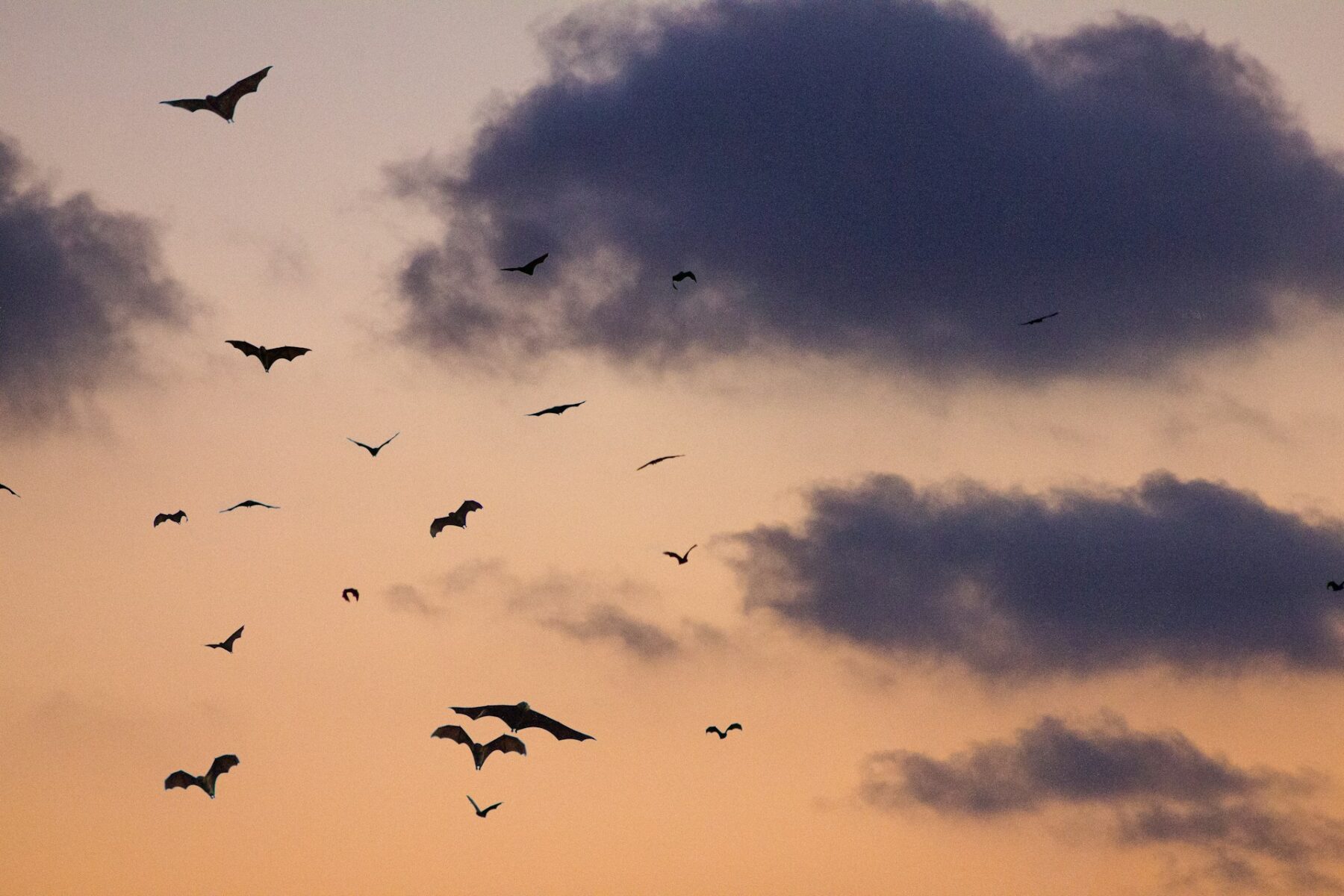
Bats hang upside down from a light fixture, pale stalks of mushrooms crowd the corners of the ceilings, and black mold inches its way up the walls. Bats fly in and out through a smashed window across open ground that was once a garden and is now a densely matted square of undergrowth. In this neighborhood there are no people, no traffic, no other sounds to complicate the process of echolocation. A few silent cars remain dotted here and there on the mud-caked streets, as if abandoned by a child who lost interest in playing with them.
This is the bats’ territory. They never need to venture further inland; there is more than enough food for them here on the city’s deserted coastal edge. What was once Edinburgh is now New Reekie, although this doesn’t fool its inhabitants into forgetting the recent catastrophes. There are too many reminders for a simple name change to persuade them: The line of crow-stepped gable buildings along the once-attractive shore now drip green with algae; the house that played host to Mary Queen of Scots as she danced a reel with her third husband now shuttered and silent; the cement factory so large that it was rumored to be a Cold War rocket hangar is now a smashed and empty shell.
The city authorities no longer pay for the streetlights to work here, and on moonless nights only the lighthouse still pulses seaward to warn off incomers desperate enough to try and land here from the north. Anyone disobeying the prohibition on entering this sector must grope their way along dark and silent streets, hoping they don’t slip on mud from the latest flood. But darkness is relative. Animals with adequate night vision, or those that rely on other senses like echolocation to guide their way through the world, are quite settled. Quite at home here.
The bats aren’t exactly alone. As they go about their nocturnal process of catching insects, tiny trackers attached to their chests collect information about every aspect of their lives and transmit it onward. A few miles inland sits Drover in his home office, facing a computer screen and going about his work.
Drover analyzes the bats’ flightpaths, food intake, respiration, heart rates, digestion, fertility and lifespans. There’s nothing that Drover doesn’t know about this colony of bats, and he can display it all in carefully annotated graphs and diagrams, accompanied by spreadsheets that he sends to the authorities at the end of each working day.
As they go about their nocturnal process of catching insects, tiny trackers attached to their chests collect information about every aspect of their lives and transmit it onward.
From his house on one of New Reekie’s seven hills, he’s a long way from the sea, but when he stands to ease his aching back, he catches a glimpse of the water’s surface gleaming like metal in the low winter sun, and he hastily sits down again. He knows he’s lucky to live this far from the coast, and on a hillside as well. The winds may be severe, the house may lose part of its roof on a distressingly (and expensively) frequent basis, but at least it won’t be flooded.
Sometimes just a glimpse of the distant water is too much for Drover. Now he slumps forward and his eyes droop shut, the bats temporarily forgotten. This is how Quine finds him, 20 minutes later. She stands and watches, knowing better than to disturb him. As long as she’s known him, he’s been prone to these sudden sleeping fits. A form of narcolepsy, he explained when they first met, using the medical term—she guessed accurately at the time—to cover up the trauma of his accident at the seaweed farm. When he’s out cold like this, he has the odd appearance of a man underwater, except it’s not the sea washing over his face but a play of extreme emotions. She’s learned that he has to ride it out and surf the wave onto land.
Eventually he opens his eyes and, glancing around, spots her and tries to smile.
“How’s it going?” she asks.
“Okay. I’m fine,” he lies.
Quine does something in financial services, in one of the oldest and most prestigious banks in the city; whenever people ask about her job she laughs and says, “It pays the bills,” before gesturing at Drover. “He does the interesting stuff. Ask him anything about bats!” Clearly she means it to be the sort of comment made by a supportive spouse, but sometimes to Drover it feels like she’s overcompensating for his pitiful earnings. Data analysts are ten-a-penny after all, doing work that in most other parts of the world has been superseded by AI. But in Scotland, thanks to strict laws on carbon accounting, the job has been protected. Drover knows he should be grateful, but he thinks sourly that it’s a shame the salaries haven’t been equally protected.
He’s revived by a barley coffee and then it’s time for the weekly chat with his boss, Toring, who shows up promptly on his screen. Toring’s always dressed in a typical scientist’s outfit of scruffy tartan shirt and t-shirt advertising some obscure band’s comeback tour, and he’s always very understanding about Drover’s condition.
They start by exchanging the usual pleasantries.
“How is Quine doing? Job still going well?”
“Very well,” but Drover pauses. Quine hasn’t actually mentioned work at all lately. “At least, I assume so.” What does she talk about? The weather, he supposes. Everyone talks about the weather.
“And now, anything out of the ordinary?” Toring obviously wants to move the conversation on to its real purpose, the bat data.
“A slightly heightened heart rate among 63% of the colony. A small but statistically significant increase in expiration rates, and a corresponding decrease in food consumption,” Drover pulls up the relevant graphs and diagrams as he speaks, “all of which point to collective anticipation of a problematic weather event in the medium-term future.”
“It’s not quite enough yet, though. It doesn’t meet the threshold for triggering the alarm system, so just keep an eye on it,” Toring advises Drover.
Drover nods, but he’s been working with the bats for long enough that he can almost feel the coming storm himself.
“Bat heart rate?” says Quine later, when they’re eating lunch. “How reliable is that at forecasting the weather?”
“It doesn’t meet the threshold for triggering the alarm system, so just keep an eye on it.”
“At least as reliable as the other technologies, and quicker,” says Drover. “It was their heart rate that forecast last year’s storm, several hours before the weather satellites picked up on it.”
Quine still looks dubious. “But do you completely trust it?”
Drover frowns. Quine knows all this, has always been supportive of his work. Why is she doubting it now?
Last year’s storm was one of the worst so far. Eight tower blocks east of the city center were so badly damaged they were rendered economically unviable for renovation. At least their inhabitants escaped alive; as a result of the decrease in air pressure, the bats were flying at lower altitudes than usual. Drover was able to calculate the corresponding decrease in distances traveled, and alerted Toring that a storm was on the way.
Now, this afternoon, the bats’ heart rate suddenly shoots up, and the warning process is initiated. Drover can’t resist the temptation to tell Quine before the official city sirens sound, their rising and falling tone reverberating across the hills and valleys. Straightaway Drover’s and Quine’s phones vibrate with a mass alert from the authorities instructing them to go through the usual pre-storm preparations and assemble candles, battery torches, water supplies, emergency food, and sandbags.
After they’ve finished, Quine says, “Fancy a walk?”
“Now?”
“Why not?”
“But there’s a storm on the way.”
“So? It’s not here yet,” and she glances out the window. It’s true, the tree branches are swaying no more than usual. “Looks okay to me.”
But Drover can’t bring himself to move. His limbs feel inert, and he can’t do anything but sit immobile at his desk, mesmerized by the dots swarming on the screen. As he watches black dots collecting in dense patches, he pictures the bats leaving their usual colonies in the broken buildings along the coast and heading to temporary roosts inland, huddling together and finding shelter from the storm. So Quine goes out by herself, and when she returns, he notices how much more cheerful she looks. He doesn’t ask where she’s been.
Later, they watch the local news, which shows the remaining tower blocks being decanted, and a long queue of people waiting for the buses to take them away. Each person is carrying a small rucksack.
“Change of clothes, essential medication,” Drover mutters, and Quine glances at him but doesn’t comment. The queue is silent, and Drover can sense their resignation at this enforced flight from their homes. It’s not the first time, of course. It’s not even the second, third, or fourth time.
“At least it’s all organized,” Quine comments. “Buses to the municipal halls, chemical toilets, camp beds lined up in rows, and vats of soup.”
Soup. Drover can still taste the metallic green soup. He shuts his eyes.
Two days after the storm and Drover’s at his desk checking the latest data.
The queue is silent, and Drover can sense their resignation at this enforced flight from their homes.
“Let’s go for a walk,” Quine tries again. “We need to get out of the house. You need to—”
Drover glances at her. Normally she doesn’t make such a big deal of his behavior; until now she’s been accepting of the admixture of narcolepsy, agoraphobia, and general anxiety that he brings to their relationship. He glances back at his screen, finds an outlier in the data. Something located nearby that appears to be motionless. He looks closer. Quine gives up and wanders off.
“Mm?” says Toring at their meeting later that day.
“It hasn’t moved for a few hours,” Drover points out. “And it’s odd. You don’t normally find bats in such populated areas.”
“No,” but Toring doesn’t look as if he’s paying attention. “How’s Quine doing?”
Quine? Drover’s confused. They’re talking about work.
Later, Drover makes the mistake of telling Quine that Toring was asking after her.
“Me? He doesn’t even know me.”
“Perhaps he’s just being courteous.”
“Huh,” Quine narrows her eyes. “What did you tell him about me?”
“Nothing!” Why does Drover feel like he’s caught in some sort of interrogation between the two of them? “I need to—” he adds. She’s right. He should get out more.
The sky’s washed clean, a deceptively innocent pale blue as Drover walks down the hill away from the house, picking his way past roof tiles and tree branches that landed there during the storm. Soon he reaches the position of the data point: a broken paving stone with something dark hunched on it. Something small and easy to miss, but he knows he’s looking at his first dead bat in real life. Knows too that he shouldn’t approach it. But there’s something so pitiful in its splayed wings, and in the way its tiny hand-like claws seem to be clutching at something just beyond its reach. The tracker, a bright plastic disk no larger than a penny, is still in position on the bat’s chest. It must still be transmitting—that’s how he found the bat. He lowers his head, averts his gaze out of a surely misplaced desire to give the bat some privacy. This is fundamentally different to seeing the representation of death on his screen, where it’s nothing more than a static data point. The body lying crumpled on the pavement reminds him of the essential mystery of death; it’s beyond numerical analysis. Beyond comprehension. As is the sorrow he feels for this small animal.
The body lying crumpled on the pavement reminds him of the essential mystery of death; it’s beyond numerical analysis.
As he’s standing there, he hears a van pull up, and at the same time a dog starts to bark.
“Step away from the corpse!” someone shouts and, turning, he sees a person in a hazmat suit. Of course, dead bats are dangerous and have to be disposed of using the correct procedure.
A large dog is sitting on the pavement, watching the proceedings with interest.
“What is that dog doing here?” Hazmat fiddles with a small robot, the sort that are sent into battlefields to disarm mines.
“I have no idea, it’s nothing to do with me,” Drover tries to explain, anxious that Hazmat might report him to the authorities for owning an illegal pet, but he’s drowned out by the whirring sound of the robot strutting its way along the pavement, accompanied by more barking. The bat shouldn’t have to lie there, waiting to be scooped up like rubbish. Especially not when everyone is so reliant on the bats. They should be treated with more respect.
“Get—that—animal—under—control!” screeches Hazmat above the inharmonious sound of the dog and the robot. Drover grabs the dog by the scruff of its neck and pulls it out of the robot’s path just in time, as the metallic pincers reach out and seize the tiny corpse. Clearly excited by this contact with a human, the dog jumps up on its hind legs, almost knocking him to the ground.
“A dog?” says Quine, “I don’t understand. Why did you bring it home?”
They’re all in the kitchen. The dog senses that it’s the topic of conversation and rolls over onto its back.
“Tummy rubs, eh?” Drover feels around on the animal’s chest for a tracker. He doesn’t find anything; this dog’s a stray and therefore of no scientific interest to the authorities.
“Oh, just leave it alone.” Quine looks annoyed. “I don’t like that it knows where we live. It’s probably got fleas or ticks.”
“Maybe.” Drover continues to pet the dog, and it scrambles to its feet and leans against his legs in a way which feels curiously comforting. Quine disappears for a meeting, so Drover searches for a piece of kit he hasn’t used for years: the granddaddy to the bat trackers, an old collar with a camera on it. The sort of collar that used to be worn by pets so their owners would be able to trace them and make humorous videos of the footage for internet use. Both the pets and the videos are long gone of course, included in the authorities’ extensive category of “waste of resources” and therefore prohibited. This collar once belonged to his mother’s terrier, and now Drover shows it to the dog, who sits patiently while it’s fastened around its neck. Then he fetches the dog a tin of tufa, the fake tuna that is the main export of the soya fields south of here. The dog bolts it down and, realizing there won’t be any more food today, wanders off outside.
Both the pets and the videos are long gone of course, included in the authorities’ extensive category of “waste of resources” and therefore prohibited.
Drover turns on his computer and manages to find the old camera software. Soon he’s getting a dog’s-eye view of the streets, snuffling along pavements, wading through the urban lakes that lap at the city buildings, cocking a leg, and there’s a sudden blurring as the dog presumably chases something small. Then he’s pausing at the entrance to an old tenement block, seemingly abandoned, nosing the door open and entering a long dark corridor. It’s quiet, empty of people, as the dog makes his way up a wide staircase and pauses at a door. Only a brief moment later the door’s opened, as if the dog has been expected, and he’s inside. Bare floorboards and scabby walls pass by; the flat must still be occupied, probably illicitly. Then human legs appear and a hand reaches down for a pat. A dish of food is set in front of the dog, who starts to eat.
Drover can’t stop watching. This dog’s version of the city is so different from his own. He hasn’t been inside a tenement block for years, not since the accident and the retreat to this house on the hillside. The heart of the city is only a few miles away, within walking distance, but it might as well be on the other side of the moon as far as Drover is concerned. He can’t bring himself to venture into the valley rendered amphibious by the succession of storms, where seawater has spilled into the streets and created makeshift canals. For centuries Edinburgh was known as the “Athens of the North,” and now some business ventures are trying to position New Reekie as the “Venice of the North,” complete with boat tours of the more picturesque ruins. Drover knows that Quine’s bank is involved somehow, but she stopped talking to him about it after he dismissed this as “catastrophe tourism.”
Eventually the dog stops eating and curls up. The camera’s pointed down at the floor, undulating with the dog’s breathing, as if the floorboards themselves are shifting back and forth, like the sea. Nothing is fixed or permanent anymore. Drover turns off the laptop and goes to bed.
Drover knows that Quine’s bank is involved somehow, but she stopped talking to him about it after he dismissed this as “catastrophe tourism.”
That night it’s even worse than usual. He’s underwater, checking up on the seaweed hanging in strands from the pipes. A difficult job, and dangerous too, because of all the other debris now under the water. Broken walls, bricks and stones, even bits of old furniture and household appliances. What was once on land is now under the sea and invisible to all but the people who work on the seaweed farms. It’s alright for him; he knows his way around this waterscape, can bend and flex like a seal as he fastens errant strips of kelp, can peer through the murky green fluid around him. A shoal of small fish dart past his legs and he reaches out to them to stroke their silvery bodies but something grabs his legs, stops him moving, he’s trapped and the air’s running out, he’s gasping and the fish have forsaken him—
He sits up in bed, still gasping. Beside him, Quine murmurs in her sleep and turns over. She isn’t disturbed by his nightmares anymore. He remains sitting bolt upright; it’s always impossible to get back to sleep afterward, so he swings his legs out of bed and makes his way to the office. He turns on the link to the dog and watches. Slowly his breathing calms and he relaxes.
That evening Drover is eating dinner with Quine. As a special treat, she’s bought salmon. And not the fake stuff, but real wild-type, genetically engineered to be identical to the indigenous species that lost its spawning grounds and became extinct.
“It’s a reward, you know how hard I’ve been working lately.” She clearly wants to justify the price—it’s orders of magnitude more expensive than tufa.
“And …” she pauses as if trying to judge whether or not to continue, “we’ve been developing a new product. And it was more successful than we predicted.”
“Predicted?” He predicts adverse weather from the bat data. What does Quine predict?
“It’s a way of laying a wager on the outcomes of weather.”
“Betting on the storms?”
“It’s a way of laying a wager on the outcomes of weather.”
“It’s fantastic really, it seems to be popular across all groups of people. We made far more profit than we expected last week.”
“But don’t you think that’s immoral?”
“Look, Drover. A lot of people can’t even buy insurance, at any price. If their house has been flooded already there’s no way they can get it insured again. So we’ve set up this product that allows them simply to bet on the probability of there being a certain type of weather event with certain characteristics in a certain time period. Unlike the insurance companies, we don’t ask them any questions, don’t set any conditions or limitations. If the weather event happens and we pay out—and we do pay out, with no quarrels or quibbles—at least they get some money to help deal with the consequences. It’s the victims of the weather who can benefit from what we’re doing. Not the usual big companies.”
“And you get expensive dinners.” Drover pokes at his fish.
“I got a bonus for developing a successful product for the company. Why shouldn’t I benefit too?” She gestures at his plate. “And you seem to be enjoying it.”
“It’s dancing on graves.” His reaction is extreme, he’s aware of that. Both extreme and irrational. He drops his fork.
“I’m the one footing the bills. Your little bats bring in sod-all.”
Now he hears clearly what has been muffled until now: her distaste for his work. And he has to agree that she is the one who rescued him financially. He couldn’t afford to live in such a nice place on a hill and safely away from the water, not after losing everything.
He picks up his fork and they continue eating in silence; the salmon can’t be wasted even after an argument.
After dinner, the dog shows up at their front door with scratch marks on its muzzle and a mournful expression. Drover cleans the scratches with hot water and gives the dog its usual tin of tufa, and goes to sit in his office with it. He turns the camera off beforehand—he doesn’t want people spying on him and the dog. This is a private relationship.
Quine appears in the doorway. “Aren’t you going to let anyone know about the dog?”
Drover turns to look at her. “You want me to tell the authorities about it.”
“It might be a disease carrier. Like the bats.”
Drover can feel the dog’s heartbeat beneath his hand. He hugs the animal closer to him. “No, I’m not going to do that. It trusts me.”
The next day, Quine has already left the house before Drover’s out of bed. He notices a new pair of sunglasses, a silk scarf, some new sandals. Quine’s bonus must have been bigger than he initially assumed.
At their meeting, Toring’s wearing one of his most ancient and scruffy t-shirts. “How are things?” he asks. “What’s new?” He’s just being polite, knowing full well there is never anything new in Drover’s life.
“We ate salmon last night. Real salmon.”
“Wait, what? How on earth can you afford that?”
“Quine. They’ve developed some new financial product. And she gets a bonus as a result.”
“A bonus?” Toring raises his eyebrows. For the first time since Drover started working with him, he looks judgmental.
Over the next few weeks, more silk scarves appear, and Quine buys Drover some cashmere gloves. She discusses plans for a holiday: “The wellness resort at the peak of Ben Nevis is perfect in June,” she says. “All that healing sunlight!” Or she talks about eco-treehouses in the Galloway Forest. Drover lets her talk without commenting; he hasn’t left New Reekie since his accident and has no intention of going anywhere now. In any case, Ben Nevis is covered in plastic waste, and the Galloway Forest has never recovered from the great inferno that turned most of its trees into broken sticks and ash.
When the dog’s not there, Drover watches its livestreamed footage. Once, a shabbily dressed man appears and waves. And even though he knows the camera is only one-way, he slowly lifts a hand and waves back.
A few days later, Drover observes an escalation in the bats’ perspirations, coupled with a decrease in their food intake. This combination of changes in the bats’ behavior hasn’t been noticed before, not even by Drover, but he seems to be proving more adept at picking up smaller and smaller deviations from their routines.
Even though he knows the camera is only one-way, he slowly lifts a hand and waves back.
During his meeting with Toring, he blurts out, “I picture the bats in flight as they swoop around the wrecked buildings. I can sense them, somehow, just as they sense the coming storm.” This isn’t what he meant to say because it sounds silly and unscientific when spoken out loud. What must Toring think? But Toring simply nods.
Perhaps this is in his blood. Given his name, his distant ancestors were likely drovers, those men who walked with livestock—cattle, sheep, even geese—across the country from farm to market. Perhaps this explains his ability to understand the movements of animals.
In any case, Drover is proved right. That afternoon, a new weather system is detected to the west of Scotland and the routine starts up. Quine announces that it’s refreshing to go out before the storm hits; there’s a heightened sense of excitement and danger in the air that makes her feel grateful to be alive! Drover doesn’t say anything. He doesn’t feel particularly energized when contemplating the damage the storm can do. Quine comments that he’s so unresponsive to her, it’s like living with a dead man. Drover doesn’t bother arguing; she’s right, he is a dead man. She leaves the house, slamming the door behind her.
Two hours before the storm’s due, the trees are already swaying and Quine still hasn’t returned. Drover hears a noise outside and opens the door to let in the dog. Instead, just outside on the garden path is a stranger. A small, slight woman, wearing a formal trouser suit and highly polished boots.
Occasionally they get people wandering up from the valleys asking for help, so Drover waits on the doorstep. He does donate small amounts of money and now, thinking of Quine’s recent purchases, he’s determined to do the right thing, as if to counteract her extravagance. But this woman seems too well-dressed to be in need of help, so perhaps she’s a volunteer herself. Drover encountered a few of these people after the accident. Some had good intentions, but others were just disaster junkies. They all backed away when it was clear that putting him right again would be a possibly lifelong task.
The woman removes her rain hat and shakes out a plume of long dark hair before she speaks.
“Hello, Drover.”
How does she know his name?
She holds out her hand. “It’s nice to meet you in person. Finally.”
Finally?
“Eaten any more salmon dinners recently?”
Perhaps he’s still asleep, dreaming that he’s standing on his doorstep on a chilly Scottish spring morning and being asked about his diet by a complete stranger.
The woman smiles. “I’m Toring.”
“Sorry?” he blinks at her, taking in her glossy hair and buttoned suit.
“Yes, I suppose this is a bit of a surprise.”
“But Toring’s a man!” Toring, who waves his arms around when he wants to emphasize a point, is the archetypal scruffy male scientist who cares only about his work. He’s not this neat and quietly confident woman.
“You’re sure about that?” she raises one eyebrow.
“Yes …” But he hasn’t actually seen Toring in person for years.
The dog bounds up and sniffs her. Drover envies its unabashed curiosity.
“Is that your dog?”
“I—I don’t know.” Is that why the woman’s here? Because of the dog? Perhaps someone has hacked into its camera, notified the authorities.
“I see. And is Quine at home?”
“No.”
“Glad you’re sure of something.” She moves toward the door. “May I?”
He doesn’t know what else to do, apart from step aside and let her enter his house. Once inside, she perches on the sofa and faces away from him in the direction of the distant sea, already churned up by the approaching storm. “You’ll get a message from the authorities,” she glances at her phone, “in a minute, telling you Toring has gone offline for work reasons. He—” and here she pauses to smile to herself, “is doing fieldwork.”
They wait in silence. Drover knows he should speak but can’t think what to say. Finally, his phone pings with the message.
“And when did you first meet Quine? How long after your accident?” The woman is watching him carefully, waiting for his reaction.
This apparent non sequitur takes him aback, and he pauses to think. “A few months, I suppose. And then she offered to let me move in with her almost straightaway, and I was grateful. More than grateful. I was desperate, to be honest, my flat was unliveable and I had nowhere else to go apart from the temporary accommodation in the tenements.”
“I can imagine.”
“Are you saying—” he stops. He doesn’t know what she’s saying.
“Would it surprise you to know that Quine’s company isn’t in the habit of paying out bonuses to staff?”
No. No, he’s not surprised, because she’s never mentioned bonuses before. So—
“She’s been betting on the weather.”
“She’s been betting on the weather, and she’s been winning her bets because she’s got an inside track on the bat data before it’s made public. Your bat data, of course. But now the company has grown wise to her too-frequent successes and had her arrested for fraud. Then they contacted the authorities, and so here I am.” The woman looks around. “Let’s go check your laptop for the spyware she’s installed on it.”
Later, as they’re drinking barley coffee, she says quietly, “Toring’s dead, I’m afraid.”
He nods. “When?”
“A couple of years ago. He was in Fraserburgh.” She doesn’t have to say more; a hurricane hit the town too quickly for anyone to escape.
She continues, “It was thought advisable to develop an avatar that mimicked him in every way, to ensure continuity with his staff. With you, in particular. Your work was going so well, we didn’t want to do anything that might jeopardize it. It was too valuable to us.”
He nods again. Of course. He has become so good at analyzing the bats’ data, and so keen to avoid the world around him. The numbers were the only thing that could make him forget, until he met the dog.
“But why did you have to come all the way out here to tell me in person?”
“Because of Quine. And because the authorities are wondering if you might have been in on it too. But you don’t think like that, do you? You take the world as it is, you don’t seek to manipulate it or take advantage of it. You’re too passive, or too good. It doesn’t matter which, it comes to the same thing in the end.” She waves her hand at the outside world. “And now I must leave. Will you be alright?”
He nods. “I’ve got the dog.” He might have lost both Toring and Quine in one day, but when the storm the bats are foretelling hits soon, he can bury his head in the dog’s fur while the windows rattle and the roof shakes. And he knows the real reason why the woman bothered to come out here in person: Thanks to him, and the early predictions of storms, the city authorities protect the inhabitants. Not to mention saving a lot of money. So it’s worth their while to protect him, just as the bats are allowed to continue living in the derelict properties on the coast.
The last time he sees Quine, her image is blurred in the poor-quality feed from the cell where she’s being held. It’s easy to think of her as nothing more than a collection of pixels as her face shudders silently and the text transcription scrolls underneath: Get me out of here! I haven’t done anything wrong!
Although she’s gone, her perfume is still present, the ghost of long-ago roses lingering in the bedsheets. Her bank is still promoting the gambling product that allows some to benefit from extreme weather while others lose everything.
It’s four years to the day since his accident. Four years since he’d been sent to check up on the seaweed crop in the eye of a storm. If the growing seaweed did loosen and detach from the holding pipes, the farm’s entire profit would be washed away, but the robotic divers were too expensive to risk being damaged by the churning sea, so a human had to go instead.
As the storm whipped up sand and debris, the sea slammed into Drover’s body over and over again, tumbling him around so that he was no longer sure of the way back to the boat. He managed to grip the upper pipe and anchor himself to it, getting his feet as well as his arms around the metal. The pipes were solid, and had survived many such storms. They were part of the old infrastructure that transported North Sea oil from ship to shore back in the twentieth century, before Scotland moved to renewable energy and repurposed that infrastructure for valuable seaweed crops.
But the pipes were too solid. Drover’s right foot became stuck fast between them, and he started to panic, using up too much oxygen as he breathed quicker and quicker. Peering through the cloudy water, he spotted something impossibly bright: a red sack shifting around near his trapped foot. An old shopping bag? God knows there was enough plastic in this sea. But no, the thing wasn’t moving randomly—it had a purpose. One long tentacle emerged, and then another. An octopus. Once an alien, exotic species, they were often found up here in Scottish seas since the water temperature had become so much warmer.
Her bank is still promoting the gambling product that allows some to benefit from extreme weather while others lose everything.
He watched, incredulous, as it squeezed out its tentacles one at a time from between the pipes, finally followed by its body, and he realized that instead of simply trying to wrench his foot out from between the pipes, he could maneuver it along the lower pipe toward the octopus, and the fractionally larger gap it had found for its own escape, and free himself as well. The octopus shot off into the busy, debris-filled water, and he swam upward toward his boat.
It was worse on the surface. The storm had arrived and enormous waves washed over the boat, rocking it back and forth. Exhausted, he hauled himself into it and was straightaway tumbled out again as it capsized. He repeated this process at least three times before he eventually found himself, more through luck than ability, lying in the bottom of the boat. And this was where his colleagues also found him, a good few hours later, half-conscious and drifting. His flat was destroyed in that same storm, and that was the end of his work at the seaweed farm and the beginning of his retreat from the world.
Now he logs into the database. The raw data scrolls upward, screen after screen of numbers. Numbers he has been living with for nearly four years now.
Why does it always come to this? he thinks. Is it inevitable that information gets coupled to money, and to the desire to make a profit? Can it ever remain pure? He can still hear Quine pedantically reminding him that it’s partly private-sector money that pays for the bat research. Everything must pull its weight in this half-drowned, wind-battered country. As far as anyone can tell, the bats aren’t physically hampered by the trackers, but they’re tied into a system that extracts information about them. An economic system that has utterly failed to preserve the natural world is now exploiting what remains to protect not the animals, but the humans.
After the dog has finished its evening tufa, they go for a walk. Away from the sad, dark house where he’s imprisoned himself for so long, down the hill and into the valley, walking carefully along the temporary boards set over the swampy ground, until they arrive at the coast and the abandoned sector of the city.
Inside the ruined flat, man and dog pick their way through the debris of Drover’s former life: the moldy rugs, the broken furniture, the books swollen with damp, until they reach the remains of the kitchen where he used to boil haggis and fry potatoes. No human can live here anymore, but these flats have escaped demolition because the bats have moved in.
Now, a bat swoops in through the broken window and, sensing Drover and the dog standing in the middle of the enclosed space, does a graceful turnabout. And Drover feels acknowledged.
The Disaster Flaneur
When I was a young American studies major in college, I became fixated on the role of the flaneur in literature. These characters—think of the narrator in The Strange Case of Dr. Jekyll and Mr. Hyde, or Virginia Woolf’s Mrs. Dalloway—are particularly tied to urban fiction; they wander the vibrant streets not actively participating but simply observing their surroundings, absorbing information and impressions.
The protagonist in Pippa Goldschmidt’s story “The Way Out” is a new kind of literary character that we’re likely to see more of as the climate keeps warming: the disaster flaneur. Drover is a data analyst who studies the slight variations in bat heart rate, flight patterns, and other somatic and behavioral factors in order to better predict oncoming storms. The bats of Edinburgh have taken over former apartment blocks and coastal manors, abandoned due to increasingly frequent storm surges that have flooded the city and displaced its people. Drover, with his computer data and bat trackers, observes it all from a house on a hill, constructing a narrative of the city’s destruction that he tells only to his disembodied boss, Toring, and his live-in girlfriend, Quine.
Like many flaneurs before him, Drover eventually gets a little more involved in what he observes; he sees on his monitors that a bat has died, and he ventures out of the safety of his hilltop home to find it on the real streets. There, he encounters both the epitome of the faceless state—a hazmat-suited figure sent out by the city to collect the bat—and its opposite, an affectionate feral dog who Drover eventually takes home. No other humans seem to be about in the apocalyptic cityscape that Edinburgh—now called “New Reekie,” an allusion to the longstanding nickname Auld Reekie, which affectionately mocked the city’s smoggy Industrial-Era ambience—has become.
As our own world becomes warmer and catastrophic weather events become more frequent and severe, it’s easy to imagine worlds like the one Drover observes from his hilly refuge. While in the United States we still respond to disaster mostly through cleanup and rebuilding efforts, as in the recent Los Angeles fires, we’re slowly starting also to talk about “managed retreat”—proactively moving houses or whole communities away from areas that will likely see repeated flooding or fires, or heat so extreme humans cannot realistically spend time outdoors. These retreats are a regular occurrence in Drover’s world, with residents carrying “only a rucksack” shuttled out of their homes and onto waiting buses, never to return.
Our flaneur status may be coming to an end.
These kinds of major population shifts have to date mostly happened in the Global South, not in the northern climes of either the United States or Scotland. Indeed, richer northern countries like ours have largely been observers to the darkest realities of climate impacts. But our flaneur status may be coming to an end: In 2024 alone, the United States experienced 27 climate-related disasters that each had a price tag of at least $1 billion. Observing from a distance is also easier when a robust insurance system protects those fortunate enough to own property from the worst economic impacts of climate disasters. House flooded or burned to the ground? Insurance companies will pay for you to build another one on its footprint, as happened after wildfires in the Oakland hills near where I live, or farther north in Paradise, California, or in flood zones across the Southeast—provided homeowners have procured the right kind of coverage, which is increasingly difficult as disasters multiply.
As recently as a decade ago, many people in developed economies like the United States and Europe thought insurance would continue covering most disasters, whether through the private insurance system or through government-funded programs such as the Federal Flood Insurance Program or California’s FAIR Plan. Back when I and others created the Risky Business Project, one of the first analyses of the economic impact of climate change on specific US regions and industry sectors, we believed it was the reinsurance sector that would see the brunt of the costs of climate change. Reinsurers exist to take on the risk of major catastrophic losses that front-line insurers would not otherwise be able to pay without going bankrupt; they pool these risks across global markets in exchange for premium payments from insurance companies. In essence, they are the insurers of the insurance market. Insurance companies, with their ability to adjust coverage on an annual basis and easily move away from the riskiest markets, seemed like they would be protected from the worst climate losses.
It turns out we were wrong—or rather, that the risks from climate change were far more frequent and widespread than we originally projected. The past two years have been full of stories of insurers retreating from major markets, including the states of California and Florida. As public insurance plans step in to try and fill these gaps, they face enormous fiscal strain, leading financial experts to worry about municipal bankruptcy stemming from increasing disaster-related costs. Climate disasters can create a kind of fiscal doom loop, raising government costs for cleanup, unemployment insurance, rent and food support, and other strands of the social safety net, while depressing property values and in turn, tax receipts.
Observing from a distance is easier when a robust insurance system protects those fortunate enough to own property from the worst economic impacts of climate disasters.
Insurance is so important to the climate story because it’s the main way our economy interacts with short-term disaster and long-term risk. Fundamentally, managing climate impacts—impacts that are now baked into our system due to 150 years of carbon-intensive industrial activity—is an exercise in risk analysis. Insurance companies are making a series of bets about what catastrophic events will play out, where, and on what timescale. Those insurers still making money today are spreading their risk across multiple geographies, so that no single event will wipe them out, and they can continue to make some money when an event fails to materialize. They’re making bets on catastrophic events—but because these events are now happening everywhere all at once, they’re starting to lose.
In Drover’s Edinburgh, the insurance industry has apparently abandoned the city, and the doom loop is well underway. Some blend of public- and private-sector money seems to pay Drover’s salary, but it’s not clear where the funds come from—possibly through taxes on residents, or some international financial assistance for Scotland, or the few private-sector players successfully gaming the system. We can see in the story that the weather data generated by Drover and his bats is of great potential value to private enterprise: Quine works for a shadowy financial company that is capitalizing on the new climate reality through a product that allows homeowners who can’t access insurance to bet directly on the probability of catastrophic events, getting a payout if they guess right, and giving the financial firm the payout when they guess wrong. As Quine points out when Drover questions the morality of this system, “A lot of people can’t even buy insurance, at any price. If their house has been flooded already there’s no way they can get it insured again. So we’ve set up this product that allows them simply to bet on the probability of there being a certain type of weather event with certain characteristics in a certain time period.… If the weather event happens and we pay out—and we do pay out, with no quarrels or quibbles—at least they get some money to help deal with the consequences.” Quine, unbeknownst to her employer, is secretly using Drover’s data to make her own private, fraudulent bets; she’s making out like a bandit playing this disaster roulette, spending her time buying silk scarves and engineered just-like-wild salmon while Drover toils away at his low-paid public service job and all around them, residents of lower-lying apartments file onto buses and are taken away from the floods.
It turns out we were wrong—or rather, that the risks from climate change were far more frequent and widespread than we originally projected.
Is this scenario really so futuristic? I’d argue that some version of it is happening already. While insurance companies, which are regulated by state governments, are starting to back out of many markets, there is still plenty of catastrophe arbitrage happening around the world. Look at the oil and gas companies betting on ice melt to open up new shipping lanes in the Arctic, or hedge funds playing the futures market based on carbon prices or water availability, or even the increasing popularity of catastrophe bonds, which allow insurers to transfer the risk of events to investors who then get a payout if the disaster doesn’t happen. These financial markets thrive while those who are already the most vulnerable, with the fewest options, bear the brunt of each successive disaster. The difference between what’s happening today and what Quine describes is simply that in her scenario, those most vulnerable to disaster are also those allowed to bet on it. In effect, Quine’s product takes the rarefied disaster markets of today’s financial sector and applies the logic of newly legal sports-betting apps like FanDuel and DraftKings, or consumer-grade stock trading apps like Robinhood, making gambling on disasters accessible to the general public. But there is still a middleman taking their cut—Quine’s own financial firm—and I assume that only those who still have the means to play in the markets are set to profit from it.
Drover, who is struggling with post-traumatic stress from a past storm and is functionally agoraphobic, has serious qualms about the ways that others are profiting off the catastrophic events he watches unfold on his screen, day in and day out. He chides Quine for the new betting system, comparing it to “dancing on graves,” and feels similarly anguished about the “catastrophe tourism” happening through boat tours of ruined parts of the city. He worries that information, his stock-in-trade, will always be coupled to profit motive, and wonders whether it can ever be “pure.”
In portraying data-driven Drover as the white hat and money-driven Quine as the villain, Goldschmidt’s story might overlook a fundamental tendency of humans in crisis—something that’s become increasingly clear over my 20 years working on climate issues. Like other animals, humans gravitate toward survival, including adapting to current conditions and finding ways to be resilient in the face of long-term change. It’s true that our economic system prioritizes making money from current conditions, which includes betting on the worst outcomes. But it also has the potential to rise above those conditions. Each year of disaster brings new innovations in wildfire monitoring, desalination, regenerative agriculture, reforestation—all born of necessity, and all moving toward a more resilient future.
They’re making bets on catastrophic events—but because these events are now happening everywhere all at once, they’re starting to lose.
Humans tend to band together in times of stress, finding fellowship and shared strength through community. Wildfire and flood events bring heartbreaking stories of loss, but also—always—inspiring stories of empathy and human connection, as Rebecca Solnit documents in her book A Paradise Built in Hell. Ironically, Scotland itself is a bastion of community-mindedness, with an enviable “community council” system organized by the national government to foster community empowerment across the country. I can’t imagine that culture breaking down in New Reekie just because of a few big storms.
It’s tempting to view climate change, with its steady march of disasters and disrupted social systems, from a critical distance: to take on the role of disaster flaneur, viewing the impacts through our computer screens until the moment it happens to us. But the reality is that across the world we will need to be right there in the fray, standing shoulder to shoulder, and marshaling all our creativity to find new technologies, systems, and financial structures that adapt to the world as it is now—not the world we are increasingly leaving behind. Like Drover at the end of “The Way Out,” standing with his new pet in the wreckage of a flooded apartment on the coast, we need to move beyond our yearning for a past, pre-disaster life, and instead seek connections and renewed purpose in a world that is changing fast—whether we’re prepared for it or not.
Out of Ash
This story was originally published in Slate in May 2022. It is republished here as a part of the Future Tense Fiction project, presented by Issues in collaboration with ASU’s Center for Science and the Imagination.
Author’s note: Even though “Out of Ash” first appeared early in 2022, a lot has happened.
Predictions about sea level rise have grown more dire year after year. Meltwater rivers run on and below glaciers, pouring new water into almost every sea. Our local Mount Rainier, where New Olympia is born in this story, is nearly bare this summer; gray and rocky. It used to look like an ice cream cone all year. While it surely feels absurd to many Washingtonians to even suggest that our capital city might need to move, the city itself is building the longest-range plans in its history to deal with sea level rise.
Second, the current political moment illustrates that good government matters. Good government goes largely unnoticed. Its absence hurts. Part of why I wrote “Out of Ash” is to demonstrate that local and state government is crucial and that it is full of people who do care. Each of us should be grateful, engaged, and present as we face a polycrisis of our own creation together. Because to create a future we can stand, we must work together—people and government, heart and power.
I have enjoyed this future and this tale enough to create other short stories and a novel with these characters. Perhaps you will see those in print one day.
New Olympia was, at best, half-birthed.
The evening after the legislative session ended, I walked her nearly empty streets in a comfortable pair of jeans and a pale pink sweatshirt. The shirt was so ragged that Susannah, my chief of staff, had tried to steal it and throw it away a week ago. But I loved it, and besides, it made me look like no one. Far easier than looking like a governor. Guards followed at a distance.
Mist gave way to soft rain, then faded back to damp cold. Stored sunlight made octagonal tiles on the path under my feet glow. I followed its light to the middle of Central Park, where dusk barely illuminated the blue and red mosaics of the town well. Volunteers had moved every piece of the well they could salvage from drowning historic Olympia to the replica in New Olympia. By car, the journey was over 65 miles. The new city perched on the lower slopes of Mount Rainier, and the water tasted as clean, although more like mountain than river. This well, like the old one, operated as a free community asset. The glowing streets, the well, and, a few blocks away, the new State Capitol all looked even more beautiful than the artist’s renderings. The city ran on sunlight. Edible plants bordered parks, fed by recycled wastewater as clean as the well water. New Olympia gave as much back to the ecosystem as it took.
I ran my fingertips over the decorative tiles on the well. I had set the first mosaic in a ceremony that had taken all of 15 minutes. Impossible to tell now which one it was, although I recalled the blue-green of a sunlit summer sea. Immediately after, I’d been rushed away to visit heartsore firefighters after flames erased over 400 homes in Wenatchee.
I had dreamed New Olympia into being, fought for her, introduced bill after bill and bared my soul at physical and holo lecterns. New Olympia. A new capitol for a new time. A place for a time when humans were finally driven halfway into one another’s arms by the vast price of our sins. When I first won the governor’s job, it had been partly because voters shared my vision of a new state rising from the ashes of the world we were burning with yesterday’s carbon.
A place for a time when humans were finally driven halfway into one another’s arms by the vast price of our sins.
Tears stung my eyes. I should have paid attention. But no. I’d sold the idea and ridden it to power. Then I’d assumed New Olympia would work, or at least believed people when they told me it was working. So stupid.
All session, New Olympia had been full of lawmakers and deals, of passion and argument. Then, yesterday, cars drove themselves up from Seattle, Bellevue, Vancouver, Cle Elum, Walla Walla, and every other corner to gather the beleaguered servants of the State and their many minions and ferry them to shrinking constituencies far from here. The protesters had left with them. Also, all of the reporters except the few assigned to me. They knew what I knew.
I had failed. I had built a city, but I had not moved one. New Olympia died as soon as the lawmakers left each session. Yes, Washington’s people had almost all snugged up to thriving Seattle or Bellingham, and yes, our population had shrunk for 10 years running. But there were still a lot of people in Washington State, and this beautiful place wasn’t attracting them. Meant as a model community, New Olympia served as a temporary home for a desperate government twice a year.
I sat on the cold, hard bench next to the well, my hair damp, the sky low and dark. No stars. Nightbirds chattered. I’d rather hear the aggravated pleas of parents calling children in for dinner, the chatter of friends strolling and talking, the padpadpad of joggers, and the lilting notes of street buskers.
Exhaustion weighed on my bones and muscles. It felt almost like despair, which was never, ever acceptable.
Session had been full of knives. Not the old knives of lies, but the new ones of competing realities: low birthrates, disease, food shortages, fires, sea level rise, threats from neighboring Idaho, and no help at all from the Federal government. We had succeeded at many things—because we had to—but no bills passed to move other cities. We had merely condemned more to die as we scraped human infrastructure from places in peril. Managed retreat rather than glorious rebuilding. Returning what we had taken to nature about to take it back anyway.
I had failed an entire state. In this, anyway. In vision. Washington’s politicians and her people—both—had bought my dream and given me money.
Then seawater had risen faster than the scientists predicted, and disruptions had slowed design and building. The people of Olympia had needed to move before we finished their new home, and they had gone elsewhere.
I let the water run over my hands, cool and bracing. The original well had been forced up and out by gravity and the pressure of rocks, a gift from the Earth. Here, we had to drill down and force the water up. There was meaning in that metaphor, but I was simply too tired to pull it together. I ran my wet palms over my face, turning my skin crisp and cool. I wanted to do so much more for Washington State, but first, I had to make this right. Political enemies were already making it election fodder. Washington’s people had birthed this dream and fed on the hope it carried.
Mist surrounded me as I strolled back to the governor’s mansion.
At home, I stared out of an ornate living room that overlooked the empty Main Street and sipped hot mint tea. After an hour, I called my harried chief of staff. “Susannah?”
Her tone was friendly and unsurprised, even after 9 p.m. Susannah had been with me for 16 years, since 2027, when I was partway through my first stint as a state congresswoman. “Louise?”
“I need help.”
Tired curiosity edged her voice. “What can I do for you?”
I felt as exhausted as she sounded. Maybe more. “I need help with the city. With New Olympia.”
A short silence, then questions. “An urban planner? An artist? An engineer?”
I laughed. “They did their work. I need an immigrant or two, people who will be liked.”
“Two? Is that enough?” she asked.
“Two. With organizing experience. And of course not. I need 50. But let’s start with a team I can hide inside my operating budget.”
“Any other specifications? Immigrant is a little broad.” I heard the smile in her voice. “Refugees? From a particular country?”
“They’ll need to talk to residents. Bilingual.” I mulled her question. “Young? Enthusiastic, anyway.”
“I’ll have them there by noon.”
And she would. Susannah knew me well enough to read import in my tone. “Thank you. I … I need to fix this.”
I didn’t have to explain what, and even though it might be utterly unfixable, she replied, “Of course you will. We all need this damned city to thrive.”
In my dreams I walked the gleaming, nearly empty city all night long.
At noon, an older woman I had seen before but couldn’t remember talking to and a woman maybe a third of her age stood awkwardly just inside my office door. The older one shifted her burly body back and forth, one foot to the other. The younger woman’s dark eyes looked eager, excited, a little apprehensive. Long black hair fell flat and perfectly manicured down her back. Her khaki pants and navy shirt were neat and practical. The older one appeared Latina and the younger East Indian. Susannah hustled them into chairs. “This is Guadalupe and Chandra.”
I smiled to put them at ease while Susannah offered them peppermint tea and small chocolate cakes. As they sat, I asked them to tell me their stories.
Guadalupe had worked as an organizer on my first and second gubernatorial campaigns, primarily on the peninsula. A reminder of the thousands of people I had never met but needed, owed. Her family had come up from Nicaragua in the late 1990s and she had been born just after they crossed the border. A Justice Warrior now, and once, when it mattered, Antifa. Her voice rumbled through the room, deep and compelling. She would be able to convince crowds. I signaled Susannah that she was a keeper with a nod, and turned my attention to Chandra’s story. Her father died of heat, in India. Her mother brought her from Uttar Pradesh when she was 10, taking a cruise and disembarking forever and illegally in Florida. They’d made their way west, finally finding a path to green cards here. The girl looked like she might be 20 now. Maybe. She was quiet and clear in her speech, and so calm that it took me a while to understand that her response to her father’s death was a plan to fix the entire climate and remove all the greed and meanness from humanity along the way.
I mulled that for a while. Was she too naïve for this? Too young? The job might need passion. I hesitated. Eventually, I touched Susannah’s arm to signal my approval for Chandra, and the four of us began to plan.
A day later, we rode one of the armored cars into Seattle. While Guadalupe seemed focused on the problem of populating New Olympia, Chandra peered out of the windows and took hand notes in a paper journal. From time to time she asked the car a question. After a while I put it into tour guide mode, so that it told her where we were and related snippets of each town’s history as we passed through. Chandra’s questions implied far more interest and expertise in flood and fire scars than history.
The Seattle Downtown Coalition was always happy to meet with me. I wore one of my go-ahead-underestimate-me suits complete with purple granny glasses. I settled Guadalupe and Chandra in back to observe as I pressed a room full of CEOs and CFOs. Yes, they would move some franchises to New Olympia. If we subsidized them. They had, already, hadn’t they? Who cared if they only stayed open half the year? Yes, the University was a draw. But it wouldn’t open for two more years. If that. Hadn’t the whole city been two years late? No, they wouldn’t move tech jobs there. People in tech could live there if they wanted. They could live anywhere. Anyone could choose New Olympia, if I could figure out how to make it attract them. Right now it was too far away and too sterile and there was no nightlife. What would I trade for small manufacturing? Not the price they quoted me. Couldn’t I just be patient? After all, they asked, why did it matter?
They concluded with a question. Hadn’t they helped to clean most of the drugs and homelessness out of Seattle? Made huge investments in affordable housing?
I had to say yes to that. And thank you.
After, in my Seattle office, Guadalupe gestured and fussed over corporate greed, about the right thing being utterly unimportant. She paced. I empathized, without reminding Guadalupe we needed an economy. When the fire of her frustration burned down, she sat back and asked, “How do we teach them to give a shit?”
“Good question.” I poured myself a glass of merlot.
Chandra looked up, catching me with her quiet, intense gaze. “You asked us to watch that horrid meeting just to show us that this path is dead.”
I raised my glass and nodded in acknowledgment.
After the door closed behind them 10 minutes later, Susannah plopped on the couch and poured herself a glass of sauvignon blanc. She brushed long dark hair away from sky-blue eyes and sipped her wine with purpose. After a long moment, she let out a noisy sigh. “Chandra’s quieter than I expected her to be. Maybe you frighten her.”
I smiled. “She parcels her words out like gold. And mostly, they are.”
Susannah nodded and we turned to other matters of governance. Tomorrow, I had meetings on infrastructure and safety, and Chandra and Guadalupe had an assignment. Each was to find one regular person—a laborer, a teacher, a shop owner—willing to move to New Olympia for a year. We would subsidize moving. Only that; it was coming from my personal budget. Still, the basic state stipend would be enough to buy food and pay for housing. There were 40,000 empty dwellings out of session, 15 in. Two new residents a night was like two drops in a dry riverbed. Not a program, but a series of tests.
Each was to find one regular person—a laborer, a teacher, a shop owner—willing to move to New Olympia for a year.
Sunset spilled gold and umber across the glassy surfaces of the tallest buildings before I escaped to wander the city. I wore a long blue coat and a tight black hat. Just a middle-aged blond woman out for a late-spring walk. Never mind the black-clad guards behind me with dogs and the small drones scanning the area around me.
The crowd sounded good, upbeat, chatty.
Tourists. Workers. Buskers. Families. Pike Place’s iconic “Market” sign glowed primary red and the air smelled lightly of fish and flowers.
Seattle would never retreat. We’d just keep building more sea wall. The latest iteration had added 10 feet. West Seattle, visible from here as a low-lying hump of hills that projected into the sound, had climbed up and away from its beaches. Olympia had been doomed for lack of elevation. It had no place for a wall, just a thousand inlets for the South Sound that also served as outlets for multiple river basins. Seattle had the resources and will to wall itself safe. West Seattle could climb away from drowned beaches. Olympia had only been able to move or die.
Downtown hummed with laughter, music, hawkers. Nightclubs, shows. Seattle was the “hot” city on the West Coast. With a little help from government. From me. But frankly, not much. The people I’d lost the arguments with the night before had earned the right to argue with me.
I climbed up University Street. High-rise on high-rise on high-rise. The occupants of a mere 10 of these buildings could fill most of New Olympia’s squat five-story housing.
A rooftop bar in the Nickels Building offered a view of other rooftops spread below it. Rhodies and azaleas bloomed in pots, and rooftop gardens were dark with freshly turned soil or spring-green sprouts. Laughter still inhabited Seattle—and safety. The rich weren’t going to move because I asked them to.
I hesitated, chose a black metal table by the edge of the balcony. Two of my minders took a table near the wall and watched me watch the city. Embedded communication tech would let us talk if we needed to.
A short, thin middle-aged man pulled up a chair at my table. Nondescript, with regular features and the beginnings of a bald spot, undistinguished in any particular way. “Can I buy you a drink?”
Tempting. But I wasn’t stupid. I’d order my own. “No. But thank you.” I pulled off my cap. Ran my fingers through my hair.
His voice sounded soft and sweet. “Do you mind company?”
“No.”
He hadn’t recognized me yet. After he sat, I looked directly at him.
“Do I … Governor!” He stood.
“No. Stay.”
He leaned away, one step already taken, poised to flee. “I didn’t vote for you.”
“I don’t care.” I smiled my best Louise Lucky smile at him. Just a public servant. Nothing to see here. “Join me.”
After a minute, he sat, and after a minute more, his shoulders relaxed and he almost smiled. “Pretty night,” he whispered.
West Seattle could climb away from drowned beaches. Olympia had only been able to move or die.
“Yes.”
“I didn’t mean to intrude. You just looked … lonely.”
That hit a mark I seldom noticed anymore. I flinched. “I’m thinking.”
He flushed, looked down.
I spoke into the awkward void. “I’m thinking about New Olympia. How to get people to go there.”
“Why?”
Wasn’t that just the question? But I countered. “Why not? Would you go?”
“Me?”
I laughed. “Yes. I did after all.” Not that moving the governor’s mansion was anything like moving a normal person, or even a displaced family.
“I have a house. Here, in Seattle. If I sell it, I don’t know if I can get back in five years if I want to.”
Real estate. Seattle’s golden goose and Achilles’ heel. “What if you could rent your place for the cost of your mortgage?”
“I couldn’t.”
Because I had helped champion rent control. “What else?”
He blushed. “And I like the opera. There’s no opera way out there.”
“I like the opera, too.”
I wore an earbud. One of my minders spoke into it. Frank Smithson. Inherited a concrete company. Built part of the sea wall. Votes for your opponents. Two kids.
It irritated me to know people’s names before they offered them to me. I made a mental note to remind staff not to give me personal information unless someone was a threat or I asked for the data. “Thank you for saying hello. And for the honest answer.”
He nodded, smiled. And fled the moment I stood up.
A woman about half my age recognized me, gestured for me to join her. I did. I’d seen her somewhere. Ebon skin with long, black hair caught in a net. She wore a trendy emerald-green pantsuit. “Kinady,” she stood and offered an elegant and long-fingered hand. “I interviewed you for Seattle News Now.”
I reached across the table, shook her hand. Her nails were perfect blue ovals with stars on them. We hadn’t met in person, even in the interview, but I’d seen her on newsreels and in press audiences multiple times. Always stand-up-and-notice pretty. “You talked to me about the military bases we bought?”
She interpreted the question as an opening. “Yes. Do you mind if I ask a few follow-up questions?” Her smile was broad and friendly. “I’m freelancing now.”
“I can schedule time with you later this week.”
“I heard the Chinese … ”
I stood. “Thank you, Kinady. Nice to see you again.” I didn’t want Kinady to move to New Olympia. Reporters were required for democracy, but they were also why governors couldn’t ever say a single wrong word. “I will set up a time.”
A signal. Staff would tell Susannah, who would set up a meeting, and I’d lose an hour for prep and 20 minutes for the interview.
I left, and before I’d had so much as a single glass of water. Back at ground level, the streets were so packed the guards walked close enough for me to hear the dogs pant.
The next morning, we met in my most impressive Seattle conference room. Chandra looked stunned by the sweeping views of downtown and peekaboo sightings of Puget Sound. Birds wheeled by the window. Guadalupe proudly showed me pictures of three families, all brown-skinned and dark-haired, with two children peering out from behind one of the men. “They will go, maybe start a restaurant.” Guadalupe watched me closely, looking as much like a student who wanted a good grade as a 63-year-old woman.
“Thank you.” I told her, genuinely pleased. “That’s fabulous. I’ll write a personal note to the families and send it when staff contact them tomorrow.” Regular people like Guadalupe—well, regular activists like Guadalupe—could do so much more than I could. Why the hell did I forget that over and over?
I glanced at Chandra.
She smiled. “I found a piano teacher willing to move if we help her move her piano. I said we would do it.” She projected a picture of a diminutive Asian woman with wispy white hair and deep wrinkles.
Less impressive than Guadalupe’s find, especially since the piano teacher was a senior citizen. But, I thought, better than I’d done. I asked, “Chandra, why did you choose her?”
The girl offered me a wise smile. “Every city needs music, and Amelia Wu is the matriarch of a large family.”
Well.
The seven days went quickly. We collected 30 people in all, which was 10 more than my budget had planned for. My efforts accounted for two.
Susannah found me a donor to cover the costs. God bless the chiefs of staff of every elected official everywhere.
We were making progress and learning lessons. But in a week, I would have to stop this foolishness and run back full-tilt into campaigning and the other duties I was giving half-time to.
I gathered Chandra and Guadalupe together. “Where shall we go now?”
“Spokane?” Guadalupe suggested.
I shook my head. It was a gateway to Washington, but military intelligence suggested it would fall to Idaho soon. Not through actual war, of course, but Spokane’s people (mostly) liked the Idaho ideology of every man, woman, child, wolf, and dog for themselves. “Walla Walla?” Guadalupe asked.
“No. But that’s a good idea. I’ll have the Border Patrol tell immigrants they let in through Walla Walla and Vancouver that we’d look kindly on them locating in New Olympia.”
“Can you make them?” Guadalupe’s voice fell to a mumble as she said, “I know it’s not what you normally do.”
“I’ll have the Border Patrol tell immigrants they let in through Walla Walla and Vancouver that we’d look kindly on them locating in New Olympia.”
“And become a dictator?” Spokane might be falling in love with a dictator in Idaho, but Washington wouldn’t go there on my watch. “People need the freedom to move where they want. We’ll encourage immigrants to choose New Olympia, but I won’t force anyone.”
Guadalupe’s slight grin signaled relief. So she had become comfortable enough to test me. Good.
Chandra stood and moved to the window. “What smaller cities are being relocated? I hear there were votes about that, money given.”
Her question was good. The Long Beach peninsula had been gone for 10 years, and Ocean Shores and Moclips lost as well. The tribes were taking care of themselves; gambling increased near the end of the world we used to know. The Quileute Tribe and the Lummi Nation had each moved significant parts of their reservations to safety. I stood and stretched, providing a moment for my minders to catch up and whisper in my ear. Sultan’s downtown.
I did remember. Good choice. “Sultan. On the Skykomish River. We prohibited rebuilding two years ago, and this is the year of return.” Return. The law called it managed retreat, but return sang happier in my heart.
Guadalupe’s eyes widened slightly. “How the hell did we lose Sultan? That’s not near the sea.”
Chandra spoke up. “Atmospheric rivers. The Skykomish flooded Sultan and Gold Bar badly in 2036 and again two years ago. They hadn’t really finished rebuilding yet.” She looked proud of herself and called up a few more facts. “One hundred seventy-two homes were destroyed, and 86. A chunk of Highway 2 as well.”
I had signed a disaster resolution for that. But somehow it hadn’t surfaced in my head, not really. Sultan wasn’t huge, but it had been home to families and lost a historic downtown. “I’ll have two days.”
Susannah asked, “A formal visit?”
I didn’t hesitate. “No. I’ll stealth in.”
“Does that work?” Guadalupe asked.
Susannah answered for me, laughing. “Sometimes.”
Chandra raised her hand for attention. “Can we go next week instead? Saturday?”
“Why?” I asked.
“That’s the town’s LastDay. The burning.”
I’d been to Olympia’s burning. I’d hated it. But she was right. I glanced at Susannah. “Can we make that happen?”
“I have to move out some meetings on next year’s agenda, and the interview you just scheduled. Kinady.”
“OK.”
Chandra spoke up, an unusual note of pleading in her voice. “I went to school with Kinady. Can she come?”
A reporter? Chandra had started to earn my trust, but now she wanted me to jump off a ledge. I stopped myself from saying no. “Why?”
“She sees things I don’t. All of her work bends toward fixing things.”
Even when she had to skewer me or one of my programs to do that? But it wasn’t like I could populate New Olympia by myself, and damn it, the town needed people. I hesitated.
“Please?”
The piano matriarch had, in point of fact, already convinced two of her children to go with her. And they had children. But a reporter? A hard look at the trust and hope in Chandra’s eyes convinced me to surrender. “If she’ll agree not to broadcast unless I say she can.”
“But you won’t censor her? I mean, if you do let her do a show?”
I relented. “Very well. She can meet us there.”
We rode in a line of armored trucks camouflaged with dents and scrapes and missing bumpers. I had ordered the stealthy appearance, including requiring my guards to dress in old jeans and leave the dogs in the car with a minder.
Blue sky hung over a late spring day. Sultan’s streets were potholed and cracked, spalled at the edges, and in a few places missing altogether. The houses, of course, had been scraped off the selected streets by the Department of Ecology cleaning crews. Street trees and yard trees showed off their best bright new growth, the greens of katydids and not-quite-ripe limes. They would stay behind to capture carbon and retain memories until they flooded or burned away. Glass and metal would have been recycled, the best wood as well. Toxins carted away and properly disposed of. Street art re-homed. Now, a pyre of consumables built on a parking lot rose almost two full stories. Rotted but unpainted wood from fences and side yards, paper and cardboard, cotton draperies. It was deliberate. Everything could have gone. But every town we retreated from deserved a funeral pyre. There were at least 100 cars and trucks pulled onto the high school parking lot and field already. Residents whose homes were high enough and didn’t need utilities, and thus had been allowed to stay. Former residents. Curious neighbors. Press and pseudo-press. National Guard, as well, scattered here and there in soft camo. Tables and chairs and bright canopies filled the center of the field. People grouped and mixed and mingled. Children played. Dogs barked at one another.
Every town we retreated from deserved a funeral pyre.
It was going to be hard to stay here all day. So much pain.
More people came. Families. Women holding hands and glancing at the burn pile with distrust or loathing. Children running and playing, laughing while they waited for the last town barbecue. The river that had destroyed the town ran gray-blue and fast, holding itself neatly inside its banks as if it were well behaved.
Chandra walked up to me, Kinady striding behind her. Today, Kinady’s shirt was a blue brighter than the sky. Darker blue and carmine beads clattered together in her newly braided hair. She wore drones like decorations, small and expensive. A tribute to her success, even if they did look like pet insects.
Food came in on trucks labeled with the names of various climate NGOs and community groups, even Elks and Rotarians—vestiges of an old world almost lost. I pulled my hat down and went to wander through the tables and gathering crowds.
No one expected me; no one saw me.
A pair of old men commented on the size of the crowd. “Vultures coming to watch us die.”
His companion answered him with a bit of a growl. “People need entertainment.”
The first speaker laughed. “It’s not Burning Man. Did you ever go? That was entertainment. We were making a new world. The man was 80 feet tall the year I went. What the hell do we burn the town for?”
The other man laughed. “So we know it’s gone.”
“I knew that when it flooded.”
I passed them, lost the thread of their talk. Catharsis. Not creation. I’d been to see the man burn once, and that had been defiant and showy. City pyres were acquiescent and sad. Small, to keep the carbon cost low. A woman told two daughters, “Stay away from the fire until it starts up, burns a few minutes. Someone hid fireworks in the Ocean Shores pyre.”
Guards watched this fire. Not just because of me. This day would wipe away a city founded in the 1880s. Its loss wouldn’t please anyone. Generations had owned some of the houses we’d forced them out of. Nobody liked it. Return hurt. Every town fought its own demise. Not that it made a difference. Lawyers, insurance companies, and climate events were bigger than the people who lived in these places. Every adaptation stuck a knife in someone’s heart.
I passed a middle-aged man sitting on a bench by himself, fiddling with a drone. He was dressed in old clothes, and a large backpack sat on the ground beside the bench. It had tools and water bottles and a red raincoat tied to it.
Every adaptation stuck a knife in someone’s heart.
I picked up my pace, trying to force myself out of the morose mood squeezing my chest.
A hand on my arm. Kinady. I turned to look at her, a brightly colored dark woman in a sea of mostly white rural Washington faces, her body so full of energy that even when I stopped to give her an opening, she bounced in place. “What do you want to tell people?” I asked her.
She spoke fast, smiling and speaking with her whole body. “I found a family I want to talk about. They moved here 20 years ago, from Mexico. Fleeing Tijuana. Now they have to flee again. And the Xiangs. They came here from China. And the Paulsons, who have been here as long as they know. All of them. Not one kid moved away. Now everyone has to go. I will make their stories compelling.”
I pursed my lips. Thought about the mother and the old men. “Can you make the burn pile mean something? The sacrifice?”
She nodded.
I wanted more. “Can you keep the story from being sad?”
Her smile had a sardonic edge to it. “Maybe not. Not for these people.” She glanced toward the crowd continuing to gather around the food, to take plates. Kinady continued, “Chandra asked me to talk about Amelia Wu. She’s already moved to New Olympia. Chandra and Susannah found her a condo on the top floor. When she practices, her music will spill out into a park.”
Chandra hadn’t told me that. Surely she was going to? I could see the story Kinady was putting together in her head. “So people will see that New Olympia is a valid choice?”
“One of many good choices, but yes.”
Could she pull it off? She was following the rules I had lain down, asking. Legally, she didn’t have to do that. I really didn’t want to like a reporter. “Chandra wants you to include me in the story, right?”
Kinady smiled at me as if I were a 5-year-old who had earned a silver star. It irritated me, a little. The people from Sultan probably had places to go already. But some might not. And there were two other towns on the list for this year. Maybe no more for a few years. Maybe. If the damned disasters slowed down.
Kinady was a reporter. She’d be hard on me. “You’re going to tell them how I failed.”
She licked her bottom lip, hesitated, then leaned slightly toward me. “I’m going to say that it takes more than you to succeed.”
I thought of the well in New Olympia, how the old well had given to us freely and the new one took engineering, force, and effort. Hope, and bringing a heartbeat to New Olympia, also required engineering and force, and Kinady was a true force of human nature. And Chandra. And me, to the extent I could get out of the way. “Go ahead. Have fun. Tell me when you need me.”
“I’m going to say that it takes more than you to succeed.”
She grinned. “Can I be the one to reveal that you’re here?”
I swallowed.
“Not yet.” Her eyes danced with the idea of her story. “In a little bit. In fact, I’d like it if no one knows you’re here for another hour.”
“I often get recognized.”
“I know.” She leaned toward me, almost a move to give me a hug, but then stopped herself.
We stood self-consciously apart for a moment. Then I told her, “Thank you.”
She disappeared into the crowd despite her bright colors. Maybe I would regret this. But maybe not. There would be no single answer to New Olympia’s population problem, no one way to bring life and heart to the city when we politicians weren’t there.
The firefighters coming to keep the last fire safe pulled up in a truck. We had robots, but I knew from briefings that we chose humans on purpose. Somehow it was far more fitting to see the young men and women in bright yellow uniforms with white helmets and silver tape and big black boots. They looked appropriately somber.
I tugged my hat further over my eyes and headed to find Chandra and offer her a more permanent job on my staff. She had a good eye for detail and strategy. I could use that. I’d get a grant for Guadalupe’s operation, help the people on the peninsula who weren’t going to be displaced by flood. They were threatened by the damaged ocean anyway, with its depleted fisheries, strong storms, and dry forests. Washington needed a good leader there.
And after that, in spite of the horror of it, the sadness and loss, a part of me was looking forward to Sultan’s funeral pyre.
Out of ashes.
You Can Build It. But Will They Come?
Resisting Tunnel Vision
When my daughter was about 18 months old, we took her through an abandoned railway tunnel while on a walk. She was fine until we got to a point in the tunnel where neither the entrance nor the exit was visible. She freaked out. The tunnel had played a trick on her, making her believe we were trapped. My daughter’s panic was temporary—but the feeling was relatable. Living through, amid, and in the knowledge of the polycrises that define our world in this moment can feel like living in a tunnel. The world’s woes can weigh heavily on us—mind, body, and spirit—and in many cases, we have lost sight of both how we got here and how we might get out. Given our dangerously warming climate, devastating losses of wildlife, microplastics, air pollution, violence, and increasingly divisive politics, it is not surprising that many people report feeling anxious and overwhelmed. Such feelings are a natural response; even if we are lucky enough not to be directly experiencing catastrophic events, the news about them is ever present on the devices at our fingertips.
Reading Margrét Helgadóttir’s “Tunnel Fever,” the newest Future Tense Fiction story, gave me a visceral sense of the kind of claustrophobia that its central character, Vilde, suffers from. The story is infused with an enormous weight—from the cold ocean pressing down on the domes and tunnels that connect the underworlds where the majority of the world’s population now lives, to the artificial light and recycled air, and the subdued, depressed, anxious, or violent dispositions of many of the characters. There is a cloying atmosphere that builds through the story, much like the experience one might have of traveling through an actual tunnel.
Faced with apocalyptic narratives, the field of view about what is possible or desirable gets restricted.
In our nonfictional world, a similar kind of tunnel vision has taken hold of policymakers, politicians, and citizens collectively over the past several decades. Faced with apocalyptic narratives, the field of view about what is possible or desirable gets restricted. Indeed, the climate crisis is often referred to as a crisis of imagination; when we cannot imagine the world differently, we are prevented from truly seeing how disastrous current ways of doing things are. This is the classic TINA (“there is no alternative”) rhetoric first used by Margaret Thatcher in the United Kingdom in the 1970s, in reference to the liberal capitalist economics she promoted. And so, as the saying goes, it becomes “easier to imagine the end of the world than the end of capitalism.” Or, to give another example, it becomes easier to imagine a world where artificial intelligence infiltrates every aspect of our lives—even substituting friendships—because narratives about such a future abound. When such narratives are not balanced with alternative visions, they funnel us toward particular eventualities and make it harder and harder to imagine that it could be any other way.
In “Tunnel Fever,” most of civilization is pushed underground by “toxic air that had slowly but surely enveloped the planet.” Layered underground cities are connected by a network of tunnels and domes that weave through the ocean. The story’s protagonist, Vilde, works at a “roadside” bar that caters to tunnel travelers. But she dreams of life on a distant, rumored above-ground island. Like this island that Vilde barely dares to dream of visiting, the possibility of an equitable, peaceful, safe, clean, abundant world feels like (and we are often told is) a utopian dream. A sense of resignation permeates the story, leaving me wondering at what point the idea of the underground cities was mooted, and then became likely, and then became inevitable. There is a fine balance to be struck between acknowledging and being rightly horrified by the dire circumstances of the present, so that we can use this as a spark to action, and succumbing to fatalistic narratives about the future that render us apathetic and unable to act. Environmental activists sometimes stray into this territory—take, for example, Extinction Rebellion’s slogan on a banner hung over Westminster Bridge in London in 2018, which read “Climate change” and “We’re fucked.”
People can and do exercise their agency in unexpected ways.
Such declarations do little to cool the climate, both politically and literally. Rather, in narrowing the field of vision about what is possible or likely, they can pave the way for evermore restrictive and dangerous politics. They close down debate at a time when what is desperately needed is space for opening up, imagining, naming, exploring, and creating different futures. Such spaces can help us resist the pull toward the isolation and defensiveness that apocalyptic narratives create—instead bringing citizens together in spaces of respectful dialogue, including disagreement. Just a few years on from the banner drop at Westminster Bridge, Extinction Rebellion must have come to the same conclusion; their tactics during a protest in London in 2021 centered around erecting enormous pink tables in the street with the slogan “Come to the table,” inviting people to come together and talk about climate solutions.
The setting of “Tunnel Fever” seems symbolic in other ways. The story takes place, after all, at a bar positioned at the crossroads of two tunnels, where travelers take a pause before continuing on their way. Perhaps here they might consider their options about which route to take, consult a map, or chat with their fellow travelers. Again, we could read this as a parable for there being many possible pathways and many possible climate futures—ranging from liveable to catastrophic. The Intergovernmental Panel on Climate Change (IPCC) is clear that “every bit of warming, every year, every choice matters,” and as the climate scientist Mike Hulme reminds us, it is never too late to make purposeful interventions. The future is determined by myriad small—and large—decisions and changes that make up the tapestry of society and which are happening every moment of every day.
The etymology of the word “crisis” is helpful in this sense; the word does not (contrary to popular use) mean a disaster, but rather a “vitally important or decisive state of things, a point at which change must come, for better or worse.” As the IPCC has documented, we are at a critical juncture this decade if we want to cut emissions steeply enough to keep warming below 1.5 or 2 degrees Celsius. Just this fact alone can be enough to induce paralysis and apathy, especially because we tend to think of the world changing only incrementally (and too slowly). But as Vilde demonstrates in her own crisis moment in the story, when she distracts the tunnel robbers and averts disaster, people can and do exercise their agency in unexpected ways.
People’s capacity to envision possible, likely, and desirable futures influences policy, governance, and the overall direction of social change.
What would happen to our ideas about the future, and what could we dare to believe is possible, if our paradigms of social change took more seriously the notion that people—and their agency, free will, and intention—matter? Our individual actions might not feel like much, but they make ripples and reverberations that move out into the world in complex ways, mingling and merging with other people’s intentions and actions, adding up to collective impact that we couldn’t have foreseen.
In these particularly feverish times, we need stories about ourselves, the future, and how change happens that can rupture the tunnel vision that besets dominant ideas about both apocalypse and progress. People’s capacity to envision possible, likely, and desirable futures influences policy, governance, and the overall direction of social change. As the author Rebecca Solnit says, “The revolution that counts is the one that takes place in the imagination; many kinds of change issue forth thereafter.”
Tunnel vision is linear; it keeps us moving on a two-dimensional plane—either nostalgically looking back and fleeing from the future or propelled forward by the same vision of techno-utopian capitalism that leaves environmental and social disaster in its wake. If we want to avert the kinds of dystopian futures depicted in “Tunnel Fever,” then we need to bash holes in the tunnel walls with our words, imaginations, art, and actions, to let the light of other ideas flood in and inspire our ways out.
Extreme Heat and Climate Storytelling: An Interview With Harrison Cook
Harrison Cook’s “The Shade Technician” takes us to a heat-sieged city whose residents have become functionally nocturnal. We meet an essential worker tasked with laboring during the day to fix private shade structures designed to provide shelter from the grueling sun for anyone who can pay. When the worker discovers someone is sabotaging the structures, he faces a dilemma—and then, a heat-induced emergency.
In an interview with editor Mia Armstrong-López, Cook shares the story behind his May 2025 Future Tense Fiction story.
It had once been an animal, that much is certain. The sun has shrunk the water bottle to one-third its size, and the remaining mass is slumped over an adjacent rock. The pit forming in my stomach mirrors the nugget-sized carcass at the bottle’s center. Four legs pulled into a torso, no fluffy tail, leather holes where eyes once blinked. Mammal, reptile, or amphibian, the sun and humidity don’t care. They kill now. Together.
My mind plays the critter’s slow crawl into the vessel, scrabbling for a drop of water. That’s where it stayed, cooked inside the gas-station water bottle. Perhaps it was a stray migrant from the animal exodus that’s been in the news? Animals have been fleeing the concrete island en masse. They’re moving on, while we humans are dumb enough to stay.
I focus the lens of my camera to balance the visual presence of the once-animal within its single-use coffin. Before I take the shot, I watch its little fingers clutching the air and swear they twitch.
Twenty-nine years of life have led me to this conclusion: Living through historic times is exhausting. I often hear words like “unprecedented” and “unforeseen,” as if our present circumstances are the result of some magic spell cast upon our land, instead of the actual cause: a compounding force of preventable decay. “Wet-bulb effect” wasn’t in that crystal ball. Neither was “shade technician” or “The Shift.”
The heat machine is too perfect. Once started, it only ramps up—bringing in industries, new jobs, and new words that become common knowledge. Here’s one: the wet-bulb effect, which measures the deadly combination of heat and humidity. The wet-bulb temperature is the lowest temperature to which an object—like a human body—can be cooled down by evaporation. As the wet-bulb temperature climbs, sweating no longer helps; the body cooks itself. By the middle of the century, the rest of the Midwest will take the same hit our city has already weathered—outside is and will be uninhabitable.
The heat machine is too perfect.
Here’s another new word: shade technician. I am one. My dad, and his dad, don’t know what that means; it’s a macabre new career path they never thought to prepare us for in school. I maintain devices that produce shade, which makes traversing the city survivable under soaring wet-bulb temps. The devices, called umbras, were designed for conditions up to 97 degrees Fahrenheit and 90% humidity, when walking outside feels like swimming, all of us out of breath, panting, drowning. Today, I’ll face temperatures of 105 degrees. Without my cooling suit, my body would shut down in minutes.
Lastly, there’s The Shift. It got hotter much faster than models predicted, creating the need for additional cooling infrastructure. More shade, less heat-trapping concrete, making cities more livable and preventing heat-related illness; on particularly hot days, our hospitals are quickly overwhelmed. Until those measures can be put into place, most of the workforce labors at night and sleeps during the day. The city has become functionally nocturnal. Most people buck their circadian instincts, retraining themselves to stay up later and later. But what about the rest of us, stuck doing “essential work” on the day shift?
We are the weathered. A weathering: a stone constantly beaten by a river’s current, drops of water added to wet paper until it rips from the erosion and pressure. We are what’s left. We are the left-out.
My metal freebie token—a crucial part of the technician’s kit—kerplunks in the change reservoir. The sound of mechanical flaps unfolding, then hitching and misfiring, echoes from the base of the umbra, indicating an electrical shortage (according to my trusty technical manual). I switch the power off, and the flaps go limp and descend. Despite the umbra’s heatproof coating, extreme external temperatures lead to internal overheating, baking the wiring. There’s a gallows-humor in the image of a melting shade structure.
The city has become functionally nocturnal.
I focus the lens of my film camera to show the umbra’s exposed bubbling tubules juxtaposed against its hard outer hatch, like a marine biologist examining a dissected deep-sea find. Point and shoot—whether you’re an urban camera hobbyist or a hunter on safari, the photographer’s mentality is the same. What I would call art, UMBRA’s PR team would call “highlighting product deficiencies,” painting the company in a bad light. Technically, UMBRA employees are allowed to take photos of the outside of the umbra devices, so long as they aren’t doctored and, ideally, if they’re accompanied by copy in what PR terms a “positive optimist” tone. If the photo depicts the umbra as part of a “healthy, sustainable urban lifestyle,” PR might even pay to share it on the company’s socials.
A push of wind reminds me I need to actually fix the umbra instead of parsing the company’s media strategy. I take the shot—the frozen black ooze has pooled and sizzled on the outer surface, leaving behind an oily rainbow. In the camera’s viewfinder, the whole umbra is dark, metallic, and glimmering. It’s a technology whose dark majesty a camera can’t accurately capture. I picture this image as a sculpture with photographic elements, characteristic of my portfolio as a deflated professional artist. A slab of clay drinks in the cool blue of the cyanotype quite nicely, and UV exposure burns an image into the emulsion, leaving a picture colored in a gradient of blues. Exposure is the keyword here.
Exposures—exposed.
Sometimes an umbra stops working at the slightest internal irregularity. A melted coupling, bent wiring, something small and invisible to the untrained eye. In this case, one end of a tube carrying hydraulic fluid melted, filling the inside cavity—not an electrical shortage. A simple replacement. But when I fish the tube out, a loose end flops to the ground. I look inside to see if an internal mechanism could’ve severed the tube—a minute misalignment of precise machinery—and I find nothing. No evident cause.
I close the hatch and wipe away the fluid to see an impact wound on the umbra’s base. Old metal scraping new metal. Great, an incident report, I think, while I plug in the new tube and flip on the machine.
The umbra hisses back to life, unfurling its shimmering sails to their full span for just a moment, then folds back like a tree growing in reverse, retreating into its spike. Site 6, just north of the Downtown Rehabilitation Project, is littered with original umbras. (Umbri? I’m not sure of the plural. I’ll have to check with Branding on that one.) Picture a naked prairie, dotted with black spikes. When retracted, the umbras are taller than traffic cones, smaller than mailboxes, protruding from the pavement. When their sails are extended, they stretch several feet overhead. The original models run on a 60-minute timer. As the time ticks away, the circular sails grow apart, like a reverse Pac-Man gobbling itself into nothingness. Users pointed out that because of this gradual retraction, the device doesn’t really provide shade for an hour; the shaded area is always shrinking.
The original umbras are old and ill thought-out when compared to UMBRA’s model 2.0. The updated version takes inspiration from the arched, serene interiors of cathedrals. The user enters the structure, pays with a card or app, and the shades contract around the openings, shielding the body from sunlight while dehumidifying the air inside, gradually filling an attached vessel with water.
For each hour spent working outside, workers are legally required to take a 15-minute cooling break to reduce the risk of heat-related illnesses, even when wearing suits. Umbra 2.0 meets the evolving requirements for shaded structures and even dispenses a complimentary cup of water. The Future just got cooler.
UMBRA initially got its target demographic wrong. The umbras were never popular among tourists, well-heeled city dwellers, or professional-class commuters. Instead, the devices became essential for daytime laborers with construction and cooling infrastructure firms, which make up a sizable portion of UMBRA’s contracts for the next few years. For now, there’s more of a future with the umbras than without them. It’s already hard to imagine their absence. I can’t picture a spikeless field. Increasingly, there are few of us who can.
The devices became essential for daytime laborers with construction and cooling infrastructure firms.
So who would bother to sabotage one of these old umbras, and why? They’ll all be replaced within the year, anyway. The mystery bobs up and down in the current of my thoughts. Meanwhile, inside my cooling suit, water sloshing in the tanks around my calves shoots up and circulates through the intricate system beneath the off-white fabric—another circulatory system on top of my own. With every step, a river flows over the heat maps of the human body, under the pits, across the chest and back.
The whirr of the fan in my helmet is a clock my ears have learned to tune out, along with the sounds of the fluid moving through tubes across my body. For our safety, there’s no music, which reminds me of the sobering fact that aside from the other umbra workers and cooling infrastructure teams with fast-tracked projects, nobody is out here—no one’s supposed to be out from sunup to sundown, that is. Not even the cicadas sing here anymore. The only song we hear is the wind.
But now I also hear a soft lullaby of metal. I squint my eyes through my visor and see the shadow of an outstretched umbra up the hill. The man seated beside it is as lean as the umbra pole—I can tell by the way his knees hit his chest. The grass crunches under my feet as I approach the umbra. He starts to pack up, throwing his sack over his shoulder, ready to dart and scurry. I realize I’m dressed like a spaceman—of course he’s terrified.
“You don’t need to leave,” I say. “Please stay in the shade.” I reach for a freebie token and the man quivers. “I’m just restarting your time.” When the sail blooms, shade falls over his freckled face. He has long, straw-colored hair held back by a bandana; everyone uses some form of cooling cloth these days. His eyes are the kind of blue that always looks watery, like he’s about to cry. He beams a smile, revealing a gap in his front teeth.
“Well, why didn’t you say so?” the man says.
“You were about to dash.”
“I know this is a restricted perimeter,” he says. “But it’s the only place in town with old-model umbras. I have all this change.” He holds out his hands, jangling a stack of battered coins.
“Unfortunately, this area is getting upgrades,” I say. “I hate to bring bad news.” He places the trove of coins in his canvas New Yorker sack and dusts off his hands on the front of his pants.
“How long will that take?”
“Within the month,” I say. “I’m Spencer.”
“Call me Buddy. I thought you were a mirage from my mind, the way you glided across that field.”
“Not today,” I joke. “I’m about to take my break. Would you like company?”
“There’s more than enough shade for the two of us,” Buddy says, and plays a little melody on an instrument he produces from his bag. It fits in his palm and shines like a seashell—the opaline glint catches the sunlight. Eight flat, bronze keys protrude from the middle, and as his thumbs hit different combinations of notes, they reverberate, making their clunky chime. “This is my kalimba I made from a seashell down on the coast.”
“It’s beautiful,” I say, thinking that Manny would love to hear this. I picture him at his writing desk, penning a poem while streaming kalimba music for hours at a time. It’s a peaceful sound to imagine to…
“Could you take my picture?” Buddy asks, snapping me from my reverie. “I’ve never had my picture taken analog before, even as a baby—I’m pretty sure.”
I think of all the times I goofed taking pictures in the studio or out in the wild. The candid shots of Manny cooking or writing, my family members in unflattering poses. Random wads of gum on the street I tried to convey as meaningful. Hearing I’ve never had my picture taken forces my brain to collage all these nonsense shots into an amalgam masquerading as art.
“I’ve never had my picture taken analog before, even as a baby—I’m pretty sure.”
My head feels tight, growing somehow in the space of the helmet, as I start to tear up. I stand up to take the helmet off. The fan positioned along my neck dies. The vacuum seal tugs around my face, leaving me almost breathless. Inside the suit, I’m fine, feeling nothing but sanctuary, lulled into a false sense of safety. But here’s Buddy living—not thriving—without one. A critter escaped from its bottle.
“While you think of a pose, let me get a close-up of your kalimba,” I say. “Step into the sun a little.” Buddy pokes his hands past the perimeter of the umbra, bathing them in harsh sun. His kalimba dazzles, juxtaposed against the roughness of his leathery hands.
“Okay, next.”
“Well,” Buddy starts. “How about this?” He retreats into the circle. Laying down on his back, he crosses his dusty boots, leaning against the umbra’s base. He pulls a wide-brimmed hat from his tote and tips it over his face, leaving the faintest of smirks visible. It’s a pose of leisure, suggesting I won’t let anything get me down. His kalimba is tucked in his breast pocket, peeking out a little. I think of a title for the photograph: “Tired Kalimba Player.” No, no: “Kalimba Player’s Rest.”
“You look pretty cool in that one,” I say. “Can you give me an alligator smile?”
On command, Buddy grins from ear to ear, rustling the kalimba out from his pocket to cup in his palm. “Perfect,” I say. “I can come back tomorrow and deliver the hard copies, if you’d like.”
“You mean I get to keep them?” Buddy asks. “I was content with just being your model. A muse, you know.”
“I’ll develop them tonight and be back here around the same time.” His eyes begin to well.
“It takes a person to recognize that you’re also a person,” Buddy says.
Loneliness evaporates off his body.
“It does, Buddy, it does.” I hand him enough tokens to power the umbra till nightfall. “Stay safe.”
When the shuttle delivers me back to HQ, I join the other techs from my shift at the row of bubbles—temperature-stabilizing cells that cool us down gradually after we’ve shed our suits. Shock is common when the body tries to cool down too quickly after prolonged heat exposure. After about 40 minutes, we’ll hit the showers. The Medical team keeps track of our vitals during de-escalation. There are three other techs in the bubble, but none that I know. I try to remain calm, fighting off nausea and a dull headache as my body fumbles for equilibrium.
For me, the worst part of de-escalation is the fear of passing out. Two years ago, I fainted during my MFA exhibition, smashing my six-foot frame into the cool tile. I hadn’t been drinking enough water. It was my thesis show, and I watched a wealthy patron taking pleasure, or pity, in my sculpture covered in blue photographs called cyanotypes. The sculpture was a clay figure, an abstracted caricature of a suited man readying himself by adjusting his bubble-round jacket. With no eyebrows and little dots for eyes on an otherwise adult-sized face, the sculpture oscillated between Ken doll and Walmart-yellow smiley-face sticker. People either hated or loved looking into the bubblegum gleam of his forehead and comb-over.
The cyanotypes mimicked a Prada pattern I’d found in the back of Vogue, and featured miniaturized photographs of my childhood, rendered in white and blue: digging up pig bones in the backyard, mistaking them for dinosaur remains; my grandfather bracing himself against a rusted gate to bring a piglet within petting distance; shouting a victorious toddler’s yawp from the back of a grazing horse as if I were riding a walking mountain. Tattooed memories floating on marble.
The sculpture apparently spoke to the patron. He seemed caught in its orbit. He strutted around it, surveyed it from the far corner of the room, and produced a magnifying glass to scrutinize the vignettes. “Spencer,” Manny whispered, “I’m surprised he hasn’t sniffed it yet.” We both chuckled as the patron walked up to us, claiming he’d like to purchase it.
“You’re selling yourself short with this one,” he started. “The juxtaposition of metropolitan longing and Midwestern nostalgia is compelling me to add another zero at the end of your check.” Manny’s mouth dropped, and I dropped to the floor unconscious, suffocated by hot success.
Like emerging from a dream’s deep waters, the light was acute before it filled in the rest of my vision. Manny’s was the first face I saw, copper eyes framed by rust-colored bangs. “Spencer, Spencer, Spencer,” he commanded.
“I’m fine, my love,” I told him. “Everything is so beautiful now.”
“That’s the concussion talking,” Manny said. “Everything will be a little fuzzy.”
“It’s like the hard edges are humming.”
“That’s the gossamer love,” Manny said and kissed my forehead. My would-be patron went to call an ambulance; we never saw him again. Manny and I would joke about the incident later, calling it an expensive date—I still haven’t attempted to remake the sculpture.
I remember its head, broken off at the neck, peering at me. I’d collapsed right into it.
Leaving the bubble now—the green light flicks on as we enter the locker room. I place my bag on the top shelf of my locker. While I’m draining the circulating liquid from the tubes threaded through my suit, I notice some puckering along the seams. I’ll report it to my manager on my way out, and he’ll dismiss it as normal wear and tear.
The shower’s pressurized arrows erase any inklings of worry about damage to my suit. The tenderizer, I call it. After sludging around in a suit of salty water for hours in the hot sun, you feel nothing less than hammy. I’ll spritz on some cologne once I’m back in my own clothes because you can never truly get rid of the smell, only cover it up. I reach for my bag and feel the weight of it, of the photos I’d taken: the carcass in the water bottle, the umbra fluid, Buddy and his kalimba. Documentation, I tell myself.
Being a shade technician was never a full-time dream. It’s a temporary way to pay the bills, so I can do the work that really matters. I check for signs of anyone creeping around. I’m greeted with the precise kind of silence I usually only encounter under the sun. Alone.
My watch sings; it’s 7 p.m. Manny will be waking up soon. We each try to be there when the other wakes up; if we can’t, we leave a note rather than calling or texting. Calling is reserved for absolute emergencies, and silenced texts go through quietly while the other sleeps. How to communicate with my partner working diurnal is one of the most frequently searched phrases on the internet. My time in online marketing revealed this insight. There’s a new audience of people our client’s blogs can cater to, our manager would type in teamwide messages. I quit that same day and didn’t care if I had a backup plan. Fuck the fuckers—I’m not helping companies profit from tragedy.
Abruptly, the world had flipped—deserted days, rumpus nights.
When temperatures started soaring, fatigue took a chomp out of all of us. I believe the expression is “worn down to a shadow.” After the first month, we Midwesterners were thinner than sandpapered onion skins. The urban heat island effect, with our miles of concrete and asphalt, turned cities into ovens. Despite our stubbornness, our way of life had changed. The law firm where Manny works took up nighttime hours as soon as The Shift was announced. Abruptly, the world had flipped—deserted days, rumpus nights. I stayed diurnal because hot daytime work was all I could find with an advanced degree in picture-taking.
Documenting, I think, for the body of work. It must be done.
Note-pebbling, a cultural phenomenon inspired by penguins gifting each other small rocks, has been a fad since The Shift. Manny and I make a game of it, hiding tender notes and affirmations in plain sight and concealing jokes meticulously. I rigged one to spring out of our coffee pantry when the doors were opened. The parcel read, “Do you still need coffee?” To which Manny grunted, still groggy, and filled up his mug with fuel.
It’s comforting to know Manny and I haven’t changed. Yet. There’s still a semblance of ourselves held over. I remember editing photos on my computer, Manny writing poems in the same room, our “rainy day vibe” playlist in the background. Upon completion he’d flip the paper over, letting the poem marinate before he’d ask me to read it aloud, so he could gauge the “mouth feel” of his words.
The Shift felt like passing out: Society checked out for a moment and when we came to, most of us were nocturnal, those left behind were diurnal, and couples “fortunate” enough to still have jobs, straddling both realities, had to find ways to make it work. Weekends are still a thing—but barely, with our clashing sleep schedules. If we try to tough it out and spend the whole day or the entire night up, one of us inevitably falls asleep, and the other covers him with a blanket, props his head with a pillow. We wake up to this ghost of kindness.
Usually, I’ll see Manny standing in the window from the driveway when I get home from work. He’ll lift his shirt up, flashing me. Once inside, I’ll make a smartass remark: “Leave something to the imagination, babe. And some for the neighborhood too.” But this evening, the window is dark, with a little lamp left on. I’ve missed Manny. I open the door and the ghostly blur of his recent movements flutters around our apartment. I can see the path he took from the bathroom sink to the kitchen, leaving a little gloop of toothpaste on the floor. His sandalwood-and-honey cologne still hangs in the air, filling our empty home with quiet grief.
I stay up for another hour or two, poking around my studio in the basement. I switch out the used film for a new roll. There’s the world’s smallest window with a little sill in the east corner of the house. I leave the transparency of a photograph over a paper with the cyanotype emulsion exposed to the light on the little alcove; by the time I come back from a shift, the images are fully cooked. I’ll pull the transparencies away from the paper, revealing the blue blur of the print, then take them over to the sink and wash the paper to kill the active UV chemical, leaving the cyanotype to dry on a rack. Depending on the paper, it’ll take two to three days to fully dry. The best blues take time. I’ll make more emulsions, put the papers and photographs on the sill for the next day, keep the conveyor belt going.
I don’t sense that Manny’s been down here. Sometimes he’ll look at my work for inspiration with his writing. The Ekphrasis Couple, we call ourselves. The current run of prints are renderings of the first photographs I had published on paper after finishing my MFA. For me, that publication marked the end of normalcy; The Shift was announced later that week. I had proof I did something with my degree. Other people had proof. I could show my relatives “the proof.”
In the photographs, a car has exploded at the end of a street—and firefighters are delayed for some reason. The fire begins in daylight and they arrive at dusk. The pressure from their hose is so strong it forces sparks out the passenger-side door. Bits of upholstery kindle on the sidewalk. The smoke from the car catches the blues of the siren engines and the reds of the fire—in the cyanotype, the smoke looks dusty and ethereal, and the faint outlines of the firefighters look lost. The image lived with people. Well, anyone who subscribed to that particular niche photography magazine. It lived with people who bought the gloss mag and that’s enough for me, I tell myself. I envision a whole wall of the single repeated image—a wall of blue fire.
Buddy’s photos turn out well: casual in their subject, sharp in their execution. He’ll enjoy seeing his jovial self, relaxing and thumbing his kalimba. As I hang the photos to dry in the darkroom, I notice a smudge on the base of the umbra behind Buddy. After a moment of scrutiny, I decide it’s original, not an artifact of my processing. I hang the umbra-ooze image next to it. In both photos, the ichor catches the light, creating a radiancy—the chemical process of the film camera struggling to capture its subject.
An idea oozes out of my ears, down my shoulders before settling on my shaky hand. There’s hydraulic fluid running out of Buddy’s umbra. It was cut with the sails out. The timer would run, but the device wouldn’t retract. When I went to deposit the freebie coin, I was inches away from seeing the back, where the hatch is located. I would’ve noticed the crowbar scrapes.
The timer would run, but the device wouldn’t retract.
I look at the photo again and don’t see a tool strong enough to open that hatch, though Buddy could have anything in his tote bag. Is he the saboteur? Even if he is, what good would it do to turn him in? The old umbras are slated for replacement anyway. He’s surviving. And I have plausible deniability—nobody has seen the camera or these photos. What umbra vandal? I’d tell my manager. I look down at the first photo I took today, of the desiccated creature trapped in the bottle, still suspended in the developer fluid. I put my tongs down, rest my face in my hands, leave them there for a good while.
I wash my hands upstairs and begin the ritual of getting ready for bed. It’s 9 p.m. when I lay my head down and I feel the negative space of Manny’s outline next to me, his craters and canyons in the charcoal covers.
I flip through my phone, trying to decompress, until I stray and my mindless searches turn into WebMDing, self-diagnosis. Vasovagal syncope pops up—triggers like stress, anxiety, heat, and trauma can make the body shut down and reboot. VVS can lead to secondary issues like bone fractures and concussions. I haven’t broken a bone—yet. I plug in the phone and turn on my side. I bury my right hand underneath my pillow, to support my head, and feel paper brush my palm. It’s a scrap from Manny’s gridded journal, folded four times: a pebbled note. I open a poem.
Don’t let the world permeate—
Don’t let the outside ruin good sleep—
The good blue of sleep.
I’ve told him that good cyanotypes are shades of blue: weathered bucket pall blue, denim blue, soul blue, deep blue, rich blue, electric blue, deep-ocean blue, grief blue, fruit blue, crystal candy blue, lapis blue, good-grief blue, simply a good blue. Now he’s added to the list. So, I drift into the good blue of sleep.
I wake up to a band of pulsating pain around my head where a crown would fall. I open my eyes and the light haloes, diffused, unable to focus on a single point. It could be dehydration or stress. I’ll pour a packet of electrolytes into my water and start the great chug as I get my bearings for work. A rectangle of light cuts through the door window and lands on the photograph of Buddy reclining, lying by my keys; the tableau looks like an art photograph in itself. Chiaroscuro slices Buddy’s torso in half—one part in shadow, the other in light. A photograph of a photograph of a person I only know well enough to know they’ve never had their picture taken analog.
Later, in the car, the picture bends slightly in my passenger seat. Stepping out the driver’s door, the wind nearly rips it out of my hand before I stow it in my messenger bag. Somehow the weight of the picture feels greater than the camera. The proof of the thing I’m not supposed to have. The proof of Buddy being a person. The proof of the umbra vandal.
Somehow the weight of the picture feels greater than the camera.
Sometimes I pretend my shadow follows me on my route, slinking over burned grass and steaming concrete. It’s less lonely this way in the empty downtown. When the cooling infrastructure team greets me from across the street, my shadow waves back, bending and stretching along the edges of buildings. We make our stops in the Bricktown district, checking out a few old-model umbras while construction workers replace the brick with a heatproof synthetic material that jiggles like jam until it sets. It takes five people to lift a cube of the stuff and plop it into the square hole. String 50 of them together and you have a street you can’t cook with.
Before The Shift, there was a novelty in cooking your meals on the bare sidewalk. Influencers would flock to the scorching walkways with their artisanal chef’s knives and subscription boxes of fresh produce, chopped fine and neat on cherrywood cutting boards no one could afford. Tripods perched on lawns pointed toward the ground like a hunter lying in wait. They’d talk us through a recipe they stole from another cook. They’d throw “urban” in front of the recipe name—urban banh mi, urban bison-gouda omelet—since it was cooked on “urban” concrete.
My headache persists and a pit forms in my stomach as my noontime meeting with Buddy looms. He’s sheltering at Site 6, a couple of umbras down from where we were yesterday. His thumbs crank out a whirl on the kalimba, emulating the wind rushing over sunbaked streets. He’s grinning from ear to ear. I try to assess the condition of the umbra out of the corner of my eye.
“Morning, Buddy,” I say flatly. “How’d you sleep?”
“About as good as you can when it gets all loud at night now,” Buddy says.
“You need a white-noise machine,” I say. I feel lightheaded and squeeze my calf muscles, hoping to send more blood to my brain. The black dots dissolve in my field of vision. The readout of the cooling suit suggests everything is normal.
“Did you bring those pictures?” Buddy asks.
“One turned out alright,” I say, handing him the photo. Buddy recreates his leisurely pose as dizziness fills my ears.
“It’s really me.”
“Listen…” I begin. Buddy says something else. He’s repeating something.
My vision flips as the word “button” escapes behind my deflated lungs. I stretch toward the distress button on the umbra’s spindle as I flop into inky darkness.
The incident report reads as follows:
The distress button at umbra B-037 was activated at 12:03 p.m. in the Brickwork district. At approximately 12:07 p.m., cooling infrastructure teams heard the distress alarm and located the umbra. They observed a tall man leaving the scene. Shade technician Spencer Luzbek was found unconscious due to a cooling suit failure. In his possession was one film camera. The ambulance arrived at 12:10 p.m. and transported the subject to the hospital for further medical evaluation.
“Is there anything you can add to this report?” the HR officer asks.
“That man wasn’t a threat or anything,” I say. “He was just using the umbra.”
“That’s not my lane, son.”
“He wasn’t doing any harm.”
“Unfortunately,” the HR officer starts, “we can’t confirm or deny your impression, given the age of the umbra you were checking. There’s no camera on site. Site 6 is overdue for an update.” She turns on her heels and leaves. Just a moment later, Manny bounds through the door.
“I wasn’t allowed to come in until she left, babe,” Manny says, sounding exhausted. “Was she from UMBRA?”
“Yes, she was just asking questions for the incident report.”
“The nurse told me you were being treated for heat exhaustion. Something with your suit?”
“She mentioned a cooling suit failure,” I say. “Yesterday I noticed a weird puckering on my suit.” I didn’t mention Buddy—not enough time.
A nurse enters and adds bloodwork results to my chart. “Excuse me, miss,” I say. “Are there any other shade techs being treated?” She looks around, slowly closes the door.
“There are 14 other shade techs being treated right now,” she says. “You’re in better condition than most, but you didn’t hear it from me.” She leaves.
“There are 14 other shade techs being treated right now.”
Manny burrows his face in the crook of my neck. Tears slither down my chest. Hot and warm, but cooling quickly on my skin—big, fat tears like jiggling Jell-O.
“I sure have a talent for expensive dates,” I say. He looks at me and giggles. “There isn’t a sculpture to KO this time, my love.” We kiss as the doctor walks in.
“Well, Mr. Luzbeck, it looks like you had a vasovagal syncope incident brought on by the failure of the cooling suit, plus prolonged heat exhaustion.”
“Heat exhaustion is kinda my line of work.”
“Well, the medical leave of absence I’m going to recommend will give you time to make a list of pros and cons. In the meantime, you need to stay hydrated, eat nourishing foods, and relax. Nothing overstimulating.”
“Doctor, it’s supposed to rain tomorrow,” Manny says. “I heard it on the radio on the way here. Would that be too much, or would the cool air do him some good?”
“I don’t see a problem with it, as long as you feel rested tomorrow morning—and as long as you go inside if the sun comes back out,” the doctor says, then exits.
“Is it really going to rain tomorrow?” I ask.
“Yes, it’s like a local holiday,” Manny says. “It’s really going to rain.”
We get home and it feels familiar, like before The Shift. Manny taking the groceries from the trunk and asking me to open the door. Dropping the groceries as I go to kiss him. Both of us here, in orbit of one another.
“Yes, it’s like a local holiday. It’s really going to rain.”
“Do you want dinner in a timely manner?” Manny asks.
“I’ll get it when I get it.” I say, kissing his neck.
“The doctor said nothing overstimulating!”
“Well, seeing you chop the vegetables did the trick then,” I say, positioning his ear piercing between my teeth.
“Let me get these noodles simmering first,” Manny says.
After sex, I’m sent to get Manny a glass of water. “Get yourself one too,” he says. “And put some pants on!”
I flip the faucet on and get lost in the boiling noodle water. The bubbles spring to life from the bottom, rushing to burst on the surface. Again and again, the continual loop of energy. Fire and water.
“You’re drowning the cups, babe,” Manny says, sprinting into the room naked. I snap back and turn the sink off. “You’re about to pass out again. You need to sit down.”
“Please, I’m fine,” I say. “Just out of it.”
“I know,” Manny says.
We hold each other because there isn’t anything left to say. His lungs expand, pressing his chest against mine. Manny’s care takes me to the deep blue of tomorrow.
We wake up together. I am in my place and Manny in his. We roll around on top of each other before spooning.
“How are you feeling, big spoon?” Manny asks.
“Spritely.”
“Spritely enough to sing in the rain?”
“As long as we stop by Redline for coffee first,” I say.
“That can certainly be arranged.”
It’s so rare that we have the same day off together—let alone on a rainy day. The grass could’ve used this rain months ago; I worry the sharp, crunchy blades will turn to mush.
Neighbors we haven’t seen in years stream from their front doors, toting picnic baskets and folding chairs. We arrive at the café and sit at our usual table, order our usual drinks. The local self-appointed café funny guy quips to the room, “Quick, someone put on a BBQ.”
As we leave Redline, something changes; the wind is the same, but the air is different. Everyone looks exhausted, the bags under our eyes big enough to stuff a billfold in. But everyone is smiling—the night-dayers and the day-nighters don’t look out of place together. How can everyone act so normal? Does this say more about me being unable to adapt to change? Unable to just be happy on a rare good day?
Flocks of people with folding chairs flood the streets. I’m searching, scrutinizing the faces in the ceaseless current of people flowing up the hill. Not one of them is Buddy’s.
Looking up from the sidewalk, I hear Manny’s voice. “Spencer, Spencer, Spencer,” he commands.
The Limits of Heat Resilience
I have spent my career studying how the human body adapts to environmental heat stress—and what happens when it cannot. My research, often focused on exercise and work in the heat, has examined how increased temperatures change our cells, our intestinal flora, our organ systems, and our entire physiologies. To do this research, my colleagues and I ask healthy volunteers to exercise in heat chambers and analyze their physiological responses. As with much of academia, the work has been an intellectual pursuit of knowledge: examining complex stressors in controlled laboratory conditions.
In the 40 years I’ve done this research, conditions outside the lab—in my current base in Phoenix, Arizona, and across the country—have been changing. Temperatures are increasing; these changes are incremental, but relentless and sustained. Now, the “extreme” heat and humidity conditions we previously used for studies of healthy volunteers in the cocooned safety of a lab are a part of our lived experience, sometimes for days at a time. In effect, we humans have transferred the extreme heat and humidity conditions of a controlled laboratory environment into an unfortunate and concerning free-range experiment for outdoor workers on this warming planet.
Now, the “extreme” heat and humidity conditions we previously used for studies of healthy volunteers in the cocooned safety of a lab are a part of our lived experience, sometimes for days at a time.
Harrison Cook’s “The Shade Technician,” the newest short story in the Future Tense Fiction series, confronts what this shared heat-stress experiment will look like in the future. The story imagines future cities so plagued by heat that the majority of their residents sleep during the day and work at night. This is a privilege not afforded to essential workers, including those tasked with retrofitting city infrastructure to attempt to adapt to rising temperatures. Readers learn about this world through Spencer, an outdoor worker whose job is to repair pay-to-use shade structures.
Importantly, the story alludes to the limitations of heat “resilience,” the great hope of heat adaptation that we cling to and repeat almost as a mantra. In the story, adaptation is hitting its limits: The climate is so extreme that it does not allow a net transfer of heat from people to the environment around them, which means that to function, people need protection from the heat and humidity. In such an environment, any work done, from maintaining basic body functions to exertion, results in a rise in core body temperature. Rather than some wishful idea of resilience, survival requires avoidance—avoiding the intolerable combined effects of heat and humidity.
Researchers define resilience as physiological durability or the capacity to endure physical factors. Resilience is the ability to tolerate stresses and maintain function, whether during exercise or while dealing with environmental stressors such as heat. In the case of environmental heat stress, we can dramatically improve our heat resilience through the process of heat acclimatization, which is already at play in most hot climates of the world. The process of heat acclimatization involves physiological changes: Our bodies train themselves to sweat more, begin to sweat at lower body temperatures, and expand their blood volume.
When thinking about resilience in my world of exercise science, I like to imagine a thought experiment of a person training to be a resilient swimmer by swimming laps in a pool. Through training, that person will be able to swim more efficiently and with greater strength. If they’re then put into open water, with the current beating against them, that trained resilience will allow them to endure and continue their forward progress.
Now, what would happen if our swimmer were actually swimming in a pool with a lid placed above the water’s surface? If more water is slowly added to the pool, the water level fills and displaces the air space. In this scenario, no amount of resilience through adaptation will suffice, unless the swimmer miraculously grows gills.
Does an analogous maximal thermal limit—a kind of heat lid for our planetary pool—exist for humans? There is evidence for such a limit for mammals, and we are coming surprisingly close to it. In a 2010 article in the Proceedings of the National Academy of Sciences entitled “An adaptability limit to climate change due to heat stress,” Steven Sherwood and Matthew Huber described the maximum temperature for which “exceedance for extended periods should induce hyperthermia in humans and other mammals, as dissipation of metabolic heat becomes impossible.” This temperature, they estimated, is 35°C (or 95°F) wet-bulb temperature—a measure of temperature that accounts for the cooling power of water evaporation. A wet-bulb temperature of 35°C, for example, is roughly equivalent to an air temperature of 40°C and a relative humidity of 70%, or a temperature of 42°C at 60% humidity. Since evaporative cooling is hampered by humidity, there is less cooling from evaporation under higher humidity. Humans are evaporative coolers, so wet-bulb temperatures more closely approximate the impacts of humidity, wind, and other climate factors, providing a better overall measure of heat transfer between a person and the environment than temperature alone.
Does an analogous maximal thermal limit—a kind of heat lid for our planetary pool—exist for humans?
The 35°C wet-bulb temperature limit is the lid to the pool. It is also a best-case lid, since it does not account for individual factors like age and preexisting conditions, among others. In fact, more recentstudies have suggested that even for the very healthy, this 35°C wet-bulb temperature is, in fact, a very optimistic estimate.
In their original article, Sherwood and Huber note that while exceedance of this temperature “never happens now, it would begin to occur with global-mean warming of about 7°C, calling the habitability of some regions into question.” In 2010, these life-limiting temperatures were rare and only present during brief periods in isolated geographic areas. By 2024, a number of areas in Southern Asia regularly exceeded 35°C wet-bulb for significant amounts of time. The free-range experiment has begun.
A major contributor to these sustained, intolerable temperatures is urbanization. In Cook’s “The Shade Technician,” the for-profit shade structures are a Band-Aid-like, profit-motivated solution to cities that were built with little regard for how brick, concrete, and asphalt convert our surroundings into slow cookers. In large metropolitan areas such as Mumbai, Karachi, Dhaka, Lagos, and others, urbanization can increase temperatures by several degrees and can reduce night-time cooling. Thus, those images of respite at night described in Cook’s story are far less tolerable in the heat islands of our built city environments. These urban environments, especially in moist climates, can now experience sustained periods above 35°C wet-bulb temperatures. Around these temperatures, the body cannot transfer its heat to the environment, meaning there’s no cooling. No cooling means no metabolic work: The system shuts down like an overheated engine.
Resilience is an important temporizing measure to buy a bit of time, but it is not a solution.
A second and major adaptation, resilience through environmental cooling systems, is also trundling toward its limits. Most of the Earth’s population relies on the evaporative cooling of living spaces. For a small proportion of the world’s population, this happens through air conditioning, but most turn to other air-flow designs for living structures and water-based cooling systems. Some regions, including in Southern Asia and Sub-Saharan Africa, are starting to exceed wet-bulb temperature ranges where these evaporative cooling systems can provide sufficient temperature reduction to blunt the physiological impacts of environmental heat. The result is migration, a migration that will far exceed the population migration driven by rising sea levels.
For urban planners and others focused on developing more heat-resilient populations to address rising temperatures, the pool analogy should serve as a warning. Resilience is an important temporizing measure to buy time, but it is not a solution. If we keep filling the pool beneath its lid, people will scramble to get out—translating into mass climate migration, disruption of food production and distribution, and competition for the remaining livable and efficiently coolable land. These factors will alter human life on the planet long before we are driven into the world occupied by Spencer the shade technician.
Our alternative—the only alternative—is to work to slow the filling of our pool. Global warming is not necessarily relentless or unresponsive to intervention, and efforts to lower carbon emissions are at the forefront. Carbon sequestration and increasing the planet’s carbon sink by restoring soil and forests are also important. While a daunting task full of setbacks, we are not destined to the vision described in “The Shade Technician”—or to a far worse vision of mass migration, conflict, and starvation.