
Edward You Protected America From Bioterror
On Science Policy IRL, we talk to people in science policy about what they do and how they got there. Most of the people we’ve interviewed work in the legislative branch of the federal government or in agencies in the executive branch. In this installment, we’re going to an unexpected place for science policy: the Federal Bureau of Investigation.
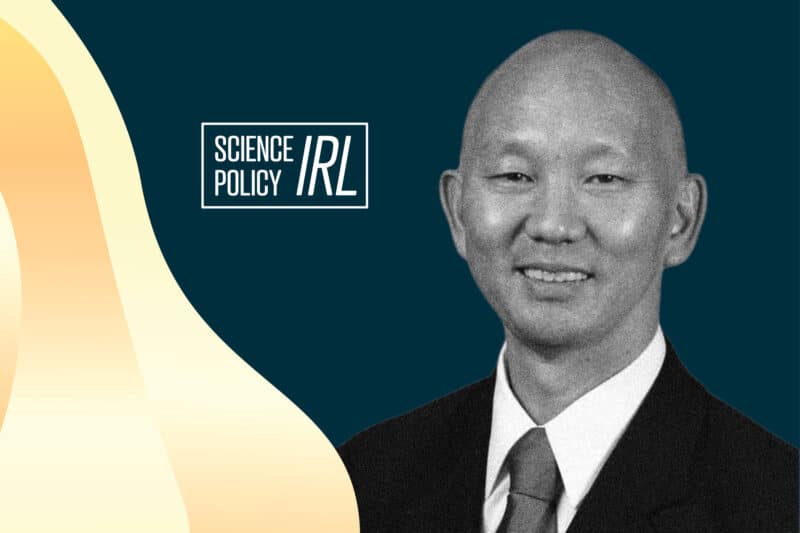
Host Lisa Margonelli is joined by Edward You, who has been called “America’s Top Bioterror Cop” by MIT Technology Review. A biochemist by training, You worked for the FBI for over 20 years. At the FBI, he served in the Weapons of Mass Destruction Directorate, and was also on joint duty assignment at the Office of the Director of National Intelligence, where he served as the National Counterintelligence Officer for Emerging and Disruptive Technologies. In this episode, Margonelli and You discuss how his time as an FBI agent enabled him to reframe the way the policymakers understand what is required to protect biosecurity and support innovation


Resources
- Watch a 60 Minutes episode on DNA and the big-money market for biodata, featuring Edward You.
- Read “National and Transnational Security Implications of Big Data in the Life Sciences” (2014), a joint report from the FBI, American Association for the Advancement of Science, and United Nations Interregional Crime and Justice Research Institute.
- Learn more about big data, security, and the FBI’s role by reading “Biosecurity in the age of Big Data: A Conversation With the FBI”.
- Check out Issues’s recent publications on biosecurity:
- Interview with Senator Todd Young on emerging biotechnologies.
- “Reconsidering Research Security” by John C. Gannon, Richard Meserve, and Maria T. Zuber.
- “When All Research Is Dual Use” by Sam Weiss Evans.
Transcript
This is an uncorrected transcript and may contain errors.
Lisa Margonelli: Welcome to The Ongoing Transformation, a podcast from Issues in Science and Technology. Issues is a quarterly journal published by the National Academy of Sciences and Arizona State University.
I’m Lisa Margonelli, editor-in-chief of Issues. On this installment of Science Policy IRL, we are going to an unexpected place for science policy: the Federal Bureau of Investigations.Today, I’m joined by Edward You, who has been called “America’s Top Biology Cop” by none other than the MIT Tech Review. Ed is a biochemist by training, but he worked for the FBI for over 20 years before he retired recently. And I’m excited to talk to Ed about how being an FBI agent enabled him to reframe the way the country protects biosecurity and supports innovation. Ed, welcome.
Edward You: It’s great to be here. Thanks for having me.
Margonelli: Thank you for joining us. So we have a usual four questions and I was going to start with the first one, which is what is science policy to you?
You: I think it’s sort of innate. It’s about how do we ensure that science is developed, grown, and applied for the benefit of society so that we do as much as we can to derive all the beneficial outcomes of science, while at the same time we identify the risks associated with it, and most importantly, especially with my background, how do we prevent the misuse, abuse, theft, or exploitation of science is how I considered basically a holistic application of science policy.
Margonelli: So you did 20 years at the FBI, but I think you started initially as a scientist. So tell me about, when you were a kid, did you dream of I’m going to be America’s top bio cop?I mean, how did all this start?
You: Yeah, so growing up, I mean, of course you had the obligatory playing cops and robbers, wanted to be an astronaut, grow up watching, had a voracious appetite of watching Star Trek in the Twilight Zone, but ultimately fell in love with science and ended up getting a graduate degree in biochemistry and molecular biology and pursued that.
Margonelli: What was your specialty?
You: Well, so I started off in three years of clinical research in autoimmune diseases and then transitioned from there, found out that I really liked research. And so decided to pursue that rather than pre-med, much to this point in my first generation Korean American parents. So did six years of academic research in human gene therapy with a focus on using retroviruses at the delivery system, and that’s going to factor prominently later in my career. And then transitioned to private sector where I worked for three years in cancer research at Amgen.
Margonelli: Wow. And so when did you become a G-man? How did this happen?
You: It was September 11th, 2001. It was 9/11 attacks. I remember distinctly waking up in the morning because I lived on the West Coast at the time and NPR played a story about a plane crashing into one of the World Trade Center towers. And I thought, well, either the pilot was really bad or the weather was bad or a combination, but then when I turned on the TV and saw the crystal clear sky and saw the second plane and realized that we were under attack. And I was attending graduate school at the time and that changed everything. And so later in my career, as much as I loved research, as much as I loved the idea of helping develop cancer therapeutics, just wanted to do more and applied to the FBI just to shot in the dark.
Margonelli: Do they have specific jobs for postdocs in biological research?
You: No, no. I applied for the special agent program.So yeah, I just went for it and got accepted, pleasantly surprised to, and spent the next four months at the New Agent Academy in Quantico, Virginia. So left the laboratory, hung up the lab coat and put on a badge and gun. So it was a completely change in career trajectory. And so my first four years as a nearly minted agent, I got a chance to go back to Los Angeles and I was on the Joint Terrorism Task Force there and spent four years working counter-terrorism investigations, which is exactly what I signed up for and specifically was going after Al-Qaeda.
Margonelli: But you weren’t actually doing biology.
You: No, no. And actually I’m a product of the 9/11 attacks, especially as it impacted the FBI because historically the hiring priorities were prior law enforcement, law degrees, lawyers, CPAs. So it’s basically going after white collar crime and major crime. Because the 9/11 attacks was a failure of imagination and intelligence, the FBI diversified its hiring practices. And so they’ve got language speakers, computer scientists, and also emphasis in STEM, which is probably the reason why they hired me.
But having said that though, as a recovering biochemist, I put the scientific method to great use, meaning that as a new guy on the counter terrorism squad, I was assigned some of the older cases and taking one of them and applying the principle saying, “Hey, this is my subject. This is the hypothetical violation.” Determine what evidence do I need to support that? And sort of like a thesis committee, what criticism should I expect from a defense attorney or a jury to be able to support any criticisms or weaknesses and develop the evidence for that.And by pursuing it that way, turned a 10-year-old basically cold case into one of the top three counter-terrorism investigations in the field office. So that showcases that the education and training prior served me very well.
And then despite just being a street agent, I also had the opportunity to volunteer. So FBI has collateral duties. So you can volunteer to be like an evidence response where you process crime scenes, you can volunteer to do SWAT or underwater evidence collection. So I decided to do hazardous material response team. So I was trained to put on personal protective equipment, breathing apparatus, and learned decontamination procedures and was certified to be able to go down into a contaminated crime scene and collect evidence, whether with unknown radiological, chemical, or biological contaminants. So I got to do that as a volunteer and supported some interesting investigations to that.
So that was all during my time as a field agent and then got promoted to headquarters and moved to Washington, D.C. where I joined the Weapons of Mass Destruction Directorate, and that’s where I resided for 15 years before I retired. And my mission was to counter biological threats, which is basically good fit for me.
Margonelli: So this is really interesting because in addition to 9/11 providing an entrée for you into the FBI, the world of synthetic biology was really starting to rev up all through the early 2000s. And then of course, then there was CRISPR, which was sort of the next explosion on the horizon there. And I think CRISPR was kind of incubating 2011 through 2014 or something like that before it kind of became a publicly known thing. So your time going into that Weapons of Mass Destruction Directorate was also this time in big shifts happening in synthetic biology.
You: Oh, absolutely. And there’s also one other pivotal moment too, because one month after the 9/11 attacks, we had the anthrax mailings. So that was the Amerithrax investigations. And it turned out to be the suspect was Bruce Ivans, which was a highly positioned scientist in the Army laboratory. So he had a Top Secret clearance. He was part of the regulatory program, the select agent program, and yet we had this insider threat. So when I joined the headquarters, we were dealing with the aftermath of that in how do you improve biosecurity, how do you improve the vetting and sustaining personnel suitability and reliability? So you had that converging with the dawn of synthetic biology and these powerful tools. So it sort of came to a crescendo in a way, looking at all these different biosecurity and biotechnology challenges.
Margonelli: We often kind of talk to people about doing science policy through an agency or through legislative means, so we’re actually sort of talking about official kinds of policies or regulation. But you’ve been involved in a whole range of different policy things. So I guess first we must back up slightly. So you were with the Weapons of Mass Destruction Directorate, but you also moved into ODNI, which is the Office of the Director of National Intelligence, which has sort of a coordinating role in the executive branch. And you have done other things as well. Why don’t you give us a little sense of how your career moved, and then let’s get a little deeper into some of the policies that you’ve been involved with.
You: Yeah, sure. So as I said, I got promoted to the WMD Directorate to headquarters, and that was circa 2009. And then around 2019, actually, I was approved and selected to go into the joint duty assignment program, which is within the intelligence community, you’re allowed to transition to different departments and agencies to basically diversify your experience. And at that time, I got a chance to go to the Department of Health and Human Services. And so again, that was late 2019. So you know where this is going.
Margonelli: Yes.
You: So I guess depending on how you look at it’s either right place, right time, or wrong place, wrong time, or a combination of that. That’s when we got hit with COVID. And so HHS was like, “Dude, you’re an FBI agent with a background on virology. Come on over.” And I ended up supporting Operation Warp Speed for two years, which was an absolutely phenomenal and privileged experience. I was supporting the security of the development of the COVID mRNA vaccines, as well as the eventual domestic and international distribution. Those were incredibly challenging times. We were exercising the emergency use authorization, which accelerated the review process. So that meant that the early clinical trial data, the manufacturing of processes, all the different precursors, we had to ensure the supply chain for each of those things. We had to make sure that each of the entities that were being contracted were properly vetted because literal lives were on the line.
And then to ensure that once we actually were able to manufacture it and scale it up, we had to safely distribute and disseminate the vaccines as well too, because don’t forget, there was that horrific bombing in downtown Nashville on Christmas Day, and it turned out, unfortunately, to be one of those conspiracy theorists, anti-vaxxers. So we had to ensure that we protected the ability to deploy the vaccines. And so that was a Herculean effort in every stage of that response. And so there are a lot of unsung heroes, the men and women of both in HHS as well as the Department of Defense who helped out 24/7 on the logistics of all of that.
Margonelli: That’s really an untold story of Operation Warp Speed.
You: Yes.
Margonelli: So there you are, it’s 2019, you’ve been transferred into HHS and then you’re there for the two years of Operation Warp Speed through the COVID pandemic. And what happened then?
You: Yeah, so that term ended in 2021, and rather than taking a breath, when word got out that I was available, I got picked up by ODNI. And so from 2021 to 2023, I served as a National Counterintelligence Officer for Emerging Disruptive Technologies, which means that I was one of the point personnel in the intelligence community to look at how do we protect or identify threats to US critical emerging technologies, which included artificial intelligence, quantum computing, semiconductors, autonomous systems, and of course biotechnology, even commercial space infusion energy. So bottom line, I got my nerd on in a big way, but that was a phenomenal experience to look at not just the individual critical technologies, but helping the government to understand that it’s not just the discrete technology, but the convergence of them all. And the subsequent transformative disruptive application is where we really need to identify some of the risks.
And that applies also in biotechnology and synthetic biology. We tend to get enamored or go down the rabbit hole on specific technologies like CRISPR, for example, and not paying attention to what the applications are because quite frankly, the second, third order impacts on the applications are probably more profound, more consequential, and therefore have some more security related issues that we may not be in consider.
Margonelli: Talk me through what the second and third order effects of CRISPR are.
You: Yeah, I knew that would come up. So a couple of things. One is that as powerful as, as vaunted as CRISPR is, it still has limitations, right? It’s still heavily reliant on data, in this case, genomic data. So if you want gene editing to be more reliable, to have better accuracy, you need better data for targeting purposes, for editing purposes. And it’s just a sheer number game. It’s the more data you have, especially at a population scale, the more reliable your ability is to edit the DNA. And so the second order impact is that you’re going to want to acquire a lot of DNA or a lot of biological data in general. And so this really came to a point for me. So in 2014, I partnered with the American Association for the Advancement of Science, the publishers of Science magazine, and also with the UN, specifically the United Nations Interregional Crime and Justice Research Institute or UNICRI.
And we held a workshop where we brought in experts from places like Amazon, Google, Intel, Microsoft, Northrop Grumman, and basically posed the question that, hey, if synthetic biology is going to be developing these tools like CRISPR or others, they’re going to be very much data-dependent. And so where are we with regards to security? And there was overwhelming response that we’re doing a lot on privacy, but very little on economic or national security. And this resulted into us being able to publish a report called National and Transnational Security Implications of Big Data in the Life Sciences.
So more than a decade ago, we highlighted, hey, there are vulnerabilities associated with our genetic sequence, our health records. So it’s more than just theft of data for privacy’s sake or for potential ransomware. But if you think about, hey, someone’s going to know what our intimate health state is or predict what our future medical conditions are going to be, but more importantly, use the tools to then start designing specific therapeutics or diagnostics. We may be opening ourselves up to being leapfrogged or having some other adversary or competitor acquiring those capabilities and we’d be at an immense disadvantage. And so you kind of can tell where I’m going with this. But it translated that biosecurity is not just worrying about the pathogens and toxics and high containment labs. It is now bioeconomic, meaning that biotechnology is going to impact in multiple critical sectors like health, food, agriculture, manufacturing, energy production. And we are just not positioned to look at security in the way that’s commensurate with how biotech is being deployed in those areas.
Margonelli: So this is an interesting case of being involved in really reframing an issue because another way to look at that is like, yeah, you don’t need a lot of genetic information to look around the US population and say, okay, they’ve got a pretty big out of control diabetes problem, they’ve got an opiate problem, and they’ve got probably a fair amount of Alzheimer’s or memory issues coming down the pike. And a previous generation that was maybe more laissez-faire would’ve said, “Well, yeah, I mean, if China or Belgium comes up with a cure for diabetes, if this other country comes up with it, well, then that’s great. That’s the way the global network works. That’s the way globalization works, all the boats rise.” So this is one of these examples of a policy reframing what you’re talking about.
You: Yeah. And no, I’m really glad that you put it that way because to your point, as it stands right now, for example, I’m just going to focus on healthcare for now because it does impact other areas. But as it stands, we can’t make antibiotics to save ourselves here in the US. We completely outsource that to China. Almost all of our generic pharmaceuticals also come from China, and the active pharmaceutical ingredients come from China or India for our frontline drugs. So the concern, and we raised, which again was over a decade ago, is that if we are not paying attention to where our data is going or more importantly, understanding the consequence and the value of that data, then we’re sort of seeing what’s happening now because right now China has really roared onto the global stage in coming up with new innovative candidate drugs. They basically wiped out the European Union and they’re taking a big chunk out of the US market as well too.But even the bigger tell is that China is now sponsoring more CAR-T cell clinical trials than any other country, bar none. And I’m not just talking within China, but abroad.
Margonelli: Let’s just back up. So CAR-T clinical trials, CAR-T cells, can you just give us a little-
You: Yeah. So CAR-T cells are basically the next potential breakthrough therapy where you take a patient’s cells if they’re suffering from cancer, for example, and you basically use CRISPR or some other technique to genetically modify, engineer them, your T-cells, and then you reintroduce it back into the patient. And now your immune system has been trained to identify cancer cells and target them. It’s basically putting in a precision missile into your system to be able to knock it out, which is great. It’s that’s powerful. And so far early indications are that it’s effective. But the problem is that again, it’s all data-dependent, meaning you need access to the individual’s genetic information. What is a normal genetic sequence? What is a mutated sequence that may potentially be triggering the cancer?
So the point is, to your point, is that, yeah, great. In the short term, you cure cancer, that should be a win. Sure it is. But then the long term though is that, well, wait a minute, if we are now looking at, if an entity like China, especially when it comes to CAR-T cell therapy, it’s uncharted territory, they’re shaping those rules and shaping the standards. And if you do that, then you influence global markets, right? You’re going to influence how clinical trials are going to be conducted. You influence the specifications.
Then if we’re not paying attention, then we suddenly might find that an authoritarian regime is able to control and influence almost every single aspect of the inputs that sustain healthcare. And so we sort of saw what that looked like in COVID when we weren’t able to get able to get masks. We completely outsourced the mask production to China and they nationalized the factories there. So take that by extension, that could be really scary for us, not only from a supply chain standpoint, but also from a market standpoint, from a potential job loss standpoint, because they’ve invested in data acquisition, they’ve invested in AI for using that data, they’ve invested in scale manufacturing for things like CAR-T cell therapies or even mRNA vaccines now where we’ve pulled back.
So the nightmare scenario for me today, and this is coming from a guy who worked in the Weapons of Mass Destruction Directorate, is as we speak, companies like OpenAI, Anthropic, Meta, they’re looking at the convergence of AI and biotech and their predominant focus is, wow, can someone use now AI to generate a sequence that causes the zombie apocalypse? But my characterization is everything I’ve articulated, we’re going to wake up one day and realize, well, hell, we just became healthcare crack addicts and China’s become our pusher. And what happens if we completely are dependent upon a foreign supply chain for all of our healthcare needs, not only for today, but also for tomorrow? That is really precarious. And then also it’s a signal that we lost our innovation lead in this critical area. So going back to your very first question, to me, that is absolutely a science policy question. And it’s not just focusing on a technology, but it’s also looking at what are the economic implications, what are the geopolitical implications?
And so I’m really glad you framed it that way. We really have to rethink what biotechnology and biosecurity policy is in light of what’s happening as we speak in real time.
Margonelli: One of the things that’s really interesting about this is that in another era also, this issue around competitiveness or even supply chains would’ve been seen as an industry issue, as a commercial issue and not necessarily the role of government. And what’s interesting is that from your perch and this really braided career that you have of having the STEM education, having the experience with law enforcement, and then also moving into counterintelligence, and then moving to ODNI, this high level executive office that’s in a coordinating position, you’re also looking out for competitiveness of US companies. And you are trying to, through framing, trying to coordinate the actions of not only this sort of science assets, the traditional US science assets like the national labs or research through universities, but also the private sector.
You: Yeah, you nailed it. I firmly believe we’re in the midst of a global biotechnology space race. It’s not an arms race, it’s not a counter-proliferation perspective, which again, is traditionally how most policymakers address security implications of biotechnology, it’s a race. And I’m afraid of what happens if we come in second place. But if you look at the first space race, when the Soviet Union launched Sputnik into orbit, that was a rude awakening for the US government because they came to the realization, it was like, “Wow, we’re behind.” And what was one of the first things they did was they passed the National Defense Education Act, which dropped a couple of billions of dollars into the university systems to build up the next generation of engineers, computer scientists, physicists.
Margonelli: I would add it also extended into high schools and middle schools in terms of getting people ready to go into these sorts of career tracks.
You: Absolutely. No, thank you for that. And so we need to be looking at biotechnology that same way, that there’s just that much at stake. If we recognize that, then it’s not just about playing defense, right? You don’t win a space race by playing defense. You don’t win it by exercise, export control or other security regimes, although they are necessary. But if you’re not also supporting innovation, if you’re not supporting the university systems, if you’re not supporting, to your point, students and providing that vision and that support, then we’re kind of in a real bind because we’re not right-sizing security the way that’s commensurate with where the technology is advancing and we’re not investing in the innovation either. So that’s what’s kind of galvanizing me to raise awareness in that, quite frankly, Houston, we absolutely have a problem here.
Margonelli: It’s really interesting because I think that when you say America’s top biology cop, the impression is more of export controls, controls senses of security, looking for bad actors. And what you’re actually talking about is rather than the need to step on the brakes, it’s the need to hit the gas. And that is, I think, another sort of reframing of security and law enforcement that’s pretty interesting.
You: Yeah. No, again, that’s a product of 9/11 because the FBI, it’s a law enforcement agency, but that inherently means that it’s reactive, meaning a crime has occurred, you go in and you conduct an investigation and then you do your due diligence, but that’s in many ways, especially in the world that we’re living in, maybe too late. So since 9/11, the priority for the FBI has been being, how do we become proactive and preventative? And so when I came onto the headquarters and when I looked around from a WMD perspective, biology sits in a very unique space, meaning that when you’re talking about chemical weapons or even especially nuclear weapons, you’re talking about very specific material, very specific expertise, which in many ways is very somewhat easy to regulate or monitor, but biology, biotechnology, it’s inherently open source in nature, both technologically and the materials naturally occur in the environment as well too.
So you cannot take the chemical or nuclear regimes and apply to biology, which there’s a lot of policy folks who think that that’s the way to go. That’s not going to work. In fact, you’re probably more likely going to impede innovation if you don’t do it correctly. So with that in mind, I realized that one of the fastest and most effective ways to address protecting the technology is engage the members themselves, engage the community. And so right from the get go, I embarked on intentionally reaching out to universities, to companies, even to grudge DYI biohackers. I got a chance to speak at DEF CON a couple of times, which is a high mark in my career, I think. But-
Margonelli: Tell us what DEF CON is.
You: Oh, so DEF CON, it is the international premier basically cyber hacking conference, so cybersecurity. And so if you think about that, an FBI agent was invited to go to what they’ve implemented what they call the biohacking village. And so they look at biosecurity there. And in many ways, I was going into the lion’s den. Well, you’re an FBI agent. I should have been tarred and feathered and thrown in the street, but actually I was invited with open arms and I gave the presentation about how valuable our information was, our genetic information, our family history, our medical history, even if you’re wearing smart wearables, that’s tracking your heart rate, your sleep activity, that’s all really valuable. And so what happened is their response was amazing. They were like, “No way do I want my data to be used that way. No way do I want my data to be suborned and utilized by another government for other purposes.” And they’re like, “What can we do to help?” Which is awesome.
And then my favorite was like, “Do you want us to hack them back?” And so my official government response was, of course, no, while nodding actually. But the point is that how powerful is that in that if you engage the community, if you message it right, then it’s what I call, how do you ensure that whether you’re a student, a biohacker or a CEO of Fortune 500 biotech companies, how do you help them become guardians of science is how do you help them understand what’s at stake and then ensure that they become wherever position they’re in, that they be on the lookout and prevent the misuse, abuse, exploitation, theft of science. So it’s not just IP theft or expert control. It’s not on my watch, do I want my invention, my hard work, my efforts to be misused in a way that it was not intended.
And so who better to potentially identify that type of activity than the people who are actually developing it themselves?
Margonelli: And so this was also part of the FBI’s sort of vision after 9/11 was how to work with communities. And so you were doing that with the DIY bio community and also with industry as well. I think that the DIY bio community came up with a statement of ethics.
You: Yes.
Margonelli: Were you at all involved in that?
You: Indirectly. So way back in 2009, one of the very first acts I organized when I got the headquarters, I executed the FBI’s first ever synthetic biology conference in San Francisco. And I brought academics, private sector representatives, DIY bio, and also local FBI field office representatives from their respective companies or where their locations were, and basically had a get together, a meetup, and help them understand what’s at stake and then who each other were. And so help understand the science, the field, and then more importantly, especially for the community, if they see something suspicious, do they even know who to contact, which is powerful. And then for the FBI, we have a position called the Weapons of Mass Destruction Coordinator, so WMD coordinators, and they’re local agents that are in every one of our field offices and they’re trained in chemical, biological, radiological, and nuclear matters. So they’re kind of like the local ambassadors.
And so in that sense, I was sort of like a glorified matchmaker. It’s like, here’s setting the field, you really ought to know who each other are. And that was phenomenal because that got ingrained in the DIY bio community. And one of my favorite stories is that we actually hosted an international one a few years later and they were so impressed by the relationship that the FBI was trying to facilitate and the partnership that when they went back to their home country, they went to their own national law enforcement and introduced themselves like, “Hey, I’m DOI Bio. I have a community lab.” And the response was, “Whoa, who the hell are you? What the hell are you doing?” It’s just absolutely remarkable that they took it upon themselves to make both a US version and an international version of a code of ethics, which that’s where we need to be.
Margonelli: So this all speaks to a very soft and the sort of friendly side of law enforcement and security and proactive rather than reactive policy.
You: Yeah, no, it’s critical because… I’m loathe to give Department of Homeland Security any credit, but I got to hand it to them. They came up with a really cool slogan. It’s “see something, say something.” And by building those partnerships and the relationships, you’re helping both the communities, the scientific community, be able to be on the lookout for what constitutes a suspicious or potential criminal activity. But then also for law enforcement, they have to understand this is what it means to be a DIY bioer. It’s not a clandestine methamphetamine lab or something along those lines. They know about the communities. That familiarity will translate into better communication, better transparency, better understanding of what the actual risks are. But even more importantly, fundamentally, the scientific community is now basically empowered to turn the tables, meaning that they’ll educate entities like the FBI like, “Hey, this is the new technology that’s coming down the pike. You should be aware of it. Here are some of the security concerns.” And then, “Oh, by the way, we’re also designing in security measures.” And that’s the best of everything.
One quick anecdote, years before this became commercially viable, but a student group in synthetic biology brought to my attention that, “Hey, we’re now able to engineer baker’s yeast to produce medicinal precursors.” And they’re like, “Well, then we really run the risk of potentially a drug cartel engineering yeast to make precursors for opioids.” And that is very different from worrying about viruses or pandemic causing agents or rysin or other toxins. And they were very thoughtful about it. And so like, “Wow, you’re right.” And in this country, we’re still in the midst of an opioid and a fentanyl epidemic. And if you are able to have an engineered microbe like that and you take it and you go home and you get your beer fermentary and you just add sugar and then you can start making your own personal narcotics, the threat that they coined was, “Hey, are we on the verge of going from breaking bad to brewing bad?” But they identified it themselves. And so that’s powerful and we need more of that.
Margonelli: And that also sort of led to some questions about if you’re going to engineer such things, how do you make them so that they are kind of encrypted in a way, the processes are more encrypted?
You: Right. Or engineering the vinyl products so that you get the desired medicinal effects while you basically program out the addictive nature of something. So there are things that they’re starting to think about, which is great. I mean, it really is them taking on what does it mean to become a citizen scientist or a guardian of science, which is, I think, very impactful.
Margonelli: So after ODNI, what did you do at the FBI?
You: Yeah. So after that tour ended, I returned to the FBI and in my last year before I retired, I was part of the National Counterintelligence Task Force, which was fantastic because I started my career in the joint terrorism task force and I ended in the counterintelligence task force. So I bookended my career on being a task force setting. So this is all the departments and agencies, so Defense, Homeland Security, even IRS, so treasury. And all working together again to protect our emerging technology areas. And again, with a focus on biotech, because we’re seeing the impact right now, meaning that just for example, a second third impact, we’re in this condition with Iran right now, and you’re seeing the impact on the global oil supply. Well, guess what’s happening is there’s renewed interest in renewables, so energy. And so the question I pose, and this is what I’m doing now since I retired, I opened up my own consultancy and taking all that prior experience, all that high level thinking, the second third of impacts and trying to identify the risk areas.
And so for example, if suddenly we’re thinking, “Hey, can drops become viable carbon feed stocks for energy production versus petroleum?” And we are missing out on something right now. Because of the trade war, China is no longer buying our soy and corn and our farmers are struggling. They’re absolutely struggling right now. But wouldn’t it have been nice if we had invested in a biomanufacturing capacity within the US infrastructure because then we could have turned that surplus into converted soy into biodiesel, corn into ethanol at scale. So it’s not a replacement for petroleum, but it would make our energy and especially our economy a little more resilient. But we’re getting this double whammy right now in that we’re going to see a continued sticker shock when it comes to oil. And if you think about it’s going to be compounded by the fact that with the growth of AI and data centers, the energy requirements are going to just go through the roof.
And so you’re going to see these compounding factors. And I’m telling you, biotechnology could be a viable way through this, but again, we’re not looking at the security implications and we’re not making the strategic investments to make this happen.
Margonelli: We’re also very, very dependent upon fossil fuel for fertilizer.
You: Absolutely.
Margonelli: Which is what helps all that corn and soybean grow.
You: Right.
Margonelli: So you left the FBI, and what’s it like to do policy from outside that part?
You: I am unchained and unfiltered. But the beauty of it is that it’s not that about critiquing the bureau. I’m immensely proud to be a member of that. It was an honor and privilege to be working shoulder to shoulder with the men and women that were working that mission. They’re still continuing to do that despite all that’s been going on. Being part of the FBI comes with a lot of cache. But I have to tell you, I have not missed a beat because there’s too much at stake. And the beauty of it now is that I’m my own boss, but then it also means that I can go ahead and speak my mind. But I think what’s most important is that I have the latitude to be able to not only just … Before in FBI, it was great, it was engaging, but for most part, I was kind of like Chicken Little saying the sky is falling and raising the warnings, but not really a position to help come up with solutions.
That’s not our role, that’s not our responsibility. But now that I’m on the outside, I can do both. It’s keep Horizon scanning, identify what the potential challenges are, and then help Congress, for example. So just a week ago, I was invited to the Hill and I was part of a co-sponsored event by the Council on Strategic Risk and the Emerging Biotechnology Research Consortium. I was able to provide this kind of perspective to staff members, so, according to me, making policy. So I’m able to do that now and so help better inform policy, but then also for potential clientele in academia or in the private sector, also come up with solutions. And so it’s only been the five-month mark. I’m still in the early stages, but it’s very promising and very rewarding. So I’m not stopping.
Margonelli: That’s interesting. You’ve had this very, very interesting career in a number of different levels of policy. And also, I think that your work also speaks to the space for entrepreneurs or what we call policy entrepreneurs are oftentimes seen as kind of lone actors out of academia. But in your case, you were well within these agencies and were able to assist and lead in reframing where it went with obviously other national or agency objectives, but you were able to help in reframing the policy landscape.
You: Yes. I mean, it was definitely not a one-man show. Being the bio-nerd that I am was able to kind of look at what the security implications were, but no, it was all about coalition building too. And I am immensely proud and fond of the relationships that I built with other members of the government across departments and agencies. And so they all became champions for the cause. So I’m doing something similar now in my personal capacity and my new business endeavor, but really just trying to always keep a finger on the pulse of where technology is going. And then really rather than just looking at just the now, but trying to forecast what the broader implications are. And to your point, I think because I had such a diverse background, I think it’s still me trying to figure out what I want to be when I grow up.
But that capability has really helped me to look at things that at first blush might be completely orthogonal, but it’s experience and looking at framing through analogy, I guess, is one way of characterizing it. But for the most part, it’s been really successful in looking at it that way. And if I’m speaking to students, I always challenge them, “Hey, try to give yourself a multidisciplinary approach or mix yourselves with… ” If you’re biology students spend time in computer science or speak to a computer science or engineering student or social science or law, because those different perspectives when combined can potentially be very powerful. And we need to start thinking about that, especially from biotechnology. Biotechnology is becoming incredibly multidisciplinary approach. From a policy angle, we need to be doing that too. And so it can’t be just me. I mean, there should be policies, programs, and hey, I’m a big fan of ASU. I mean, you have the Biodesign Institute and other spaces where that type of collaboration can occur.
And quite frankly, one of the things we need is we need to have that more broadly than anything else. And that kind of goes back to making the proper investments in education.
Margonelli: Well, normally we sort of end with what are the big things that keep you motivated? You have so many different motivations. I’m wondering if we should change it to something. What are two or three things that make you feel like we could pull this off and have a better future?
You: Yeah. Well, the very first thing is that, and I already mentioned too, I have a heart for students and I’ve got my soapbox if you obliged me just one minute.
So if we believe that biotechnology is as powerful as it’s going to be, the Schmidt Foundation actually came up with the board and they distributed the future bioeconomy a value of about, I think what, $30 trillion in the next decade or so. And it would be a shame if our students, our up and coming generation are not able to participate in that. But then also the fact that in the very first biology class in middle school, and maybe in seventh grade or eighth grade, there ought to be one class where we talk about the biological weapons convention, this international tree that we’re a party to. We don’t talk about that. What was the genesis of that treaty?
We don’t talk about the Tuskegee experiments. We don’t talk about Henrietta Lacks where biology was exploited by governments, was exploited by corporations, and just how precious and how powerful biotechnology is and how we need to be responsible stewards of that, especially as they grow onto their careers. Because again, a computer scientist might be doing something profoundly powerful in biology, but they never had a single conversation about what biosecurity means. So we really need to do it for the students and we need to do it soon because especially with the dawn of artificial intelligence being incorporated into all that, I think it’s incredibly enabling, but we need to be able to ensure that it’s harnessed in a way that addresses some of the things we talked about in our conversation here.
Secondly, I’m worried about the US. I’m worried about our ability to maintain our historical leadership and innovation. I also think I’m worried that there’s this misunderstanding that we should be going this alone. We should be building a coalition with other partners that, but at the same time, not for the sake of profit, not for the sake of leverage, but really it’s because there’s a shared desire to do everything responsibly, equitably. Again, because biotechnology is going to be so profound in our ability in our lives and future livelihoods, not just for work or occupation, but also it’s going to impact every input to our lifestyle, whether it’s our health, our food, looking at the next generation therapeutics, being able to make renewable bio-manufacturing.
I mean, biotechnology is probably going to help us colonize Mars, for example. So if we start thinking about that, then we need to become better protectorates and guardians of biotechnology.
Margonelli: Thank you. Thank you, Ed. This was a great conversation. I really appreciate it.
You: Oh, thanks for having me.
Margonelli: Want to learn more about biosecurity, the FBI, and Edward You’s work? Check out our show notes. Are you also working on science policy in unexpected ways? Let us know by emailing us at podcast@issues.org or by tagging us on social media using the hashtag #sciencepolicyIRL. Please subscribe to the ongoing transformation wherever get you get your podcasts.
Thanks to our podcast producer, Kimberly Quach and our audio engineer, Shannon Lynch. I’m Lisa Margonelli, editor-in-chief of Issues, and thank you for listening.