
Drawing the Great Hall
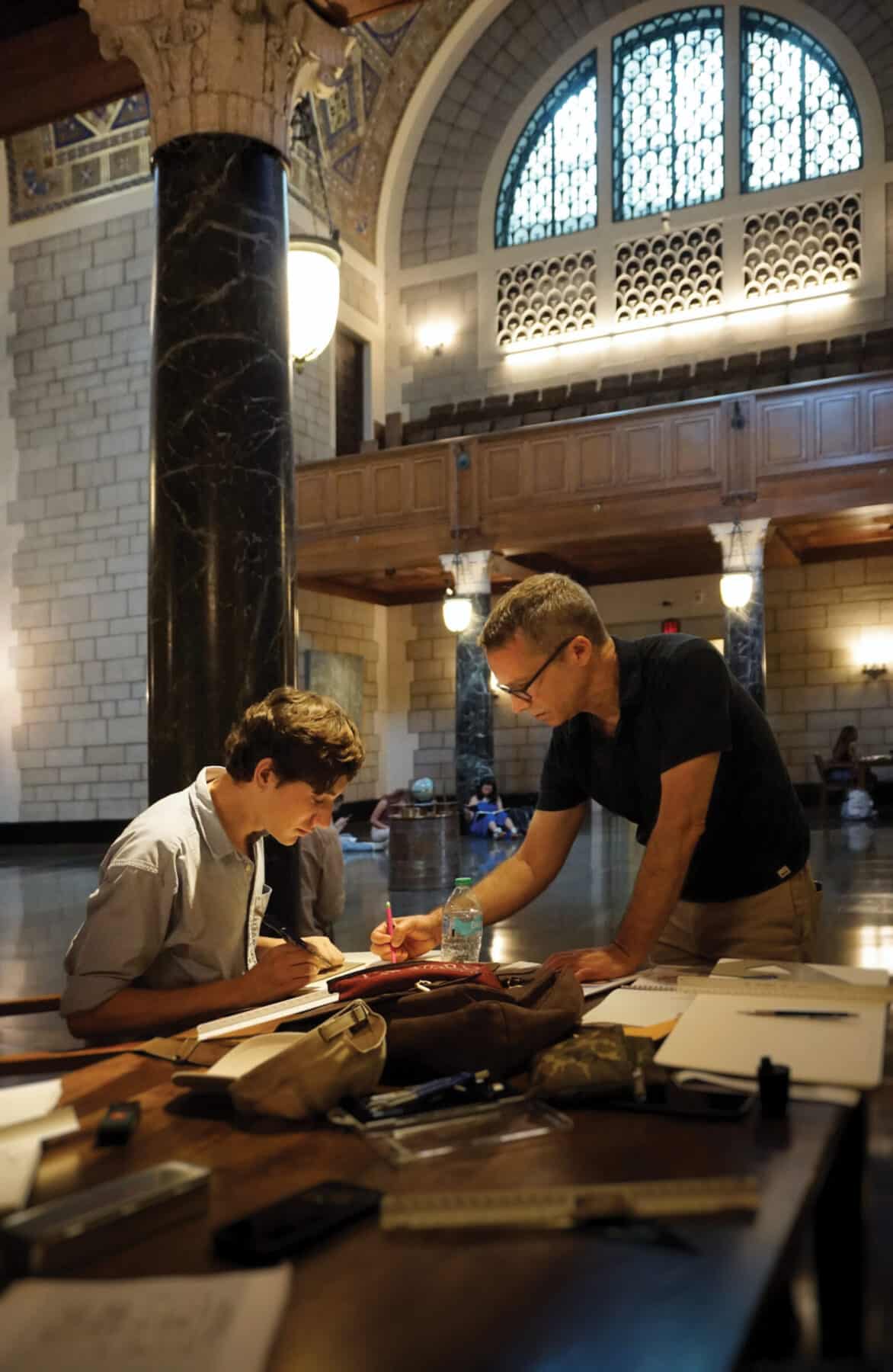
A highlight of leading tours of the National Academy of Sciences building is observing visitors’ astonishment as they enter the gilded Great Hall, the focal point of the building. Designed by architect Bertram Grosvenor Goodhue, the neoclassical building incorporates Egyptian, Hellenic, and Byzantine elements alongside Art Deco motifs. The Great Hall’s iconography, created by artist Hildreth Meière, celebrates the history and significance of science. A mural on the north wall by Albert Herter portrays Prometheus, aided by Athena, stealing fire—the symbol of knowledge—for humanity, thus enabling civilization and progress.
Recently, a group of architecture students from the Institute of Classical Architecture & Art—a national nonprofit focused on promoting traditional architecture and its allied arts—visited the building. One student remarked that closely observing and drawing the Great Hall provided her with a clearer understanding of the pendentives—the curved, vaulted triangles that facilitate the transition from the square base of the room to its circular dome. Her insight is supported by research showing that drawing enhances comprehension and promotes a deeper, more integrated, and longer-lasting retention of information. Both students and faculty noted that the opportunity to learn about the building’s iconography, materials, and history during the tour deepened their appreciation of its architectural significance.
—Alana Quinn, Cultural Programs of the National Academy of Sciences