Self Isolation Stroll
Andy Howlett
A narrated short film of a walk I took on the day the UK Government announced Lockdown. It was a beautiful spring day and it really didn’t feel like The Apocalypse but there were some signs…
Andy Howlett
A narrated short film of a walk I took on the day the UK Government announced Lockdown. It was a beautiful spring day and it really didn’t feel like The Apocalypse but there were some signs…
the AHRC funded ART/DATA/HEALTH Project /Dr Aristea Fotopoulou at the University of Brighton
“Shielding” explores the impact of the the COVID-19 quarantine on women facing domestic abuse and the paradoxical meaning of home as shelter. News stories around the world have highlighted the significant upsurge in violence and the need for increased support for victims of abuse from both governments and the charity sector, a time when support has been much harder to access because of infection control measures and reduced capacity, especially in the early stages of the pandemic.
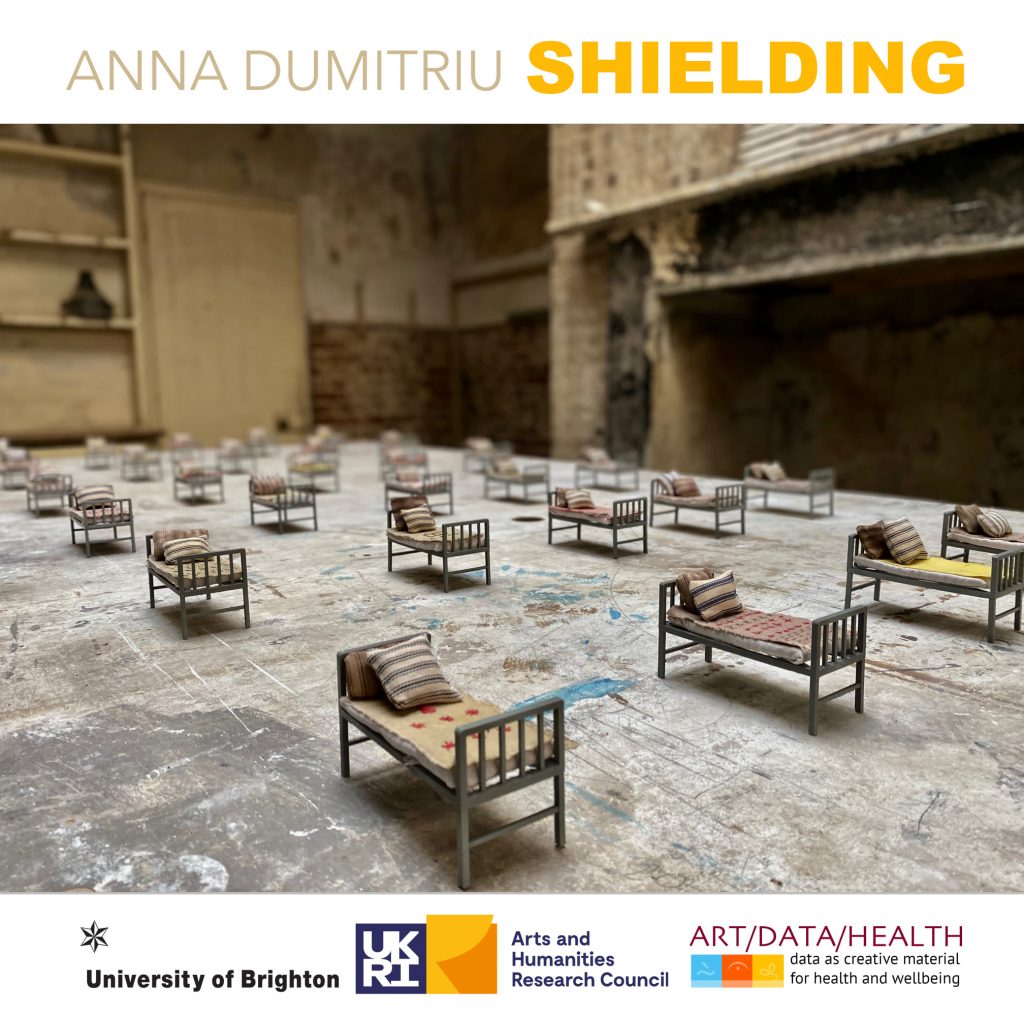
The artwork is inspired by Virginia Woolf’s feminist essay “A Room of One’s Own” (1929) which states that women need their own safe space in order to flourish and be creative. This notion of a safe space is set against the stark image of the hastily constructed temporary hospital ward that has become such a familiar image in the news stories of 2020. Those locked down with abusive partners have no safe space in which to escape. Movement restrictions aimed to stop the spread of COVID-19 are making violence in homes more frequent, more severe and more dangerous. “Shielding” has become a familiar term for protecting those vulnerable to COVID-19 who are asked to stay home but the reality is for those at risk of domestic abuse the home is not a place of safety and care, and helplines globally are facing an increase of up to one third. The final installation combines traditional feminine crafts such as sewing, embroidery and natural dyeing with healing plants (such as turmeric), with 3D printing based on digital reconstructions of hospital beds from the first temporary hospitals in Wuhan with their rows of identical beds, often with a bizarre jumble of colourful makeshift bedding sourced at speed from nearby factories. The doll sized beds also remind us of Henrik Ibsen’s play “A Doll’s House” (1879) which deals with the fate of a married woman in a male dominated world. In the context of Dumitriu’s BioArt practice the aim is also to safely incorporate biomaterial related to the pandemic in the work. This Art/Data/Health commissioned artwork by Anna Dumitriu is particularly relevant in the current crisis where numbers of domestic violence cases have been rising globally, while under-resourced civil society organisations struggle to remain accessible to those who need them most. The commission initially aimed to represent and creatively explore data around domestic abuse through hands on art workshops with staff from Brighton-based charity RISE, but has been adapted to respond to the global pandemic situation in light of the limitations that social distancing has brought. Since the creative workshops planned by the ART/DATA/HEALTH project were cancelled due to the pandemic, Dumitriu prepared an art kit for the participants instead, which they were able access online. The creative activity prompted them to imagine an ideal a room of their own or a safe and cosy space for a service user, reflecting on Woolf’s writings. It is hoped that in due course participants can work with artist to create miniature bedcovers to be incorporated into the artwork with embroideries that bring their own meaning to the piece. Dumitriu said in an interview for SENSORIUM in March 2020: “An important aspect is to let this situation inspire work and I am relieved that I have been able to adapt one current art commission to explore the impact of self-isolation and quarantine due to the COVID-19 pandemic on the issue of domestic abuse and violence from a global perspective.” This work is commissioned as part of the AHRC funded ART/DATA/HEALTH Project led by Dr Aristea Fotopoulou at the University of Brighton 2018-20. Anna Dumitriu’s project is inspired by the work of community domestic abuse and violence charity RISE.
@caistudio
This selfie, done in Cai’s signature style using gunpowder was posted by @caistudio instagram account.
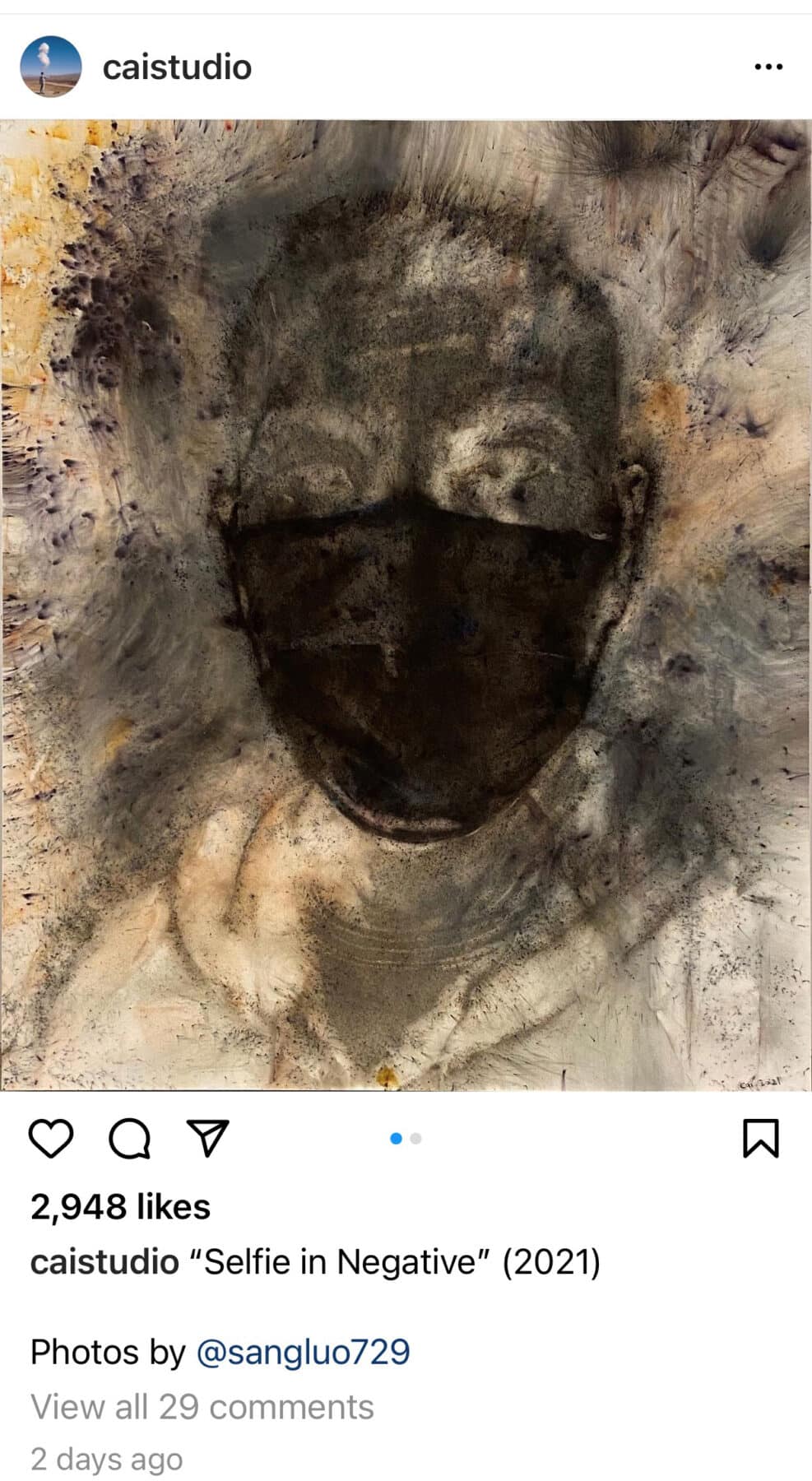
Cai Guo-Qiang (b. 1957, Quanzhou, China) was trained in stage design at the Shanghai Theatre Academy, and his work has since crossed multiple mediums within art including drawing, installation, video, and performance. Cai began to experiment with gunpowder in his hometown Quanzhou, and continued exploring its properties while living in Japan from 1986 to 1995, which led to the development of his signature outdoor explosion events. Drawing upon Eastern philosophy and contemporary social issues as a conceptual basis, his often site-specific artworks respond to culture and history and establish an exchange between viewers and the larger universe around them. His explosion art and installations are imbued with a force that transcends the two-dimensional plane to engage with society and nature.
New York Times / Mauricio Lima
PARIS — For much of the last two months, Paris has been empty — its shops and cafes shuttered, its streets deserted, its millions of tourists suddenly evaporated.
Freed of people, the urban landscape has evoked an older Paris. In particular, it has called up the singular Paris of Eugène Atget, an early 20th-century father of modern photography in his unsentimental focus on detail.
In thousands of pictures, Atget shot an empty city, getting up early each morning and lugging his primitive equipment throughout the streets. His images reduced Paris to its architectural essence.
Mauricio Lima has followed in Atget’s footsteps, shooting images of the same scenes his famous predecessor captured. But this time those streets are deserted because of the coronavirus pandemic. Mr. Lima’s recreations offer new insight into Atget’s work — and into the meaning of a city unique in its beauty but also in its coldness.
Alexandre Valentim
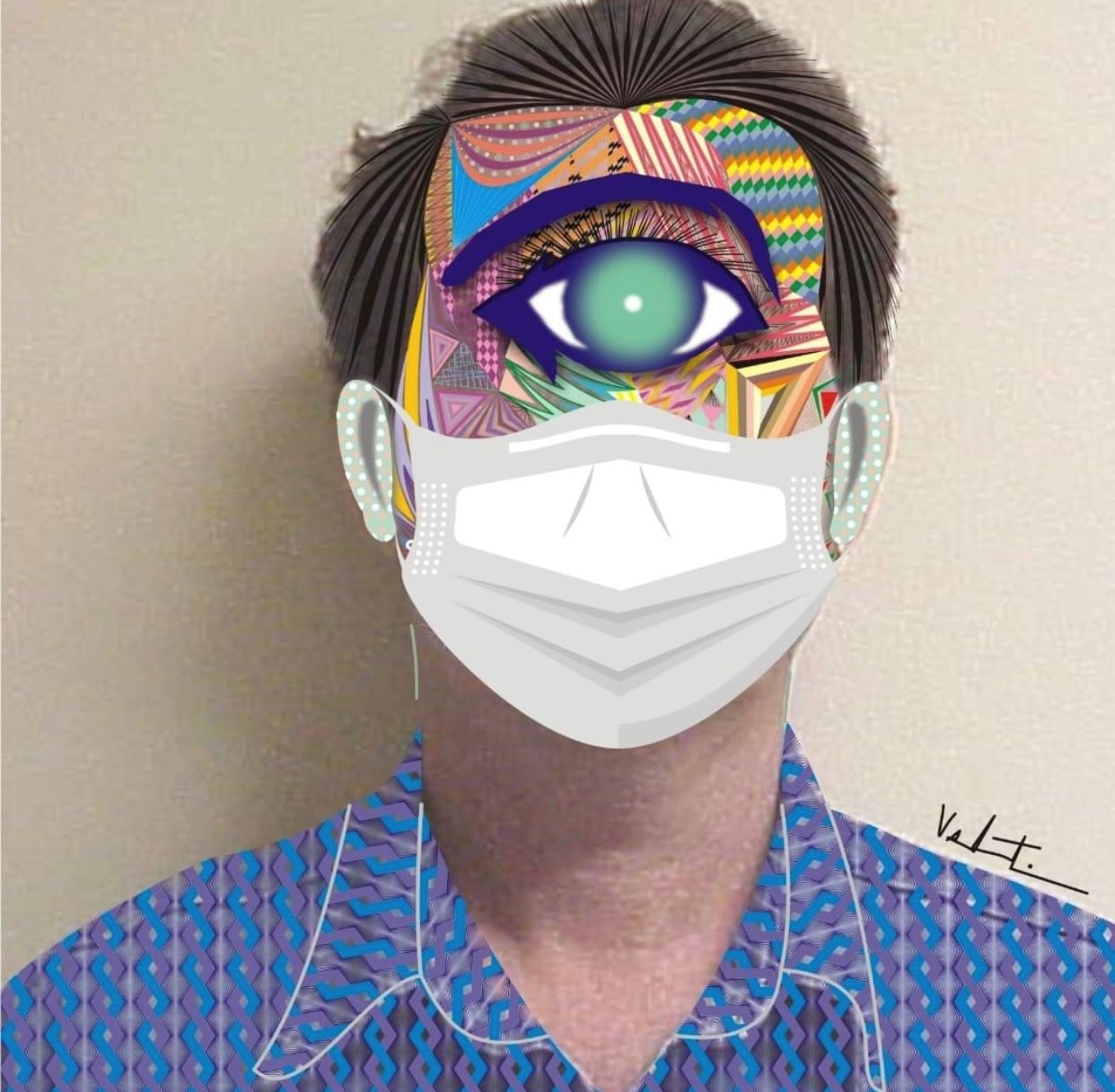
Alexandre Valentim is a digital artist Rio de Janeiro – Brazil. He writes, “In times of seclusion, I realized the great opportunity that I was given to pay a visit to my interior. A trip inside, another angle of observation (multidimensional, maybe …). Sometimes pleasurable, sometimes painful. Sometimes enlightening, sometimes disturbing. Reflect on the act of observing more and talking less. To be more attentive to perceptions, to the information that arrives via our intuition. Allow our connection to the Universe to guide us in our actions.”
Direct Talk
Reimagine Hope With Music: Paul Miller aka DJ Spooky / Multimedia Artist, Composer, Author. Spooky writes, “Japanese National TV did a documentary on me where they hung out with me in NY at the height of the Pandemic to see how artists and creatives were coping with the situation (socially distant, of course…)”
Tamara Lai
Video poem & music “What flavors here? What scents now …” Nostalgia for the days before … Carelessness, freedom of movement, human warmth, nature … which the Coronavirus deprives us cruelly. This new video-poem by Tamara Laï whose images were filmed in various places and countries (Belgium, China, Scotland, Italy, Netherlands) was finalized in residence at her home in Liège, during the lockdown period. Video and poems: Tamara LAI Music: Caroline BOE
Production : Thalamus Prod.
With support of Transcultures & Pépinières européennes de Création
Amherst Early Music
We created online music classes to keep our community playing music and connected to each other during the crisis. Every weekend we run 4 online classes. We had never done this before. The creativity of our faculty has been amazing. Students from all over the US, Canada, and abroad have been taking the classes.
While recognizing that virtual learning cannot replace the in-person experience, we’ve launched “AEM Online” – four classes each weekend taught by different faculty members. Our goal is to feature as many faculty members as possible while also giving students a chance to learn and interact with each other. As we work to offset deep community financial losses, registration fees fund the work of the teachers and organizers of the program.
Anna Foer
The initial inspiration for this collage was a scene I saw while driving down MLK Blvd in Baltimore. There are always homeless panhandlers and squeegee boys on the boulevard, in between cars waiting at the stoplight. One day, when coronavirus was new to all of us, my focus was on an empty chair near an intersection. I imagined this chair on the median, emptied by a homeless person who died from the virus and I knew, at that moment, that any art I would make about the virus would include an empty chair to represent all those who have succumbed to the pandemic. In my collage, the chair’s upholstery is spiked to represent virus outbreak data graphs. Often, I use scientific images in my work; collage made in a traditional way; constructed with cut paper and adhesive and to play with distortions between visual perspective and surface image. I started this collage with a sketch of the composition. Visualizations of the corona virus are, by now, ubiquitous and easily recognized. I found the most straightforward and graphic of these images and printed multiple copies in different sizes and colours and cut them out to use in the collage with the empty chair. The large watercolour shapes that define the sky and ground are repeated, large scale drawings of the outline of the virus visualization: https://www.nytimes.com/2020/04/01/health/coronavirus-illustration-cdc.html These forms, in relation to the smaller scale versions in the collage, become fractals. At this time, I was, as were many others, watching the Netflix series “Unorthodox” which reminded me of the concept of an eruv; an urban area enclosed by a wire or geographic boundary which symbolically extends the private domain of Jewish households into public areas for shabbat observance. The eruv in this case, is made of cut up copies of visualizations of the coronavirus, thereby making it the defining element that is keeping us seperated in our dwellings, united by a common threat. Now the public space is transformed into our private spheres. Some of the virus images depict hot air balloons tethered to the eruv; reminiscent of strings of decorative lights, defining the quarantined space. A nod to the political implications of the spread of the virus and how it is being mitigated and manipulated is in the upper left corner.

University of Maryland College of Arts and Humanities
Keep Creating is a College of Arts and Humanities (ARHU) virtual initiative that creates spaces for University of Maryland’s community to share their works and for anyone to experience UMD’s arts offerings from home. As a college of arts and humanities, it was important for us to create an online space to continue to share, engage and celebrate creativity. Engineers are artists. Scientists are artists. Teachers are artists. The hope is that everyone across campus will respond with how they’re creating. We want to encourage people to continue to think about new ways to explore creativity given the challenges of our day. The space features a digital stage, virtual events, news items about how the UMD community is staying creative and more.
During this time of uncertainty, the arts and humanities can help us create new approaches and insights for empathy and for understanding our rapidly changing world. More than ever, they also connect us to our shared humanity. We invite all members of our creative community to join our movement to keep creating.
Bonnie Thornton Dill
Dean, College of Arts & Humanities
Penn State University
Seeking to create a communal capturing of art and design responses to the Covid19 crisis, including activities that can be shared for anyone to use.
The Arts & Design Research Incubator (ADRI) at Penn State seeks to improve lives through research and application of arts and design practices to health and well-being. The ADRI is part of the College of Arts and Architecture at Penn State. We constructed this repository of arts-based wellness activities and resources in response to the COVID-19 global pandemic, as many of us struggle to navigate the uncertainties of this reality, now and into the future. This is a work in progress. Please look around, download and share, and do feel welcome to reach out to us with feedback, questions, and additional content suggestions. We hope you stay safe and well.
Elizabeth Littlejohn
Based on the poem by Pablo Neruda, “Keeping Quiet”, this film is a portrait of my experience from April 23 to 28 2020 during the COVID-19 Pandemic. I shot it entirely by bicycle on an iPhone in my west end Toronto neighborhood. Read by Sylvia Boorstein, with music by Ólafur Arnalds, “Only The Winds.”
Corinne Whitaker
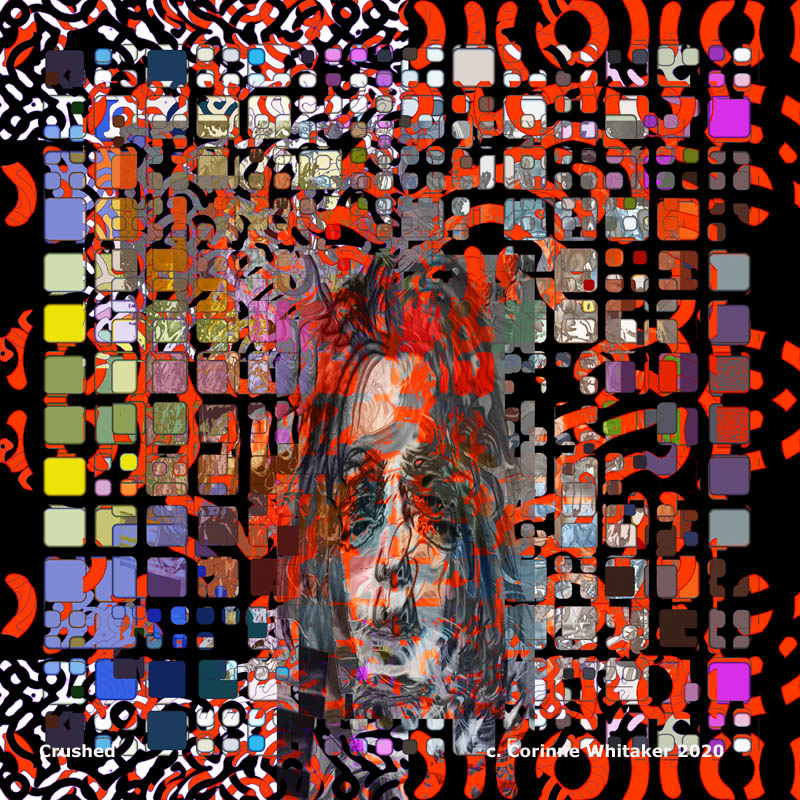
We created 187 cover images in 2020 to reflect how it feels to live through a pandemic. You can see those cover images online, then change the number to see others.
“As the covid 19 virus sweeps the globe, it is difficult to underestimate the dismay and disarray visited upon us all. In recognition of that worldwide affliction, giraffe.com will offer a new cover image every day, reflecting how it feels to live with a global pandemic. Some of the images are based on A.I. transcriptions of my selfie. I cannot ease the terror, the pain, the chaos. But I can at least offer one artist’s view of what is happening to the human species right now, right here and everywhere. We have abused nature’s gifts to us. Now, perhaps, she is shedding her tears in reply.” Corinne Whitaker 2020
Tosca Teran
Mediated 2.0 The Air We Breath (working title) Mediated 2.0
The Air We Breath is about our collective environment. Our microbiome, collectively speaking and individually. How our presence in a space, within our shared environments is felt and what we leave behind. With COVID-19 and other potential hazards in our air streams, the concept here is towards visualizing our multi species entanglements, our interactions and our awareness or unawareness of how we impact the nonhuman world. [Still in conceptual phase] the installation can be purely a VR/AR environment, web-based and/or with physical elements that employ haptic sensors within a space along with the mixed reality. The physical elements are soft circuit/soft sculptures. Everything in the environment is visualized in its microscopic forms. From the bacteria and fungi that populate our tissue, hair, exhales, the floors, other organisms in this environment; birds, cats, how our microbes intermingle when we come close to one another, when we touch. In order to make the subjects in the space more ‘clear’ human and other life forms are outlined, however, the biomes spill over and out -they are not confined (as in reality) the outlines here are used as a marker of sorts. Air readings are taken from within the space as well as the surrounding area this installation might take place in. This data is shown in percentages as well as in the virtual space. In some circumstances some of this data will be sonified towards creating a soundscape within the installation. Kinect sensors map visitors in the space to project their microbiome, TouchDesigner will be used for some of these visuals.
In 2012/13/14 I started building large and small scale phytoplankton, fungi and bacteria out of glass and sometimes metal: copper/sterling. In 2013/14 I received grants from the Glass Art Association of Canada and the Ontario Arts Council towards creating the working space to do so, supplies, and time to create sketches in flame-worked and cast glass. The concept being to create macro versions of pollens, fungi, bacteria, dust/dirt, phytoplankton and other particulate found in our airstreams. Using a Vitrigraph kiln arraignment I started building up murrini- glass cane that would create the textural elements. It was amazing to create custom colour palletes, and work in my super small studio similarly to working in a Hot shop (aka glass blowing studio). For the most part this initial stage was successful, however, the kiln and space required to create large renderings was out of my means, and the only available studio is in Brooklyn, NY and I am in Toronto so, I created a foundation that could potentially be utilized at a later date. VR/AR: Since the 90’s I have been fascinated with the concept of Virtual worlds and creating them! The work of Jaron Lanier only added to this. Plus, he coined the term or maybe William Gibson did or? Who knows! It sounded amazing. Add to that my dreams as a small child in the 70’s of cars that had windscreens like televisions (for lack of a better word then) and motorcycles that turned into robotic suits around the rider (think Transformers but in 71/72 and I don’t think that even existed yet!) I have always been a child of SciFi. In 2015/16 I participated in workshops that taught Unity gaming and AR. I believe now that a mixed reality, maybe working with Magic Leap, Holo Lens or similar (like a AR contact lens!) is the way to create the visualizations I am considering.
Jennifer Gradecki and Derek Curry
Infodemic is a neural network-generated video that questions the mediated narratives created by social media influencers and celebrities about the coronavirus. The term ‘infodemic’ can be traced back to the SARS outbreak in 2003, but gained popularity in February of 2020 when the WHO Director, General Tedros Adhanom Ghebreyesus stated: “we’re not just fighting an epidemic; we’re fighting an infodemic. Fake news spreads faster and more easily than this virus, and is just as dangerous.” The speakers featured in the video are an amalgam of celebrities, influencers, politicians, and tech moguls that have contributed to the spread misinformation about the coronavirus by either repeating false narratives, or developing technologies that amplify untrue content. The talking heads are generated using a conditional generative adversarial network (cGAN), which is used in some deepfake technologies. Unlike deepfake videos where a neural network is trained on images of a single person to produce a convincing likeness of that person saying things they did not say, we trained our algorithms on a corpora of multiple individuals simultaneously. The result is a talking head that morphs between different speakers or becomes a glitchy Frankensteinian hybrid of different people that contributed to the current infodemic speaking the words of academics, medical experts, or journalists that are correcting false narratives or explaining how misinformation is created and spread. The plastic, evolving, and unstable speakers in the video evoke the mutation of the coronavirus, the instability of truth, and the limits of knowledge.
Jennifer Gradecki is an artist and theorist who aims to facilitate a practice-based understanding of socio-technical systems that typically evade public scrutiny. Using methods from institutional critique, tactical media, and information activism, she investigates information as a source of power and resistance. Her work has focused on Institutional Review Boards, social science techniques, financial instruments and, most recently, intelligence agencies and technologies of mass surveillance. She teaches Game Design and Media Arts courses at Northeastern University.
Center for Arts in Medicine, University of Florida
The Remote Cultures Conversation Series documents various interpretations and practices of how artists and arts communities are supporting public health efforts. We recently hosted our first conversation centered on experiences of uniquely precarious artists in performing public health (please see project website for further details), i.e. the lived-experiential knowledges they possess of how best to combat social isolation, shifts in social routines, creative practices to engage and maintain well-being, and/or statements/discussion of the lack of any change to routine whatsoever. This project is part of a larger effort in collaboration with the University of Florida’s Center for Arts in Medicine’s COVID-19 Arts Response, which houses the Performing Public Health initiative, as well as a COVID-19 Arts Repository, advisory briefs, and links to a white paper entitled “Creating Healthy Communities: Arts and Public Health in America.”
In this context, “Remote Cultures” refer to the cultures evolving in response to the public health measures implemented due to the Coronavirus pandemic. Remote Cultures vary among different populations and communities, including Unique Precarities (particular experiences, knowledges, needs, and abilities of marginalized groups) and individuals’ adaptations to the novel public health measures implemented during this pandemic.
Baker Lab, Institute of Protein Design
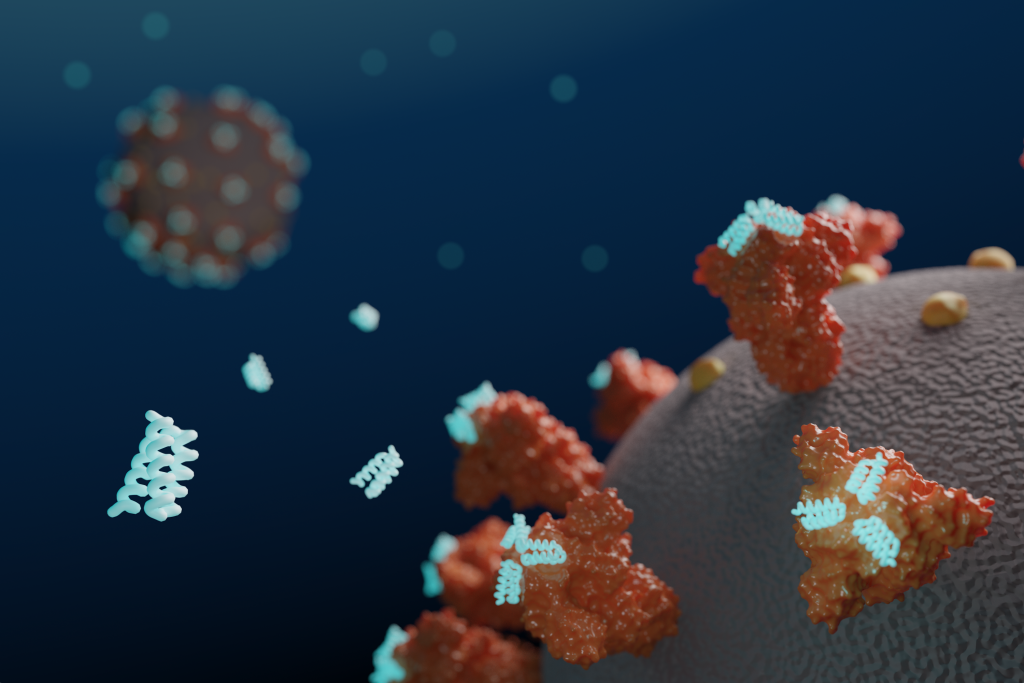
This artwork shows a comparison between minibinders (small antiviral proteins, shown in shades of red) and antibodies (blue) that bind to the spike proteins on the surface of the SARS-CoV-2 virus. Prof David Baker’s group at the Institute of Protein Design commenced the computational design of minibinders in January 2020 around the time when community transmission of the virus began. By the end of May, they had identified minibinders that were able to strongly bind the spike proteins and neutralize the virus. Minibinders are 20-fold smaller than antibodies, and can be scaled up in production at a lower cost. While antibodies have only two binding sites to its target, minibinders in an equal mass offer 20-fold more potential neutralizing sites. The small size and higher stability of minibinders offer a possible advantage of nasal formulations for drug delivery and eliminating the need for refrigeration during storage and transport. These minibinders are currently in development for their potential use as SARS-CoV-2 therapeutics. This example highlights the power of computer-generated protein design, especially during a pandemic when time is critical.For more information refer to https://www.bakerlab.org/index.php/2020/09/09/covid-minibinders/
CellSpace
Information about the spread of coronavirus is critical knowledge for personal safety and global response to the pandemic. In collaboration with SciCommMake 2020, an event hosted by SigmaXi and ScienceTalk, “New Ways of Living” explores the science of COVID-19, using art to provide friendly, intuitive and evocative windows into the growing body of information about how the virus is transmitted. The show is seeded with the work of V. Anne Burg and David S. Goodsell, and includes work from an international community of participants in the 2020 “CellSpace” sciart workshop. The show explores the science behind transmission of the virus, from the nanoscale details of respiratory drops, to the persistence of virus in our household environments, to the population-level mechanisms and implications of testing. Cross-discipline dialog informs the work of participating sciartists and creates work that bridges knowledge silos that span from the molecular to the human scale.
CellSpace is a workshop for cellular and molecular sciartists. For our 2020 project, we are creating work for “New Ways of Living.” The artists are located around the world, and are working in multiple media, including traditional painting, digital art, animation, virtual reality, sculpture, and sonification.
Saji Malavika
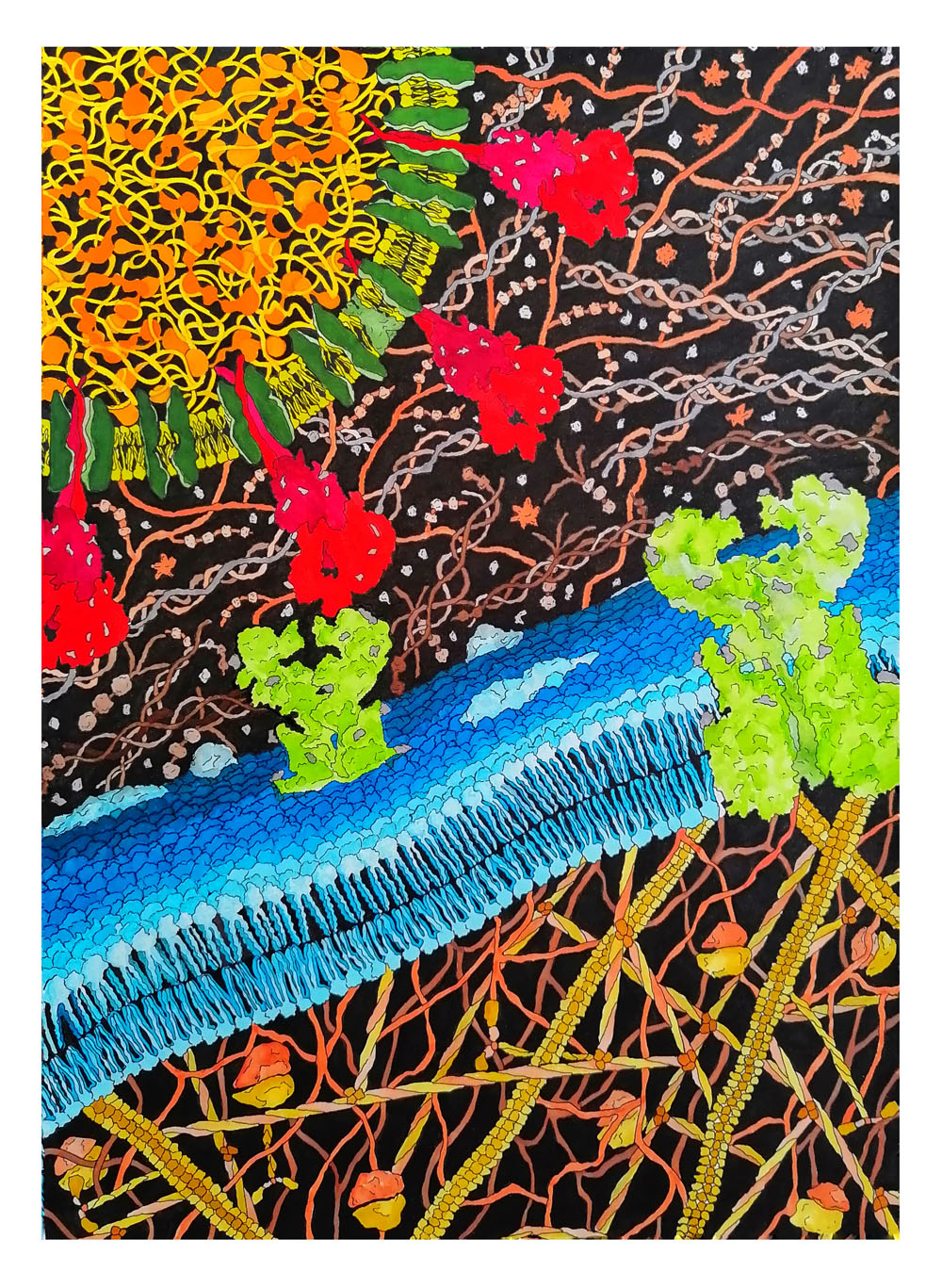
The creative response is a watercolor painting showing the SARS-CoV-2 entry into the cell. The painting illustrates the viral spike protein coming in contact with the ACE-2 receptor in the plasma membrane of a lung cell.
Samar Abdelhady
I do scientific illustrations mainly in the scope of neuroscience, in accordance with my primary research focus. I barely got excited for visualization projects except for the brain research. Since the Covid world-wide crisis, I thought why not try hands with the COVID urging-focus. It has been the most appraised project I have worked on so far establishing my on-going design style. From there on, I became more established as a scientific illustrator divergent about exploring various visualization projects of research focus other than my primary one.
Sketching Process
The behind-the-scene initial paper sketches; literature excerpt to visualize, list of vectors to draw, and some random doodles.
https://www.behance.net/gallery/106831155/COVID-Sketching-Process
Andrew Yang and Christa Donner
As the Covid-19 epidemic emerged, so too did an abundance of how-to hand washing videos. Starting in late January 2020, one in particular played on a continuous, hypnotic loop in the dining hall that my partner and I shared with hundreds of others in Singapore. Always running, hands in motion, suds, instruction, rinsing, sensation, ablution. My partner’s and my time as artists-in-residence in Southeast Asia transformed into one of sheltering-in-place for months on end. With a hazard so invisible and communicable, and within a global mesh where everything is shared, the significance of safety, of self, and of contact became more pressing and at the same time more difficult to discern. The ritual choreography of hand washing became deeply embedded in our bodies and minds over those months, while forms of protection, isolation, and communion continue to mutate.
My partner’s and my time as artists-in-residence in Southeast Asia transformed into one of sheltering-in-place for months on end. With a hazard so invisible and communicable, and within a global mesh where everything is shared, the significance of safety, of self, and of contact became more pressing and at the same time more difficult to discern. The ritual choreography of hand washing became deeply embedded in our bodies and minds over those months, while forms of protection, isolation, and communion continue to mutate.
University of Florida Center for Arts in Medicine
The UF Center for Arts in Medicine, along with arts and public health leaders from across the U.S., created an array of resources designed to support arts-based responses to COVID-19. They call for and enable cross-sector collaboration between the public health, arts and culture, and community development sectors to drive high-impact responses to COVID-19 across diverse communities. The resources include advisory briefs, webinars, an evidence-based framework, and a robust resource repository.