This micro-course aims to help teachers deal with the suspension of classes due to measures against the coronavirus (COVID-19) outbreak.
ART AND SCIENCES TOGETHER
We believe in a learning model based on the student’s active role, in contextualized knowledge, in the promotion of curiosity and in the constant integration between Science, Technology, Engineering, Arts and Mathematics (STEAM).
This site is a repository for observations, reflections and collections from this global pandemic. It hosts voices of many featuring content from familial, social, creative and scientific networks.
Additional Details
Take action in quarantine, 3 easy steps! We are a creative and multidisciplinary team developing a repository of the COVID-19 experience. As experts collect information worldwide, we are building a database for creative expression. Great Pause Project is entirely open source, available to a global community to reflect, share, and document this unique experience. Join us as we archive this story!
Between March and September 2020, the Boston University Arts Administration compiled this list of media articles that chronicle the impact of the pandemic on the sector and the creative responses of the field. We are currently conducting a longitudinal research project with ArtsBoston to track the career outcomes of professional arts managers who were employed at a large sample of Greater Boston arts organizations at the time the pandemic hit in February. We will post the results of that study at regular intervals as they become available.
How COVID-19 accelerated change in design and arts education at ASU.
Liz Cohen wasn’t eager to teach online. The Guggenheim-winning associate photography professor, who considers herself a people person, didn’t think it was for her.
When COVID-19 happened, Cohen threw herself into figuring out “how to use this (ASU Sync) platform in ways that are interesting.”
To her surprise, she said, “I like it. COVID has taught us something — not that I’m going to give COVID too big a pat on the back.” She appreciates the “dynamic relationship” between herself and the students — “there’s banter, and everyone’s engaged”—and she likes the ease and convenience of teaching via ASU Sync.
Early artistic responses to Covid-19 offer fascinating insights into key issues arising from the crisis, argue ART/DATA/HEALTH researchers Elodie Marandet, Harriet Barratt, and Aristea Fotopoulou.
This Too Shall Pass: Creativity in the Time of COVID-19
The Science & entertainment exchange with Cultural programs of the national academy of sciences
This Too Shall Pass: Creativity in the Time of Covid-19 is a series of online discussions organized by Cultural Programs of the NAS and by the Science & Entertainment Exchange to explore creative responses in all disciplines to the pandemic.
Programs included:
July 1, 2020 Claudius Conrad, Andrew Janss, and Indre Viskontas
August 5, 2020 Clifford Johnson, Mike Smith and Molly Webster
October 2020 Lauren Gunderson, Deric Hughes, and Kevin O’Brien
Almost overnight, circles and shoe pads became our ubiquitous governing:
Social distancing, also called “physical distancing,” means keeping a safe space between yourself and other people who are not from your household. To practice social or physical distancing, stay at least 6 feet (about 2 arms’ length) from other people who are not from your household in both indoor and outdoor spaces
CDC, Social Distancing “Keep a Safe Distance to Slow the Spread” Updated July 15th 2020
Additional Details
Savannah Walker is a visual designer based in NYC. She crafts identity systems, is fascinated by digitally converted experiences, draws a lot of buildings, and has 18,729 photos on her phone, some of which are shared here.
“Through my practice I explore ways that we work with or against nature; how we react and intervene, and how nature responds back at a domestic level and beyond.”
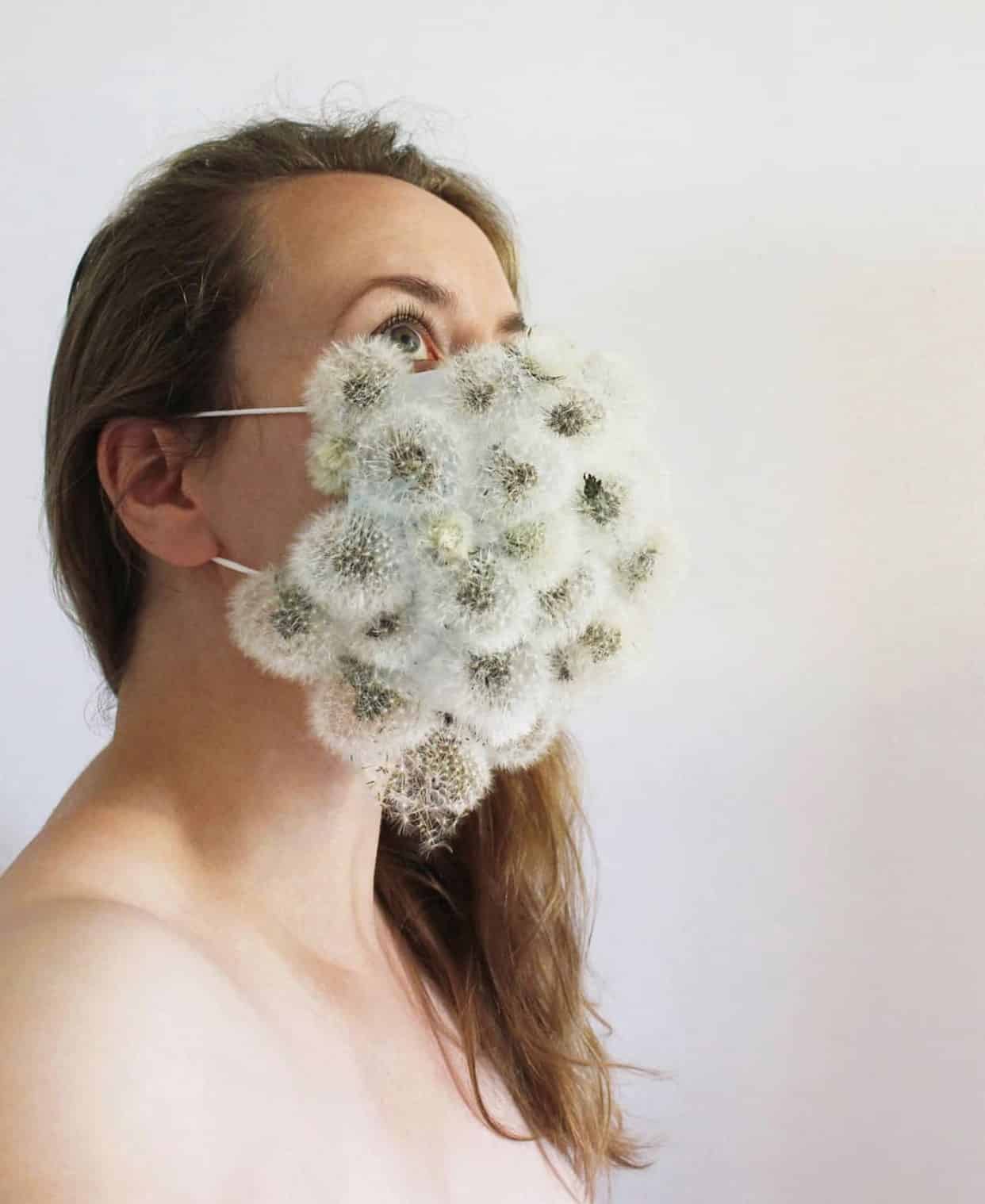
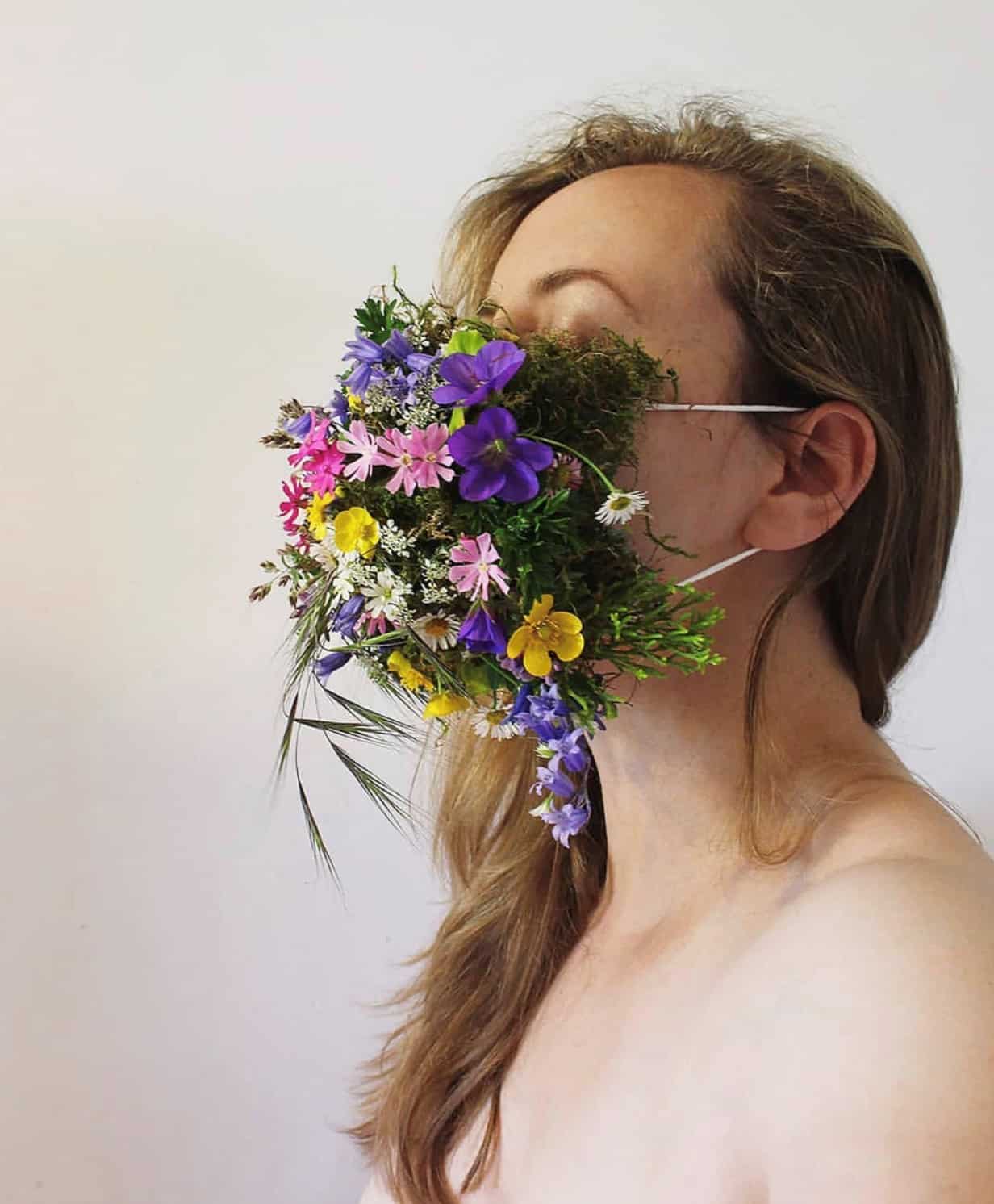
At the beginning of the initial lockdown Estelle Woolley returned to her family’s farm in Cheshire (UK), finding nature therapeutic and inspiring in adverse times. She was commissioned by Chester Virtual Bandstand to create a series of pandemic inspired facemasks from foraged, natural materials. These were collected from her daily walks, where she has been homing in on her immediate surroundings, paying close attention to the plant life coming in and out of season.
The materials chosen are collected with a sense of purpose. A colourful rainbow meadow represents the amazing work of the National Health Service during the pandemic; Dandelion clocks delicately parallel the invisible nature of the virus spreading; Nettles and thistles remind us to keep our distance otherwise there will be consequences. Plants act as a natural filter; they give us oxygen so that we can breathe through them; they give us life. The masks also aim to question whether the spread of the virus is nature’s way of retaliating and teaching us to care for our environment more, to slow down and pay attention to the world.
The images have since gained a lot of national and international recognition, from being featured on the front cover of The Sustainability First Art Prize where she gained Highly Commended, featured in The Wales Arts Review, selected as Axis art highlight of the week, selected as the poster image for the Ty Pawb Open Exhibition, and featured in the New York Magazine, and the Danish newspaper Politiken. She won first place in The Art of The Mask exhibition with Bluegirl Gallery, and gained the Ty Pawb Open People’s Choice Prize. The self portraits have been exhibited both online and in New York, Denver, Miami and London.
The Social Distance Art Project (TSDAP) was set up in the wake of Covid-19 by a small group of 2020 Fine Art graduates hoping to offer a platform to showcase and discuss graduate work in the absence of Degree Shows.
Our mission doesn’t stop here. As emerging artists, we need more than just a degree show alternative. At TSDAP our goal is to provide a digital community for artists, providing them with the exposure they need to make it in the art world. We want to create a more diverse and equal model for our artists by encouraging a spread of shared opportunities, both digital and physical, not based upon nepotism.
Performed simultaneously in Ireland, London and Milton Keynes, older non-binary live art gang FBI+A perform individual responses to the theme. Soundtrack also created from a mix of individual responses.
The CAPE Network Forum is a place where our artists, teachers, program staff, and researchers share their inquiries, ideas, reflections, and video instructions in response to the pandemic and school closures.
A fast moving musical journey made on 3 continents by a diverse team of actors, dancers, musicians, cinematographers, and regular folks sending their made in quarantine/social distance videos from around the world. Then assembled into a unique film. An incredible array of talent on display to raise spirits and bring a smile. Creative within science guidelines. Building community through art.
Additional Details
Directed by Ashley Maria Composed by David Raiklen Edited by Crystal Lentz Cinematography by Autumn Palen Produced by David Raiklen and Ashley Maria
(social distancing and PPE used during production and post)
Offered an exercise for people to do at home, on invitation by galleria Milano in Italy.
Instructions
PURPOSE: to regain one’s path of attachment to the domestic place.
CONTEXT: Attachment to a place, was defined by Rubstein (1992) as “a set of feelings that refer to a geographical place, which emotionally binds a person to this place according to their role or as an experiential setting”. Awareness of our relationship with the place is essential to wellbeing. At this time for many, the home place has coincided with the workplace. For many of us, the home is also, as it was before, the workplace: that of taking care of oneself, and of caring. At this time the coordinates have changed, the referential paradigm is being reversed, the roles are often shared. The opportunity here is to welcome this shift in position, unhinging patterns and rules, including those of geometry and geography applied to measuring and controlling place. Let’s get rid of the specific reference of how the body occupies the physical space and follow the indications of how the soul reveals our own micro-geographies to us!
3-D Simulation Shows Why Social Distancing Is So Important
New York Times
Simulation, created using research data from the Kyoto Institute of Technology, offers one view of what can happen when someone coughs indoors. A cough produces respiratory droplets of varying sizes. Larger droplets fall to the floor, or break up into smaller droplets.
Willson Center Micro-fellowships in the Arts and Humanities
The University of Georgia Willson Center for Humanities and Arts, in partnership with the UGA Graduate School, Arts Council, Franklin College of Arts and Sciences, and Flagpole magazine, awarded 34 micro-fellowships in its Shelter Projects program. The $500 fellowships supported graduate students and community-based artists and practitioners in the creation of shareable reflections on their experience of the pandemic through the arts and humanities. Projects were shared publicly in a virtual exhibition, and continuing phases of the program have provided further support for UGA graduate student research in the arts and humanities.
Sean Dunn is a photographer and musician originally from New Orleans and currently based in Athens, GA. View “Everyone In My Dream Is You,” Coronavirus Portraits 2020 Athens GA
Principal Turns ‘U Can’t Touch This’ Into COVID-19 Safety Video
CNN
CNN’s Anderson Cooper talks to Childersberg High School Principal Quentin Lee, the principal behind the viral “U Can’t Touch this” parody video meant to help students deal with Covid-19 ahead of his school reopening.
Humanizing Epidemiology: Non-medical Investigations into Epi/Pandemic Phenomena
Nature
Since the current global outbreak has emerged, most of the prestigious scientific publishers including ours (Springer Nature) have raised open-calls and free material in order to fight COVID-19. all these efforts logically are addressed to the medical societies and related disciplines. However, we are convinced that the contributions of academics, policymakers and other stakeholders from other areas, including the humanities, arts and social sciences (HASS), should not be overlooked. Therefore, I am pleased to announce this open call for research article collection that aims to examine the innovative role and contributions of Humanities, Arts, and Social Sciences -HASS- disciplines, as well as interdisciplinary efforts, in shaping the global response to public health crises. To this end, this collection intends to bring together a range of perspectives, empirical and theoretical, qualitative and quantitative, which draw on methods and approaches from, among other areas: cultural studies, new-media arts, history, digital humanities, law, media and communication studies, political sciences, psychology, sociology, social policy, science and technology studies. Further, Interdisciplinary perspectives are welcomed, whether between HASS disciplines, or at the interface between HASS scholarship and the physical and clinical sciences, or engineering, mathematics, computer science.
Additional Details
Prospective authors should submit a 200-word abstract and a short biography to the Collection Editors in the first instance. Authors whose proposals are deemed suitable will be invited to submit full papers at any point up until the end of June 2021.
Guest Editor: Diaa Ahmed Mohamed Ahmedien (Faculty of Art Education, Helwan University, Cairo, Egypt)
Co-Guest Editor: Michael Ochsner (ETH, Zurich, Switzerland)
Advisory board: Jon Hovi (University of Oslo, Norway), Adele Langlois (University of Lincoln, UK), Tony Waters (California State University, Chicago, USA), Merryn McKinnon (Australian National University, Australia), Chisomo Kalinga (University of Edinburgh, Scotland, UK), Ann H Kelly (King’s College London, UK), Jochen Buechel (Charite Berlin, Germany), Lin Wang (University of Cambridge, UK), Shinichi Egawa (Tohoku University, Japan).
Pandemic outbreaks as public health crises have the potential to reshape human life, from herpes, and Legionnaires’ disease to HIV and Ebola. Each virus or bacteria has its unique biological properties by which it interacts with and affects populations. Human coronaviruses, for instance, have been known since the 1960s. In the past two decades, however, several new dangerous human coronaviruses have emerged, namely, SARS-CoV in 2002, MERS-CoV in 2012, and currently, SARS-CoV-2 is the cause of the disease known as COVID-19, which has put global public health institutions on high alert. Each pandemic brings its own political, economic, cultural, social and ethical challenges. Although efforts to combat such outbreaks are primarily driven by clinical and medical professionals, the contributions of academics, policymakers and other stakeholders from other arenas, including the humanities, arts and social sciences (HASS), should not be overlooked.
Against this backdrop, this research collection aims to examine the role and contributions of the HASS disciplines, as well as interdisciplinary efforts, in shaping the global response to public health crises. To this end, this collection intends to bring together a range of perspectives, empirical and theoretical, qualitative and quantitative, which draw on methods and approaches from, among other areas: cultural studies, new-media arts, history, digital humanities, law, media and communication studies, political sciences, psychology, sociology, social policy, science and technology studies.
Covid-19 – I can’t live without you 36×36” Nihonga Pigment Painting on Kozo Washi paper wrapped on birch panel. During my quarantine days.
Additional Details
This painting is Japanese style distemper on paper. The colors are from organic dye and mineral pigments. The binding agent is collagen (glue) called nikawa, which usually comes from deer or rabbit, and then leveled with water. The paper surface is treated with alum and nikawa leveled with water and then as gesso, sun dried oyster shell white that is calcium carbonate is used to treat the surface before paint colors. The pigment gives its own personality. The colors are from velvet mat finish to dazzling sparkles, which are best seen under lights. Each color and texture is mixed with nikawa, by hand with fingers in small dish, and leveled with water to change its strength of luminance. This method has been traditional way in large area of Asia, but the method has particularly been preserved by Japanese art culture for over 1000 years. The substrate is durable hand-skimmed paper Kozo Washi. This Washi is made from mulberry bark, wrapped twice on a birch wood panel. If you wish, you can separate the art from the wood panel and use a different kind of framing.
Like the 1st-century sacred Buddhist text that inspired it, the latest project from renowned theater director Peter Sellars is a call to community to learn and heal together during a time of sickness. In the Vimalakirti Sutra, Buddha sends his disciples to the sickbed of an enlightened lay person to hear his reflections on the fragility of physical being and the liberation of conscious awareness. A foundational scripture of Zen Buddhism, it is the resonant center of this body is so impermanent…, a multi-disciplinary performance film born of a remarkable international collaboration between Sellars and a trio of acclaimed artists as COVID-19 washed over the globe. Working virtually across continents under quarantine, South Indian devotional singer Ganavya, master calligrapher Wang Dongling and improvisatory dancer Michael Schumacher engaged with the Sutra and each other in an ensemble act of creation and healing. Sellars orchestrates breath and brushstroke, movement and mindfulness into a visual poem of stunning power. At a moment when grief persists and hope seems more possible, UCLA Film & Television Archive is honored to present the world premiere of this timely work in collaboration with the producers and UCLA program partners. Digital, color, 79 min. Director: Peter Sellars. With: Wang Dongling, Ganavya, Michael Schumacher.
Going Viral is an interactive artwork that invites people to share COVID-19 informational videos featuring algorithmically generated celebrities, social media influencers, and politicians that have previously spread misinformation about coronavirus. In the videos, the influencers deliver public service announcements or present news stories that counter the misinformation they have spread. Viewers are invited to share the videos on social media to help intervene in the current infodemic that has developed alongside the coronavirus.
Going Viral was commissioned by the NEoN Digital Arts festival. It was created by Derek Curry and Jennifer Gradecki as part of their research into the spread of misinformation and neural networks.
Mary Savig, the Lloyd Herman Curator of Craft at SAAM’s Renwick Gallery, has been collecting firsthand accounts of the dual pandemics, COVID-19 and systemic racism, from artists working with craft-based materials and techniques. In this series, “Making the Most: Craft Practice during the Dual Pandemics,” artists share personal insight into how they responded to the cascade of canceled or delayed programs, workshops, and exhibitions, as well as the demands of social distancing and social justice. Each account brings new understanding to the import of the studio as a space of reflection, creation, and collaboration.
We’re kicking off the series with Julia Kwon, an artist who sews interpretative bojagi—Korean object-wrapping cloths—and wraps figures with them to comment on the objectification of Asiatic female bodies. The museum recently acquired a face mask by Kwon from her series Unapologetically Asian. Kwon, whose studio is located in Northern Virginia, stitched a vibrant patchwork of Korean silk to honor her ethnic identity during the rise of anti-Asian racism in the United States, and emphasize the importance of public mask wearing to stop the spread of COVID-19. Unapologetically Asian is an extension of Kwon’s interactive art projects that facilitate solidarity and community in the throes of violent social and political unrest.
100,000: They Were Not Simply Names on a List, They Were Us
Anna Foer
collage A decision was made, as a first in “modern times” that there would be no picture on the front page of the New York Times on Sunday, 24 May, 2020. The significance of the moment was the number of Covid deaths in the United States reached 100,000. The list of names and brief descriptions represents only a one-hundredth of the deaths, as there are only 1000 names on the page. I obtained a hard copy of the front section of the paper to use for a collage. The use of newspaper copy to commemorate this moment connects my new work to the collage I made as a memorial to 9.11.01, also incorporating a newspaper list of the victims. In lieu of basing the composition on hand drawn interior spaces, I opted to work more directly on photos, a first for my approach to collage. The choice of photos represents the ubiquity of the coronavirus’ spread and those spaces that are off limits to the public; the New York subway, a morgue, a library and an art gallery. The upper floors are a home environment and at the top are hospital ICU units, complete with ventilators. The interior spaces we inhabit now are reflected with an overlay of virtual viewing commands, superimposed on those rooms. The commands of “Next”, “Previous”, “Read More” and “Share” take on new meaning and significance in these confines. At the time of this writing, six weeks after 24 May, the number of deaths in the US is 130,000.
I am doing two narrative responses. First is Vintage Card Tiny Stories. Being isolated and alone, I decided that mail was a way to give a unique narrative experience and for me to connect in a meaningful way to a reader. I found a bag of vintage postcards and I write a unique short micro story and mail it off to an audience of one. This unique story for an individual is akin to a message in a bottle both for myself and for the reader. The other project is the Exquisite Birth, which I have instigated as a collaborative narrative game based on the surrealist Exquisite Corpse game. Only this story goes from End to Start. I’ve recruited novelists and comics creators to contribute a paragraph or art panel to the story game. It’s a way of connecting creatively with colleagues in a time when we are flung apart. Collaboration and conversation are key to artistic nourishment.
I used the colors and patterns of flowers of this captured by my this year on my long pandemic walks to create energetic mosaics containing hundreds of images. I use the energy contained within these mosaics to merge with photographic portraits of people amidst the pandemic to help restore balance, calm and peace. This is a form of quantum energetic alchemy. The responses for those who have contributed their portraits have been incredible. I have used mostly those wearing masks, from all walks of life; homeless, local political leaders, protestors, and friends. I offer the service for free, but ask for a donation to the project.
How Artists Are Trying to Solve the World’s Problems
New York times
A cohort of 30 artists have received funding to find creative solutions to 21st-century problems like surveillance, digital inequality and inherited trauma.
AIDS Quilt and Masks for COVID-19: A Brief but Spectacular Take on Turning COVID-19 Grief Into Action
PBS News hour
Mike Smith co-founded the Names Project AIDS Memorial Quilt in 1987. Now living through his second pandemic, Smith is finding ways to help out amid COVID-19 — and to inspire others to do the same. He shares his Brief But Spectacular take on turning grief into action.
Rio de Janeiro Used Cutting-Edge Technology to Transform Its Giant Jesus Statue Into a Doctor to Honor Healthcare Workers
(reported by) Artnet
With churches and other houses of worship closed to maintain social distancing measures, Brazilian archbishop Orani Tempesta conducted an Easter service at the feet of the Christ the Redeemer statue overlooking Rio de Janeiro and projected a special message onto the 125-foot-tall statue. For the second time since the coronavirus escalated to a global pandemic, the statue appeared illuminated with images of the flags of countries hardest hit by the virus, including the United States, China, Spain, Italy, and Brazil, and the words “hope,” “thanks,” and “stay home” written in various languages. The statue, depicting Christ with outstretched arms, was also dressed up in a doctor’s scrubs, lab coat, and stethoscope as a tribute to the healthcare workers on the front line of the pandemic. Projected images of doctors and nurses also intermittently appeared on the figure, putting individual faces to that vital workforce.
Lockdown in Lancaster and Morecambe (and Area): Walk, Run, Pedal, Push, Map by Louise Ann Wilson
Lancaster Arts at Lancaster University, UK and Louise Ann Wilson Company
Have you discovered new places and routes to walk, run, pedal or push due to the recent Stay at Home (Stay Aware) restrictions we are experiencing due to COVID-19? Places and routes that give you a breathing space – mentally, emotionally and physically. If so, can you record them so they can be added to a map/artwork: Lockdown in Lancaster and Morecambe (and area): Walk, Run, Pedal, Push, Map? Since the COVID-19 Lockdown, I have been running and walking every day from home. Gradually, I have found and followed new paths that have taken me to parts of Lancaster that I didn’t know were there and had not explored!! I am now becoming more aware of how the city connects; where tracks, streams, waterways, roads and the river meet and cross. I have found allotments, prisons and graveyards, followed narrow bluebell-lined tracks through woods and into high-up places where the view across The Bay or The Lakes open up and lorries on the motorway push past. I wave at Ingleborough Fell and glimpse Clougha and Pendle Hill in the distance. I’ve gained fitness, am running more regularly and a little further than usual. The pull of fresh air, warm sun or the whip of the wind is irresistible as is the need to stretch my legs and body, and clear my mind – and have some physical, emotional and mental breathing space. I am not alone in these findings and revelations – lots of others have told me they are doing exactly the same as me. Whether it be on foot or bicycle, with pushchair or wheelchair we are still venturing out from home. Those who can’t leave the house, move very far or easily are walking indoors, in yards, squares, gardens, streets and parks. So, can you start recording the route/s you are finding and share them with me? Walks from all parts of Lancaster and Morecambe AND the surrounding areas can be shared RECORDING AND SHARING YOUR ROUTE/S You can record and share your route/s via GPS, email or post. From hand drawn to digitally captured GPS, all maps are welcome! All of the mapped routes will be combined in to a single Lockdown in Lancaster and Morecambe: Walk, Run, Pedal, Push, Map map. This map will then become a bespoke artwork that abstracts and stitches the routes and paths into a made-at-home PPE intensive care gown. Please note, walks can be share from all parts of Lancaster and Morecambe (UK) AND the surrounding areas. Digital GPS maps and hand drawn maps can shared, please email: louise@louiseannwilson.com This project has been commissioned by Lancaster Arts, which was devised a support programme called ‘Breathing Space’ to connect people with each other and support the freelance arts community in Lancashire (UK) during the current pandemic.
Walks to Remember During a Pandemic: ‘With memory I was There’
Louise Ann Wilson
Is there a walk that you long to do but can’t due to the current stay at home restrictions we are experiencing due to COVID-19? If so, could you make a memory-map of that walk? Your memory-map could be of: a spring-time or a winter walk, a walk in a garden, a walk to a place you never thought you’d reach!, an every-day or local walk, a walk in a distant place, a once-in-a-lifetime walk, a work-related walk, a family walk, a friendship walk, a group walk, a celebratory walk, a pilgrimage, a solitary walk, a scientific walk, a creative activity walk, a therapeutic walk, a childhood walk, an indoor walk … It could include: stopping places, viewing places, picnic places, sleeping places, swimming places, narrow places, lying-down places, herding sheep places, orienteering places, grafting places, scattering places, recovery places … MEMORY-MAPPING The activity of drawing a memory-map is the most important thing – not the finished product. Through remembering you can be transported beyond the physical limits of a room or a house. Your memory-mapping can be undertaken alone or as a shared activity with others of ALL ages – family, friends, groups. It can be done in person or at a distance. I’ve done memory-mappings via Skype and at times people have drawn a map on behalf of a person unable to mark-make themselves. You can create as many memory-maps of as many walks as you wish – this could be a one-off or a daily or weekly activity. Your memory-map can include words, lines, symbols. It can be pictorial, graphic or abstract. It can be drawn in pencil, crayon, felt tip or a combination of materials. Please draw your memory-map on one side of a sheet of paper only – this will make it easier for me to upload, if you’d like to share it. PROMPTS Here are a few prompts designed to help you think about your ‘walk to remember’ and things you could include in your memory-map: • Where (place, region, country) is your walk to remember? • Where does your walk begin and end? • What route does your walk follow? • When and how often do you walk your walk? • Is there a specific reason or a purpose for your walk? • Do you walk alone or with others – if so, who and why? • Are there any specific landmarks along the way that are important? • Are there any particular stopping places on your walk? • Are there any actions/activities/jobs associated with your walk? • What sights, sounds, smell might you notice on your walk? • Why are you no longer able to walk your walk? • Do you have any photos relating to your walk? • Do you have an object associated with your walk? SHARING YOUR MEMORY MAP Your memory-mapping can be a private exercise. However, it would be great to create a collection of Walks to Remember During a Pandemic: ‘With memory I was there’ So, if you are happy to share your walk please scan/copy it and upload it to a Drop Box folder I’ve created. Just email me (louise@louiseannwilson.com) and I’ll invite you to that Drop Box. Please include a short 80-word description of your ‘walk to remember’ (the prompts could help with this). Plus, if you have them, photo/s that relate to your walk (3 photos max.). Before you upload it, please title your ‘walk to remember’ in the following way: [Name/s of the walker/s] [place] Walk: [A few words to describe the walk] e.g.: Margaret Crayston’s Upper Eskside Walk: ‘As a Child, I walked this valley everyday’ Please write this title on the memory-map itself and on any files and the Drop Box folder. I will then add your walk to remember memory-map, description and photo/s to the website page that I’ve created. See, https://louiseannwilson.com/work/walks-to-remember-during-a-pandemic-with-memory-i-was-there BACKGROUND Walks to Remember During a Pandemic: ‘With memory I was there’ is inspired by a ‘surrogate’ walking project I’ve been working on over the last few years in which I re-walk walks people can no longer do but long-for – a process that involves participants drawing a memory-map. That project is inspired by Dorothy Wordsworth who, when living at Rydal Mount, became bedroom-bound, relying on memory to transport herself back into the landscapes she once walked: No need of motion, or of strength, Or even the breathing air: – I thought of Nature’s loveliest scenes; And with Memory I was there… Extract from the poem “Thoughts on my Sick-Bed” by Dorothy Wordsworth. See, https://louiseannwilson.com/work/womens-walks-to-remember
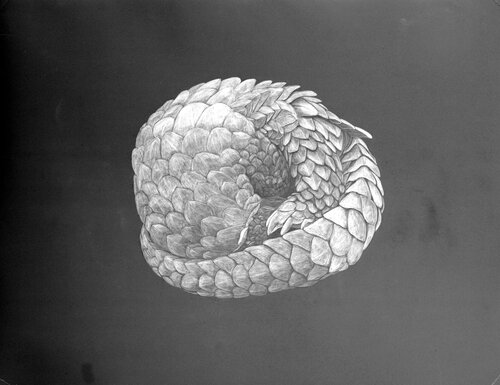
Artist Sarah Ronald, based in Port Coquitlam BC, Canada writes, “I am an animal artist, I focus on creating educational artwork about human behavior and our treatment of wildlife. With the Covid-19 pandemic, I began reading a lot about potential causes, and learnt about Zoonotic viruses – that this virus is thought to have come from bats, to pangolin, to humans via the wet markets. This has inspired a whole new body of work, which I have titled Pandemica. The work is (so far) focused on bats and pangolin, but after absorbing Merlin Tuttle’s talk about covid-19 and bats, the arc of this work has shifted and will soon include humans (we will find deadly viruses wherever we decide to look, including humans), and will eventually include other host animals that have been thought to pass viruses onto humans. My entire message with my art practice is to re-present wild animal information in an effort to educate and bring self-awareness to individuals, and the fact that we are all part of nature, not separate from it. I embrace the concept that when we fight with nature, we are fighting with ourselves (ref. GA Bradshaw’s book ‘Talking With Bears, Conversations with Charlie Russell’)”
Pangolin (II), 2020, Pencil crayon on drafting film, black paper backing, 17″X22″ digitally enhancee contrast