Going Viral is an interactive artwork that invites people to share COVID-19 informational videos featuring algorithmically generated celebrities, social media influencers, and politicians that have previously spread misinformation about coronavirus. In the videos, the influencers deliver public service announcements or present news stories that counter the misinformation they have spread. Viewers are invited to share the videos on social media to help intervene in the current infodemic that has developed alongside the coronavirus.
Going Viral was commissioned by the NEoN Digital Arts festival. It was created by Derek Curry and Jennifer Gradecki as part of their research into the spread of misinformation and neural networks.
Lockdown Yields First Global Sound Map of Spring Dawn Chorus
The Guardian
Scientists and artists have used the drop in noise pollution during the coronavirus lockdown to create the first global public sound map of the spring dawn chorus.
Throughout May, people around the world have uploaded about 3,000 early morning bird recordings made on their phones to the Dawn Chorus website, where they are being shared to help conservation and to create public art.
The soundscape project is inspired by the pioneering work of the bioacoustician Bernie Krause and is led by Prof Michael John Gorman, the founding director of the Biotopia museum in Munich, Germany.
Gorman said the idea was created rapidly after Covid-19 led to lockdowns around the world: “Suddenly the natural world could be heard more clearly. It is a moment to stop and listen, to record and share the unique acoustic fingerprint of the bird species of your local area.”
The Covid-19 lockdown silences the noise of civilization around the world.
Rushing traffic, airplanes, industrial noise – all this has come to an almost full standstill and is bringing the otherwise often drowned out sounds of nature to the foreground. We are experiencing a historical moment that makes us stop and consider, feel, and above all hear!
Hundreds of bird species are welcoming the Spring sunrise with their songs every morning. Now is the time to listen to them.
Under the unique circumstances of this memorable spring of 2020, the idea for this Citizen Science and Arts project was born – inspired by the work of the American musician, bio-acoustician and artist Bernie Krause, the founding father of soundscaping.
I am doing two narrative responses. First is Vintage Card Tiny Stories. Being isolated and alone, I decided that mail was a way to give a unique narrative experience and for me to connect in a meaningful way to a reader. I found a bag of vintage postcards and I write a unique short micro story and mail it off to an audience of one. This unique story for an individual is akin to a message in a bottle both for myself and for the reader. The other project is the Exquisite Birth, which I have instigated as a collaborative narrative game based on the surrealist Exquisite Corpse game. Only this story goes from End to Start. I’ve recruited novelists and comics creators to contribute a paragraph or art panel to the story game. It’s a way of connecting creatively with colleagues in a time when we are flung apart. Collaboration and conversation are key to artistic nourishment.
‘Window Swap’ Lets You Watch A Stranger’s View And It’s Incredibly Calming
(Reported by) Huffpost, Rachel Moss
‘Window Swap’ Lets You Watch A Stranger’s View And It’s Incredibly CalmingPeople around the world are sharing video footage taken from their windows, “ and it’s just what we need after months of lockdown.”
Bored of the view from your window? Why not swap it for grazing cows in the rural fields of the Philippines or the dazzling lights of the Manhattan skyline?
Travel may still be restricted, but a new video project will virtually transport you around the world, allowing you to watch the view from someone else’s window. The relaxing footage is just the thing you need after months of lockdown.
The project, titled Window Swap, was created by Sonali Ranjit and her husband Vaishnav Balasubramaniam, two advertising creatives based in Singapore.
Between them, they’ve previously lived and worked in India, Shanghai, Singapore, San Francisco and Stockholm, so spent lockdown wondering how their friends abroad were getting on.
The Magik Theatre is a professional theatre in San Antonio and one that is dedicated to youth and promoting literacy through the arts.
With our theatre closed due to COVID-19 and with many children at home due to school closures, Magik made the pivot to creating online materials for our young audiences. This has ranged from online story time and Madlibs to full-scale videos of our productions. On the 4th of July, we launched the premiere of “Jack and the Beanstalk.”
Starting on 24th March 2020, I started writing a daily public diary logging the first 100 days of lockdown in Stirchley, Birmingham, UK. Guest posts have also become a regular feature offering different perspectives and experiences. The diary is an important part of my writing practice and rather than keep it in a private diary, I decided to write more publicly as a matter of social/historical record. The digital artefacts also included photos, video, collaged artworks and a walk map.
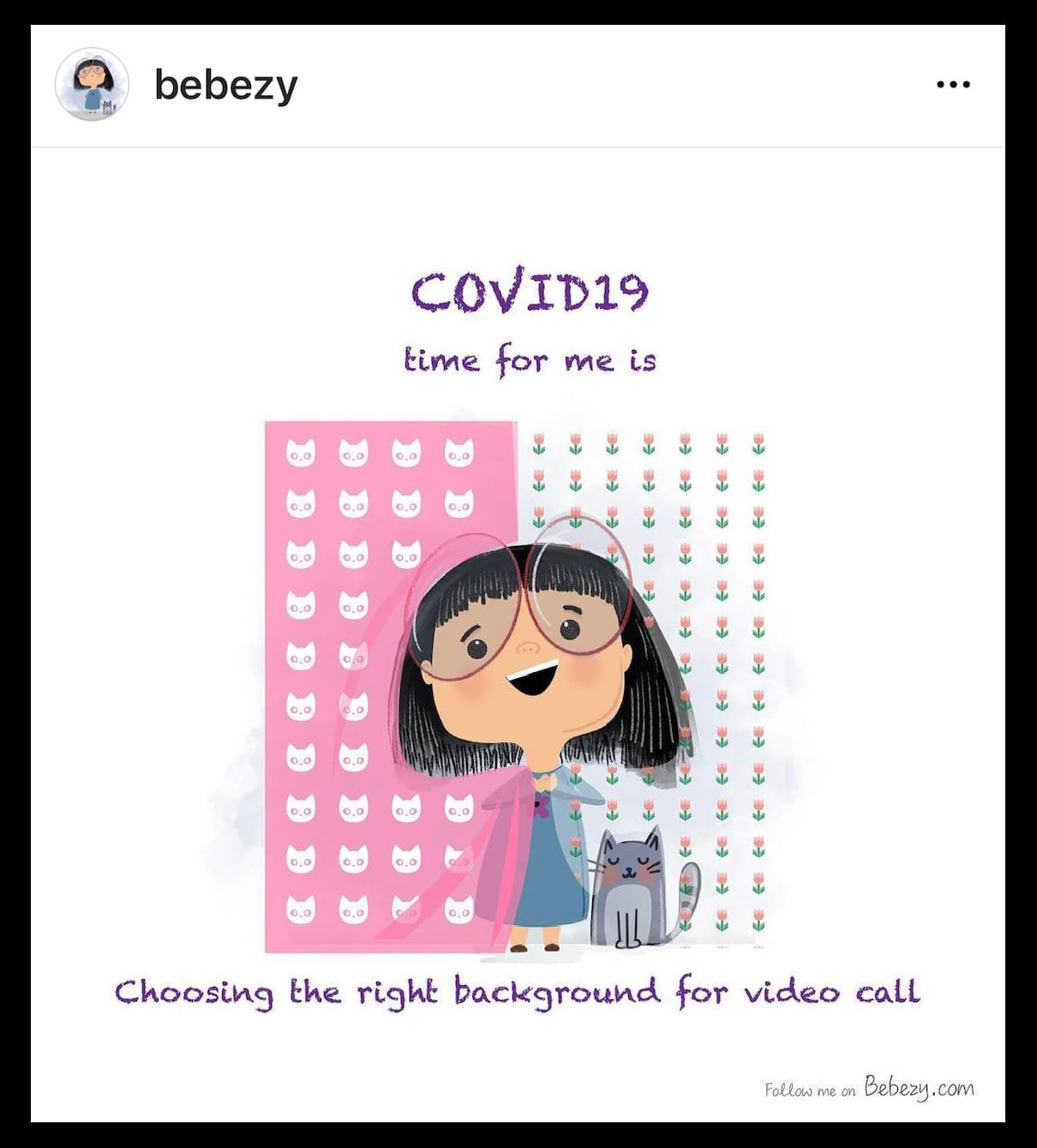
COVID-19 Time for Me is (Bebezy the Happiness Champion)
Kadambari Sahu, Viswatej Kurma and Sandeep Mulagapati
Bebezy: Bebezy is an empathetic happiness champion to fight negative contagion caused by Covid-19. She champions safety and emotional well being. She is a collaboration between Kadambari Sahu, Viswatej Kurma and Sandeep Mulagapati. Covid-19 time is unprecedented. A big part of this battle is fighting the ill effects of isolation. Modern technology has provided some means of coping with this. Art in this context becomes a solution where it can be used to create togetherness by giving a platform for expression and sharing the commonalities. It also becomes one of the effective channels which when used in the service of people can create positive emotions more infectious and break the negative contagion. In an article by HBR tilted The Contagion We Can Control “While medical and public health leaders are working as hard as they can to control the spread of the novel coronavirus, we, of course, listen to and heed their advice. But experts in emotional intelligence also have something powerful to offer” a way to help us manage a different type of contagion that, if we let it run rampant, will only make things worse. Stemming negative emotional contagion” and making positive emotions more infectious” will make us feel more prepared and in control during this frightening period.” [1] To fight this negative emotional contagion some of the methods described are to have empathy, gratitude, express emotions (art therapy), and help others. The “Covid-19 time for me is” becomes a social platform for people to send short expressions of their time which can be documented. It will also give people a chance to get creative and send us their time phrase which we will illustrate. The collection of such illustrations will create positivity, common global spirit to stay on this fight. It will become an archive preserved through illustrations. It will encourage people to stay safe and it will also spread common empathy and positivity. To create a positive, solidarity-based content we will filter the ones and create it emotionally intelligent so it can offer people to think on lines of empathy, gratitude, and positivity.
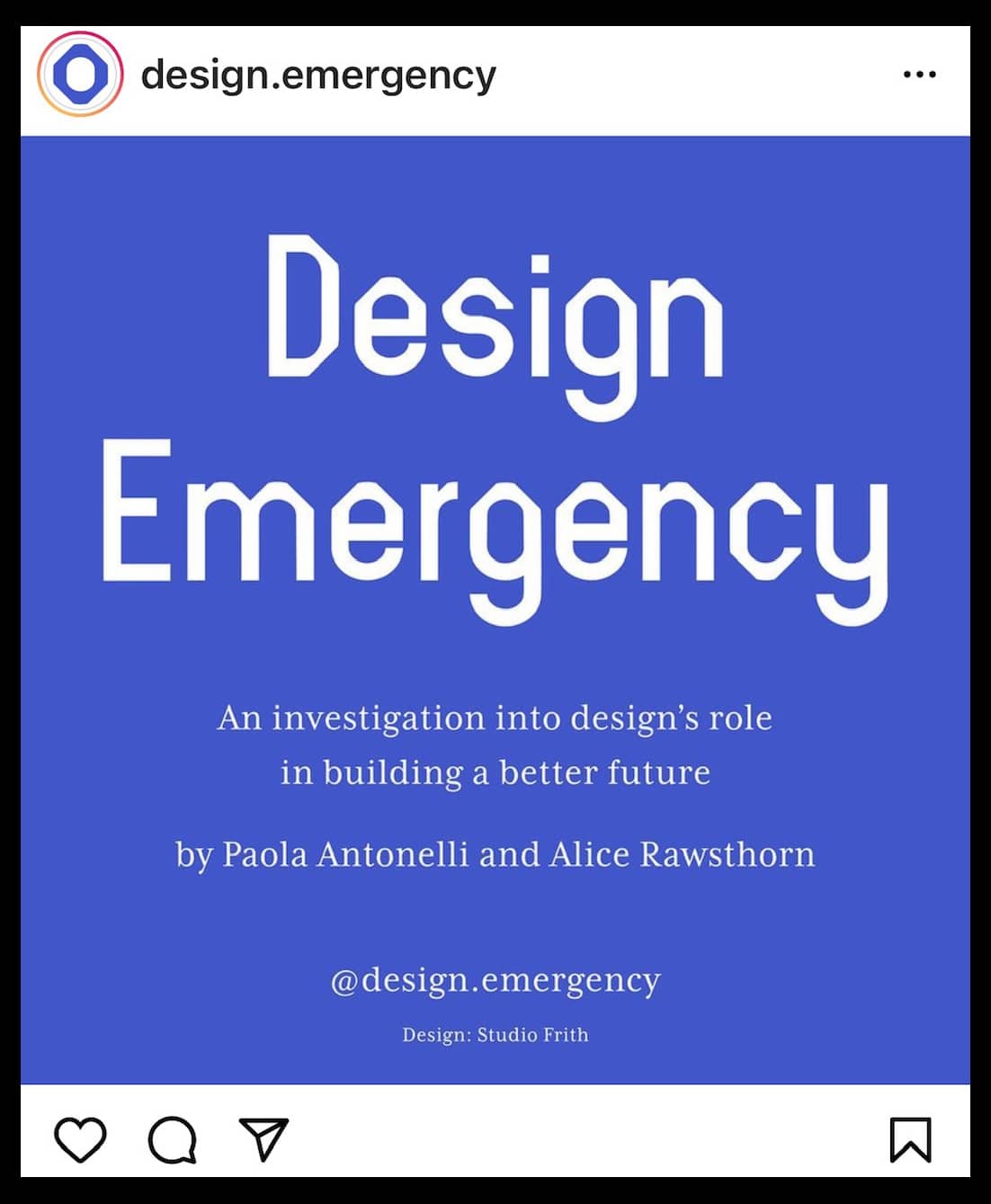
The project is by design curator Paola Antonelli and design critic Alice Rawsthorn. Paola and Alice plan to publish a book on Design Emergency and are streaming weekly Instagram Live talks with leading figures in the design response to Covid-19.
Our annual Slow Marathon art-walking event this year will be done remotely, yet together. People can join us from across the world to walk across the globe. Whatever our different circumstances, we all live under the same sky. The sky, like the virus knows no borders. As an act of hope, solidarity and resilience, we will cumulatively walk as many miles and marathons as we can and as slow as we like. In our small pockets of outdoor access, from our living rooms and around our homes, we will together symbolically walk around the globe. For Under One Sky, artist Iman Tajik will forge a digitally collaborative relationship with many people in their many varied experiences of taking part. For this he is collecting photos of the sky people see while walking. These will be brought together in a massive artwork of all of us under one sky. The 2020 Slow Marathon will finish when we jointly have walked the 40,000km/25,000miles around the world.
A narrated short film of a walk I took on the day the UK Government announced Lockdown. It was a beautiful spring day and it really didn’t feel like The Apocalypse but there were some signs…
Reimagine Hope With Music: Paul Miller aka DJ Spooky – Multimedia Artist, Composer, Author
Direct Talk
Reimagine Hope With Music: Paul Miller aka DJ Spooky / Multimedia Artist, Composer, Author. Spooky writes, “Japanese National TV did a documentary on me where they hung out with me in NY at the height of the Pandemic to see how artists and creatives were coping with the situation (socially distant, of course…)”
Infodemic is a neural network-generated video that questions the mediated narratives created by social media influencers and celebrities about the coronavirus. The term ‘infodemic’ can be traced back to the SARS outbreak in 2003, but gained popularity in February of 2020 when the WHO Director, General Tedros Adhanom Ghebreyesus stated: “we’re not just fighting an epidemic; we’re fighting an infodemic. Fake news spreads faster and more easily than this virus, and is just as dangerous.” The speakers featured in the video are an amalgam of celebrities, influencers, politicians, and tech moguls that have contributed to the spread misinformation about the coronavirus by either repeating false narratives, or developing technologies that amplify untrue content. The talking heads are generated using a conditional generative adversarial network (cGAN), which is used in some deepfake technologies. Unlike deepfake videos where a neural network is trained on images of a single person to produce a convincing likeness of that person saying things they did not say, we trained our algorithms on a corpora of multiple individuals simultaneously. The result is a talking head that morphs between different speakers or becomes a glitchy Frankensteinian hybrid of different people that contributed to the current infodemic speaking the words of academics, medical experts, or journalists that are correcting false narratives or explaining how misinformation is created and spread. The plastic, evolving, and unstable speakers in the video evoke the mutation of the coronavirus, the instability of truth, and the limits of knowledge.
Additional Details
Jennifer Gradecki is an artist and theorist who aims to facilitate a practice-based understanding of socio-technical systems that typically evade public scrutiny. Using methods from institutional critique, tactical media, and information activism, she investigates information as a source of power and resistance. Her work has focused on Institutional Review Boards, social science techniques, financial instruments and, most recently, intelligence agencies and technologies of mass surveillance. She teaches Game Design and Media Arts courses at Northeastern University.
[ I Miss Your Touch ] – Staying Connected During COVID and Beyond
Betty Sargeant PluginHUMAN
[ i miss your touch ] transports two people who are in seperate locations into a shared virtual environment. This unique online space launched in March 2020 as a rapid response to pandemic conditions. This award-winning interactive video artwork helps people maintain meaningful social and physical connections with each other, and provides a personalised art experience. [ i miss your touch ] is a live collaboration between the participants and PluginHUMAN (Dr Betty Sargeant and Justin Dwyer, the artists). The artwork responds to people’s movements. PluginHUMAN affect, in real-time, live video streams from participants’ webcams. People can instantly see the creative effects of their movements and interactions. They can also experience virtual touch. [ i miss your touch ] makes people feel as if they are together in one space. It allows friends, who are in separate locations, to dance, to virtually hug and to interact in a shared online environment. During 2020, many people have been without physical contact with others due to pandemic lockdown and physical distancing rules. [ i miss your touch ] provides a way to maintain meaningful connections with others and meaningful engagement with art during this unprecedented global situation. Participants don’t need specialist equipment of software, there are no logins or passwords. People use their computer webcam and internet; they enter their unique URL and are instantly transported into the [ i miss your touch ] experience. This ephemeral artwork is freely accessible to broad audiences.