The MIT Press & UC Berkeley launched an open access, rapid-review overlay journal that accelerates peer review of COVID-19-related research and delivers real-time, verified scientific information that policymakers and health leaders can use. Scientists and researchers are working overtime to understand the SARS-CoV-2 virus and are producing an unprecedented amount of preprint scholarship that is publicly available online but has not been vetted yet by peer review for accuracy. Traditional peer review can take four or more weeks to complete, but RR:C19’s editorial team, led by editor-in-chief, Stefano M. Bertozzi, Professor of Health Policy and Management and Dean Emeritus of the School of Public Health at University of California Berkeley, produces expert reviews in a matter of days. Using artificial intelligence tools, a global team identifies promising scholarship in preprint repositories, commission expert peer reviews, and publishes the results on an open access platform in a completely transparent process. The journal strives for disciplinary and geographic breadth, sourcing manuscripts from all regions and across a wide variety of fields, including medicine; public health; the physical, biological, and chemical sciences; the social sciences; and the humanities.
Authentic Learning of Clinical Skills Through AIMST University Model of Ambulatory Care and In-patient Care Simulation.
AIMST University, Malaysia
The lockdown in Malaysia since 18th March 2020 has created a sudden vacuum in the face to face learning opportunity of clinical skills. We had to design and deliver authentic learning of clinical-skills in a simulated environment in the faculty of Medicine, AIMST University, for the under-grad medical students studying in the MBBS program. This is a gist of the principles we have followed to achieve that to the best of the collective ability of the faculty. Guiding Principles in Brief: Structuring of Clinical Teaching-Learning (through years 3 to 5 of MBBS) has been done by adopting RIME framework. We have been following the RIME model since 2019. Briefly, it is to teach and learn, — recording (R) clinical history and physical examination in year-3; — interpreting (I) the clinical case details and the investigation reports in year-4; and — planning management (M) of the case; — how to give follow up advice by patient education (E) in year-5 of the MBBS course. Choice of the Mode of Teaching-Learning: This has been based on the predominant domain as per the revised Bloom’s taxonomy and Miller’s prism/pyramid. Academic freedom was given to each clinical unit to base their choice of the level of clinical experience based on availability of resources, feasibility and priorities. The guiding principle for the choice of learning experience was Dale’s cone of experience. For example, the clinical units with access to real ambulatory cases arranged to get the cases to the simulated bedside discussions. Other units, used hybrid models to the extent possible combining, i) standardized patients, who could give clinical history in a consistent manner, ii) normal volunteers for the students to practice physical examination, and iii) high fidelity simulators to learn perceptual skills of visual, auditory and tactile senses. Ambulatory Care Simulation: Ambulatory (outpatient) care is medical care provided on an outpatient basis, including diagnosis, observation, consultation, treatment, intervention, and rehabilitation services. The goal is to learn the skills of focused case assessment and advising the patient on home based management of the problem. It is feasible to use some of the clinical students to play the roles of ambulatory cases with a bit of guidance and coaching on key features of the case scenario. The others would then interact with them in layperson’s language to elicit the case history. Several symptoms do not have any abnormal physical findings and are diagnosed based on history alone. These are easy to begin the program of ambulatory care simulation. “AIMST University Model” of simulated In-patient environment: Cognitive realism is more important than physical realism in creating authentic learning environment. Therefore, each clinical unit has planned sustainable and practicable in-patient simulation based on the principles of design stated earlier. We have created a 4 bedded in-patient cubicle to create a realistic milieu. On day-0, the briefing is done on the objectives of the in-patient simulation exercises, which would spread over 3 to 5 days. The students who play the roles of in-patient cases will be initially coached on case details. From day-1, they would plan to narrate their daily progress until they are discharged. The clinical conditions are chosen from the common diseases prevalent in Malaysia. On day-1, the rest of the students are allotted a new patient for clerking. Appropriate Mannequins or videos will be supplemented to present the physical findings of the patient allotted. After an hour of clerking, the clinical instructor will take ward rounds and analyze each case presentation in detail, especially focusing on differential diagnosis, further investigations and initial treatment plan. On day-2, the daily progress report, and the lab reports & images will be the basis for discussions. The focus will be narrowing the diagnostic possibilities, planning further work up if needed, and modifying treatment plan based on test results. This may go on for a day or two more as planned by the unit. On the final day of the simulation exercise, the students will discuss discharge plans and instructions to the patients. Evaluation of the Ambulatory and In-patient simulation: Evaluation of the learning outcomes are assessed daily, using the RIME evaluation format already available with the major clinical units. In addition, feedback has been obtained from the students, from the role-players and from the clinical instructors on the usefulness of the simulated clinical environment in achieving the expected outcomes. The encouraging feedback has consolidated our efforts to persist with the AIMST-model during 2021, the second year of pandemic-associated disruption in face-to-face learning in real-life clinical settings. In conclusion, to the best of our knowledge, our model of longitudinal clinical-clerkship simulation over 4 to 5 days, is an original contribution to Medical Education.
COVID-19 can take some credit for the co-creation of this site. It felt necessary to to do something positive together in the face of this ongoing and frightening tragedy. We are a collective of ecological artists and activists who interpret, celebrate and defend water. These invited artists have experienced the effect that art can have upon ordinary perception, and how it can open us to new ways of being. They have chosen water as their subject matter or medium.
Nothing alive exists without water. Our bodies are mostly water, and our eyes are 95% water. It is no surprise that water has always called artists to it. These water journeys cover many disciplines. Through art, we can begin to think as water, rather than simply about it.
Think About Water is excited to learn about all ideas, projects, artists and organizations that align with our mission, especially under-represented and minority groups in the US and around the world.
We hope that all visitors to this site will fill out the contact form which adds you to our mailing list.
The Curb Center for Art, Enterprise & Public Policy at Vanderbilt University
When the COVID-19 pandemic catalyzed a sudden shift to online and virtual platforms for classrooms, exhibits, and other communal gatherings, it offered a unique opportunity for the Curb Center for Art, Enterprise and Public Policy and The ArtLab Studio to collaborate on See You Again: Students Respond to COVID-19, an exhibit of Curb Scholars’ artwork on the pandemic and the vaccine rollout, which is currently showcased through virtual reality on ArtSteps and augmented reality on the Mezzanine level of Vanderbilt University Adult Hospital at Vanderbilt University Medical Center. Additionally, the exhibit is currently being reconfigured to be displayed via augmented reality on Zapworks. The Curb Scholars’ paintings, graphic designs, collages, music, films, and poetry featured in the exhibit, as well as the ArtLab Studio’s VR and AR designs, exemplify what it means to identify as a “creative” rather than an “artist.”
An Artist a Day… was a live, online show for 15 minutes every day, that ran from June 18 -September 13, 2020. An Artist a Day… is currently presenting the project “What Are You Looking Forward to in 2021?” to examine a paradigm shift in our time through artists’ voices and their creations.
During the lockdowns of the COVID-19 pandemic in 2020, technologies that were not particularly new or innovative were rediscovered as a means to communicate during social distancing. Video conferencing in particular quickly became the standard adopted means of work, education, and collaboration. In a sense, old became new again and was presented as if it never was; the technologies were quickly integrated as part of essential communication infrastructures and their use became a key skill.
Networked performance practices have, for many years, been defined by these networked technologies and their form. Consequently, the pandemic brought to the fore several questions about this type of artistic practice. If the use of networked technologies is now a key everyday skill widely employed, can networked performance truly align itself with technology art (as it often has been), or does it revert to a closer relationship with the performance art of the twentieth century? If the latter is the case—and for many it is highly contentious that it qualifies as having any relationship with those art forms—has networked performance become isolated within art history? Is it pushed to irrelevance by the current popularization of its technological forms, doomed to be haunted by its artistic predecessors?
In response to these questions and the condition of performance in confinement, during lockdown I began to model a series of scenes in 3D that recreate the locations of landmark performance art. All performances selected occurred in the interior spaces of an artist’s home, studio, or residency to reflect on the confined circumstances artists were now required to create within during the pandemic. The result is a series of scenes for networked performance that consist of 3D-rendered images and models created from video and photographic documentation of the original performances. The artist who originally performed is absent from each scene, allowing new artists to “virtually” occupy the spaces and create new performances.
Distributed through GitHub under a Creative Commons by Attribution license, the scenes are created “after”—or in the manner of—the original artists. They constitute a form of instruction, guide, or performance media kit that enables new artists to reenact performances or create new works inspired by the originals within the context of digital technology and networked performance. The media kits can be employed within various networked environments, such as through Zoom or Skype’s virtual backgrounds or as imported models in Second Life, Unity, or various other 3D/VR/AR applications.
The series is intended to facilitate the exploration of what can be achieved when spatial and corporeal possibilities are on the one hand limited or simplified but the necessity of technology to view performance is on the other a way to move beyond those limitations. This is most obviously demonstrated in how artists can appear out of their actual living or studio spaces and in another. The spaces/props and the bodies/actions of the performances, however, are only “virtually” copresent: technically in image, through bluescreening, 3D rendering, interpretation, etc. and conceptually through the concept of “hautology.”
While employed network technologies remove the limitations of an occupied space, artists have to refer to what they know, such as landmark performances, or what their current frame of reference lets them imagine—perhaps a performance in a space they know. This existing awareness of performances and spaces known in a sense haunts all new performances by artists, a condition that spans all creative practices in postmodernism and beyond.
Trove is a durational ambient musical project created by Mutantrumpeter/Composer Ben Neill and Producer/Composer Eric Calvi. Trove originated during the Covid-19 crisis of 2020, and is created in direct response to the isolation and self-reflection that were forced by the unique circumstances of the pandemic. The project launched with the release of 5 pieces on November 24, 2020, and continues as an ongoing series of 2 releases per week for one year. Neill performs Trove playing only his self-designed Mutantrumpet – no synthesizers are used. The acoustic sound of the Mutantrumpet is captured and processed in real time by Neill’s custom system using the instrument’s 28 onboard electronic switches, joysticks, and knobs. Each piece is recorded as a single improvised performance with no overdubs. The process of making the pieces was a meditative, restorative activity for me personally, and gradually developed as the pandemic went through different stages. The compositions move through a series of chords whose pitches are based on a Fibonacci series matrix. Other aspects of the music including rhythm, melody, and formal structure are based on Fibonacci sequences, which model the forces of growth and reproduction in the natural dynamical systems of plants and animals. Trove uses this fundamental structure of lifeforms to create grounding, restorative music intended as an accompaniment to everyday life activities in these difficult times.
In 2021, OK Go Sandbox invited the world to help create a new video and remix of “All Together Now.” The #ArtTogetherNow project ended up creating 6 films and 5 new versions of the song, thanks to approximately 15,000 global collaborators.
Additional Details
OK Go Sandbox is an online resource for educators that uses OK Go’s music videos as starting points for integrated guided inquiry challenges allowing students to explore various STEAM concepts.
Developed as a collaboration between OK Go and the Playful Learning Lab at the University of St. Thomas (led by Dr. AnnMarie Thomas), OK Go Sandbox is about bringing different ideas, disciplines, and people together to explore creativity and learning. Director Geoff Shelton is creating new videos specifically designed to inspire classroom discussions and projects.
We are particularly looking forward to interacting with even more educators as we work to expand the OK Go Sandbox offerings. We encourage you to reach out to us (hello@okgosandbox.org) with your feedback and ideas. The best part of a sandbox is that we can try building lots of new things and improving them based on your input- even if we occasionally need to knock down a castle and start over!
Live video tours of the Garden during lockdown when public were not permitted on grounds, and other entities of the Garden created video and other online material to share via social media feeds
Translations: Chains of Positive Energy (c.o.p.e.)
Tova Speter, Maya Bernstein, Emily Bhargava, and Maria Beatriz Arvelo
Translations: chains of positive energy (c.o.p.e.) was launched in April 2020 in direct response to the isolating effects of the Covid-19 crisis. After experiencing the powerful connections created by participating in chains of art as part of a physical art exhibit), I started this project to help others connect as well. We may be socially distancing, but we can still be connected. Participants are invited to sign up to be a part of a chain of art where they can receive work created by someone else and then create work in response in order to then inspire someone else in the chain. Each chain in Translations: chains of positive energy (c.o.p.e.) was started by someone offering a word/phrase/quote that describes a quality or mindset they have that allows them to move forward through these challenging times. The word was then sent to another artist to “translate” into their own modality. Once complete, that new artwork was sent to a different artist to translate into a different modality, and on and on, with each artist ONLY seeing the one translation immediately prior to their own. The seven links in the completed chain are a nod to the seven days in each week that feel so long right now.
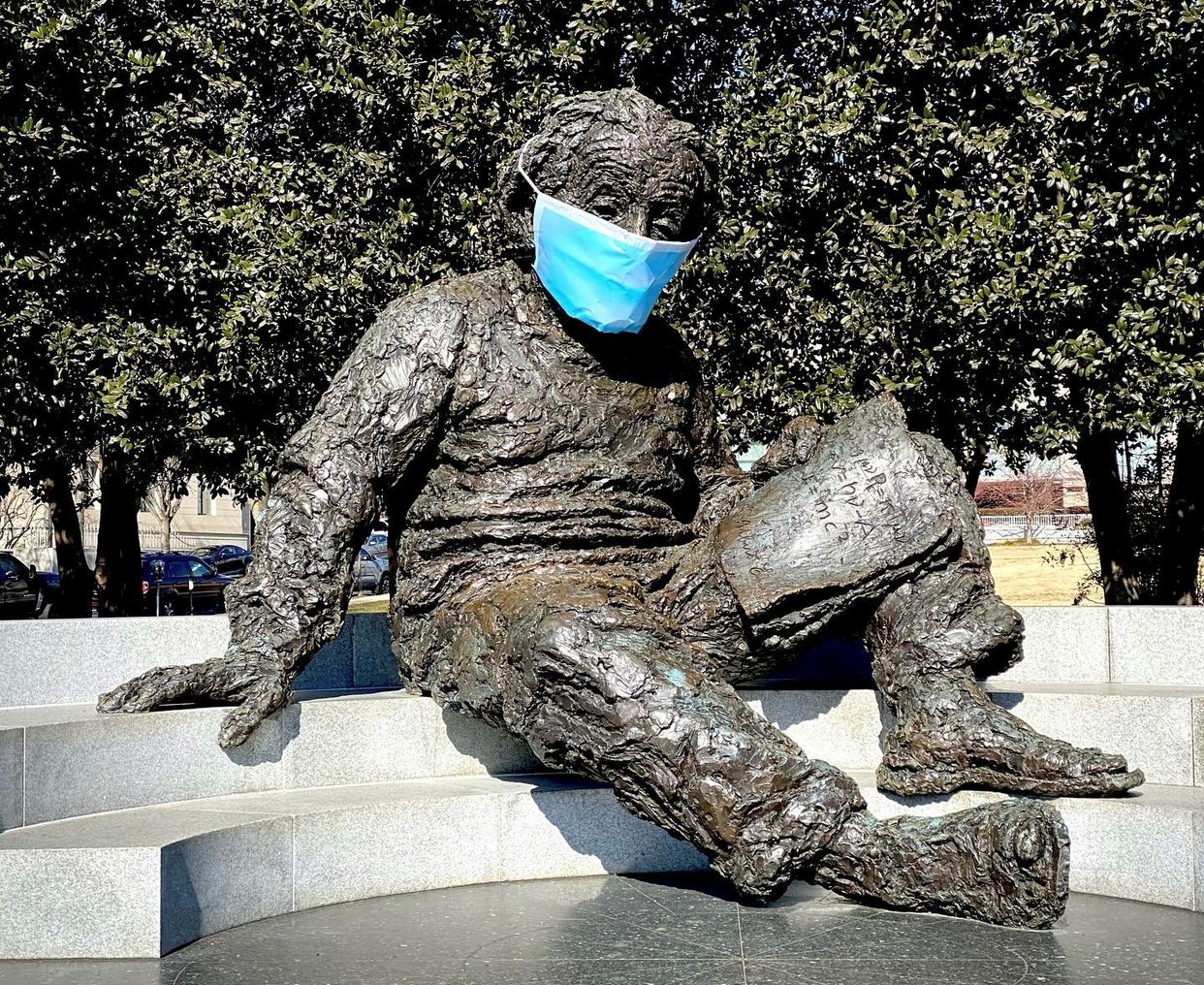
In late 2020 and early 2021, the National Academy of Sciences fabricated a large mask for the Einstein Memorial to promote the wearing of masks to reduce the spread of COVID-19. Visitors were encouraged to post images of themselves wearing masks with the hashtag #MaskUpwithEinstein
Liminal Performance Space is an arena for remote performance creation and exhibition created by video installation artist and creative coder Fernanda D’Agostino, using the coding platform Isadora. Fernanda was a Beta tester for new units of code developed by Mark Coniglio at Troikatronix in Berlin, that permit Isadora users to input live video from SKYPE or other NDI based online meeting platforms. Live video feeds via SKYPE allow collaborators prevented from meeting IRL to come together to create new work that pushes the boundaries of what remote spaces can be. In some cases my collaborators and I have been separated by oceans and days of the week. The intention is to use the restrictions of quarantine to open up and explore new ways of working together that cross boundaries of time, space and cultures. My work pre-Covid was in interactive sound and video installation. My history is as a performance artist and from that history springs my interest in creating spaces that viewers can interact with both digitally and by touch, movement, meals within the space etc. I’m also a frequent collaborator with dancers and other performance artists. I see the Liminal Performance Space as yet another interactive performance installation space in the series I’ve been creating for many years. There are fourteen distinct “rooms” within the space all with different coded effects and potential interactions. Most are activated by the movements of digital visitors to the space. Some are sound activated. Some allow visitors to manipulate sound or streams of particles by gesture. The showcase I have submitted is one of three experimental collaborations to date. Aside from The Kusanagi Sisters, (Tokyo) I’ve collaborated with Yunuen Rhi (Los Angeles and Mexico City) and the In/Body collective, (Portland, Oregon.) Interesting to me is how experienced performance artists will explore the properties of the different “rooms” and quickly discover creative acts the code permits that I did not fully anticipate.All the scenes in the Kusanagi Sister Showcase were created within one hour long session. The only post production was for me to cut our conversation between exploring each “room” and fine tune where the sound cuts in and out. All the effects you see in these clips happen in real time in response to the performers. Most of those performers quickly fall into a state of reverie and when working in duets into a heightened sense of awareness of “the other,” of scale, and of the potential within each “room’s” transformational properties. I’m currently working on a fourth collaboration, with artist/critic Pat Badani, where the role of both written and spoken language will be more central. That is an area of coding I am just now exploring and I’m sure I will be stretched by our work together. Keep an eye out for that work in the future as we plan to submit that as a distinct project.
Inspired by spending extended time in lockdown due to the pandemic, Ceremony Shadows is a dark ambient electronic music project. I’m currently releasing a few tracks that are part of a forthcoming album and live experience titled “Inception, Bloom, and Decline”, chronicling my creative cycle during lockdown.
Beginning January through mid-March 2020, global quarantine measures were taken in response to the spread of the novel Coronavirus around the world. This is perhaps the only time in recorded history when nearly all nations around the world took some form of collective action for the protection of human kind. The global response creates a unique kind of opportunity to ask a unique question: how does the intersection of culture, politics, and rhetoric reveals itself as words when every country agrees on the nature of the problem?
Around the world, speeches were delivered by national leaders addressing how daily life and laws would suddenly need to change. These viral word clouds came from those first speeches. To date, I have created wordclouds from 17 official English transcripts. I was motivated to ask how how one speech might have influenced another over time, as more knowledge about virus was became known? How are national values reflected in the words of their leaders? Which words best express a cooperative relationship between humans and the natural (viral) world? Which ones express concerns for one another? Ecology? Society? Mutual aid? Collaboration? In light of new scientific discoveries about Sociovirology – the secret social life of viruses. What are the ways their social behavior might influence our own?
STEAM challenges designed for my grandchildren, but adaptable to many age groups. Intended to stimulate creative and critical thinking, and problem-solving skills. Blog was taken on and promoted by Leonardo.
This micro-course aims to help teachers deal with the suspension of classes due to measures against the coronavirus (COVID-19) outbreak.
ART AND SCIENCES TOGETHER
We believe in a learning model based on the student’s active role, in contextualized knowledge, in the promotion of curiosity and in the constant integration between Science, Technology, Engineering, Arts and Mathematics (STEAM).
This site is a repository for observations, reflections and collections from this global pandemic. It hosts voices of many featuring content from familial, social, creative and scientific networks.
Additional Details
Take action in quarantine, 3 easy steps! We are a creative and multidisciplinary team developing a repository of the COVID-19 experience. As experts collect information worldwide, we are building a database for creative expression. Great Pause Project is entirely open source, available to a global community to reflect, share, and document this unique experience. Join us as we archive this story!
With the COVID-19 outbreak, many sociopolitical issues are becoming even more apparent. One of them is the dodging of responsibilities and shifting blame to government officials. It reflects the problem of our current sociopolitical mechanism and has been one of the causes of this pandemic’s out-of-control spread. The action of dodging responsibilities is called “甩锅” in Chinese, which literally means “tossing a pan.”
This whole toss-pan comedy has been played between the central government and local government, in China, the United States, and many other countries.
To inform, criticize, and warn fellow citizens, I made this Toss Pan Dance.
Since we are social distancing and in self-quarantine at the moment, Toss Pan Dance is also a very good exercise. You can easily do it at home without a gym. The equipment is right in the palm of your hand!
The music is made by typing on the computer: “abcdefg” on a Mac keyboard is mapped to notes on the piano keyboard.
This dance went viral on the Chinese internet. #tosspandance #甩锅舞
Huang Hung, “the Oprah of China,” used this dance to explain “Toss Pan” in her TED Talk on “how American and Chinese values shaped the coronavirus response.”
Additional Details
Working at the intersection of emerging technology, art, and design, Li Jiabao creates new ways for humans to perceive the world. She works across nature, humans’ designed environment, and belief structures and creates works addressing climate change, humane technology, and a just, sustainable future. Her mediums include wearable, robot, AR/VR, projection, performance, software, and installation.
In Li’s TED Talk, she uncovered how technology mediates the way we perceive reality. At Apple, she invents and explores new technologies for future products. She graduated from Harvard Graduate School of Design with a master of design in technology with a distinction and best thesis award.
Li is the recipient of numerous awards, including iF Design Award, NEA, STARTS Prize, Fast Company, Core77, IDSA, AACYF 30 Under 30. Her work has been exhibited internationally, at Ars Electronica, SIGGRAPH, Milan and Dubai Design Week, ISEA, Anchorage Museum, Codame, Primer, OCAT Contemporary Art Terminal, CHI, Donghu Shan Art Museum. Her work has been featured on Yahoo, TechCrunch, Domus, CCTV, Yanko Design, Fast Company, Harvard Political Review, The National, Business Insider, Bloomberg, Leonardo, and South China Morning Post.
Between March and September 2020, the Boston University Arts Administration compiled this list of media articles that chronicle the impact of the pandemic on the sector and the creative responses of the field. We are currently conducting a longitudinal research project with ArtsBoston to track the career outcomes of professional arts managers who were employed at a large sample of Greater Boston arts organizations at the time the pandemic hit in February. We will post the results of that study at regular intervals as they become available.
This Too Shall Pass: Creativity in the Time of COVID-19
The Science & entertainment exchange with Cultural programs of the national academy of sciences
This Too Shall Pass: Creativity in the Time of Covid-19 is a series of online discussions organized by Cultural Programs of the NAS and by the Science & Entertainment Exchange to explore creative responses in all disciplines to the pandemic.
Programs included:
July 1, 2020 Claudius Conrad, Andrew Janss, and Indre Viskontas
August 5, 2020 Clifford Johnson, Mike Smith and Molly Webster
October 2020 Lauren Gunderson, Deric Hughes, and Kevin O’Brien
The Social Distance Art Project (TSDAP) was set up in the wake of Covid-19 by a small group of 2020 Fine Art graduates hoping to offer a platform to showcase and discuss graduate work in the absence of Degree Shows.
Our mission doesn’t stop here. As emerging artists, we need more than just a degree show alternative. At TSDAP our goal is to provide a digital community for artists, providing them with the exposure they need to make it in the art world. We want to create a more diverse and equal model for our artists by encouraging a spread of shared opportunities, both digital and physical, not based upon nepotism.
We are developing a virtual exchange for our summer writing program for high school students, creating digital learning courses on creative writing and disabilities and creative writing and dance, and exploring ways to bring together our pedagogical interests and public health. We have just published a range of reactions from IWP alumni to The Situation, as we call the pandemic, which can be found here:
In response to the Covid-19 surge, Boston Hope Hospital was created. This field hospital based at the Boston Convention Center was designed to care for patients recovering from Covid after hospital discharge, as well as homeless patients who were Covid+ in need of respite care and isolation. Boston Hope Music project brought over 100 musicians from the around the city together who submitted “musical doses” of electronically. These were curated into over 25 playlists that patients could access via Samsung tablets three times a day to promote healing. These playlists are now available to the general public on a dedicated website. In addition, musicians visited the Boston Hope Hospital to play music for the healthcare providers to help promote wellness and wellbeing for the front line.
I created a composition challenge on social media, for myself and anyone that would like to follow. The challenge consists in creating and posting one minute of music (any kind of music) on a weekly basis, during June, July and August, 2020.
A fast moving musical journey made on 3 continents by a diverse team of actors, dancers, musicians, cinematographers, and regular folks sending their made in quarantine/social distance videos from around the world. Then assembled into a unique film. An incredible array of talent on display to raise spirits and bring a smile. Creative within science guidelines. Building community through art.
Additional Details
Directed by Ashley Maria Composed by David Raiklen Edited by Crystal Lentz Cinematography by Autumn Palen Produced by David Raiklen and Ashley Maria
(social distancing and PPE used during production and post)
In these days of quarantine, when a touch is a wave from six masked feet away, we turn again to language, to the essence of language, to the art of language, to poetry.
The “Poetry Is Like Bread” Ghazal is a collaborative poem created by a world of poets to nourish us all through the Pandemic and to envision the world After. We take our inspiration from Pablo Neruda: “On our earth, before writing was invented, before the printing press was invented, poetry flourished. That is why we know that poetry is like bread, it should be shared by all, by scholars and by peasants, by all our vast , incredible, extraordinary family of humanity.” This collaborative poem was created with the idea that each poet’s unique voice would join together as one, and that the result would be shared by all. There is no poetic form better suited to do this than the Ghazal.
“POETRY IS LIKE BREAD” GHAZAL.
If, as Neruda thought, poetry is like bread, Then let it leaven this dark time and be my bread. [ Christopher Merrill ]
Struggling (and losing) in this Antipoem, ghosted thread, Spreading cool butter, sweet jam on homemade toasted bread. [ Bob Holman ]
No one waits to forgive the dead don’t pardon the dirt, nor the psalm palms, this celebration of bread [ Mahogany L. Browne ]
Distracted by detonating deadlines and demonstrations, I couldn’t meet your request for peaceful bread. [ Sandra Cisneros ]