Authentic Learning of Clinical Skills Through AIMST University Model of Ambulatory Care and In-patient Care Simulation.
AIMST University, Malaysia
The lockdown in Malaysia since 18th March 2020 has created a sudden vacuum in the face to face learning opportunity of clinical skills. We had to design and deliver authentic learning of clinical-skills in a simulated environment in the faculty of Medicine, AIMST University, for the under-grad medical students studying in the MBBS program. This is a gist of the principles we have followed to achieve that to the best of the collective ability of the faculty. Guiding Principles in Brief: Structuring of Clinical Teaching-Learning (through years 3 to 5 of MBBS) has been done by adopting RIME framework. We have been following the RIME model since 2019. Briefly, it is to teach and learn, — recording (R) clinical history and physical examination in year-3; — interpreting (I) the clinical case details and the investigation reports in year-4; and — planning management (M) of the case; — how to give follow up advice by patient education (E) in year-5 of the MBBS course. Choice of the Mode of Teaching-Learning: This has been based on the predominant domain as per the revised Bloom’s taxonomy and Miller’s prism/pyramid. Academic freedom was given to each clinical unit to base their choice of the level of clinical experience based on availability of resources, feasibility and priorities. The guiding principle for the choice of learning experience was Dale’s cone of experience. For example, the clinical units with access to real ambulatory cases arranged to get the cases to the simulated bedside discussions. Other units, used hybrid models to the extent possible combining, i) standardized patients, who could give clinical history in a consistent manner, ii) normal volunteers for the students to practice physical examination, and iii) high fidelity simulators to learn perceptual skills of visual, auditory and tactile senses. Ambulatory Care Simulation: Ambulatory (outpatient) care is medical care provided on an outpatient basis, including diagnosis, observation, consultation, treatment, intervention, and rehabilitation services. The goal is to learn the skills of focused case assessment and advising the patient on home based management of the problem. It is feasible to use some of the clinical students to play the roles of ambulatory cases with a bit of guidance and coaching on key features of the case scenario. The others would then interact with them in layperson’s language to elicit the case history. Several symptoms do not have any abnormal physical findings and are diagnosed based on history alone. These are easy to begin the program of ambulatory care simulation. “AIMST University Model” of simulated In-patient environment: Cognitive realism is more important than physical realism in creating authentic learning environment. Therefore, each clinical unit has planned sustainable and practicable in-patient simulation based on the principles of design stated earlier. We have created a 4 bedded in-patient cubicle to create a realistic milieu. On day-0, the briefing is done on the objectives of the in-patient simulation exercises, which would spread over 3 to 5 days. The students who play the roles of in-patient cases will be initially coached on case details. From day-1, they would plan to narrate their daily progress until they are discharged. The clinical conditions are chosen from the common diseases prevalent in Malaysia. On day-1, the rest of the students are allotted a new patient for clerking. Appropriate Mannequins or videos will be supplemented to present the physical findings of the patient allotted. After an hour of clerking, the clinical instructor will take ward rounds and analyze each case presentation in detail, especially focusing on differential diagnosis, further investigations and initial treatment plan. On day-2, the daily progress report, and the lab reports & images will be the basis for discussions. The focus will be narrowing the diagnostic possibilities, planning further work up if needed, and modifying treatment plan based on test results. This may go on for a day or two more as planned by the unit. On the final day of the simulation exercise, the students will discuss discharge plans and instructions to the patients. Evaluation of the Ambulatory and In-patient simulation: Evaluation of the learning outcomes are assessed daily, using the RIME evaluation format already available with the major clinical units. In addition, feedback has been obtained from the students, from the role-players and from the clinical instructors on the usefulness of the simulated clinical environment in achieving the expected outcomes. The encouraging feedback has consolidated our efforts to persist with the AIMST-model during 2021, the second year of pandemic-associated disruption in face-to-face learning in real-life clinical settings. In conclusion, to the best of our knowledge, our model of longitudinal clinical-clerkship simulation over 4 to 5 days, is an original contribution to Medical Education.
Three electronic musicians, quarantined in different cities across the globe, record a series of short rhythmic loops. Each loop is subsequently cut into a lock groove on a vinyl record and played back on a turntable in each location. Video and audio from the turntables are streamed to a Zoom meeting so that the rhythms can be heard together, but only as transformed by the temporal distortions inherent to Zoom and to online relationships in general. Each day, new lock grooves are selected after the previous ones begin to physically degrade from continuous playback.
During the lockdowns of the COVID-19 pandemic in 2020, technologies that were not particularly new or innovative were rediscovered as a means to communicate during social distancing. Video conferencing in particular quickly became the standard adopted means of work, education, and collaboration. In a sense, old became new again and was presented as if it never was; the technologies were quickly integrated as part of essential communication infrastructures and their use became a key skill.
Networked performance practices have, for many years, been defined by these networked technologies and their form. Consequently, the pandemic brought to the fore several questions about this type of artistic practice. If the use of networked technologies is now a key everyday skill widely employed, can networked performance truly align itself with technology art (as it often has been), or does it revert to a closer relationship with the performance art of the twentieth century? If the latter is the case—and for many it is highly contentious that it qualifies as having any relationship with those art forms—has networked performance become isolated within art history? Is it pushed to irrelevance by the current popularization of its technological forms, doomed to be haunted by its artistic predecessors?
In response to these questions and the condition of performance in confinement, during lockdown I began to model a series of scenes in 3D that recreate the locations of landmark performance art. All performances selected occurred in the interior spaces of an artist’s home, studio, or residency to reflect on the confined circumstances artists were now required to create within during the pandemic. The result is a series of scenes for networked performance that consist of 3D-rendered images and models created from video and photographic documentation of the original performances. The artist who originally performed is absent from each scene, allowing new artists to “virtually” occupy the spaces and create new performances.
Distributed through GitHub under a Creative Commons by Attribution license, the scenes are created “after”—or in the manner of—the original artists. They constitute a form of instruction, guide, or performance media kit that enables new artists to reenact performances or create new works inspired by the originals within the context of digital technology and networked performance. The media kits can be employed within various networked environments, such as through Zoom or Skype’s virtual backgrounds or as imported models in Second Life, Unity, or various other 3D/VR/AR applications.
The series is intended to facilitate the exploration of what can be achieved when spatial and corporeal possibilities are on the one hand limited or simplified but the necessity of technology to view performance is on the other a way to move beyond those limitations. This is most obviously demonstrated in how artists can appear out of their actual living or studio spaces and in another. The spaces/props and the bodies/actions of the performances, however, are only “virtually” copresent: technically in image, through bluescreening, 3D rendering, interpretation, etc. and conceptually through the concept of “hautology.”
While employed network technologies remove the limitations of an occupied space, artists have to refer to what they know, such as landmark performances, or what their current frame of reference lets them imagine—perhaps a performance in a space they know. This existing awareness of performances and spaces known in a sense haunts all new performances by artists, a condition that spans all creative practices in postmodernism and beyond.
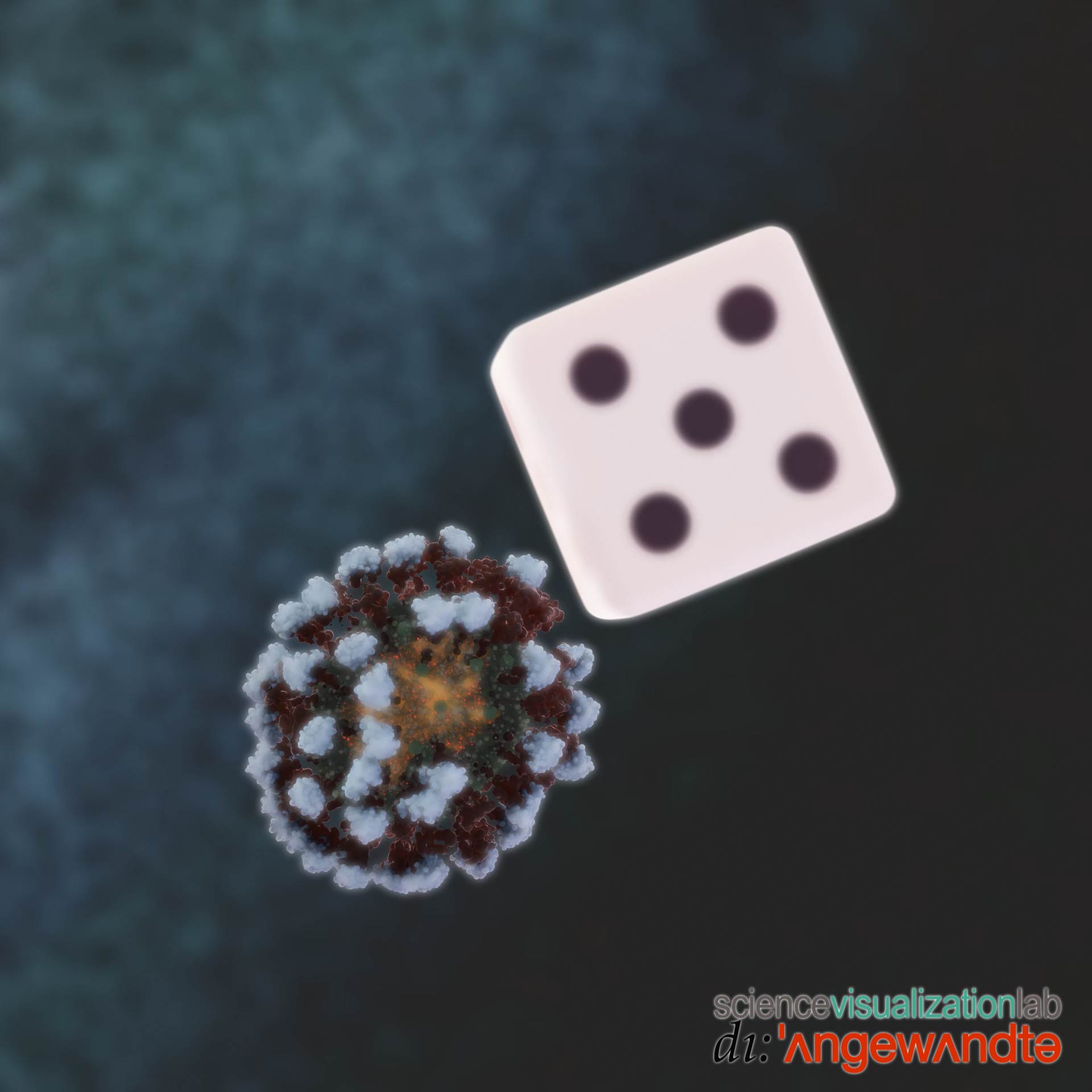
Virus Dice is an artistic and scientific visualization project. It features videos and an interactive installation. The project informs about the infection pathway and how medications work. The project makes the delicate, extremely vulnerable state of human health visible in a metaphorical way.
How Pratt Students Met the Pandemic With Creativity and Reshaped Their Practices for the Future
Pratt institue
The ongoing pandemic has changed everything, from the way we learn and create to how we think about the future. At Pratt Institute, students have used their creativity to adapt to these shifts, while addressing isolation, grief, uncertainty, hope, and community into their work. Eight of these students shared how their processes evolved over the past year and what they will carry forward into their future practices.
In response to the limited availability of personal protective equipment in Ecuador, the designer developed a method for making low-cost but effective COVID masks at home using algae as a filter.
I am scared of breathing. This year, I became fearful of inhaling, and guilty when exhaling. My new work explores how we can easily visualize and map our breathing, and learn to play with our own breath and the breath of another person.
Titled Geometry of Breath, this is my exploration of how to breath freely again. I investigate how the symmetry and proportions that Vitruvius applied to architecture, and that da Vinci considered with the exterior human body, also apply to our breath – as well as our consciousness. My geometric models are based on the geometry of a unit circle, polar curves and the roulettes of epicycloids. This work is on paper, acrylic on canvas, NFTs, and bronze. In addition, I invite everyone – especially artists – to share new ways to breathe freely again.
Mobile Projection Unit presents new, experimental, site specific outdoor projected video works throughout Portland by use of a mobile studio. This studio provides a cohort of new media artists tools, software, mentorship, and access to outdoor spaces in order to create and present these works to a public audience. The cohort pairs moving image artists with video mapping programmers to collaborate on works that use the city scape as its canvas. Fernanda D’Agostino and Sarah Turner are the co-founders of the Mobile Projection Unit (MPU). We began the project as a way to bridge the digital divide and to provide BIPOC artists with the means to exhibit their work at a monumental scale and to reclaim cityscapes impacted by gentrification. Both of us are artists and also occasionally present our own work through the MPU platform. Creative coding using Isadora allows us to create works that incorporate viewers presence into the work. Digital mapping using Mad Mapper allows us to occupy city spaces in ways that complicate the narratives habitually attached to them. Since the limitations that have been placed on everyone by Covid our practice has shifted to include support of the BLM movement and other social justice initiatives both through curated programs and by volunteering our gear and technical expertise to other initiatives. As quarantine loomed we geared up by buying an FM transmitter which allows us to host both drive in and walk up screenings. Our most recent drive in screening was guest curated by Ariella Tai a black media artist and film scholar. One way we’ve responded to our societal crisis has been providing a platform that allows people to gather safely outdoors in public for a shared experience. The other has been amplifying the voices and visions of historically marginalized communities. Some of the technology that makes this possible is cutting edge, some of it is turning to old school analog technologies uniquely suited to this time. Nimbleness characterizes our approach to both technology and our curatorial vision.
Liminal Performance Space is an arena for remote performance creation and exhibition created by video installation artist and creative coder Fernanda D’Agostino, using the coding platform Isadora. Fernanda was a Beta tester for new units of code developed by Mark Coniglio at Troikatronix in Berlin, that permit Isadora users to input live video from SKYPE or other NDI based online meeting platforms. Live video feeds via SKYPE allow collaborators prevented from meeting IRL to come together to create new work that pushes the boundaries of what remote spaces can be. In some cases my collaborators and I have been separated by oceans and days of the week. The intention is to use the restrictions of quarantine to open up and explore new ways of working together that cross boundaries of time, space and cultures. My work pre-Covid was in interactive sound and video installation. My history is as a performance artist and from that history springs my interest in creating spaces that viewers can interact with both digitally and by touch, movement, meals within the space etc. I’m also a frequent collaborator with dancers and other performance artists. I see the Liminal Performance Space as yet another interactive performance installation space in the series I’ve been creating for many years. There are fourteen distinct “rooms” within the space all with different coded effects and potential interactions. Most are activated by the movements of digital visitors to the space. Some are sound activated. Some allow visitors to manipulate sound or streams of particles by gesture. The showcase I have submitted is one of three experimental collaborations to date. Aside from The Kusanagi Sisters, (Tokyo) I’ve collaborated with Yunuen Rhi (Los Angeles and Mexico City) and the In/Body collective, (Portland, Oregon.) Interesting to me is how experienced performance artists will explore the properties of the different “rooms” and quickly discover creative acts the code permits that I did not fully anticipate.All the scenes in the Kusanagi Sister Showcase were created within one hour long session. The only post production was for me to cut our conversation between exploring each “room” and fine tune where the sound cuts in and out. All the effects you see in these clips happen in real time in response to the performers. Most of those performers quickly fall into a state of reverie and when working in duets into a heightened sense of awareness of “the other,” of scale, and of the potential within each “room’s” transformational properties. I’m currently working on a fourth collaboration, with artist/critic Pat Badani, where the role of both written and spoken language will be more central. That is an area of coding I am just now exploring and I’m sure I will be stretched by our work together. Keep an eye out for that work in the future as we plan to submit that as a distinct project.
Inspired by spending extended time in lockdown due to the pandemic, Ceremony Shadows is a dark ambient electronic music project. I’m currently releasing a few tracks that are part of a forthcoming album and live experience titled “Inception, Bloom, and Decline”, chronicling my creative cycle during lockdown.
Virtual REU Site: Neurotechnologies to Help the Body Move, Heal, and Feel Again
Jose Contreras-Vidal / university of Houston
In response to the need for social distancing and campus closures, we converted our NSF Research Experiences for Undergraduates (REU) Site to a Virtual Experience to support the research, social and creativity needs of talented students from around the nation.
Beginning January through mid-March 2020, global quarantine measures were taken in response to the spread of the novel Coronavirus around the world. This is perhaps the only time in recorded history when nearly all nations around the world took some form of collective action for the protection of human kind. The global response creates a unique kind of opportunity to ask a unique question: how does the intersection of culture, politics, and rhetoric reveals itself as words when every country agrees on the nature of the problem?
Around the world, speeches were delivered by national leaders addressing how daily life and laws would suddenly need to change. These viral word clouds came from those first speeches. To date, I have created wordclouds from 17 official English transcripts. I was motivated to ask how how one speech might have influenced another over time, as more knowledge about virus was became known? How are national values reflected in the words of their leaders? Which words best express a cooperative relationship between humans and the natural (viral) world? Which ones express concerns for one another? Ecology? Society? Mutual aid? Collaboration? In light of new scientific discoveries about Sociovirology – the secret social life of viruses. What are the ways their social behavior might influence our own?
National Academy of Engineering (NAE) President John Anderson sat down to talk about some of the engineering challenges posed by the pandemic and how engineers — and the NAE in particular — are working to meet them.
Troubleshooting the Pandemic – Engineers Pitch Innovative Solutions to Help Address COVID-19
National Academies
While the world waits for a vaccine to prevent COVID-19 infection, international and multigenerational teams of engineers have come together through the National Academy of Engineering’s COVID-19 Call for Engineering Action to find creative solutions to problems caused by the pandemic. Their ideas aim to prevent the spread of the virus, help people most at risk, and make life easier under social distancing protocols.
“This is why the NAE was created — to bring creative engineering expertise to bear in order to address vital needs of society,” said John L. Anderson, president of the National Academy of Engineering, during the first pitch showcase of the Call for Engineering Action last week.
The Call for Engineering Action was launched to facilitate crowdsourcing and brainstorming of ideas that could protect public health and the economy during the pandemic. The initiative has attracted individuals ranging from university-level students enrolled in NAE Grand Challenges Scholars Programs to seasoned engineers and other experts. This first showcase consisted of five teams pitching their concepts to an Expert Review Committee of NAE members who provided feedback and advice on how best to advance the ideas that were presented.
This Too Shall Pass: Creativity in the Time of COVID-19
The Science & entertainment exchange with Cultural programs of the national academy of sciences
This Too Shall Pass: Creativity in the Time of Covid-19 is a series of online discussions organized by Cultural Programs of the NAS and by the Science & Entertainment Exchange to explore creative responses in all disciplines to the pandemic.
Programs included:
July 1, 2020 Claudius Conrad, Andrew Janss, and Indre Viskontas
August 5, 2020 Clifford Johnson, Mike Smith and Molly Webster
October 2020 Lauren Gunderson, Deric Hughes, and Kevin O’Brien
In response to the Covid-19 surge, Boston Hope Hospital was created. This field hospital based at the Boston Convention Center was designed to care for patients recovering from Covid after hospital discharge, as well as homeless patients who were Covid+ in need of respite care and isolation. Boston Hope Music project brought over 100 musicians from the around the city together who submitted “musical doses” of electronically. These were curated into over 25 playlists that patients could access via Samsung tablets three times a day to promote healing. These playlists are now available to the general public on a dedicated website. In addition, musicians visited the Boston Hope Hospital to play music for the healthcare providers to help promote wellness and wellbeing for the front line.
One morning, I woke in the middle of a lucid dream where I was playing this game. The object is to use medical supplies to fight the covid virus particles before time runs out. To develop the game, which runs in a browser, I integrated a javscript physics engine (matter.js) into my code. I drew the particles illustrations with a glass dipping pen, scanned the drawings, and integrated them into the graphics of the game.
A fast moving musical journey made on 3 continents by a diverse team of actors, dancers, musicians, cinematographers, and regular folks sending their made in quarantine/social distance videos from around the world. Then assembled into a unique film. An incredible array of talent on display to raise spirits and bring a smile. Creative within science guidelines. Building community through art.
Additional Details
Directed by Ashley Maria Composed by David Raiklen Edited by Crystal Lentz Cinematography by Autumn Palen Produced by David Raiklen and Ashley Maria
(social distancing and PPE used during production and post)
3-D Simulation Shows Why Social Distancing Is So Important
New York Times
Simulation, created using research data from the Kyoto Institute of Technology, offers one view of what can happen when someone coughs indoors. A cough produces respiratory droplets of varying sizes. Larger droplets fall to the floor, or break up into smaller droplets.
Going Viral is an interactive artwork that invites people to share COVID-19 informational videos featuring algorithmically generated celebrities, social media influencers, and politicians that have previously spread misinformation about coronavirus. In the videos, the influencers deliver public service announcements or present news stories that counter the misinformation they have spread. Viewers are invited to share the videos on social media to help intervene in the current infodemic that has developed alongside the coronavirus.
Going Viral was commissioned by the NEoN Digital Arts festival. It was created by Derek Curry and Jennifer Gradecki as part of their research into the spread of misinformation and neural networks.
Lockdown Yields First Global Sound Map of Spring Dawn Chorus
The Guardian
Scientists and artists have used the drop in noise pollution during the coronavirus lockdown to create the first global public sound map of the spring dawn chorus.
Throughout May, people around the world have uploaded about 3,000 early morning bird recordings made on their phones to the Dawn Chorus website, where they are being shared to help conservation and to create public art.
The soundscape project is inspired by the pioneering work of the bioacoustician Bernie Krause and is led by Prof Michael John Gorman, the founding director of the Biotopia museum in Munich, Germany.
Gorman said the idea was created rapidly after Covid-19 led to lockdowns around the world: “Suddenly the natural world could be heard more clearly. It is a moment to stop and listen, to record and share the unique acoustic fingerprint of the bird species of your local area.”
The Covid-19 lockdown silences the noise of civilization around the world.
Rushing traffic, airplanes, industrial noise – all this has come to an almost full standstill and is bringing the otherwise often drowned out sounds of nature to the foreground. We are experiencing a historical moment that makes us stop and consider, feel, and above all hear!
Hundreds of bird species are welcoming the Spring sunrise with their songs every morning. Now is the time to listen to them.
Under the unique circumstances of this memorable spring of 2020, the idea for this Citizen Science and Arts project was born – inspired by the work of the American musician, bio-acoustician and artist Bernie Krause, the founding father of soundscaping.
Our goal is to identify specific domains of pandemic preparedness and response that benefit from an applied medical humanities approach, and produce detailed descriptions of the forms of output that result from this engagement. Applied Medical Humanities for Public Health will identify, synthesize, and translate humanities-based responses to COVID-19 from around the world so that these projects may together provide a blueprint for education and research on pandemic preparedness and response in humanities disciplines.
Rio de Janeiro Used Cutting-Edge Technology to Transform Its Giant Jesus Statue Into a Doctor to Honor Healthcare Workers
(reported by) Artnet
With churches and other houses of worship closed to maintain social distancing measures, Brazilian archbishop Orani Tempesta conducted an Easter service at the feet of the Christ the Redeemer statue overlooking Rio de Janeiro and projected a special message onto the 125-foot-tall statue. For the second time since the coronavirus escalated to a global pandemic, the statue appeared illuminated with images of the flags of countries hardest hit by the virus, including the United States, China, Spain, Italy, and Brazil, and the words “hope,” “thanks,” and “stay home” written in various languages. The statue, depicting Christ with outstretched arms, was also dressed up in a doctor’s scrubs, lab coat, and stethoscope as a tribute to the healthcare workers on the front line of the pandemic. Projected images of doctors and nurses also intermittently appeared on the figure, putting individual faces to that vital workforce.
Longevicity: Social Inclusion for the Elderly Through Walkability
University of Milano-Bicocca
The LONGEVICITY project is based on a strong collaboration among Artificial Intelligence and Design, developing new research and solutions allowing an active aging through the fruition of walkable cities. Because of the Covid 19 emergency, many elderly have been forced to stop an active fruition of the cities. The purpose of the project is to extend our research on affective walkability issues, measuring the level of stress (via wearable sensors and an Affective Computing approach) of aged walkers during the preservation of interpersonal distances, joint with the design of new public areas coming from architecture and design.
Reimagine Hope With Music: Paul Miller aka DJ Spooky – Multimedia Artist, Composer, Author
Direct Talk
Reimagine Hope With Music: Paul Miller aka DJ Spooky / Multimedia Artist, Composer, Author. Spooky writes, “Japanese National TV did a documentary on me where they hung out with me in NY at the height of the Pandemic to see how artists and creatives were coping with the situation (socially distant, of course…)”
This project involves a team of about 25 art, medical and instructional support faculty and staff plus art students. The project lead is Lynsey Ekema. Initially we 3D printed 1000 face shields. Now we are printing a version of the reusable (can be sterilized) Montana Mask for the health care workers at Augusta University Hospital.
Additional Details
Link to the project page: https://www.augusta.edu/innovation/covid19
Link to 2nd story in campus online newspaper: https://jagwire.augusta.edu/augusta-university-and-local-companies-team-up-to-develop-500-reusable-medical-masks/
While NASA’s Jet Propulsion Laboratory usually works on Mars Rover Perseverance and redirection of asteroids, in times of crisis they focus their collective energy for the greater good. Learn about what it was like when NASA had to pivot during the pandemic. Dan Goods is passionate about creating moments in people’s lives where they are reminded of the gift and privilege of being alive. He leads an extraordinary team of creatives, called The Studio, at NASA’s Jet Propulsion Laboratory transforming complex concepts into meaningful stories that can be universally understood. Their work is seen in public spaces, art museums, and is in outer space.
Additional Details
Dan Goods was recently honored with NASA’s Exceptional Public Service Award. In the past he was selected as “One of the most interesting people in Los Angeles” by the LA Weekly. In 2002, he graduated valedictorian from the graphic design program at Art Center College of Design. He currently lives in Altadena, CA with his wife and three kids. This talk was given at a TEDx event using the TED conference format but independently organized by a local community. Learn more at https://www.ted.com/tedx
Infodemic is a neural network-generated video that questions the mediated narratives created by social media influencers and celebrities about the coronavirus. The term ‘infodemic’ can be traced back to the SARS outbreak in 2003, but gained popularity in February of 2020 when the WHO Director, General Tedros Adhanom Ghebreyesus stated: “we’re not just fighting an epidemic; we’re fighting an infodemic. Fake news spreads faster and more easily than this virus, and is just as dangerous.” The speakers featured in the video are an amalgam of celebrities, influencers, politicians, and tech moguls that have contributed to the spread misinformation about the coronavirus by either repeating false narratives, or developing technologies that amplify untrue content. The talking heads are generated using a conditional generative adversarial network (cGAN), which is used in some deepfake technologies. Unlike deepfake videos where a neural network is trained on images of a single person to produce a convincing likeness of that person saying things they did not say, we trained our algorithms on a corpora of multiple individuals simultaneously. The result is a talking head that morphs between different speakers or becomes a glitchy Frankensteinian hybrid of different people that contributed to the current infodemic speaking the words of academics, medical experts, or journalists that are correcting false narratives or explaining how misinformation is created and spread. The plastic, evolving, and unstable speakers in the video evoke the mutation of the coronavirus, the instability of truth, and the limits of knowledge.
Additional Details
Jennifer Gradecki is an artist and theorist who aims to facilitate a practice-based understanding of socio-technical systems that typically evade public scrutiny. Using methods from institutional critique, tactical media, and information activism, she investigates information as a source of power and resistance. Her work has focused on Institutional Review Boards, social science techniques, financial instruments and, most recently, intelligence agencies and technologies of mass surveillance. She teaches Game Design and Media Arts courses at Northeastern University.
Minibinders, Small Antiviral Proteins for SARS-CoV-2 Therapeutics
Baker Lab, Institute of Protein Design
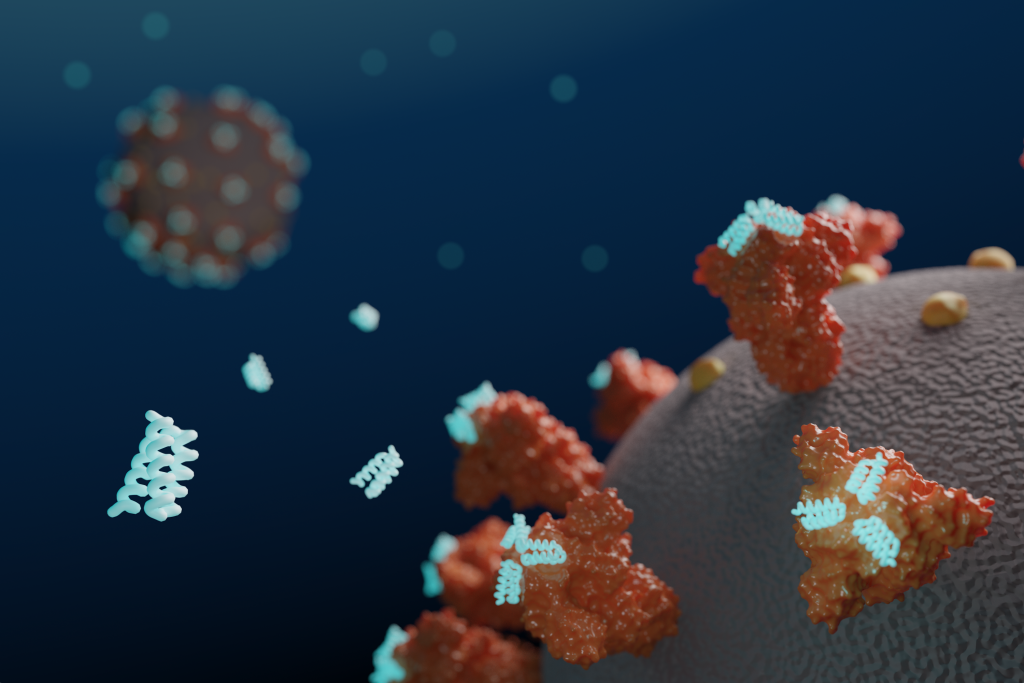
This artwork shows a comparison between minibinders (small antiviral proteins, shown in shades of red) and antibodies (blue) that bind to the spike proteins on the surface of the SARS-CoV-2 virus. Prof David Baker’s group at the Institute of Protein Design commenced the computational design of minibinders in January 2020 around the time when community transmission of the virus began. By the end of May, they had identified minibinders that were able to strongly bind the spike proteins and neutralize the virus. Minibinders are 20-fold smaller than antibodies, and can be scaled up in production at a lower cost. While antibodies have only two binding sites to its target, minibinders in an equal mass offer 20-fold more potential neutralizing sites. The small size and higher stability of minibinders offer a possible advantage of nasal formulations for drug delivery and eliminating the need for refrigeration during storage and transport. These minibinders are currently in development for their potential use as SARS-CoV-2 therapeutics. This example highlights the power of computer-generated protein design, especially during a pandemic when time is critical.For more information refer to https://www.bakerlab.org/index.php/2020/09/09/covid-minibinders/