Reimagine Hope With Music: Paul Miller aka DJ Spooky – Multimedia Artist, Composer, Author
Direct Talk
Reimagine Hope With Music: Paul Miller aka DJ Spooky / Multimedia Artist, Composer, Author. Spooky writes, “Japanese National TV did a documentary on me where they hung out with me in NY at the height of the Pandemic to see how artists and creatives were coping with the situation (socially distant, of course…)”
Collaborative videos initially planned to be created in shared physical space that have been adapted due to quarantine. These updated micro-films describe the shared experiences of isolation by recording live streamed simultaneous activities performed in the home by 2 friends on either side of the Atlantic. Audio is created from WhatsApp phone chats, and visuals streamed via Zoom, though future work may use different platforms
Additional Details
Brener and Imara are locked down in London and New York during the corona crisis. Y&I Lockdown was performed simultaneously via online streaming. It highlights the loneliness and confusion of isolation, and also the connectedness of all who are separated in physical space due to the crisis. Audio from a phone chat.
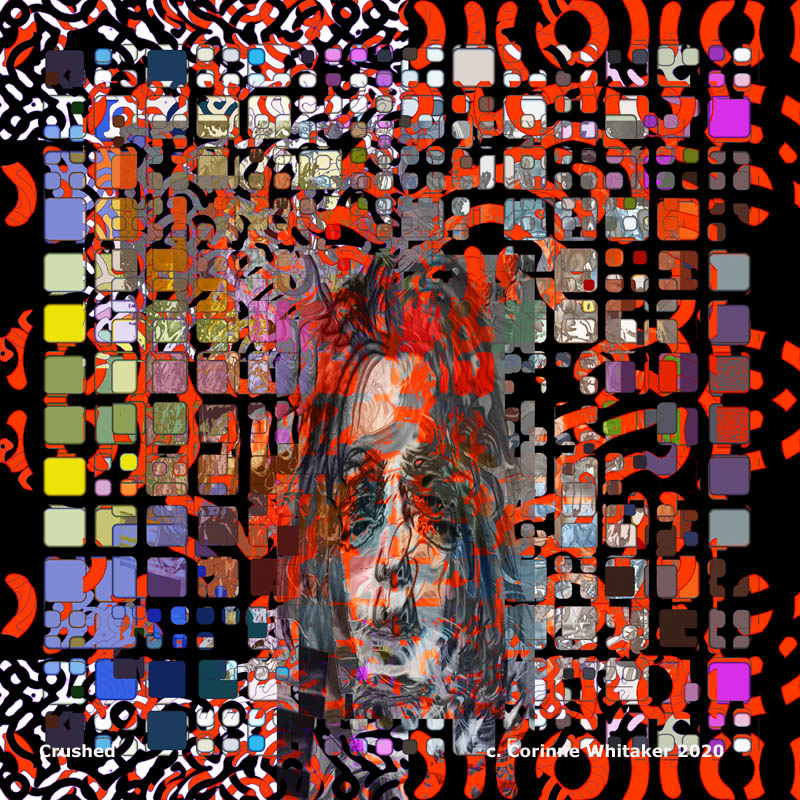
We created 187 cover images in 2020 to reflect how it feels to live through a pandemic. You can see those cover images online, then change the number to see others.
Additional Details
“As the covid 19 virus sweeps the globe, it is difficult to underestimate the dismay and disarray visited upon us all. In recognition of that worldwide affliction, giraffe.com will offer a new cover image every day, reflecting how it feels to live with a global pandemic. Some of the images are based on A.I. transcriptions of my selfie. I cannot ease the terror, the pain, the chaos. But I can at least offer one artist’s view of what is happening to the human species right now, right here and everywhere. We have abused nature’s gifts to us. Now, perhaps, she is shedding her tears in reply.” Corinne Whitaker 2020
While NASA’s Jet Propulsion Laboratory usually works on Mars Rover Perseverance and redirection of asteroids, in times of crisis they focus their collective energy for the greater good. Learn about what it was like when NASA had to pivot during the pandemic. Dan Goods is passionate about creating moments in people’s lives where they are reminded of the gift and privilege of being alive. He leads an extraordinary team of creatives, called The Studio, at NASA’s Jet Propulsion Laboratory transforming complex concepts into meaningful stories that can be universally understood. Their work is seen in public spaces, art museums, and is in outer space.
Additional Details
Dan Goods was recently honored with NASA’s Exceptional Public Service Award. In the past he was selected as “One of the most interesting people in Los Angeles” by the LA Weekly. In 2002, he graduated valedictorian from the graphic design program at Art Center College of Design. He currently lives in Altadena, CA with his wife and three kids. This talk was given at a TEDx event using the TED conference format but independently organized by a local community. Learn more at https://www.ted.com/tedx
Infodemic is a neural network-generated video that questions the mediated narratives created by social media influencers and celebrities about the coronavirus. The term ‘infodemic’ can be traced back to the SARS outbreak in 2003, but gained popularity in February of 2020 when the WHO Director, General Tedros Adhanom Ghebreyesus stated: “we’re not just fighting an epidemic; we’re fighting an infodemic. Fake news spreads faster and more easily than this virus, and is just as dangerous.” The speakers featured in the video are an amalgam of celebrities, influencers, politicians, and tech moguls that have contributed to the spread misinformation about the coronavirus by either repeating false narratives, or developing technologies that amplify untrue content. The talking heads are generated using a conditional generative adversarial network (cGAN), which is used in some deepfake technologies. Unlike deepfake videos where a neural network is trained on images of a single person to produce a convincing likeness of that person saying things they did not say, we trained our algorithms on a corpora of multiple individuals simultaneously. The result is a talking head that morphs between different speakers or becomes a glitchy Frankensteinian hybrid of different people that contributed to the current infodemic speaking the words of academics, medical experts, or journalists that are correcting false narratives or explaining how misinformation is created and spread. The plastic, evolving, and unstable speakers in the video evoke the mutation of the coronavirus, the instability of truth, and the limits of knowledge.
Additional Details
Jennifer Gradecki is an artist and theorist who aims to facilitate a practice-based understanding of socio-technical systems that typically evade public scrutiny. Using methods from institutional critique, tactical media, and information activism, she investigates information as a source of power and resistance. Her work has focused on Institutional Review Boards, social science techniques, financial instruments and, most recently, intelligence agencies and technologies of mass surveillance. She teaches Game Design and Media Arts courses at Northeastern University.
Performing Public Health: Remote Cultures Conversation Series
Center for Arts in Medicine, University of Florida
The Remote Cultures Conversation Series documents various interpretations and practices of how artists and arts communities are supporting public health efforts. We recently hosted our first conversation centered on experiences of uniquely precarious artists in performing public health (please see project website for further details), i.e. the lived-experiential knowledges they possess of how best to combat social isolation, shifts in social routines, creative practices to engage and maintain well-being, and/or statements/discussion of the lack of any change to routine whatsoever. This project is part of a larger effort in collaboration with the University of Florida’s Center for Arts in Medicine’s COVID-19 Arts Response, which houses the Performing Public Health initiative, as well as a COVID-19 Arts Repository, advisory briefs, and links to a white paper entitled “Creating Healthy Communities: Arts and Public Health in America.”
Additional Details
What are “Remote Cultures”?
In this context, “Remote Cultures” refer to the cultures evolving in response to the public health measures implemented due to the Coronavirus pandemic. Remote Cultures vary among different populations and communities, including Unique Precarities (particular experiences, knowledges, needs, and abilities of marginalized groups) and individuals’ adaptations to the novel public health measures implemented during this pandemic.
As the Covid-19 epidemic emerged, so too did an abundance of how-to hand washing videos. Starting in late January 2020, one in particular played on a continuous, hypnotic loop in the dining hall that my partner and I shared with hundreds of others in Singapore. Always running, hands in motion, suds, instruction, rinsing, sensation, ablution. My partner’s and my time as artists-in-residence in Southeast Asia transformed into one of sheltering-in-place for months on end. With a hazard so invisible and communicable, and within a global mesh where everything is shared, the significance of safety, of self, and of contact became more pressing and at the same time more difficult to discern. The ritual choreography of hand washing became deeply embedded in our bodies and minds over those months, while forms of protection, isolation, and communion continue to mutate.
My partner’s and my time as artists-in-residence in Southeast Asia transformed into one of sheltering-in-place for months on end. With a hazard so invisible and communicable, and within a global mesh where everything is shared, the significance of safety, of self, and of contact became more pressing and at the same time more difficult to discern. The ritual choreography of hand washing became deeply embedded in our bodies and minds over those months, while forms of protection, isolation, and communion continue to mutate.
The UF Center for Arts in Medicine, along with arts and public health leaders from across the U.S., created an array of resources designed to support arts-based responses to COVID-19. They call for and enable cross-sector collaboration between the public health, arts and culture, and community development sectors to drive high-impact responses to COVID-19 across diverse communities. The resources include advisory briefs, webinars, an evidence-based framework, and a robust resource repository.